
One of the most common concerns growers have when evaluating LED grow lights is whether the fixture will create a center hotspot; an area of excessively intense light directly below the fixture that can stress, bleach, or even burn plants. The Koray RX-G80 series was specifically engineered to solve this problem, and the answer is definitive: no, the G80 does not have a center hotspot. Here is the complete technical explanation of how Koray Lighting achieved this and what it means for your growing operation.
What Is a Center Hotspot and Why Does It Occur?
A center hotspot is an area of disproportionately high PPFD directly below the center of an LED grow light panel. It occurs because conventional LED fixtures use bare LED chips or simple primary lenses that project light in a relatively narrow cone. The LEDs positioned at the center of the panel deliver their maximum intensity to a small area directly below, while LEDs near the edges project much of their light outside the target growing area. The result is a PPFD distribution that resembles a mountain peak: intense at the center and rapidly declining toward the edges.
Center hotspots create real problems for commercial growers. Plants directly below the center receive far more light than those at the edges, leading to uneven growth, inconsistent flowering, and potential light stress or bleaching. Growers are forced to either raise the light (reducing overall PPFD and efficiency) or constantly rotate plants to compensate for the uneven distribution. Both solutions reduce yield and increase labor costs.
How Koray Secondary Optics Eliminates the Hotspot
The Koray RX-G80 solves the hotspot problem through Koray Lighting’s proprietary Secondary Optics system. Instead of allowing each LED to project its raw, concentrated beam directly downward, the G80 places a precisely engineered lens element over every individual LED chip. These secondary lenses capture the LED’s output and redirect it at wider angles, spreading the light across a broader area before it reaches the canopy.
When hundreds of these individually redistributed light patterns overlap across the G80’s generous 1160 x 1088mm panel surface, they blend together into a remarkably uniform field of light. There is no single point where photons concentrate intensely because each LED’s output has been spread and merged with its neighbors. The PPFD map of the G80 looks like a flat plateau rather than a sharp peak, with minimal variation between the center and the edges of the coverage area.
Proof: 64-Point PPFD Measurement Data
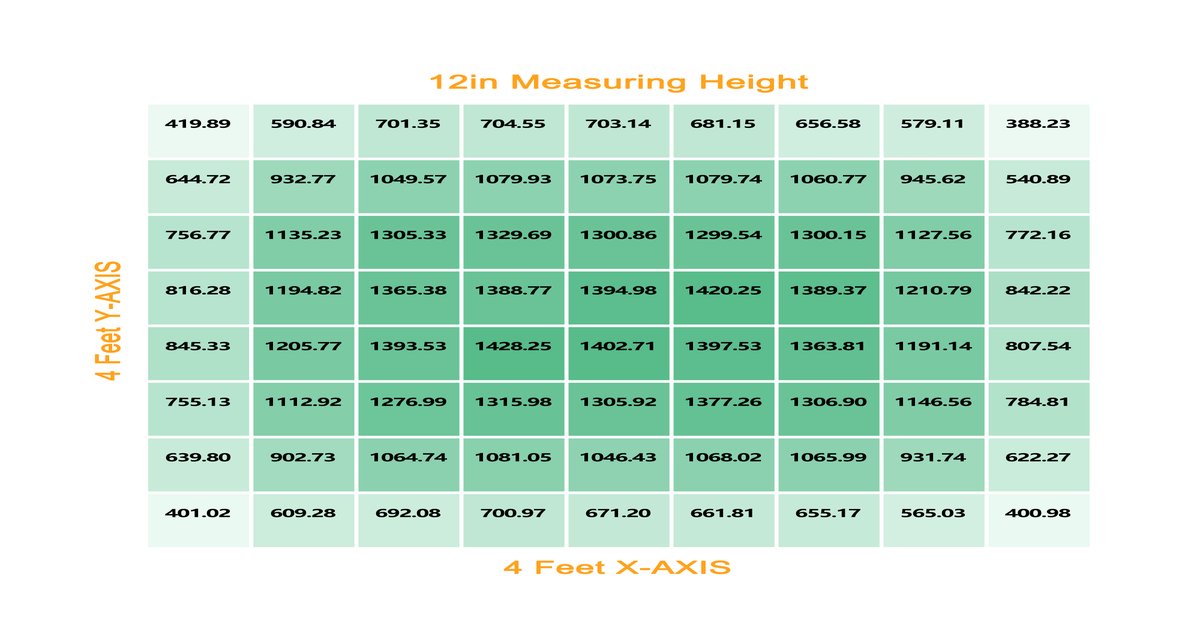
Koray Lighting validates the G80’s hotspot-free performance through rigorous testing. The G80-800W is measured using a 64-point PPFD grid across a 1.2 x 1.2 meter area in a dark room with no reflective walls. This testing environment eliminates the artificial PPFD boost that reflective walls provide, giving growers honest data about what the light actually delivers in real growing conditions.
The results speak for themselves: at 0.2 meters (8 inches) hanging height, the 64-point average PPFD is 1500 μmol/m²/s. At 0.3 meters (12 inches), it maintains 1250 μmol/m²/s. Critically, these are 64-point averages, not peak values. The fact that the average across all 64 points reaches these numbers while maintaining U0-level uniformity demonstrates that there is no center hotspot inflating the data. Every measurement point, including corners and edges, contributes to a consistent, high-performance PPFD profile.
Close-Canopy Mounting Without Light Burn
Perhaps the most compelling evidence that the G80 has no center hotspot is its close-canopy mounting capability. The G80-800W is rated for safe operation at just 8 inches (0.2 meters) above the plant canopy. At this distance, many conventional grow lights would cause visible light stress, leaf bleaching, or photoinhibition in the plants directly below the center of the panel. The G80 delivers its full 1500 μmol/m²/s at this close distance uniformly, without any single point receiving dangerously excessive intensity.
This close mounting capability is a game-changer for vertical farming and multi-tier rack systems where space between tiers is limited. Growers can maximize light interception by positioning the G80 close to the canopy without worrying about hot spots damaging the top leaves. The result is higher PPFD delivery, better light use efficiency, and more productive grows in confined spaces.
Comparison: G80 vs. Conventional Quantum Boards
To appreciate the G80’s achievement, consider how conventional quantum board grow lights perform. A typical 1000W quantum board from a well-known manufacturer often produces a center PPFD of 1800-2000 μmol/m²/s at 12 inches, while edge readings drop to 600-800 μmol/m²/s. That is a 60% or greater difference between center and edge, creating wildly uneven growing conditions. The G80-800W, by contrast, delivers 1250 μmol/m²/s as a 64-point average at 12 inches with minimal variation across all measurement points.
Moreover, the G80 achieves this superior uniformity while consuming 200W less power than the competitor’s 1000W fixture. The G80-800W’s PPF output of 2160 μmol/s at 2.7 μmol/J efficiency means it converts more of every watt into usable, evenly distributed photosynthetic light. Koray Lighting estimates this translates to approximately 876 kWh of electricity savings per year per fixture compared to running a competitor’s 1000W light.
Real-World Growing Benefits of a Hotspot-Free Design
Eliminating the center hotspot delivers tangible benefits throughout the entire growing cycle. During vegetative growth, all plants develop at the same rate without center plants stretching or edge plants lagging. During flowering, bud sites develop uniformly across the entire canopy, producing consistent flower density and cannabinoid profiles. This uniformity is particularly valuable for medicinal cannabis cultivation where product consistency is both a quality metric and a regulatory requirement.
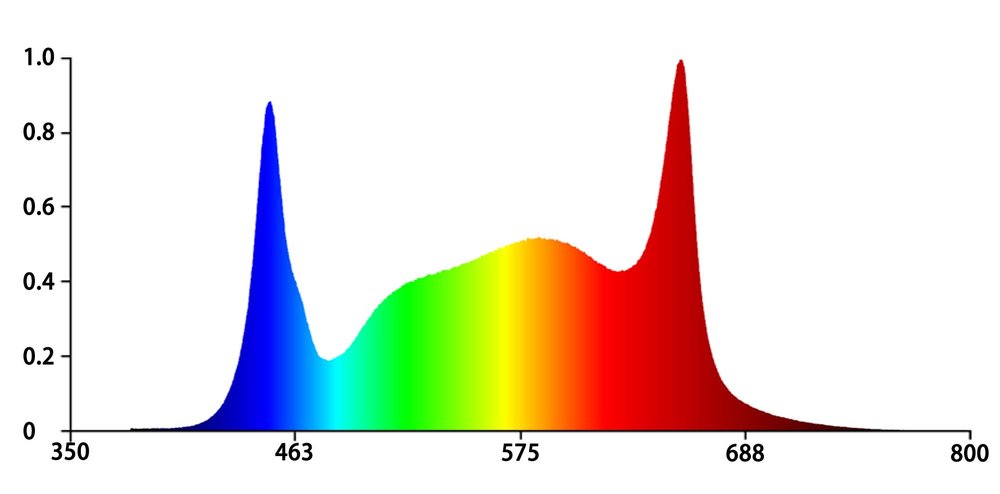
The G80’s G24B full-spectrum output with low green light content complements the uniform distribution by providing balanced spectral energy across the entire growing area. Plants at the edges receive the same spectral quality as those at the center, ensuring consistent photosynthetic response and secondary metabolite production throughout the canopy.
About Koray Lighting
Koray Lighting was founded in 2009 in Zhongshan, Guangdong, and has grown to become one of the world’s leading manufacturers of professional horticultural lighting. With over 200 patents, a 2800 square meter testing facility, and exports to more than 60 countries, Koray combines deep optical engineering expertise with practical growing knowledge. The RX-G80 series exemplifies this approach, using proprietary secondary optics technology to solve real problems that growers face every day. The G80 is available in 500W, 650W, 800W, 1000W, and 1500W configurations, all carrying ETL, CE, RoHS, and FCC certifications with a 50,000-hour rated lifespan.
Conclusion
The Koray RX-G80 does not have a center hotspot. Through its proprietary Koray Secondary Optics system, validated by 64-point PPFD testing in non-reflective conditions, the G80 delivers truly uniform light distribution that allows close-canopy mounting at 8 inches without risk of light burn. For commercial growers who demand consistency, efficiency, and reliability, the hotspot-free G80 represents the current state of the art in LED grow light design.




Leave A Comment