

A value-engineered greenhouse grow bar is judged on the numbers a buyer can actually read, and on the numbers the maker chose to leave off the page. The RX-G600L is an economical toplighting LED grow bar sold for greenhouse horticulture, and its official page publishes a compact but specific set of specifications: PAR up to 1400 umol/s, PPFD up to 1600 umol/m2/s measured at 0.3 m, ingress protection IP64 with a conformal coating, two AC input windows (100-305 VAC and 127-431 VAC) at a power factor above 0.9, a 50,000 hour lifespan, and CE, RoHS and FCC listings. The same page does not publish a rated wattage, a photon efficacy in umol/J, an LED count, a beam angle, a dimming interface or a warranty period. This article reads those entries one at a time, separates what is published from what is not, and works through what a 0.3 m reference height means once the bar is actually laid out over a bench.

Why a low-cost bar needs a specification read, not a specification quote
“Economical” and “low price” describe a position in a product range, not a defect. Value engineering moves cost away from items a grower can supply and onto items the fixture must supply, and the information problem is that a bar built to a cost target rarely advertises what it left out. The buyer therefore has to reconstruct the boundary between published and assumed before comparing it with a more expensive sibling.
Three definitions make that boundary easier to hold. Photosynthetically active radiation (PAR) is the 400-700 nm waveband that drives photosynthesis. Photosynthetic photon flux (PPF) is the number of photons inside that band leaving the fixture each second, expressed in micromoles per second (umol/s), so it is an output rather than a density. Photosynthetic photon flux density (PPFD) is that same flux divided by the area it lands on, expressed in micromoles per square metre per second (umol/m2/s), so it depends on distance and always needs a stated measurement height. A PPFD figure quoted without a height is a number without a definition.
PAR 1400 umol/s and PPFD 1600 umol/m2/s at 0.3 m: two numbers, one relationship
The official page states “High PPF, PAR up to 1400umol/s, PPFD up to 1600umol/m2/s @ 0.3m”. Read as a pair, those two figures are not independent, because PPFD is PPF divided by area. The pair therefore implies the area the flux was spread over when the density was taken: dividing 1400 umol/s by 1600 umol/m2/s gives roughly 0.875 square metres, so the two headline numbers are mutually consistent with a photon flux landing on a patch smaller than one square metre at the reference plane, roughly 0.94 m by 0.94 m. That arithmetic is a reader-side calculation from the two published values, not an official footprint or coverage claim, and it assumes a flat, uniformly lit target with no losses. It does not survive as a coverage figure for a larger target, because the same flux spread over a bigger area must give a lower density.
The practical consequence is that the headline PPFD is a near-field figure. It describes what the bar can deliver when the measuring plane is 0.3 m away, and nothing beyond that. A grower lighting a canopy two metres below the fixture has a different problem, and the page does not solve it: the mounting-height range and the measurement conditions, including the photoperiod and whether a reflective floor or wall was present, are not specified in the official datasheet. Measurement practice itself is documented outside the product page; Michigan State University Extension sets out how horticultural lighting should be measured and compared in MSU Extension – LED lighting for horticulture.
Reading 0.3 m as a layout statement, not only a test condition
A 0.3 m reference height is unusually low for greenhouse toplighting, where fixtures normally hang well above the canopy, which makes it an implicit application boundary rather than a bare test condition. At 0.3 m, the crops that sit comfortably under the bar are the ones occupying the first few tens of centimetres of vertical space: propagation and seedling benches, plug and cutting trays, low-profile leafy benches, and individual tiers of a multi-level rack where each level is its own short working volume. A canopy that closes towards the roof of a tall glasshouse is outside what a single 0.3 m reference point can describe.
Second, PPFD without hours is only half of a light budget. Daily light integral (DLI) is photon flux density accumulated over a photoperiod, expressed in moles per square metre per day, and it is assembled from PPFD, time and a fixed factor: DLI is PPFD multiplied by 3600 and by the photoperiod in hours, divided by one million. The official page publishes no photoperiod for this bar, so any DLI value has to be built from the grower’s own schedule and then verified with a quantum sensor at the canopy, in the room as built.
IP64 and the conformal coating behind it
The page states “Conformal Coated, waterproof IP64”. Under the IEC 60529 ingress-protection scheme the two digits describe two separate tests. The first digit, 6, means the enclosure is dust-tight, with no dust ingress permitted at all. The second digit, 4, means the enclosure is protected against water splashing from any direction. Neither is a jetting rating and neither is an immersion rating, so the realistic exposures covered are the ones a greenhouse actually produces, including condensation drips and splash from overhead irrigation, rather than wash-down with a pressure hose or standing water in a flooded channel. The conformal coating named on the page is the method by which the electronics are protected; IP64 is the published performance claim, and it is the claim a designer has to work against when the bar is positioned above an irrigation line.
A dual AC input window and a power factor above 0.9
The electrical entry is specific in an unusual way: “Input voltage: 100~305VAC, 127~431VAC, PF>0.9”. Two input windows are declared rather than one. A dual window matters because greenhouse sites differ in the supply they can offer, and a bar that spans a wide low-voltage window plus a separate window reaching roughly 431 V can be installed on more than one mains arrangement without a step-down transformer, which is a procurement advantage when bars are bought in volume and spread across several sites. The power factor declaration, above 0.9, is a load-quality commitment rather than a light-output one; it becomes relevant as soon as many bars share a circuit, because current draw and protective-device sizing follow apparent power, not photons.
What the same entry does not provide is active power in watts. The official page publishes no wattage for this model, so circuit loading for a row of bars cannot be read off the page. The model name contains a number, but a model name is a label, not a rated value, and treating it as a rating is a common and expensive misreading. Wattage has to be measured on a sample, or obtained from the vendor as a separate written specification, before a circuit is designed.
What the official page does not specify
- Rated power (W) – not specified in the official datasheet; no wattage appears on the page.
- Photon efficacy (umol/J) – not specified in the official datasheet; no efficiency ratio is published.
- LED brand, model or count – not specified in the official datasheet; the page names no chip supplier for this bar.
- Beam angle and light distribution – not specified in the official datasheet; no photometric curve is given.
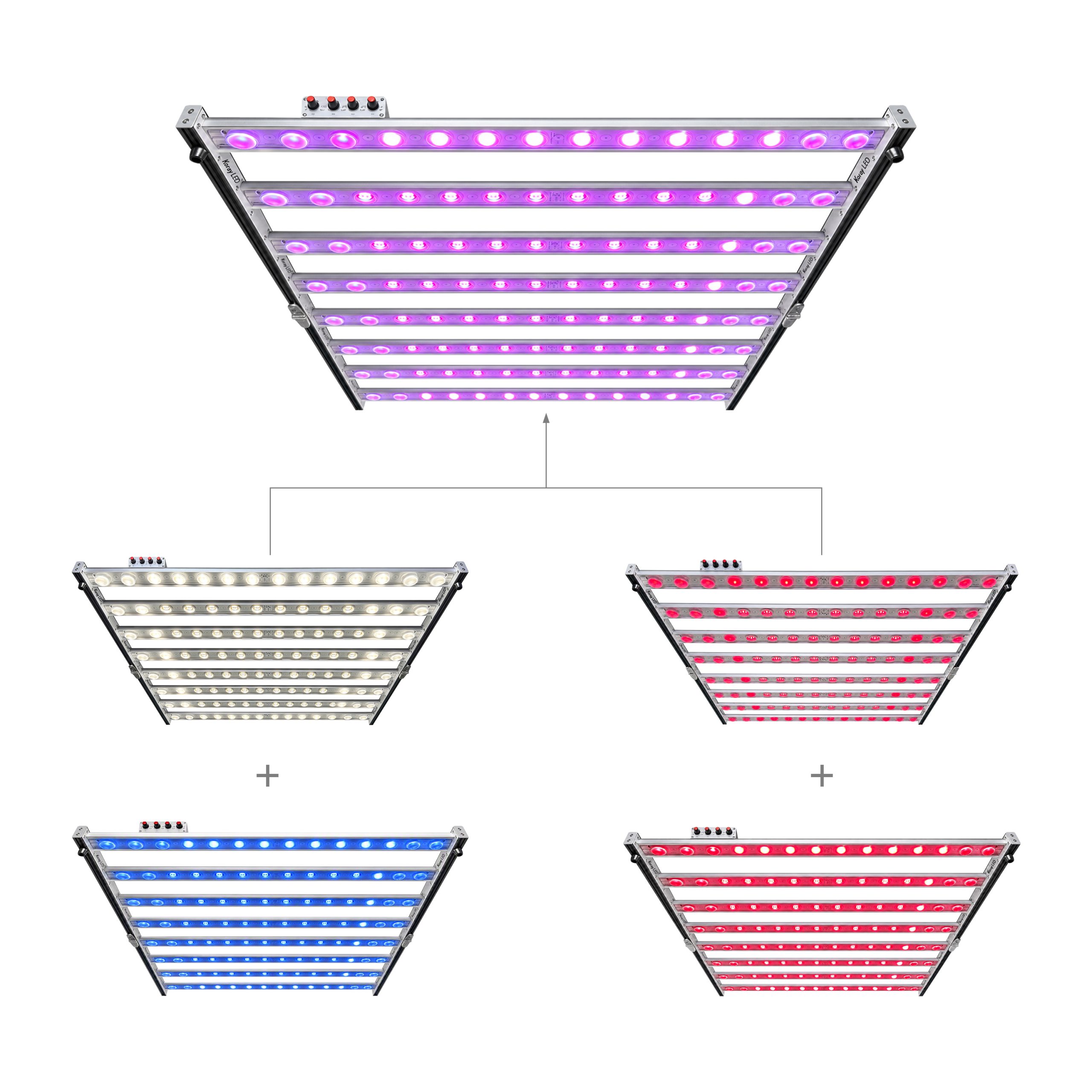
- Spectrum recipe – the page states the spectrum can be optimized for different crops or customized, but publishes no recipe code and no channel list.
- Dimming interface or control protocol – not specified in the official datasheet; no 0-10 V, resistance or network interface is stated.
- Warranty period – not specified in the official datasheet.
- Mounting-height range – only the single 0.3 m reference point is given, with no height table.
- PPFD measurement conditions – not specified in the official datasheet; photoperiod and room reflectance are not stated.
None of those gaps is evidence of a poor fixture, and none of them can be filled by borrowing a number from another model in the same family. They are items a buyer has to obtain as written data, obtain by measurement, or accept as unknown. The defensible planning rule is that an unpublished value stays unknown: a figure copied from a sibling bar is a fabrication, not an estimate, and it is the fastest way to mis-size a circuit or a light plan.
Dimension by dimension: published and unpublished
| Specification dimension | What the official RX-G600L page states | What is still not specified | What a grower can plan from it |
|---|---|---|---|
| PAR / PPF output | PAR up to 1400 umol/s | Whether the figure holds across the dimming range | An upper bound on photon output against a target daily light integral |
| PPFD | Up to 1600 umol/m2/s at a 0.3 m plane | Photoperiod, room reflectance, height table | Near-field density for short canopies only |
| Ingress protection | IP64 with conformal coating | Jetting and immersion performance | Splash and condensation zones, not wash-down |
| Input voltage | 100-305 VAC and 127-431 VAC, PF greater than 0.9 | Per-region derating detail | Multi-region mains flexibility and circuit power-factor planning |
| Rated power | Not specified on the page | Active power in watts | Nothing; must be measured or requested in writing |
| Efficacy | Not specified on the page | umol/J at a stated drive current | Nothing; energy per photon cannot be computed |
| Lifespan | 50,000 hours | Ambient temperature and drive level behind the figure | Relative service-life planning, not a burn-in guarantee |
| Spectrum | Optimized or customizable; no recipe code published | Channel mix and wavelength list | Ask for the recipe in writing before ordering |
| Compliance | CE, RoHS and FCC | – | Electrical, hazardous-substance and emissions scope only |
Read the table as a boundary map. Seven of the nine rows are anchored by a published figure; two headline purchase criteria, wattage and efficacy, are blank. That split is the whole character of a bar positioned on price, and it dictates the order of operations: fix the application height first, then measure the photons and the wall power at that height, then compare the cost per installed photon against a higher-specification alternative. That comparison is only meaningful inside a defined measurement protocol, which is why fixture programmes such as the DesignLights Consortium – Horticultural Lighting QPL publish technical requirements for photon measurement rather than headline numbers, and why independent work on plant response to electric lighting, such as that published by the USDA Agricultural Research Service, treats a source rating as one variable in a controlled environment rather than as a growth result.
Where an economical toplighting bar such as the RX-G600L fits
An economical toplighting bar suits a specific job: short working volumes where the fixture can sit close to the crop, greenhouse automation and irrigation environments where a splash-rated, dust-tight enclosure is the exposure that matters, and multi-bar installations where several units are grouped on one wide-window AC supply and the cost per bar dominates the purchase decision. Because the photon output is published as a near-field figure, a planting plan built around this bar should set the mounting height from the crop’s own tolerance, not from a claimed coverage area, and should confirm the delivered density with a quantum sensor at the canopy under the real photoperiod.
On the commercial side, the manufacturer is a 17-year LED horticultural lighting manufacturer, and the bar carries CE, RoHS and FCC listings, which is the compliance basis an export-oriented greenhouse project normally asks for. The fixtures are supplied for greenhouse horticulture, high-wire vegetable production, vegetable and flower cultivation, ornamental and succulent cultivation, and medicinal herb cultivation under dedicated light recipes, which is the application list the official page states. Where a project needs a verified umol/J figure, a published wattage or a warranty term, those items have to be settled contractually before the order, because the datasheet alone will not supply them.
Frequently asked questions
Does the official RX-G600L page publish a rated wattage or an efficiency figure?
No. The page publishes PAR up to 1400 umol/s, PPFD up to 1600 umol/m2/s at 0.3 m, IP64 with a conformal coating, two AC input windows with a power factor above 0.9, a 50,000 hour lifespan and CE, RoHS and FCC listings. It publishes neither a rated active power in watts nor a photon efficacy in umol/J, so both figures are not specified in the official datasheet and have to be measured or requested in writing. The number in the model name is a label, not a rating.
What does 0.3 m mean in “PPFD up to 1600 umol/m2/s at 0.3 m”?
It is the height of the measuring plane, measured from the fixture to the sensor. Because PPFD is photon flux divided by area, the figure describes a near-field condition and falls as the distance grows. The official page gives no height table and no photoperiod, so a mounting height has to be set from the crop’s own tolerance and the delivered density confirmed with a quantum sensor at the canopy. Treating 1600 umol/m2/s as a canopy figure at any distance is not supported by the page.
How is IP64 different from IP65 or IP66 on a greenhouse fixture?
Both IP64 and IP65 begin with 6, which means dust-tight. The second digit is the difference: 4 means protection against splashing water from any direction, 5 means protection against water jets, and 6 means protection against powerful jets or heavy seas. The RX-G600L page claims IP64, so it is rated for splash and condensation exposure rather than pressure washing or immersion; positioning the bar above an irrigation line is consistent with that claim, while hosing it down is not.
Why does the RX-G600L list two AC input windows?
The page states “Input voltage: 100~305VAC, 127~431VAC, PF>0.9”, so two separate windows are declared rather than one range. A dual window lets the same bar be installed on more than one mains arrangement without a step-down transformer, which reduces stock-keeping when bars are deployed across several sites. The power factor above 0.9 is a load-quality figure that matters when many bars share a circuit, since current draw follows apparent power rather than light output.
How should the 50,000 hour lifespan be read?
The 50,000 hour figure is a lifespan rating in hours, and it is a projection from LED and driver reliability data under defined conditions rather than a burn-in test of every finished bar. Real service life also depends on ambient temperature, drive level and supply quality, none of which the page specifies. The page also publishes no warranty term, so the 50,000 hours should be treated as a planning input, not as a commercial guarantee.




Leave A Comment