
Overview: A Low-Hang Lens Array Is an Optics Decision Before a Wattage Decision
Controlled-environment agriculture that relies entirely on electric light is classified in the U.S. Department of Energy, Solid-State Lighting Programme – Energy Savings Potential of SSL in Horticultural Applications (December 2017) as a non-stacked indoor farm: plants grown in a single layer under ceiling-mounted or suspended fixtures, with no useful contribution from sunlight. The same study records that lighting in those single-layer indoor operations runs an average of 5,475 hours per year, against 2,120 hours for supplemental lighting in greenhouses, and it notes that fixtures with better optical distributions can be mounted closer to the canopy, so that less light is lost on the way to the leaves.
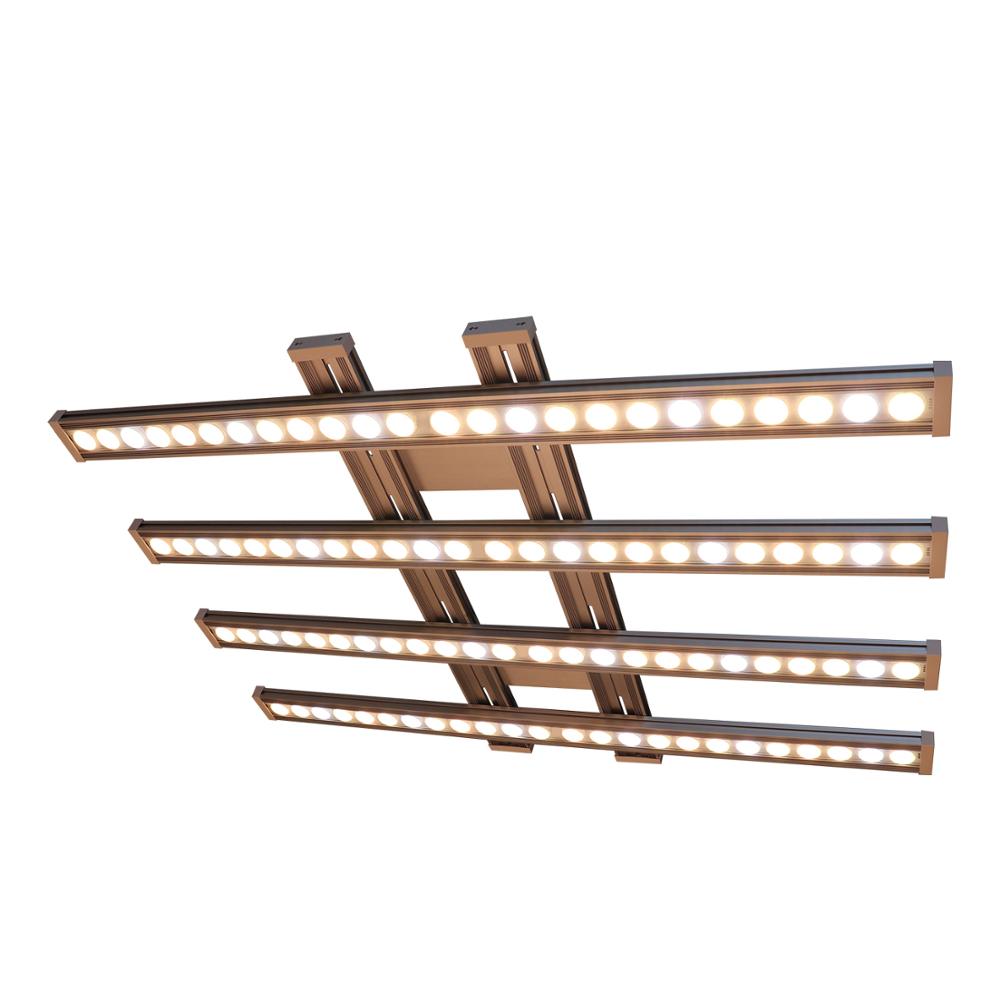
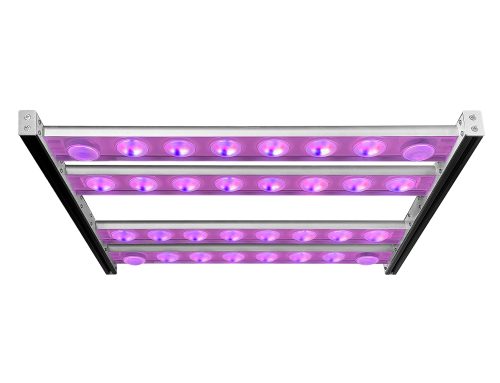
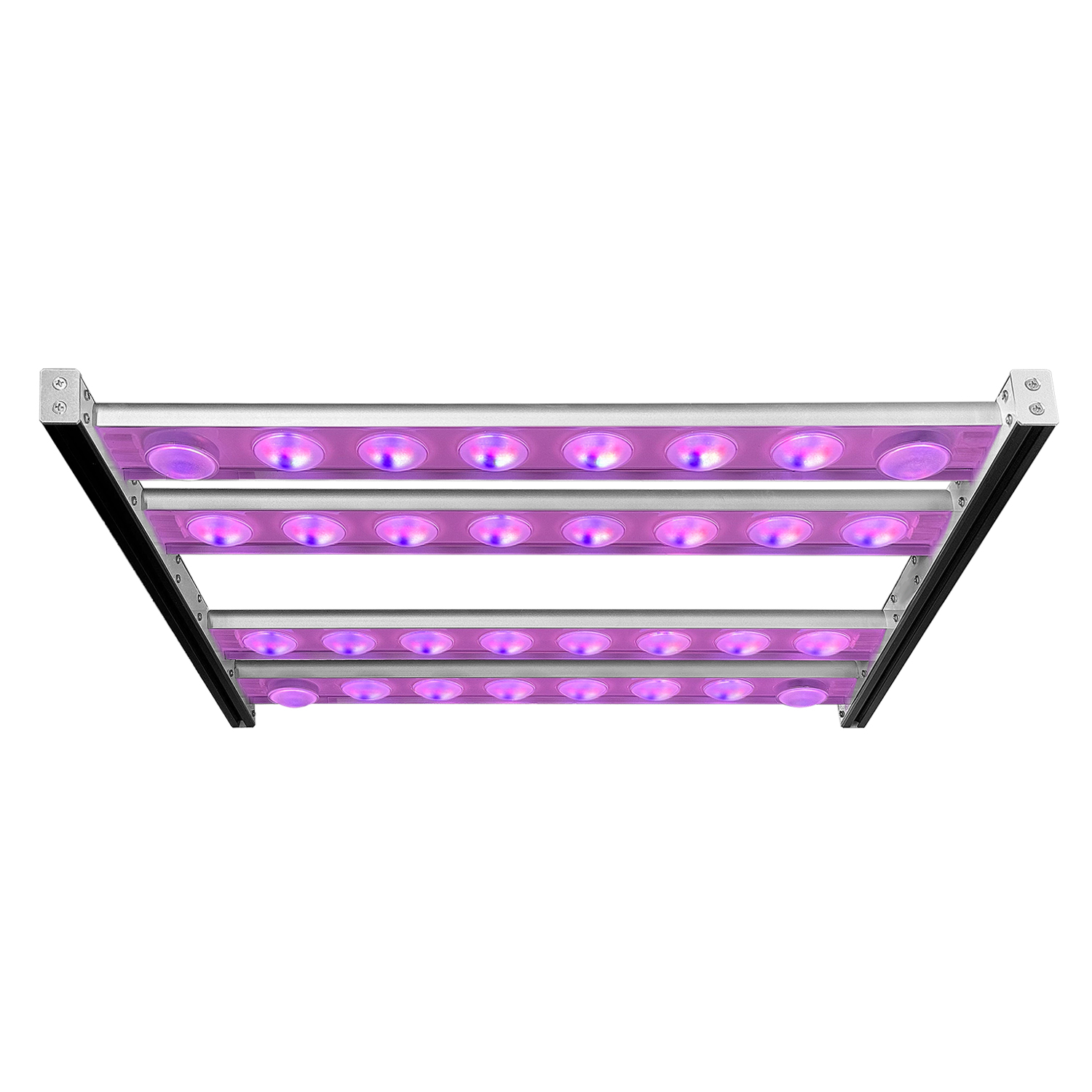
Distance is therefore a design variable rather than a fixed rule, and a fixture built for the short end of it does not look like a greenhouse top light. It looks like a low-hang array, sized to the bench it lights. The RX-GW78-120Z-2H is one such fixture: a 600 W-class four-bar lens array with a recommended irradiation distance of 0.15 to 0.3 m, a 90-degree beam angle, a stated coverage of 1 x 1.2 m, and two independently dimmable spectral channels, measured at 588 W with both channels running at AC 230 V.
Every figure below is quoted from the official RX-GW78-120Z-2H product page or the official RX-GW78-120Z-2H datasheet PDF, each with the condition it was measured under – distance, area, ambient temperature – because a photosynthetic photon flux density value quoted without a mounting distance cannot be compared with any other value. The datasheet applies a tolerance of plus or minus 10% to all of its optical and electrical data.
Photon Metrics in Plain Terms: PPF, PPFD, Photon Efficacy and DLI
Photosynthetic photon flux (PPF) is the rate at which a fixture emits photons inside the photosynthetically active radiation (PAR) waveband, measured in micromoles per second (µmol/s). Photosynthetic photon flux density (PPFD) is that flux delivered onto one square metre, in micromoles per square metre per second (µmol/m²/s). Photosynthetic photon efficacy (PPE) is PPF divided by input electrical power, in micromoles per joule (µmol/J). All three definitions follow the U.S. Department of Energy, Solid-State Lighting Programme – Energy Savings Potential of SSL in Horticultural Applications (December 2017), which defines PPF as the rate of flow of photons within the PAR waveband from a radiation source and PPE as the PPF divided by input electrical power.
The third unit is the one that most often disappears from comparisons. Efficacy is a property of the fixture alone, so it can legitimately be compared across products with no geometry attached. PPFD cannot, because the same fixture produces a different PPFD at every distance and over every area, which is why every PPFD figure in this article is followed by its distance and its test area.
Daily light integral (DLI) is the total quantity of photons delivered per square metre per day, in moles per square metre per day, and it follows from PPFD and photoperiod: DLI equals PPFD multiplied by the photoperiod in seconds, divided by 1,000,000. Applying that to the RX-GW78-120Z-2H datasheet values, both channels at 0.3 m deliver 1,240 µmol/m²/s, which over a 12-hour photoperiod is about 53.6 mol/m²/day, while the vegetative channel alone at 0.3 m delivers 783 µmol/m²/s, about 50.7 mol/m²/day over 18 hours. Those DLI figures are arithmetic on the published PPFD values, not additional datasheet measurements.
What a Lens-and-Reflector-Cup Optic Changes at Short Distance
An emitter without a secondary optic radiates into a wide distribution, so a large share of its photons departs at high angles away from the surface normal. A lens-and-reflector-cup optic is a secondary optical system: it intercepts that high-angle emission and redirects it into a narrower cone, in this case 90 degrees, without changing how many photons the emitters generate.
What changes is the distribution, and the distribution has consequences in both directions. Inside the beam, PPFD rises, because the same photon flux is concentrated over a smaller area. Outside the beam, PPFD falls sharply, because the wide-angle photons that would have landed there have been redirected. The penalties are equally real: a narrower beam covers less ground, edge plants fall outside the bright zone, and the fixture becomes sensitive to small changes in mounting height, so a 0.05 m adjustment matters far more at 0.2 m than at 2 m.
The energy case for the same idea is made in the U.S. Department of Energy, Solid-State Lighting Programme – Energy Savings Potential of SSL in Horticultural Applications (December 2017), which records that LED technology can enable energy savings through improved optical distributions that deliver light more efficiently to the plant canopy, and that fixtures can be placed close to the plants so that light delivery efficiency improves. A low-hang array is that principle taken to a short distance, which is why the datasheet recommendation of 0.15 to 0.3 m and the coverage figure of 1 x 1.2 m belong together and should always be quoted together.
Why 730 nm Far-Red Is Wired as a Separate Channel
Far-red light near 730 nm is read by plants through phytochromes. As set out in the peer-reviewed study by Kim and Son published in Frontiers in Plant Science and archived at PMC / U.S. National Library of Medicine – Kim and Son, Frontiers in Plant Science 2022, PMC9253827, phytochromes shift between two forms: the biologically inactive Pr form, which absorbs red light with a maximum near 660 nm, and the active Pfr form, which absorbs far-red light with a maximum near 730 nm. It is the balance between the two forms that changes plant responses, which is why the red-to-far-red ratio is treated as a control variable rather than as a colour.
The same study quantifies what happens when far-red is added instead of assumed. In a greenhouse sweet-pepper trial, red-and-blue LED interlighting at 71 µmol/m²/s was compared with the same interlighting plus 55 µmol/m²/s of far-red. Total yields in the far-red treatment were 9% higher for red fruit and 19% higher for yellow fruit than in the red-and-blue treatment, but carotenoid contents were 26% and 9% lower respectively – a trade-off between yield and quality that the authors report explicitly as a relationship that depends on the cultivation purpose.
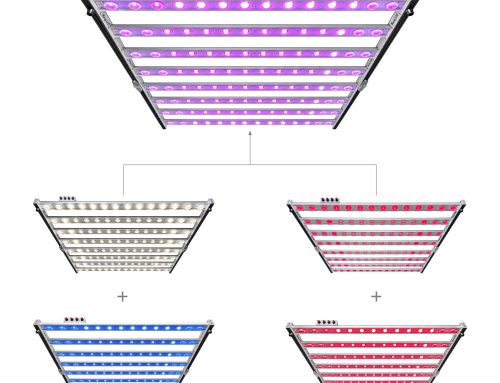
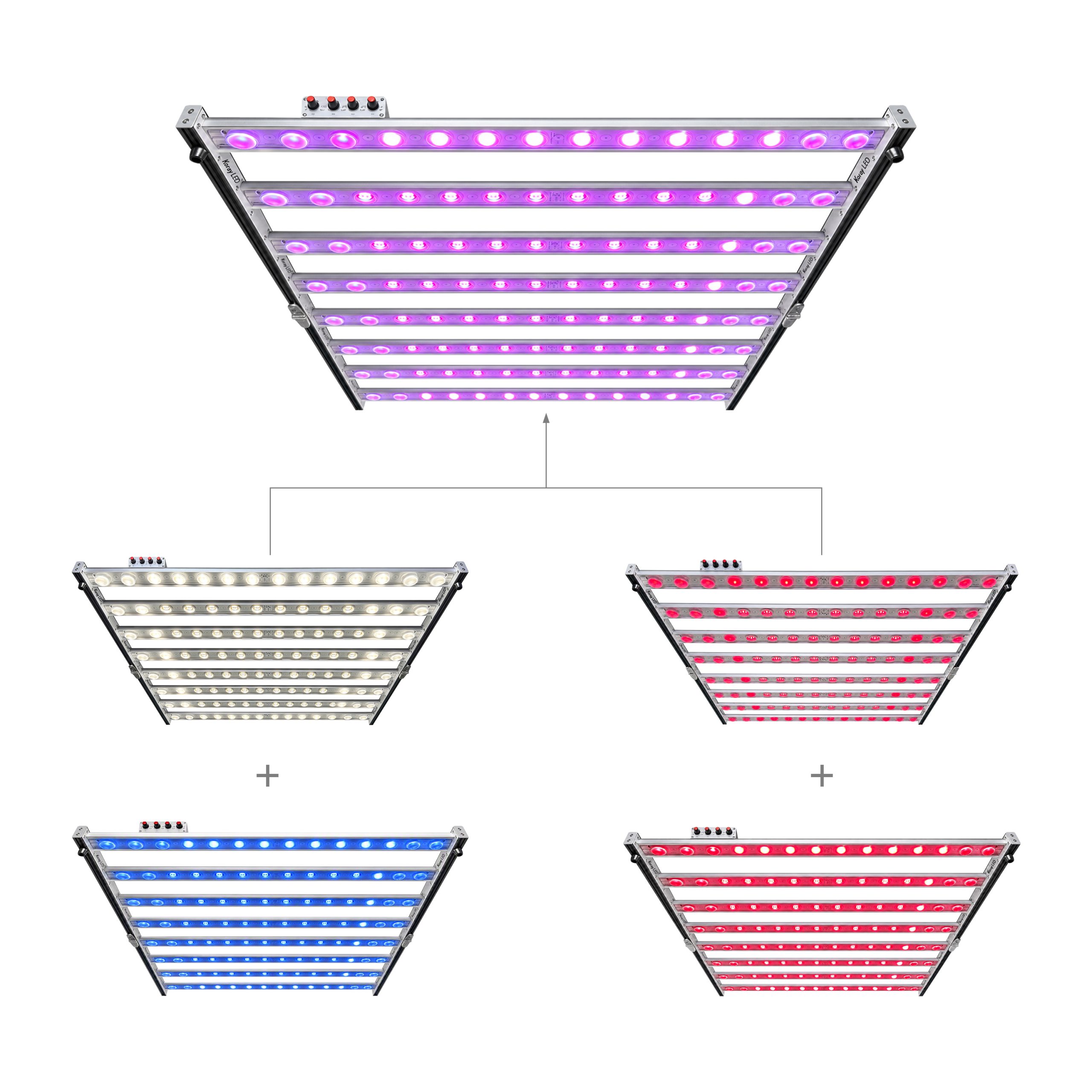
That result argues for far-red as a channel that can be switched and dimmed rather than a fixed ingredient of a blended spectrum. On the RX-GW78-120Z-2H the separation is physical: CHA carries the main output at 345 W with a 660 nm-supplemented red spectrum for vegetative growth, and CHB adds 660 nm deep red plus 730 nm far-red at 245 W for flowering. Because the two channels are separate circuits with their own 0-10 V DM dimmers, the red-to-far-red balance can be changed at the flowering transition without changing which fixture hangs over the canopy.
Official RX-GW78-120Z-2H Values and the Conditions Behind Them
The datasheet presents the fixture in three operating states and measures each of them at three distances. The comparison in the next section collects those values; the illuminance figures are included because they appear in the same datasheet table and let a grower with a lux meter make a rough field check, although lux is not a plant-relevant unit and should not be used for planning.
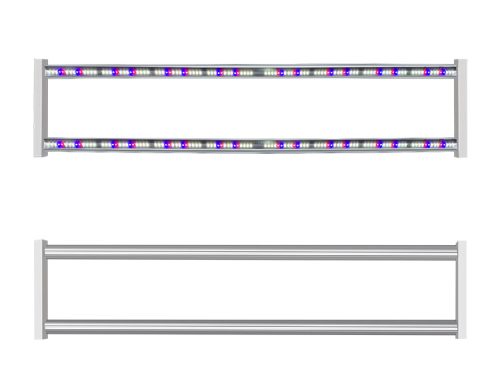
Physically, the fixture is one assembly rather than four independent lamps. The datasheet packing list specifies four waterproof LED bars with fixing bolts, two aluminium mounting brackets, two power supplies, six T-type waterproof plug cables, L20 and L16 waterproof connectors, two 0-10 V DM dimmers, two AC plug leads, four side cable clips, two double-hole wire locks, two cross wire clips, and steel cables in 1.5 m and 1 m lengths. Overall dimensions are 1,215 x 906 x 100 mm (48 x 35.7 x 3.9 in), and the emitters are Samsung LM301B plus a 730 nm far-red emitter as listed on the datasheet.
Electrically, the product page states an input range of 100 to 305 V and a rated power of 600 W, while the datasheet measures 588 W at AC 230 V with both channels running. This article treats the measured value as the operating figure and the rated value as the nameplate figure. Ingress protection is IP65, which under the two-numeral IP code defined in IEC 60529 and published by the International Electrotechnical Commission – IP ratings (IEC 60529) means protection against dust ingress and against water projected by a nozzle from any direction. CE, RoHS and FCC marks are listed. Surface temperature rise is Tc 25 K, the operating range is minus 30 °C to 40 °C, and the rated lifespan is 50,000 hours at an ambient temperature of 25 °C.
One point of discipline is worth stating plainly. The descriptive text of the datasheet summarises CHA as reaching up to 700 µmol/m²/s and the combined state as reaching up to 1,200 µmol/m²/s, while its own measurement table lists 797 and 1,316 µmol/m²/s at 0.2 m. Because only the tabulated values carry a measurement distance, this article quotes the tabulated values with their distances and treats the rounded descriptions as summaries of those same measurements rather than as a second set of figures.
Channel Comparison: CHA, CHB and Both Channels Together
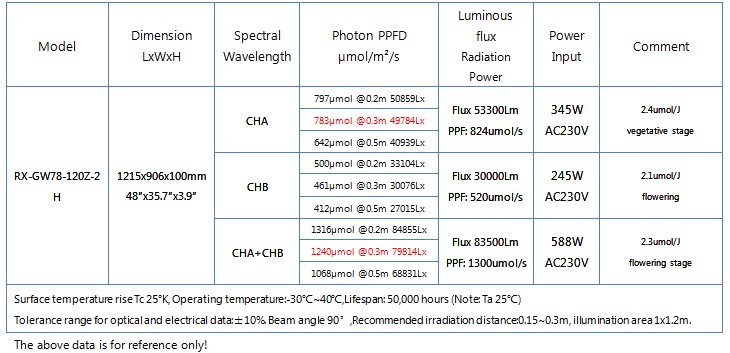
| Channel | Spectral content | PPFD at 0.2 m (µmol/m²/s) | PPFD at 0.3 m (µmol/m²/s) | PPFD at 0.5 m (µmol/m²/s) | Illuminance at 0.2 m (lx) | Luminous flux (lm) | PPF (µmol/s) | Power (W) | Efficacy (µmol/J) | Datasheet use |
|---|---|---|---|---|---|---|---|---|---|---|
| CHA | 660 nm supplemented red | 797 | 783 | 642 | 50,859 | 53,300 | 824 | 345 | 2.4 | Vegetative stage |
| CHB | 660 nm deep red + 730 nm far-red | 500 | 461 | 412 | 33,104 | 30,000 | 520 | 245 | 2.1 | Flowering |
| CHA + CHB | Both channels together | 1,316 | 1,240 | 1,068 | 84,855 | 83,500 | 1,300 | 588 | 2.3 | Flowering stage |
Two observations follow from the table. The combined state is not the exact arithmetic sum of the two channels: 345 W plus 245 W is 590 W, while the measured combined figure is 588 W, and the combined PPF of 1,300 µmol/s sits below the 1,344 µmol/s sum of the two channel values. That is the expected result when channels are measured individually and then measured together, and the datasheet tolerance of plus or minus 10% on all optical and electrical data covers the difference.
The second observation is that CHB is a substantial photon source rather than a trace signal. At 0.2 m it delivers 500 µmol/m²/s, close to two thirds of the vegetative channel value at the same distance. Switching it on at flowering therefore changes the spectrum and the total intensity at the same time, which is why the datasheet lists both-channels operation as its own flowering mode.
Mounting Distance, Delivered PPFD and Coverage in One View
Distance and the channel schedule are the two variables a grower sets; the datasheet fixes the third, which is coverage. The table below places the three states at the three published distances side by side.
| Mounting distance (fixture to canopy) | CHA PPFD (µmol/m²/s) | CHB PPFD (µmol/m²/s) | CHA + CHB PPFD (µmol/m²/s) | Illuminance, both channels (lx) | Datasheet coverage |
|---|---|---|---|---|---|
| 0.2 m | 797 | 500 | 1,316 | 84,855 | 1 x 1.2 m |
| 0.3 m | 783 | 461 | 1,240 | 79,814 | 1 x 1.2 m |
| 0.5 m (outside the recommended band) | 642 | 412 | 1,068 | 68,831 | 1 x 1.2 m |
The falloff is gradual inside the recommended band and steeper below it. For both channels together, PPFD drops from 1,316 to 1,240 µmol/m²/s between 0.2 m and 0.3 m, about 5.8%, but from 1,240 to 1,068 µmol/m²/s between 0.3 m and 0.5 m, about 13.9%. Both percentages are calculated from the two quoted values at each pair of distances. The practical reading is that the recommended band of 0.15 to 0.3 m is where the fixture is meant to operate, and that hanging it at 0.5 m – the distance the datasheet uses as a comparison plane for its optic test – costs roughly a fifth of the delivered intensity relative to 0.2 m.
What the Official Optics Test Measured
The concentration claim is supported by one controlled comparison in the datasheet, run at 0.5 m over an area of 1.2 x 1 m: the lens-and-reflector-cup configuration measured an average PPFD 17% higher than the same fixture without the lens and reflector cup.
| Configuration | Test geometry | Measured difference in average PPFD | Source |
|---|---|---|---|
| Lens + reflector cup, compared with the no-optic version | 0.5 m distance, covering 1.2 x 1 m | +17% | Official RX-GW78-120Z-2H datasheet comparison test |
The same datasheet also states a broader concentration effect of 10 to 30% PPFD improvement and describes the 600 W fixture as delivering 700 W-class PPFD. That statement is not published with a test geometry, so it is reported here as a manufacturer statement rather than as a measured result – a distinction that matters when the same sentence is used to justify a purchase.
A 17% average gain over a defined area is the more usable number, because it can be multiplied against a known baseline: the same fixture, at the same height, produces about 17% more average PPFD with the optic in place than without it, and the stated test area says what was actually measured.
Choosing a Mounting Height, a Channel Schedule and a Layout
In a sealed single-layer room the layout follows from the optic. One array covers about 1 x 1.2 m at the recommended distance, which matches the shallow tray it is designed to light. Two arrays do not merge into one continuous overlapping band the way greenhouse fixtures do; they form two rectangles with a dimmer region between them. Spacing should therefore be derived from the 1 x 1.2 m figure rather than from a target average across a large room.
Channel scheduling is the second decision. A straightforward schedule runs CHA alone through propagation and vegetative growth at 345 W, switches CHB on at the flowering transition to add 660 nm deep red and 730 nm far-red at 245 W, and runs both channels together for the flowering peak at a measured 588 W. Because CHB contributes 461 µmol/m²/s at 0.3 m, that transition also raises intensity, which is the intended behaviour of this design, but it means the DLI calculation has to be redone at the moment the channel is switched rather than assumed constant.
The third decision is photoperiod. At 0.3 m, both channels over 12 hours give about 53.6 mol/m²/day of DLI, while the vegetative channel alone over 18 hours gives about 50.7 mol/m²/day, so a grower can hold the daily total roughly constant while changing photoperiod and spectrum together. That is the point of tuning channels instead of tuning the timer alone.
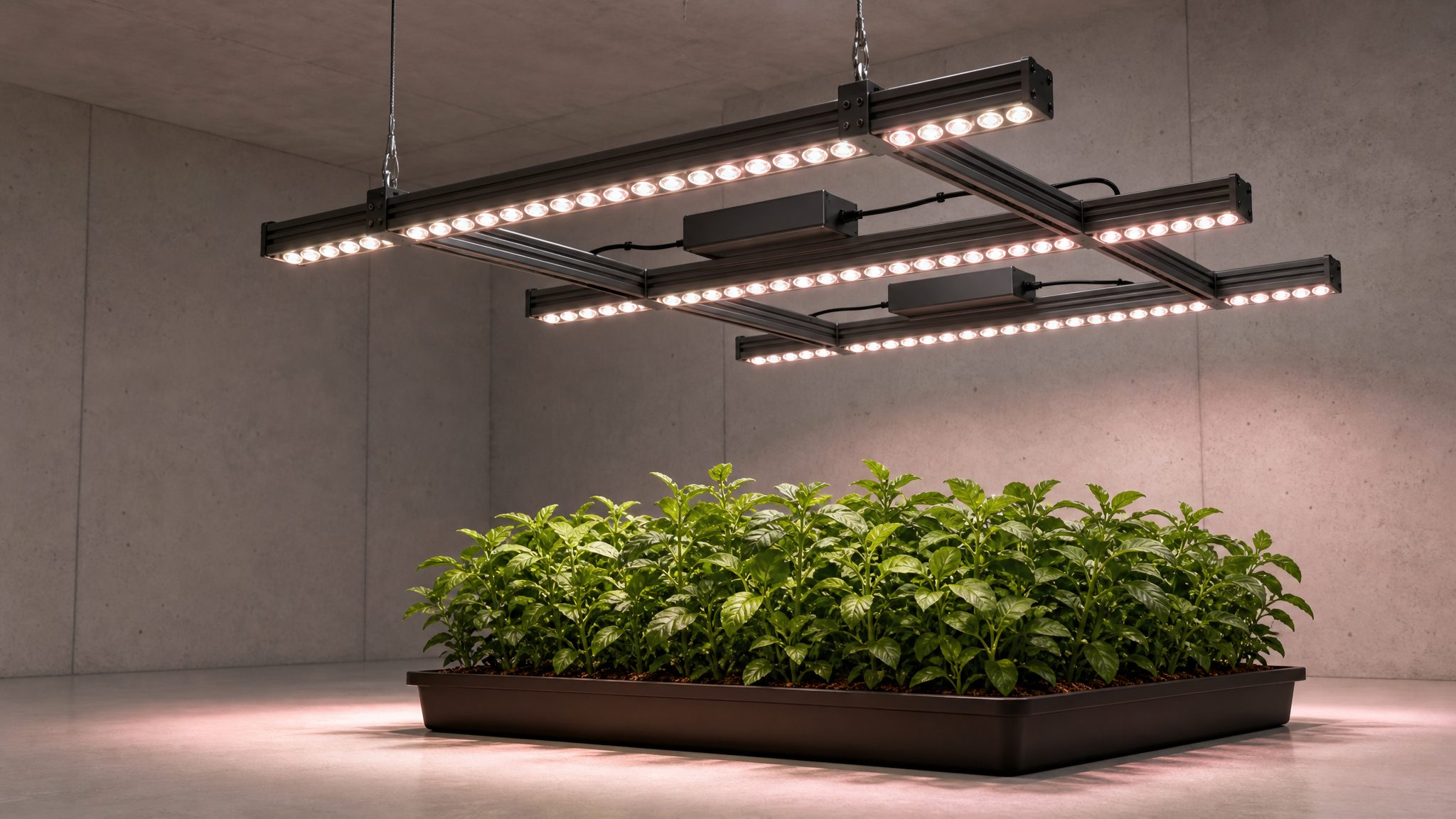
This fixture fits a specific application: a sealed room, a single layer of short medicinal herbs or leafy greens, a canopy that stays within about 0.2 to 0.3 m of the fixture, and a grower who wants one luminaire for the whole cycle rather than a vegetative fixture and a flowering fixture. It is not a greenhouse top light, and it is not a wide-coverage panel: at 0.15 to 0.3 m its beam is deliberately narrow, and a room of many small benches needs one fixture per bench footprint.
Conclusion
The RX-GW78-120Z-2H makes sense or does not make sense on three published facts, none of which is the wattage. Its lens-and-reflector-cup optic concentrates the output into a 90-degree beam, supported by one controlled measurement – a 17% average PPFD gain over a 1.2 x 1 m area at 0.5 m – plus a manufacturer statement of 10 to 30% that carries no published test geometry. Its dual channels divide the work between a 345 W vegetative circuit and a 245 W flowering circuit carrying 660 nm and 730 nm, so far-red can be added at the flowering transition instead of being carried through the entire cycle. And its recommended mounting distance of 0.15 to 0.3 m turns a 600 W-class fixture into a bench-sized luminaire covering 1 x 1.2 m, with 588 W measured at AC 230 V and a plus or minus 10% tolerance on every optical and electrical figure.
A grower who needs one fixture to run a sealed, single-layer medicinal-herb room through the full cycle has a candidate whose numbers can be checked against a tray size and a photoperiod. A grower lighting a 2 m-high greenhouse canopy does not, and should be comparing greenhouse toplighting fixtures instead.
FAQ
What is the recommended mounting distance for the RX-GW78-120Z-2H?
The datasheet recommends an irradiation distance of 0.15 to 0.3 m from the fixture to the canopy, with a stated coverage of 1 x 1.2 m. The same datasheet also reports measurements at 0.5 m, where both channels together deliver 1,068 µmol/m²/s instead of 1,316 µmol/m²/s at 0.2 m.
How much does the lens and reflector cup improve PPFD on the RX-GW78-120Z-2H?
In the datasheet comparison run at 0.5 m over a 1.2 x 1 m area, the lens-and-reflector-cup version measured an average PPFD 17% higher than the version without it. The datasheet also states a broader concentration effect of 10 to 30% and describes the 600 W fixture as delivering 700 W-class PPFD, but that statement is not published with a test geometry.
What is the difference between CHA, CHB and both channels on the RX-GW78-120Z-2H?
CHA is the vegetative channel: 345 W, 824 µmol/s, 2.4 µmol/J and 797 µmol/m²/s at 0.2 m. CHB is the flowering channel with 660 nm deep red and 730 nm far-red: 245 W, 520 µmol/s, 2.1 µmol/J and 500 µmol/m²/s at 0.2 m. Both channels together are 588 W measured, 1,300 µmol/s and 2.3 µmol/J, quoted at 1,316 µmol/m²/s at 0.2 m. All values carry a plus or minus 10% tolerance.
What coverage area and beam angle does the RX-GW78-120Z-2H have?
A 90-degree beam angle and a stated coverage of 1 x 1.2 m, at a recommended distance of 0.15 to 0.3 m. Outside that rectangle the intensity falls away quickly, so several fixtures are laid out as separate rectangles rather than as one overlapping band.
What are the rated lifespan, power and IP rating of the RX-GW78-120Z-2H?
50,000 hours at an ambient temperature of 25 °C, with an operating range of minus 30 °C to 40 °C and a surface temperature rise of Tc 25 K. Power is 600 W rated on the product page and 588 W measured at AC 230 V on the datasheet for both channels together, over an input range of 100 to 305 V. Ingress protection is IP65, and the fixture carries CE, RoHS and FCC marks.
Why Choose Koray
The RX-GW78-120Z-2H is manufactured by Zhongshan Koray Opto-Electronic Co., Ltd., a producer of the wider G-series of horticultural LED fixtures, with 17 years of experience in LED grow-light manufacturing and 300+ domestic and foreign patents. Every performance figure in this article is traceable to the official RX-GW78-120Z-2H datasheet or the official product page on koraylights.com.




Leave A Comment