
Overview: What a 1:1 HPS Replacement Has to Prove
Supplemented greenhouses are the largest electric-lighting category in controlled-environment horticulture. The U.S. Department of Energy, Solid-State Lighting Programme – Energy Savings Potential of SSL in Horticultural Applications (December 2017) records 26.8 million square feet of lit growing area in U.S. supplemented greenhouses in 2017, with lighting operated an average of 2,120 hours per year, and with high-intensity discharge and metal halide fixtures accounting for 98% of the installed lighting in that category. The same study measures electricity consumption per square foot of grow area: 10.4 W/ft² for the incumbent HID technology and 7.3 W/ft² for LED lighting in supplemented greenhouses.
The reason a fixture can claim a 1:1 replacement of a 1000 W HPS lamp is a gap in photosynthetic photon efficacy rather than marketing arithmetic. In the best-in-class table of the same report, a mogul-base HPS lamp reaches 1.02 µmol/J, a double-ended HPS lamp 1.70 µmol/J as of 2014 and 2.1 µmol/J as of 2017, a ceramic metal halide lamp 1.46 µmol/J, and the best integrated LED products of 2017 reach 2.5 µmol/J, with the report projecting that horticultural LED efficacy may exceed 4 µmol/J. That table does not account for ballast losses, which the report notes would reduce the HPS figures in field conditions.
Arithmetic on those published values shows the scale of the swap: a 1000 W HPS lamp at 1.02 to 2.1 µmol/J produces roughly 1,020 to 2,100 µmol/s of PPF, and the RX-G650 produces 1,620 µmol/s on its 600 W vegetative channel alone, with 1,630 µmol/s when its 50 W flowering channel is added. That is why the datasheet states a 1:1 replacement of a 1000 W HPS lamp rather than a watt-for-watt equivalence to a smaller HPS fixture.
Every RX-G650 figure below is quoted from the official G650 datasheet PDF or the official RX-G650 product page, with the condition attached to each number and the datasheet tolerance of plus or minus 10% on optical and electrical data.
Photon Metrics for a Greenhouse Retrofit: PPF, PPFD, Efficacy and DLI
PPF is a property of the fixture: the photon flux it emits in the PAR waveband, in micromoles per second. PPFD is delivered flux in micromoles per square metre per second, and it depends on how far the fixture hangs from the canopy and over what area. Photon efficacy is PPF divided by input power, in micromoles per joule. These definitions, and the reporting convention that feeds them, come from the U.S. Department of Energy, Solid-State Lighting Programme – Energy Savings Potential of SSL in Horticultural Applications (December 2017).
DLI is the daily photon total per square metre, in moles per square metre per day: PPFD multiplied by the photoperiod in seconds, divided by 1,000,000. It matters in greenhouses because supplementary lighting is a short daily event rather than a continuous condition. If the 2,120 annual hours recorded in the DOE study were spread evenly across the year they would amount to about 5.8 hours of supplemental lighting per day, and on that schedule the DLI is decided almost entirely by the intensity the fixture can actually deliver at canopy level. A fixture that cannot reach the target PPFD at the installed height cannot compensate indefinitely by running longer, because extending the photoperiod changes the dark period as well as the light total.
Applying the arithmetic to the RX-G650 datasheet values: with both channels running, the fixture delivers 1,250 µmol/m²/s at 20 in (0.5 m), which over a 6-hour window is about 27.0 mol/m²/day, and 230 µmol/m²/s at 5 ft (1.5 m), about 5.0 mol/m²/day over the same window. Both figures are arithmetic on the published PPFD values and a stated photoperiod, not additional datasheet measurements, and both are the reason the mounting height decision precedes every other decision in a greenhouse retrofit.
Why the Wattage Comparison Alone Is Misleading
A high-pressure sodium lamp is sold by electrical input; a horticultural LED luminaire is specified by photon output and by the efficacy that converts one into the other. Two fixtures with identical wattage can differ by a factor of two in PPF, and two fixtures with identical PPF can differ in how much of that flux reaches a canopy two metres below them. The U.S. Department of Energy, Solid-State Lighting Programme – Energy Savings Potential of SSL in Horticultural Applications (December 2017) makes the second point directly, recording that LED technology can enable energy savings through improved optical distributions that deliver light more efficiently to the plant canopy, with the effect described as difficult to quantify from published data alone.
Spectrum adds a second layer to the comparison. A high-pressure sodium lamp emits one broad, fixed spectrum with a substantial infrared component; a tunable LED fixture can shift the ratio between the wavebands that favour vegetative growth and the wavebands that influence flowering. The same DOE report also carries an explicit caution from industry stakeholders, noting that independent third-party research is needed to substantiate claims that tailored spectra offer improvements over a broad-spectrum source. That caution applies to the spectral figures in this article as well: they are quoted from the manufacturer datasheet and are not presented as third-party verified.
A third factor is control. HPS installations are typically switched in blocks, because dimming a gas-discharge lamp changes its spectrum and efficiency. A fixture with a native dimming interface changes intensity and spectrum independently, which is what makes a staged crop schedule possible within one installation rather than across two.
Two Channels Instead of One Fixed Spectrum
A fixed-spectrum fixture commits the entire crop cycle to one spectral distribution, which is a reasonable engineering compromise when the crop does not change its requirements. A two-channel fixture divides the photon budget into two separately dimmable groups, so the ratio between them can change with the crop stage while the fixture stays in place.
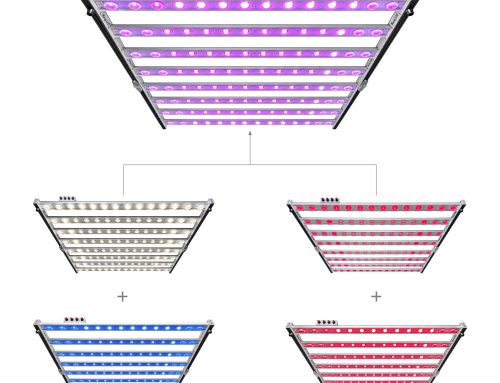
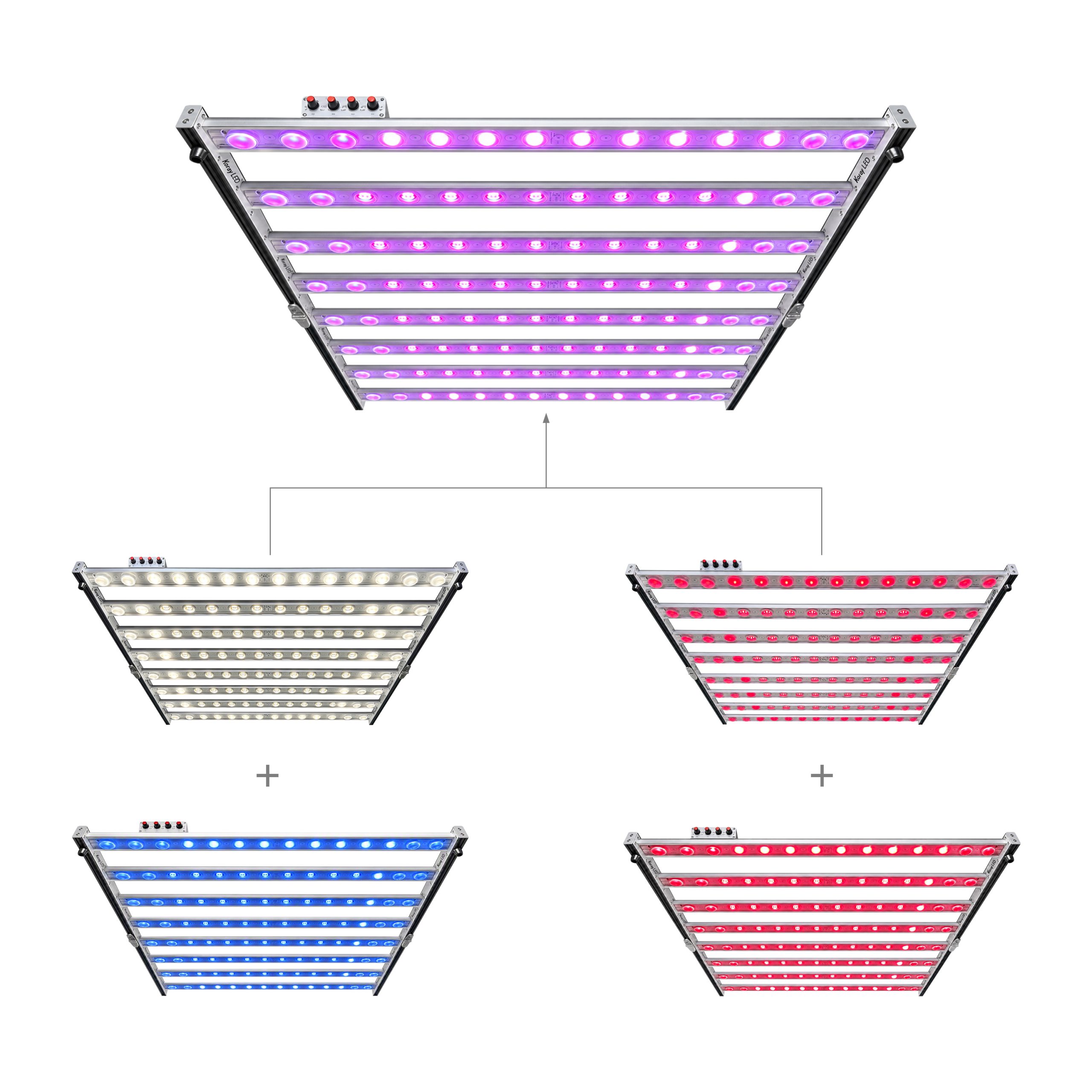
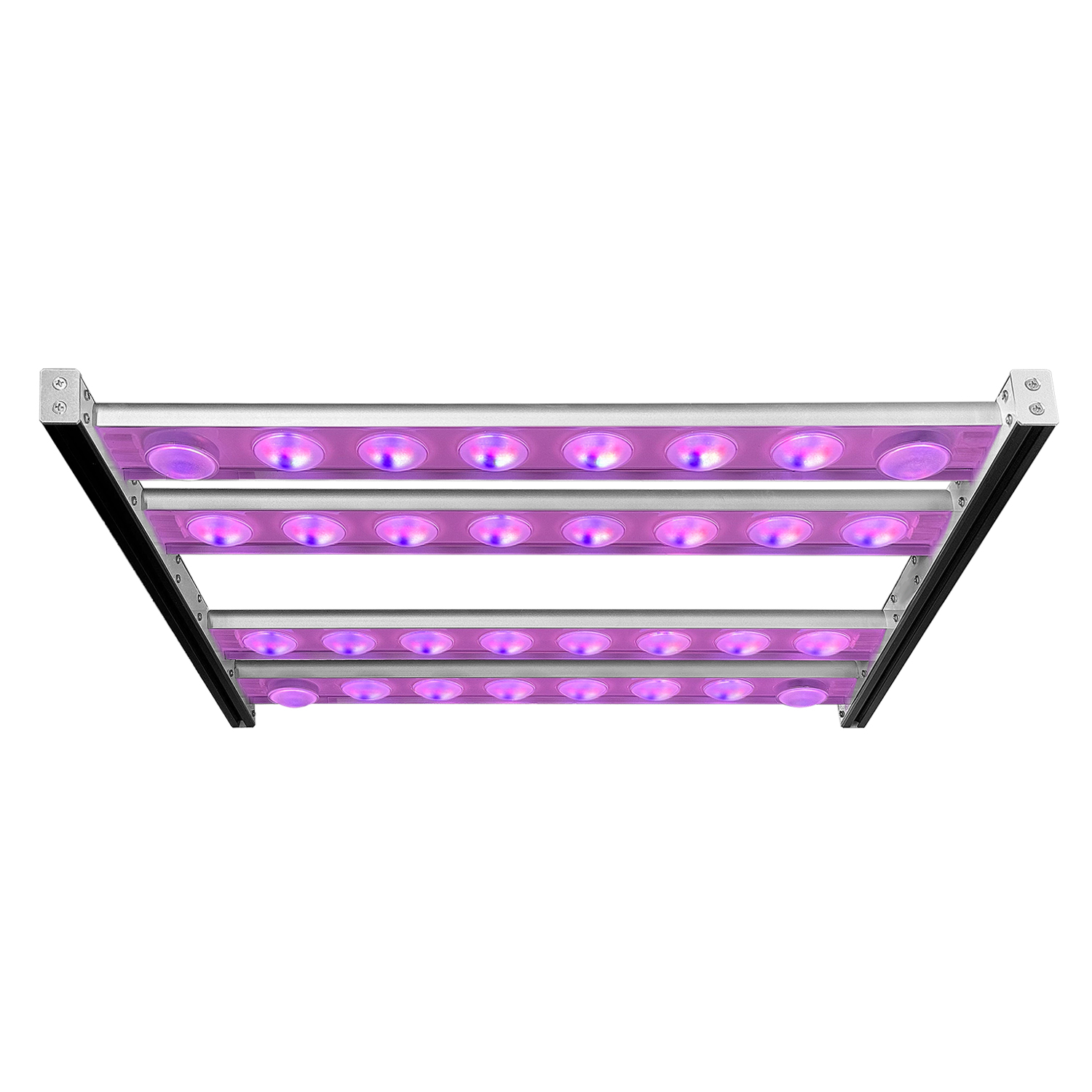
The RX-G650 divides its 650 W along those lines. CH1 is a blue-leaning spectrum, designated F131 on the datasheet, rated at 600 W and intended for propagation and vegetative growth, the stages in which root, stem and leaf development dominate the response to light. CH2 is deep red 660 nm plus far-red 730 nm at 50 W, intended for flowering.
Far-red is the reason a flowering channel is separate at all. As described in PMC / U.S. National Library of Medicine – Kim and Son, Frontiers in Plant Science 2022, PMC9253827, phytochromes alternate between an inactive form absorbing red near 660 nm and an active form absorbing far-red near 730 nm, so the red-to-far-red ratio is read as a signal. The same peer-reviewed greenhouse trial found that adding 55 µmol/m²/s of far-red to red-and-blue interlighting raised red-fruit yields by 9% and yellow-fruit yields by 19% relative to the red-and-blue treatment, while reducing carotenoid content by 26% and 9% – a yield-versus-quality trade-off, and one of the clearest available illustrations of why far-red is worth having on a control channel.
The proportions are worth stating honestly. CH2 accounts for 50 of 650 W, or 7.7% of the electrical load, and 62 of 1,630 µmol/s, or 3.8% of the photon output. A two-channel tunable fixture is therefore not two equal halves: it is a main channel plus a controllable modifier, and at 50 µmol/m²/s at 20 in the far-red group is in the same order of magnitude as the 55 µmol/m²/s addition used in the published trial.
Official RX-G650 Values and the Conditions Behind Them
The datasheet measures three operating states at two distances, 20 in (0.5 m) and 5 ft (1.5 m). The three states are compared in the next section.
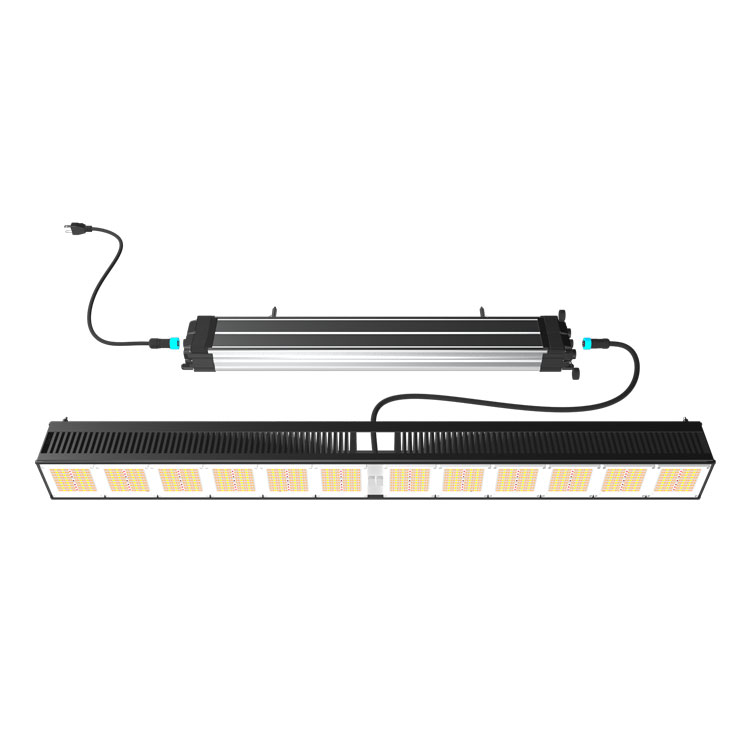
Physically, the fixture is a single linear bar measuring 1,176 x 103 x 100 mm with an integrated driver. The datasheet also prints the dimensions in imperial units as 47 x 4 x 7.6 in; the metric set is used here because the printed imperial depth of 7.6 in does not agree with 100 mm, and where a datasheet disagrees with itself on a dimension, only the consistent set can be quoted responsibly. Emitters are Samsung LM301H and Osram horticulture LEDs as listed on the datasheet.
Electrically, total power is 650 W over an input range of 120 to 277 V AC with a power factor above 0.9, and CH1 photon efficacy is quoted at up to 2.7 µmol/J. Ingress protection is IP65, which under the two-numeral IP code defined in IEC 60529 and published by the International Electrotechnical Commission – IP ratings (IEC 60529) denotes protection against dust ingress and against water projected by a nozzle from any direction. The operating range is minus 30 °C to 35 °C, the rated lifespan is 50,000 hours, the warranty is three years, and the fixture carries CE, RoHS and FCC marks. Optical and electrical data carry a plus or minus 10% tolerance, and the recommended irradiation distance is 0.5 to 3 m.
The datasheet states the replacement ratio twice: it describes the fixture as a 1:1 replacement of a 1000 W HPS lamp and, on its second page, states that 600 W replaces 1000 W HPS. Both statements describe the same fixture, because 600 W is the rating of the main channel and 650 W is the total including the 50 W flowering channel.
Channel Comparison: CH1, CH2 and CH1 + CH2
| Mode | Spectral content | PPFD at 20 in / 0.5 m (µmol/m²/s) | PPFD at 5 ft / 1.5 m (µmol/m²/s) | PPF (µmol/s) | Power (W) | Datasheet use |
|---|---|---|---|---|---|---|
| CH1 (F131) | Blue-leaning propagation and vegetative spectrum | 1,200 | 220 | 1,620 | 600 | Propagation and vegetative growth (roots, stems, leaves) |
| CH2 | 660 nm deep red + 730 nm far-red | 50 | 10 | 62 | 50 | Flowering promotion |
| CH1 + CH2 (F132) | Both channels together | 1,250 | 230 | 1,630 | 650 | Flowering and harvest |
The power column adds up exactly: 600 W plus 50 W is the 650 W total, which is why the replacement claim is anchored to the 600 W channel. The photon column does not add up exactly, and that is normal: 1,620 plus 62 is 1,682 µmol/s, while the combined measurement is 1,630 µmol/s. Measurement of individual channels and of both channels together are separate measurements, and the datasheet tolerance of plus or minus 10% on optical data covers the difference.
One further reading is worth drawing out: adding the flowering channel raises PPFD from 1,200 to 1,250 µmol/m²/s at 20 in, a 4.2% increase that is calculated from the two quoted values. The spectral change is therefore much larger than the intensity change, which is the intended function of a flowering channel.
The Official Greenhouse Layout Planning Table, Read Row by Row
The fourth page of the datasheet publishes a layout plan for medicinal-herb greenhouses, running from a 150 µmol/m²/s target up to 900-1,000 µmol/m²/s, and giving for each target the average intensity delivered, the area covered per fixture, the mounting height above the canopy and the fixture spacing. All nine rows are reproduced below.
| Required light intensity (µmol/m²/s, PAR) | Average intensity delivered (µmol/m²/s) | Coverage per fixture | Mounting height (fixture to canopy) | Fixture spacing | Fixtures per room (assumption) |
|---|---|---|---|---|---|
| 900-1,000 | 600 | 26 sq ft / 2.4 m² | 3.6 ft / 1.1 m | 6.6 x 2.3 ft (2 x 0.7 m) | at least 20 |
| 800-900 | 520 | 29 sq ft / 2.7 m² | 3.2 ft / 1.0 m | 6.6 x 2.6 ft (2 x 0.8 m) | at least 20 |
| 700-800 | 430 | 36 sq ft / 3.3 m² | 3.2 ft / 1.0 m | 6.6 x 3.2 ft (2 x 1.0 m) | at least 20 |
| 600-700 | 400 | 36 sq ft / 3.3 m² | 3.9 ft / 1.2 m | 6.6 x 3.2 ft (2 x 1.0 m) | at least 20 |
| 500-600 | 380 | 39 sq ft / 3.6 m² | 4.3 ft / 1.3 m | 6.6 x 3.6 ft (2 x 1.1 m) | at least 20 |
| 400-500 | 350 | 42 sq ft / 3.9 m² | 4.9 ft / 1.5 m | 6.6 x 3.9 ft (2 x 1.2 m) | at least 20 |
| 300-400 | 260 | 51 sq ft / 4.8 m² | 5.9 ft / 1.8 m | 6.6 x 5.0 ft (2 x 1.5 m) | at least 20 |
| 200-300 | 190 | 68 sq ft / 6.3 m² | 6.6 ft / 2.0 m | 6.6 x 6.6 ft (2 x 2.0 m) | at least 20 |
| 150 | 120 | 98 sq ft / 9.1 m² | 9.8 ft / 3.0 m | 6.5 x 3.9 ft (2 x 1.2 m) | at least 20 |
The table states its own assumptions, which travel with the numbers: wall reflectivity of 20%, a minimum of 20 fixtures per room, and a note that the figures are for reference. Those conditions matter, because a room with reflective walls or a different fixture count will not reproduce the coverage column exactly. Even so, this is the most directly usable page of the datasheet for a retrofit, because it converts a target intensity into the three numbers a contractor needs: how high to hang, how far apart, and how many.
Reading two rows shows the shape of the plan. For a 700-800 µmol/m²/s requirement the table gives 430 µmol/m²/s of average intensity, 3.3 m² (36 sq ft) of coverage per fixture, a mounting height of 1.0 m above the canopy and a spacing of 2 x 1.0 m. At the other end, a 150 µmol/m²/s requirement is served by 120 µmol/m²/s average, 9.1 m² (98 sq ft) per fixture, a mounting height of 3.0 m and a spacing of 2 x 1.2 m: the same fixture spread over nearly three times the area, from three times the height. Both readings are from the datasheet table itself.
Dimming Architecture: RJ45, 0-10 V and App Control
Dimming a horticultural fixture is a control problem before it is a lighting problem. The two signal conventions found in commercial installations are 0-10 V, where an analogue control voltage sets the output level, and 10 V PWM, where a pulse-width-modulated 10 V signal carries the level as a duty cycle. Both are low-voltage control signals carried on separate conductors from the mains supply, which is why a data cable can distribute control across a house while power is distributed separately.
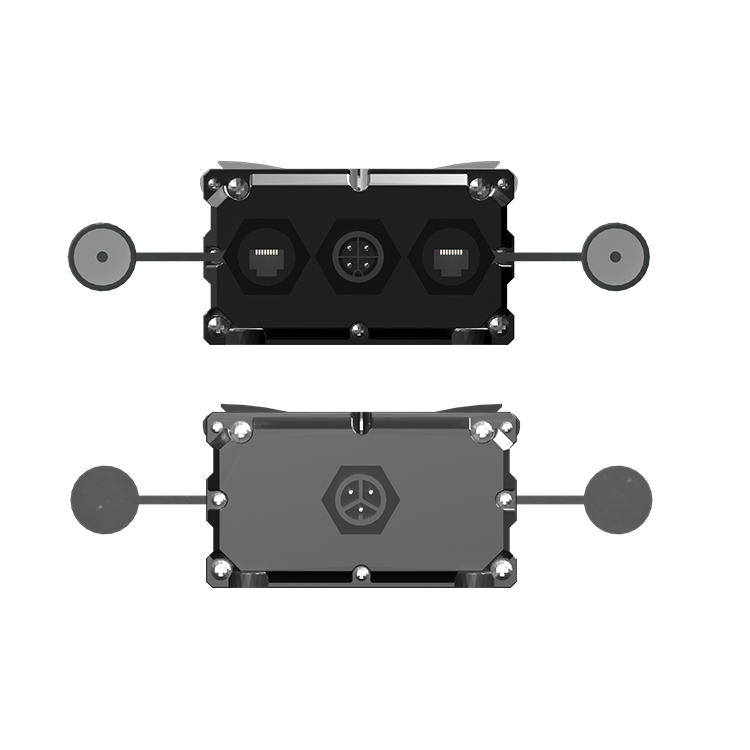
A network cable such as RJ45 contains four twisted pairs, so it can carry two independent dimming pairs plus spare conductors. On the RX-G650 that is used deliberately: the datasheet assigns CH1 to pins 1 and 2 (DIM+ and DIM-) and CH2 to pins 3 and 4, and states that the port accepts either 0-10 V or 10 V PWM. The same datasheet states compatibility with the Horti Guru smart control app, which is purchased separately. In practice, a single network drop per fixture can schedule the vegetative spectrum, the flowering spectrum and the change-over between them.
For a retrofit, the consequence is that control resolution is set by the dimming channel rather than by the fixture count. Forty fixtures on one schedule behave as a single light source; the same forty fixtures in groups on separate schedules can hold different intensities over different benches, which is the granularity the row-by-row structure of the layout table implies.
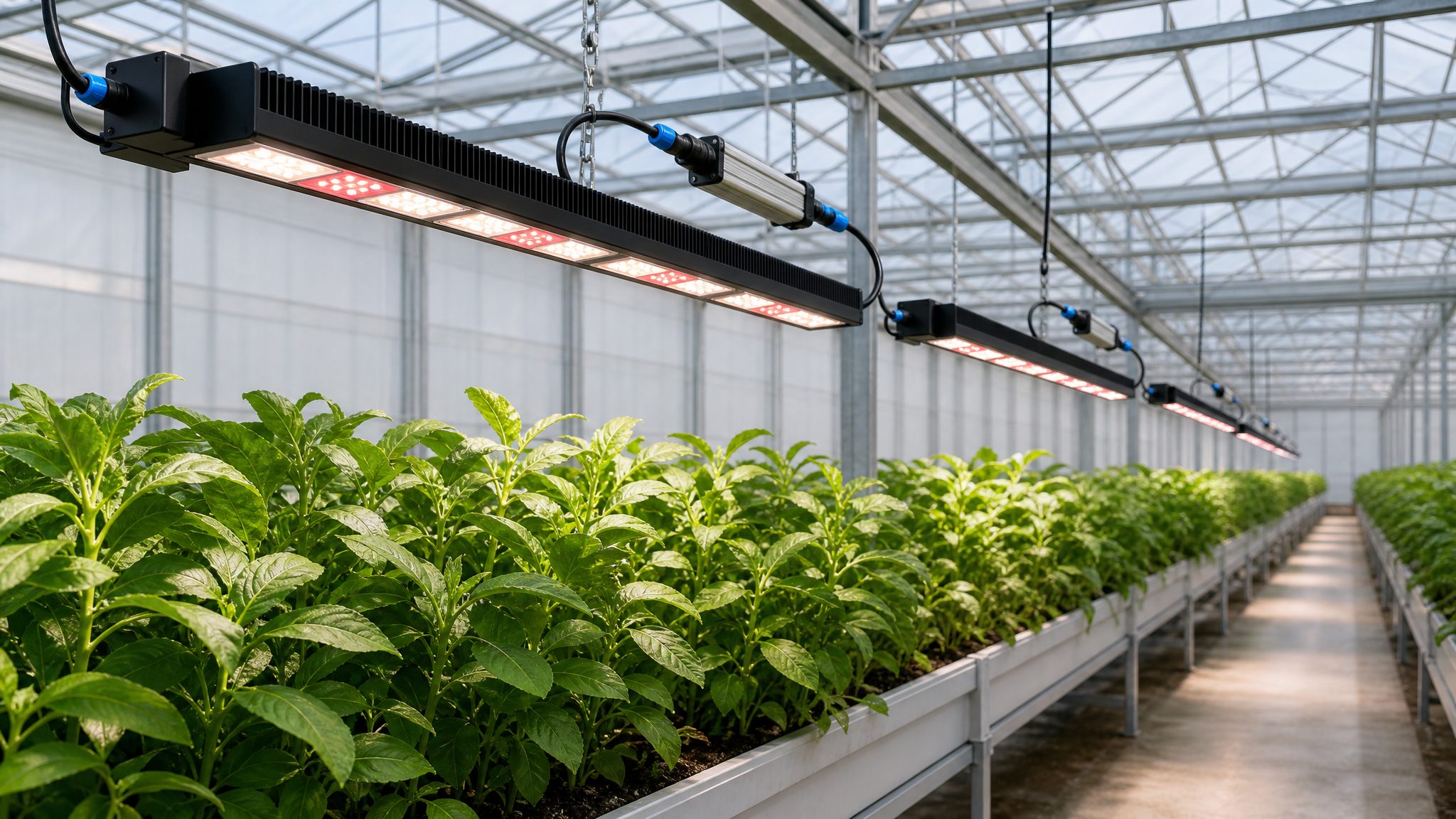
The fixture suits a glass or polycarbonate greenhouse with bench or high-wire crops, a fixture-to-canopy distance of at least 0.5 m, a retrofit away from 1000 W HPS, and target intensities between 150 and 1,000 µmol/m²/s. It does not suit a sealed room whose canopy sits 0.2 m below the fixture, where a low-hang array with a narrow optic is the appropriate architecture.
Choosing Between a Single-Spectrum Bar, a Four-Channel Toplight and a Tunable Two-Channel Toplight
Three toplighting architectures appear in commercial greenhouses, and they answer different questions. A single-spectrum linear top light, such as the RX-G320 in the same G-series, fixes one spectral distribution for the whole crop cycle and competes on efficacy, coverage and cost per delivered photon; it is the simplest retrofit and the least flexible. A four-channel toplight, such as the G320-4H, splits the spectrum into four separately dimmable groups, which suits installations that want to reproduce several spectral recipes from one fixture family, at the cost of more control channels to commission and maintain.
The RX-G650 sits between those two. It offers two channels, one blue-leaning and one deep red plus far-red, with almost all of the photon budget concentrated in the first, so it covers the two decisions most greenhouse crops actually require – a vegetative spectrum and a flowering spectrum – rather than a spectral research programme. Its second distinguishing feature is documentation: the official layout table turns a target intensity into mounting height, spacing and fixtures per area, so the installation plan can be argued from published numbers instead of from a rule of thumb.
The third is the dimming interface: a native RJ45 port with separate pin pairs per channel and stated compatibility with 0-10 V or 10 V PWM, which matters in a house that already runs a lighting control system. For a sealed indoor room, none of the three toplighting architectures is the right starting point; a low-hang array at 0.15 to 0.3 m or a quantum board at around 0.5 m is the appropriate architecture, because the fixture-to-canopy distance in those rooms is set by the growing system, not by a greenhouse truss.
Conclusion
The RX-G650 is a 650 W tunable-spectrum greenhouse toplight whose case rests on three documented facts. Its 600 W main channel produces 1,620 µmol/s at a quoted efficacy of up to 2.7 µmol/J, which is the basis for the datasheet statement of a 1:1 replacement of a 1000 W HPS lamp, and which sits above the 2.5 µmol/J best-in-class LED figure recorded in the 2017 DOE horticultural SSL report – although the two figures come from different product populations and are not a like-for-like test result. Its two channels divide the spectrum between a 600 W blue-leaning vegetative group and a 50 W group carrying 660 nm and 730 nm, on separate RJ45 dimming pairs. And its published layout table converts nine target intensities from 150 to 1,000 µmol/m²/s into mounting heights from 1.0 m to 3.0 m and spacings from 2 x 0.7 m to 2 x 2.0 m, under stated assumptions of 20% wall reflectivity and at least 20 fixtures per room.
A grower replacing 1000 W HPS fixtures in a glass house, with a target intensity already known and a fixture-to-canopy distance of at least 0.5 m, can test those numbers directly against one row of the layout table. A grower who needs four independently tunable spectral groups, or who needs a fixture 0.2 m above a sealed-room canopy, should be looking at a different architecture.
FAQ
How many RX-G650 fixtures replace a 1000 W HPS installation?
The datasheet states a 1:1 replacement of a 1000 W HPS lamp, with the 600 W main channel given as the equivalent, and it repeats the figure as 600 W replacing 1000 W HPS. The layout table then converts a target intensity into area per fixture, from 2.4 m² (26 sq ft) at a 900-1,000 µmol/m²/s requirement to 9.1 m² (98 sq ft) at 150 µmol/m²/s, assuming 20% wall reflectivity and at least 20 fixtures per room.
What are the differences between CH1, CH2 and CH1 + CH2 on the RX-G650?
CH1 is the blue-leaning F131 propagation and vegetative channel: 1,620 µmol/s, 600 W, 1,200 µmol/m²/s at 20 in (0.5 m) and 220 at 5 ft (1.5 m). CH2 is the 660 nm plus 730 nm flowering channel: 62 µmol/s, 50 W, 50 µmol/m²/s at 20 in. Both channels together are 1,630 µmol/s and 650 W, quoted at 1,250 µmol/m²/s at 20 in and 230 at 5 ft. All values carry a plus or minus 10% tolerance.
What mounting height and spacing should be used for the RX-G650?
The datasheet recommends an irradiation distance of 0.5 to 3 m and publishes a nine-row layout table. A 700-800 µmol/m²/s target corresponds to 430 µmol/m²/s average, 3.3 m² per fixture, 1.0 m above the canopy and 2 x 1.0 m spacing, while a 150 µmol/m²/s target corresponds to 120 µmol/m²/s average, 9.1 m² per fixture, 3.0 m and 2 x 1.2 m. The table assumes 20% wall reflectivity and at least 20 fixtures per room.
How does RJ45 dimming work on the RX-G650?
The RJ45 port carries two separate dimming pairs: CH1 on pins 1 and 2 (DIM+ and DIM-) and CH2 on pins 3 and 4, accepting either a 0-10 V or a 10 V PWM signal. The datasheet states compatibility with the Horti Guru smart control app, which is purchased separately, so one network cable per fixture can schedule both channels.
What are the efficacy, lifespan, warranty and IP rating of the RX-G650?
CH1 photon efficacy is quoted at up to 2.7 µmol/J. Rated lifespan is 50,000 hours, the warranty is three years, and ingress protection is IP65 under IEC 60529, against dust ingress and against water projected by a nozzle from any direction. Power is 650 W total over an input range of 120 to 277 V AC with a power factor above 0.9, and the operating range is minus 30 °C to 35 °C.
Why Choose Koray
The RX-G650 is manufactured by Zhongshan Koray Opto-Electronic Co., Ltd., a producer of the wider G-series of horticultural LED fixtures, with 17 years of experience in LED grow-light manufacturing and 300+ domestic and foreign patents. Every performance figure in this article is traceable to the official G650 datasheet or the official product page on koraylights.com.




Leave A Comment