
Overview: Why a Large Panel Is Planned Differently
A large-format grow panel changes the economics of a room in ways that a wattage figure does not describe. Two numbers matter most before anything is ordered: how much light reaches the canopy at the mounting height the room can actually accommodate, and how far below its rated capacity the LED array is being asked to work. This article works through both, using the official specification of the RX-GKC650 as the worked example, and then covers the two deployment questions that arrive with any 1.2 m panel – how the freight is packaged and how the fixture is hung, connected and dimmed once it is on site.
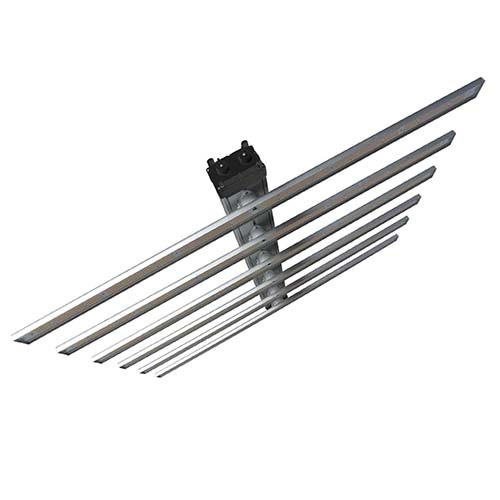
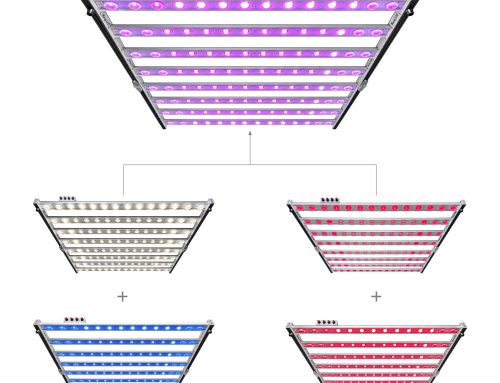
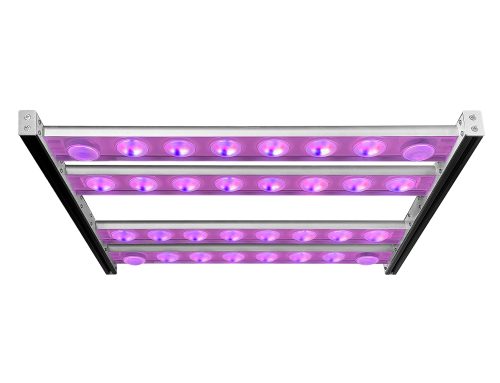
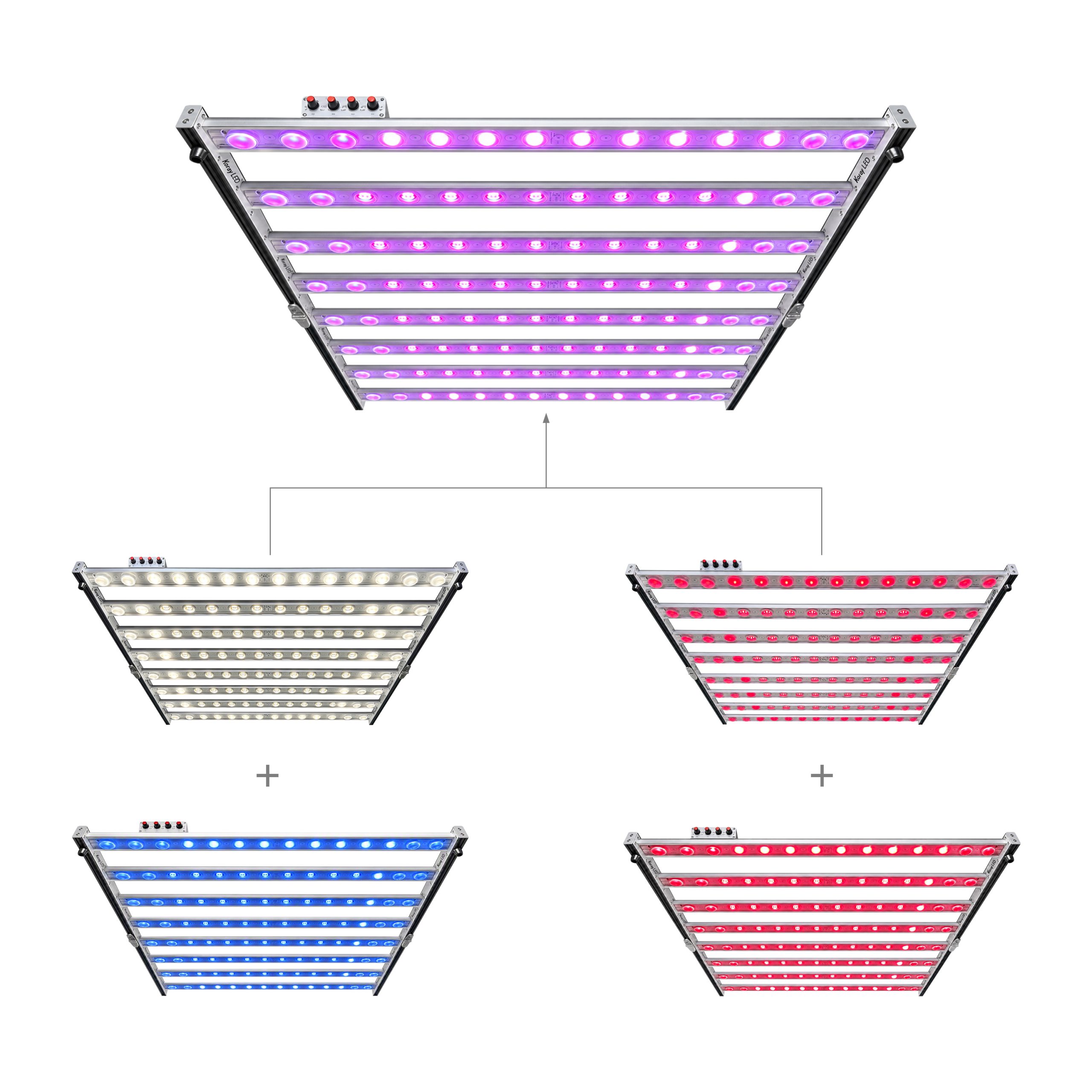
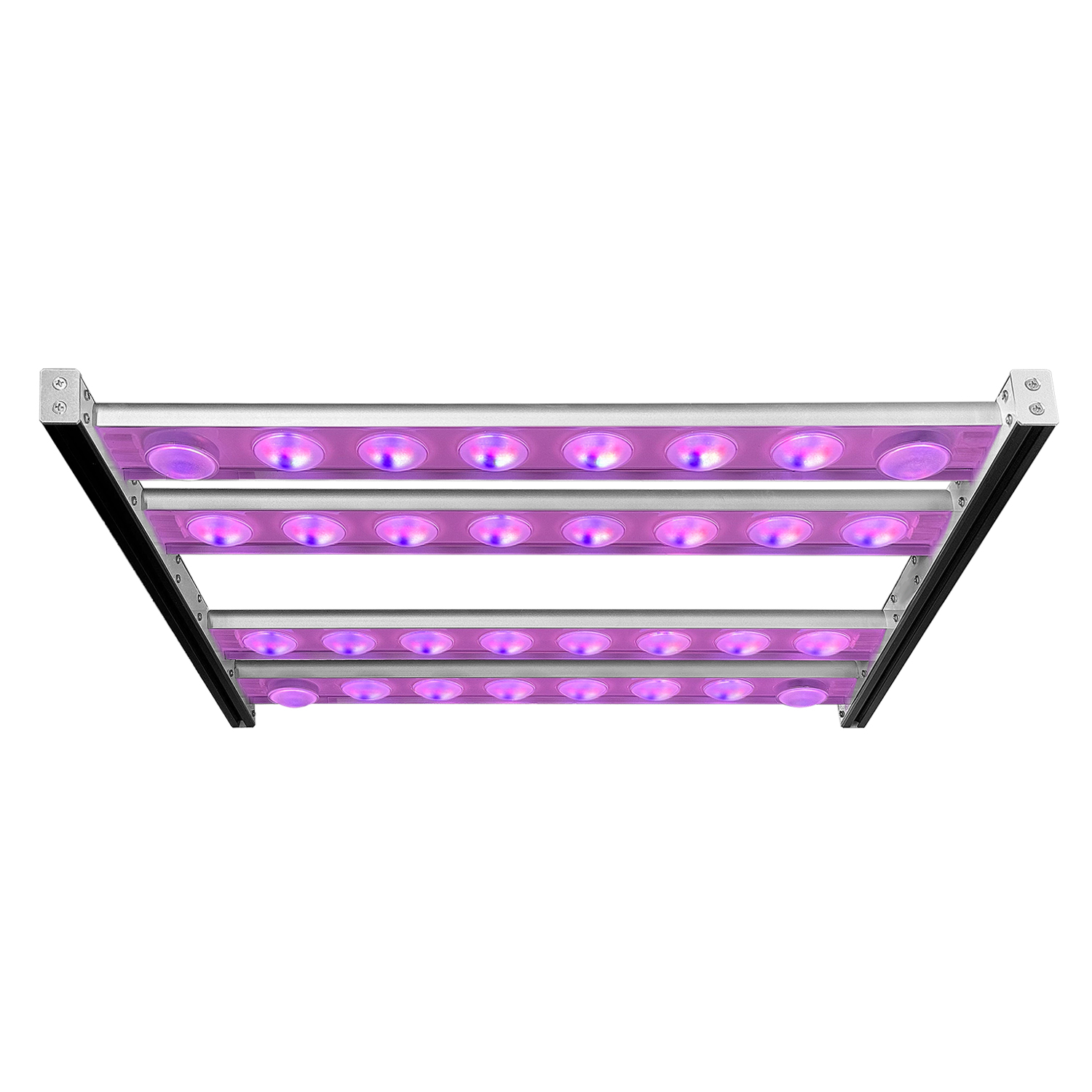
The RX-GKC650 is a 650 W quick-plug large-format panel built on a 1218 × 1192 × 100 mm (48 × 46.8 × 3.9 in) near-square body carrying up to 5904 LEDs arranged in six parallel bars. Its official literature publishes two separate coverage sets, one measured inside a grow tent and one measured in a dark room with no reflective surfaces, and the difference between the two sets is the single most useful planning input a grower has. All values below are taken from the official RX-GKC650 product page and the official RX-GKC650 datasheet (PDF), and carry the tolerance stated on the datasheet.
Photon Metrics for a Large Panel: PPF, PPFD and Why Height Comes First
Photosynthetic photon flux (PPF) is the total number of photosynthetically active photons emitted per second, in micromoles per second (µmol/s), and it is fixed by the fixture’s design. Photosynthetic photon flux density (PPFD) is that flux spread over a surface, in micromoles per square metre per second (µmol/m²/s), and it depends on the mounting height and on the room. Photon efficacy expresses the first quantity against electrical input in micromoles per joule (µmol/J); the official explanation of the micromole-per-joule metric for LED lighting is published by the U.S. Department of Energy (U.S. Department of Energy, Solid-State Lighting – LED Basics).
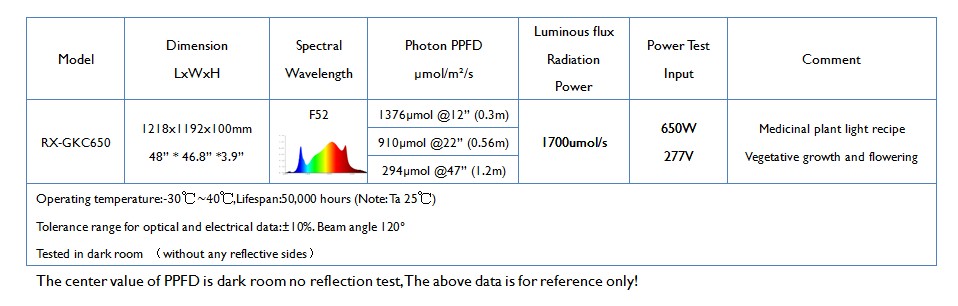
For a large panel the distance between fixture and canopy deserves more attention than it usually receives, because the panel’s emitting area is broad relative to the gap. A broad source does not behave like a point source: doubling the distance does not quarter the irradiance. The official RX-GKC650 table shows this directly, with PPFD falling from 1376 µmol/m²/s at 12 in (0.3 m) to 910 µmol/m²/s at 22 in (0.56 m) and 294 µmol/m²/s at 47 in (1.2 m). The pattern is not the inverse-square curve a small emitter would produce, and it is the reason a mounting height measured in inches can be treated as a design set point rather than an estimate. Horticultural extension guidance likewise treats fixture-to-canopy distance as a primary design variable for top lighting (Michigan State University Extension – LED lighting for plant growth).
Two definitions are worth fixing before the numbers are compared. A dark-room measurement is a PPFD measurement taken with no reflective surfaces in the room, so the value contains no contribution returned from walls or floor; the datasheet states that the centre PPFD value is obtained from exactly that condition. A coverage or grid measurement is a set of point readings taken across a defined rectangular area and averaged, which is how the coverage tables in the official literature are built.
The Derating Margin Behind a 5904-LED Array
The RX-GKC650 carries up to 5904 LEDs, made up of 5760 Samsung white LEDs plus 144 emitters at 660 nm and 730 nm. The official literature states that the LEDs in this fixture have a power rating of more than 3000 W but are operated in a derated condition, producing a 1700 µmol/s PAR output at a stated efficacy of 2.6 µmol/J.
The derating ratio is stated explicitly: the LED lamps are rated at 160 mA and are actually driven at 25 mA. A definition sentence makes the significance clear – derating is operating an emitter below its rated current so that its junction runs cooler. Because photon output and rated life both depend on junction temperature, driving 5904 individual emitters at roughly one sixth of their rated current means the array is not being pushed to its ceiling to reach the fixture’s rated output. The manufacturer states that the fixture remains stable and reliable even if the number of lamps is reduced by 50%. The benefit to a grower is not a larger PPF figure; it is a wider margin between the array’s design ceiling and its working point, which is the kind of margin that shows up in the maintenance pattern of a production room rather than on a specification sheet.
The published warranty policy reflects the same arithmetic. Because the array contains so many individually small emitters, an isolated non-working LED is compensated at USD 1.00 per LED, and if more than 100 LEDs are affected the manufacturer provides repair or replacement of the fixture. That is a policy shaped for a high-count array rather than a low-count one, and it is worth reading before a purchase rather than after.
Split Packaging and the Quick-Plug Interface: What They Change on Site
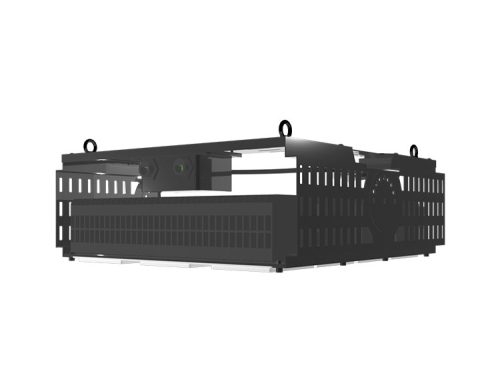
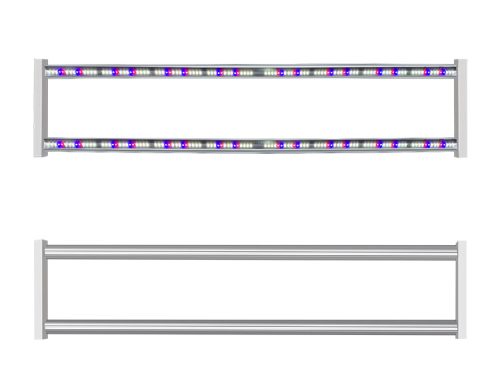
The official RX-GKC650 documentation describes two physical features that are about deployment rather than photometry: separate packaging, which saves freight, and a quick-plug interface for easy installation. Both are consequences of the fixture’s size. A 1218 × 1192 mm panel with a 100 mm body is a large, thin object, and the cost and difficulty of a panel that size sit mostly in how it is boxed and how it reaches its mounting points.
Split packaging means the fixture ships in more than one package rather than as a single oversized carton, and the manufacturer’s stated benefit is freight saving. For a project buyer the relevant consequence is that the freight burden of a multi-fixture order no longer scales with one oversized carton per fixture, and packed units are easier to carry into a basement or an upper-floor room before assembly. The quick-plug interface addresses the second half of the same problem: once the panel is in position, the connection between the panel and the rest of the system is made by mating connectors rather than by opening a junction box, which shortens the time a fixture spends with a technician’s hands on it.
Dimming on this fixture is handled through an RJ45 socket dimming connector, with the CH1 dimming signal input on Pin 1 (DIM+) and Pin 2 (DIM−). A DM35-RJ45 dimmer is supplied free of charge for test use only. Multi-fixture dimming is compatible with the Horti Guru app control system, which the official literature marks as requiring additional purchase. As with any RJ45-based dimming interface, the connector is a low-voltage signal path and should be kept distinct from mains wiring during installation.
Two Coverage Sets, Two Sets of Conditions: Tent vs Dark Room
The most useful planning information in the official RX-GKC650 literature is that coverage is published twice, under two clearly different sets of conditions, and that the two sets are not interchangeable.
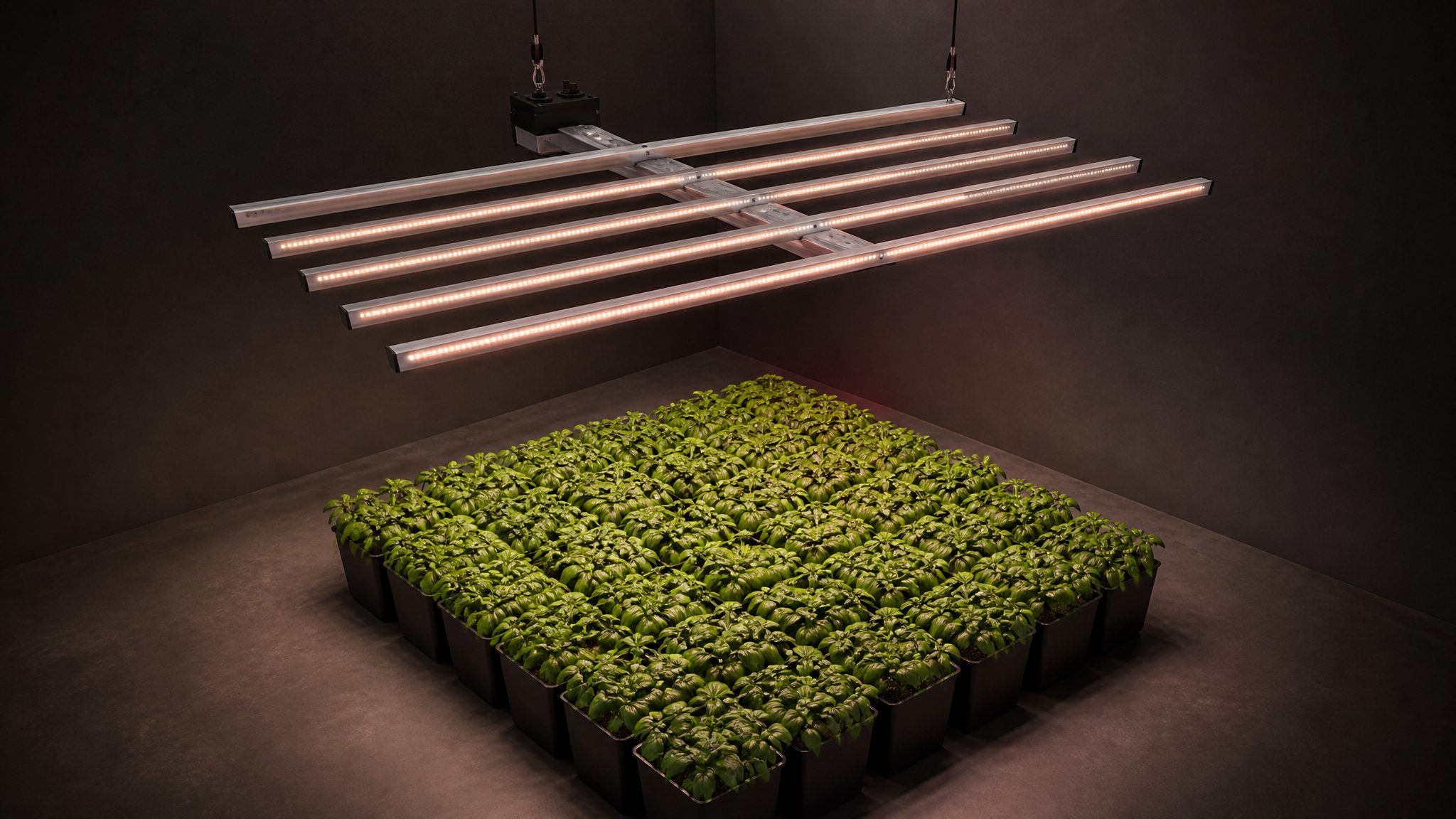
Inside a grow tent, the published coverage is 6.6 ft × 6.6 ft for vegetative growth and 5 ft × 5 ft for flowering. In a dark room with no reflective surfaces, the published coverage is 5 ft × 5 ft for vegetative growth and 4 ft × 4 ft for flowering. A tent’s reflective interior returns a fraction of the emitted photons to the canopy, so the same fixture lights a larger area to the same target; a room with no reflective surfaces receives only photons arriving directly from the panel, so the same fixture covers less ground. The panel body itself measures 1.2 × 1.2 m (4 × 4 ft), which is the physical size of the fixture and not a coverage figure – a distinction the official documentation draws, and one that is easy to conflate when reading a product listing.
The measured data follows the same split, and the numbers are worth separating carefully. In the grow tent, the fixture produced an average of 420 µmol/m²/s over 6.6 ft × 6.6 ft at 28 in (0.71 m) and an average of 802 µmol/m²/s over 5 ft × 5 ft at 20 in (0.51 m). In the dark room with no reflective surfaces, it produced an average of 422 µmol/m²/s over 5 ft × 5 ft at 26 in (0.66 m) and an average of 597 µmol/m²/s over 4 ft × 4 ft at 18 in (0.46 m). The official note accompanying this data states that it comes from manual testing of factory physical samples, that measurement error is possible, and that the figures are for reference only. All light and electrical values carry a tolerance of ±10%, and the beam angle is stated as 120°.
Hanging-Height Planning for Seedling, Vegetative and Flowering Stages
The official literature supplies a stage-by-stage hanging plan for each of the two environments. In a 1.5 × 1.5 m growth tent the recommended conditions are: seedlings at 150-250 µmol/m²/s, 20-30% intensity and 32-36 in (0.81-0.91 m) to the canopy; vegetative growth at 400-600 µmol/m²/s with CO&sub2; at 400-800 ppm, 80-100% intensity and 26-30 in (0.66-0.76 m); and flowering at 500-1000 µmol/m²/s with CO&sub2; at 800-1500 ppm, 100% intensity and 16-20 in (0.41-0.51 m).
In a dark room with no reflective surfaces, over a 4 ft × 4 ft growing area, the published plan is: seedlings at 40% intensity and 26-30 in; vegetative growth at 80-100% intensity and 20-26 in; and flowering at 100% intensity and 12-18 in (0.30-0.46 m).
Two patterns emerge when the plans are compared. First, the dark-room plan uses lower percentage settings at the same stages, because less of the emitted light is returned to the canopy by the room. Second, the dark-room flowering band reaches lower – 12 to 18 in – than the tent flowering band’s 16 to 20 in, which is the height at which the fixture can drive the 4 ft × 4 ft dark-room footprint to its published average of 597 µmol/m²/s. A grower planning a room without reflective walls should therefore plan for a lower working plane and expect a smaller footprint from the same fixture.
Planning Tables: Coverage, PPFD, Power and Derating by Condition
The first table compares the measured averages published for the two environments. The second assembles the specification and derating figures underneath those measurements, with each power figure tied to its input voltage.
| Condition | Coverage | Mounting height | Average PPFD (measured) | Stage |
|---|---|---|---|---|
| Grow tent, wider footprint | 6.6 ft × 6.6 ft | 28 in / 0.71 m | 420 µmol/m²/s | Vegetative growth |
| Grow tent, flowering footprint | 5 ft × 5 ft | 20 in / 0.51 m | 802 µmol/m²/s | Flowering |
| Dark room, no reflective surfaces | 5 ft × 5 ft | 26 in / 0.66 m | 422 µmol/m²/s | Vegetative growth |
| Dark room, no reflective surfaces | 4 ft × 4 ft | 18 in / 0.46 m | 597 µmol/m²/s | Flowering |
One clarification matters when these figures are read alongside the datasheet. The 1700 µmol/s figure is the fixture’s photon output, the 650 W at 277 V is its rated electrical draw, and 2.6 µmol/J is the stated efficacy for that pair. Those are three different quantities, and the measured PPFD values in the table above are a fourth: they describe what a defined area received at a defined height in a defined room, not what the fixture emits.
| Specification | Official value | Condition |
|---|---|---|
| Panel dimensions | 1218 × 1192 × 100 mm (48 × 46.8 × 3.9 in) | Near-square large-format body with six parallel light bars |
| Spectrum | F52 | White 3000 K, blue 5000 K, deep red 660 nm, far red 730 nm |
| PAR output | 1700 µmol/s | Datasheet rating |
| Photon efficacy | 2.6 µmol/J | Test voltage not stated on the datasheet |
| Power | 650 W at 277 V; 660 W at AC 120 V; 650 W at 230 V | Input voltage must be quoted with the figure |
| LED count | 5904 (5760 Samsung white + 144 at 660 nm and 730 nm) | Datasheet LED composition |
| LED derating | Rated 160 mA, driven at 25 mA | Lamp bead power rated above 3000 W, derated in use |
| Beam angle | 120° | Datasheet note |
| Rated lifespan | 50,000 hours at Ta 25 °C | Ambient temperature 25 °C |
| Tolerance | ±10% | Datasheet note; data for reference only |
| Operating temperature | −30 °C to 40 °C | Datasheet note |
Selecting a Mounting Plane for a 1.2 m Panel
Three build rules follow from the published data. First, decide the room type before the mounting height: a tent installation can plan around the 5 ft × 5 ft flowering footprint at 20 in (0.51 m), while a dark room with no reflective surfaces should plan around a 4 ft × 4 ft flowering footprint at 18 in (0.46 m). Second, keep the working plane inside the published stage bands, using the lower end of the dark-room bands at flowering and the upper end at seedling stage. Third, record the intensity setting and the CO&sub2; band alongside the height, because the official plan presents them as one set of conditions rather than three independent settings.
For a project, the deployment questions sit alongside the photometric ones. Split packaging reduces the freight burden of a large panel and makes it easier to move into position before assembly, and the quick-plug interface shortens the electrical connection once the panel is hung. The main mounting consideration is the fixture’s size: a 1218 × 1192 mm body needs a suspension plan that keeps the panel level and at a repeatable height above the canopy, since the published coverage figures are tied to specific distances and become less useful if the working height drifts between rooms.
Placement of the dimming hardware follows the same discipline. The RJ45 dimming connector carries a low-voltage CH1 signal on Pin 1 (DIM+) and Pin 2 (DIM−), and the supplied DM35-RJ45 dimmer is intended for test use only. A room that needs app-based multi-fixture control should plan for the Horti Guru control system, which the official literature marks as requiring additional purchase.
Conclusion
Planning a room around a 1.2 m panel is mostly a question of choosing a condition set and staying inside it. The RX-GKC650 publishes two complete condition sets – a grow-tent set covering 6.6 ft × 6.6 ft for vegetative growth and 5 ft × 5 ft for flowering, and a dark-room set covering 5 ft × 5 ft and 4 ft × 4 ft under the same stages – together with measured averages of 420, 802, 422 and 597 µmol/m²/s at the corresponding heights. Underneath those measurements sit a 1700 µmol/s PAR output, a 2.6 µmol/J efficacy rating, a 120° beam angle and a 50,000-hour rating at Ta 25 °C, all at ±10% tolerance. The derating policy behind the array – 5904 LEDs rated at 160 mA and driven at 25 mA – is the quiet part of the specification, and split packaging with a quick-plug interface is what carries a panel of this size from the freight crate to the ceiling.
FAQ
What do the two coverage sets of the RX-GKC650 mean?
The fixture publishes coverage under two different room conditions. In a grow tent the published coverage is 6.6 ft × 6.6 ft for vegetative growth and 5 ft × 5 ft for flowering; in a dark room with no reflective surfaces it is 5 ft × 5 ft and 4 ft × 4 ft respectively. The tent figures are larger because reflective walls return part of the emitted light to the canopy.
How much are the 5904 LEDs derated?
The array contains 5904 LEDs – 5760 Samsung white LEDs plus 144 emitters at 660 nm and 730 nm – and the LED lamps are rated at 160 mA while being driven at 25 mA. The official literature states that the lamps have a power rating above 3000 W and that the fixture remains stable and reliable even if the number of lamps is reduced by 50%.
What is the recommended hanging height for each growth stage?
In a 1.5 × 1.5 m grow tent: 32-36 in (0.81-0.91 m) for seedlings, 26-30 in (0.66-0.76 m) for vegetative growth and 16-20 in (0.41-0.51 m) for flowering. In a dark room with no reflective surfaces over a 4 ft × 4 ft area: 26-30 in for seedlings, 20-26 in for vegetative growth and 12-18 in (0.30-0.46 m) for flowering.
What power does the RX-GKC650 draw?
The datasheet quotes power by input voltage: 650 W at 277 V, 660 W at AC 120 V and 650 W at 230 V, with a stated photon efficacy of 2.6 µmol/J and a PAR output of 1700 µmol/s. The power figure should always be quoted with its voltage condition.
What do split packaging and the quick-plug interface change?
Split packaging means the panel ships in more than one package rather than one oversized carton, which the manufacturer states saves freight and makes a 1218 × 1192 mm panel easier to move into position. The quick-plug interface reduces the work needed to make the electrical connection once the panel is hung. Dimming is via an RJ45 connector with the CH1 signal on Pin 1 (DIM+) and Pin 2 (DIM−).
Why Choose Koray
Zhongshan Koray Opto-Electronic Co., Ltd. manufactures the RX-GKC650 and the wider G-series of horticultural LED fixtures, with 17 years of experience in LED grow-light manufacturing and 300+ domestic and foreign patents. Every figure in this article is traceable to the official RX-GKC650 datasheet or the official product page on koraylights.com.




Leave A Comment