
When designing a vertical farming system or multi-tier plant factory using Koray RX-PT8 grow light tubes, one of the most common questions growers ask is how many tubes can be safely connected in a single daisy-chain. The answer directly affects your electrical safety, installation cost, and the long-term reliability of your lighting system. In this guide, we break down the exact daisy-chain limits for the PT8 series and explain the engineering reasoning behind them.
Understanding the PT8 Daisy-Chain Capability
The Koray RX-PT8T grow light tube supports a maximum daisy-chain of 10 units when wired through standard AC wiring. If you are using the centralized power supply version of the PT8, the limit extends to 20 tubes on a single power line. This distinction is critical because it determines how you plan your electrical runs across each shelf tier.
Each PT8 tube draws only 32 to 36 watts depending on the spectrum variant (F4K draws 36W, while F175 and V3 both draw 32W). At 120V AC, a single 15-amp circuit can theoretically support dozens of tubes, but the daisy-chain limit is not about circuit breaker capacity — it is about voltage drop along the chain and the current rating of the connector pins between tubes.
Why the 10-Tube Limit Exists
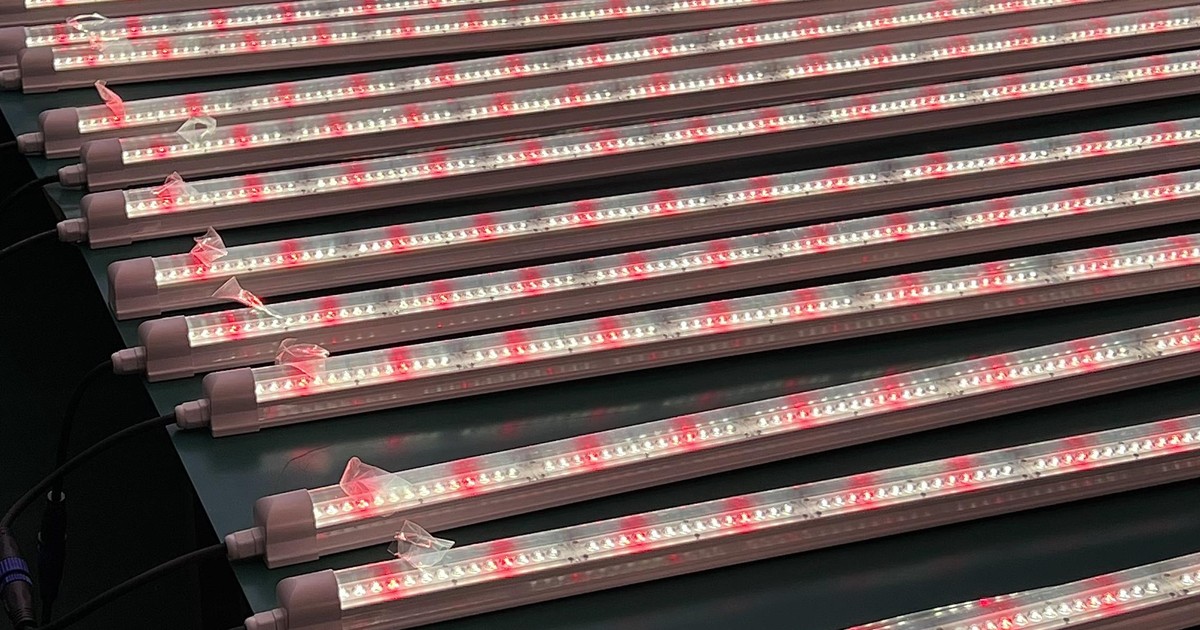
The PT8 tube measures 1,200 mm in length with a compact cross-section of just 33 x 35 mm. The daisy-chain connectors between tubes use spring-loaded pins rated for a specific maximum current. When you exceed 10 tubes in a chain, the cumulative current flowing through the first few connectors begins to approach their thermal limit, which can cause gradual connector degradation over the tube’s 35,000-hour rated lifespan.
Voltage drop is the second factor. Each tube and its interconnect cable add a small amount of resistance. Beyond 10 tubes, the voltage at the far end of the chain can drop enough to reduce light output and shift the operating point of the LED driver circuit. Koray engineers designed the system so that within the 10-tube limit, every tube receives stable voltage and delivers its rated PPFD output consistently.
Centralized Power Supply Version: Up to 20 Tubes
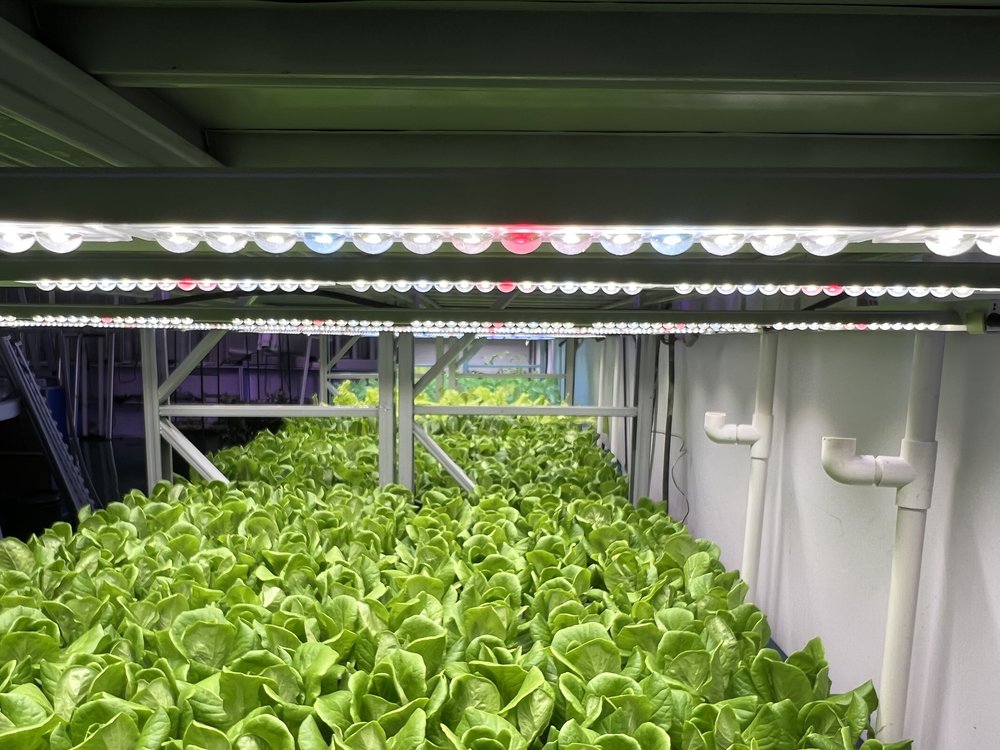
The centralized power supply variant of the PT8 uses a different wiring topology. Instead of passing full AC current through each tube’s internal connector, the centralized version routes DC power through dedicated bus cables. This reduces the current load on individual tube connectors and allows up to 20 tubes to be connected on a single power run.
For a standard 1.2 x 1.2 m growing area, Koray’s PPFD mapping data shows that 6 PT8 tubes at 0.3 m height deliver an average PPFD of 300 umol/m2/s with a total power draw of 133W per square meter. If you are running two such shelves in a daisy-chain configuration, you would use 12 tubes total — well within the 10-tube standard limit per shelf if you split them as 6+6, or within the 20-tube centralized limit if wired as a single run of 12.
Practical Wiring Recommendations
For most commercial vertical farms, the recommended approach is to wire each shelf tier as an independent daisy-chain of 6 to 10 tubes. This keeps you safely within limits and makes it easy to service or replace individual tubes without disrupting the entire tier. Use a dedicated circuit for each shelf when possible, and always leave at least 20% headroom on your circuit breaker rating.
If your facility uses the centralized power supply version, you can consolidate more tubes per power run, which reduces the number of electrical conduits needed. However, Koray still recommends grouping tubes in multiples of 6 per shelf to match the PPFD mapping data and ensure uniform light distribution across the 1.2 m growing width.
The Role of IP66 Waterproofing in Daisy-Chain Reliability
The PT8 carries an IP66 waterproof rating, meaning the tube and its connectors are fully protected against powerful water jets. This is particularly important in humid vertical farm environments where condensation forms on ceilings and shelf undersides. The waterproof connectors maintain their current-carrying capacity even in 90%+ humidity, which means your daisy-chain connections remain reliable over years of operation in challenging conditions.
Koray’s secondary optics technology also plays a role here. By shaping the light beam at the LED level rather than using external lenses, the PT8 achieves more than 40% higher PPFD compared to previous-generation tube lights. This means you may need fewer tubes per shelf to reach your target PPFD, which in turn reduces the daisy-chain count and simplifies your electrical design.
Planning Your PT8 Layout: A Quick Reference
For a 1.2 x 1.2 m shelf at 0.3 m mounting height, use 6 PT8 tubes for an average PPFD of 300 umol/m2/s. This is ideal for lettuce, herbs, and seedling production. For fruiting crops like tomatoes or peppers that require higher light intensity, you can increase to 8 tubes per shelf to push average PPFD above 400 umol/m2/s while staying within the 10-tube daisy-chain limit.
Always calculate your total power draw before wiring. Six F175 tubes at 32W each draw 192W per shelf. At 120V, that is just 1.6 amps — well within a standard 15A circuit. Even with 10 tubes per shelf, you are only at 320W or 2.7 amps, leaving plenty of headroom.
Koray PT8 Series: Built for Scalable Commercial Installation
The RX-PT8 series from Koray Lighting has been engineered from the ground up for commercial vertical farming. With a 35,000-hour lifespan, IP66 waterproofing, flicker-free operation, and a power factor above 0.9, the PT8 delivers reliable performance at scale. The thoughtful daisy-chain design — 10 tubes standard, 20 with centralized power — gives you the flexibility to configure your lighting system to match your exact growing requirements without overloading electrical connections.
Koray Lighting, established in 2009 and based in Zhongshan, Guangdong, holds over 200 patents in LED lighting technology. The PT8 series is manufactured in a facility with a 2,800 square meter testing base, ensuring every tube meets strict quality standards before shipping. All PT8 products carry CE, RoHS, and FCC certifications for global market compliance.
Frequently Asked Questions
How many PT8 tubes can I connect in a daisy-chain?
The standard RX-PT8T supports up to 10 tubes in a daisy-chain using regular AC wiring. The centralized power supply version supports up to 20 tubes on a single power run.
What happens if I exceed the 10-tube daisy-chain limit?
Exceeding the limit can cause voltage drop at the far end of the chain, reducing PPFD output and potentially degrading connector pins over time due to excessive current. It may also void the product warranty.
How many PT8 tubes do I need for a 1.2×1.2m shelf?
Koray recommends 6 PT8 tubes at 0.3m height for a 1.2×1.2m area, delivering an average PPFD of 300 umol/m2/s with 133W per square meter total power draw.
Can I daisy-chain different PT8 spectrum variants together?
Yes, F4K, F175, and V3 spectrum tubes share the same form factor and electrical connections, so they can be mixed within the same daisy-chain as long as you stay within the 10-tube total limit.







Leave A Comment