

Overview: Two Variables a Canopy Actually Sees
Growers comparing horticultural fixtures usually start with wattage, but a canopy never sees watts. It sees photons in the 400-700 nm photosynthetically active waveband at a given moment, spread over a given area, for a given number of hours per day. Two measurements describe almost the whole of that experience: the average photosynthetic photon flux density (PPFD) reaching the leaf layer, and how evenly that flux is spread across the growing area. This article works through both, using the official specification of the RX-G6000 2H as the worked example: a 660 W dual-channel quantum board whose second channel is an independent far-red 730 nm (FR730) circuit, and whose LED array is deliberately arranged with high density at the four corners and a sparse centre.
All optical, electrical and mechanical figures below are taken from the official RX-G6000 2H datasheet and the official product page at koraylights.com, and carry the manufacturer tolerance stated on the datasheet. Values are quoted with their measurement conditions, because a PPFD number without a mounting height and a test footprint is not comparable with any other PPFD number.
Photon Metrics in Plain Terms: PPF, PPFD, Efficacy and DLI
Photosynthetic photon flux (PPF) is the total quantity of photosynthetically active photons a fixture emits each second, expressed in micromoles per second (µmol/s). It is a property of the fixture alone. Photosynthetic photon flux density (PPFD) is PPF delivered onto one square metre of surface, expressed in micromoles per square metre per second (µmol/m²/s); it is a property of the fixture, the mounting height and the geometry of the room together. Photon efficacy is the ratio between emitted photons and consumed electrical energy, expressed in micromoles per joule (µmol/J); the micromole-per-joule metric is explained in the U.S. Department of Energy Solid-State Lighting reference (U.S. Department of Energy, Office of Energy Efficiency and Renewable Energy – Solid-State Lighting: LED Basics).
The daily light integral (DLI) is the total number of photosynthetically active photons delivered to one square metre in a day, in moles per square metre per day (mol/m²/day). For indoor lighting it is derived as DLI = PPFD × photoperiod in hours × 0.0036. A fixture that offers a higher PPFD can therefore meet the same DLI target with either a shorter photoperiod or a greater distance to the canopy, which is why efficacy and mounting height – not peak output alone – decide the electricity bill.
Two further distinctions matter for the rest of this article. Photosynthetically active radiation is conventionally defined as the 400-700 nm waveband, yet photons just beyond 700 nm are not inert; they interact with the pigment system, and that interaction is the reason a far-red channel can be specified separately from a white-and-red main channel. And PPFD is always an average over an area rather than a single-point reading, so a fixture can post a high peak value and still deliver a poor dose to the outer rows of a tray.
Why Far-Red 730 nm Is Treated as a Separate Channel
Far-red light at 730 nm is absorbed by the phytochrome system in a way that is distinct from red light at 660 nm. The two forms of phytochrome interconvert: 660 nm light drives the pigment towards its active form, and 730 nm light drives it back, so the ratio between red and far-red photons arriving at a leaf is itself a signal that plants read for morphology, not only for energy. A 2024 peer-reviewed study examined how different red-to-far-red ratios delivered by LED sources change plant growth and form (Frontiers in Plant Science, 2024 – red and far-red ratio regulation).
Far-red photons also interact with shorter-wavelength photons rather than acting in isolation. Work published in the PMC full-text archive of the U.S. National Library of Medicine found that adding far-red to red-and-blue supplemental lighting changed fruit quality outcomes, with the short-wave and far-red portions of the spectrum interacting across the crop cycle (PMC / U.S. National Library of Medicine – far-red added to red and blue supplemental light). The practical consequence for fixture design is that far-red is most useful as a controllable quantity. A channel that can be switched and dimmed independently of the main spectrum lets a grower choose the red-to-far-red ratio for a stage rather than accepting whatever ratio a fixed spectrum happens to contain.
A definition sentence is worth keeping in mind here: an independent far-red channel is a separately powered and separately dimmable group of 730 nm emitters whose output can be changed without changing the output of the main channel. That is a different thing from a fixed-spectrum fixture that happens to include a few far-red emitters.
Uniformity Is an Arrangement Problem Before It Is a Power Problem
Canopy uniformity is the relationship between the lowest and the highest PPFD measured across a growing area, commonly reported as a uniformity percentage or as a U1 value, the ratio of minimum to average. It is decided by geometry. Light from a compact source falls off with the square of distance, so a rectangular fixture suspended over a rectangular footprint naturally over-lights the zone directly beneath its centre and under-lights the corners; the further a measurement point sits from the nearest emitting surface, the dimmer it reads.
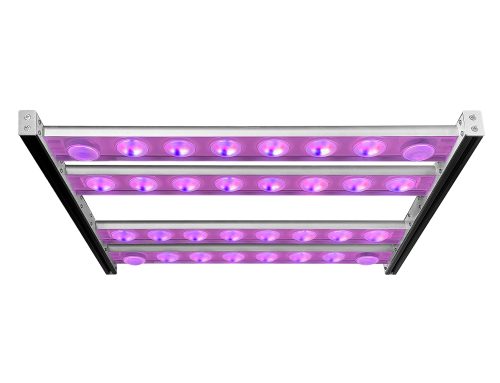
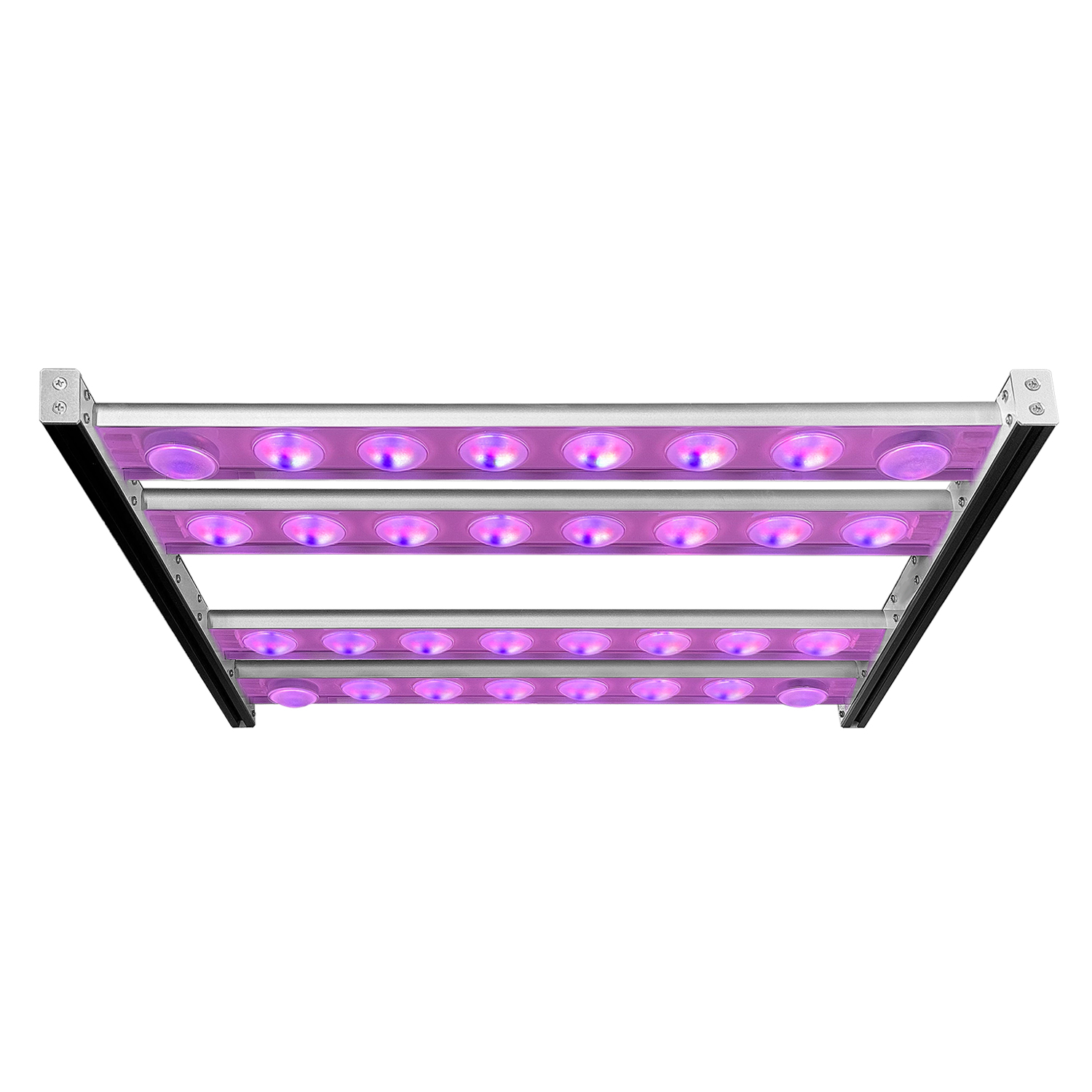
Two engineering responses exist. The first is to raise the fixture, which flattens the distribution by making the distances more nearly equal, at the cost of peak intensity at the centre. The second is to change where the emitters sit. Arranging emitters at higher density towards the perimeter and more sparsely towards the centre moves photon flux outward to exactly the places where falloff is worst. That second approach is what the official RX-G6000 2H literature describes as an optimised LED arrangement with high-density placement at the four corners and a sparse centre, intended to improve illumination uniformity.
Hanging height and uniformity are therefore linked, and both should be recorded together. Horticultural extension guidance treats fixture-to-canopy distance as a primary design variable for top lighting rather than an afterthought (Michigan State University Extension – LED lighting for plant growth).

Official RX-G6000 2H Values and the Conditions Behind Them
The values in this section come from the official RX-G6000 2H specification table and the entries that follow it, cross-checked against the official RX-G6000 2H product page and the official RX-G6000 2H datasheet (PDF). The board measures 723 × 600 × 80 mm (28.5 × 23.6 × 3.1 in) and runs on a test input range of AC 120 V to 277 V.
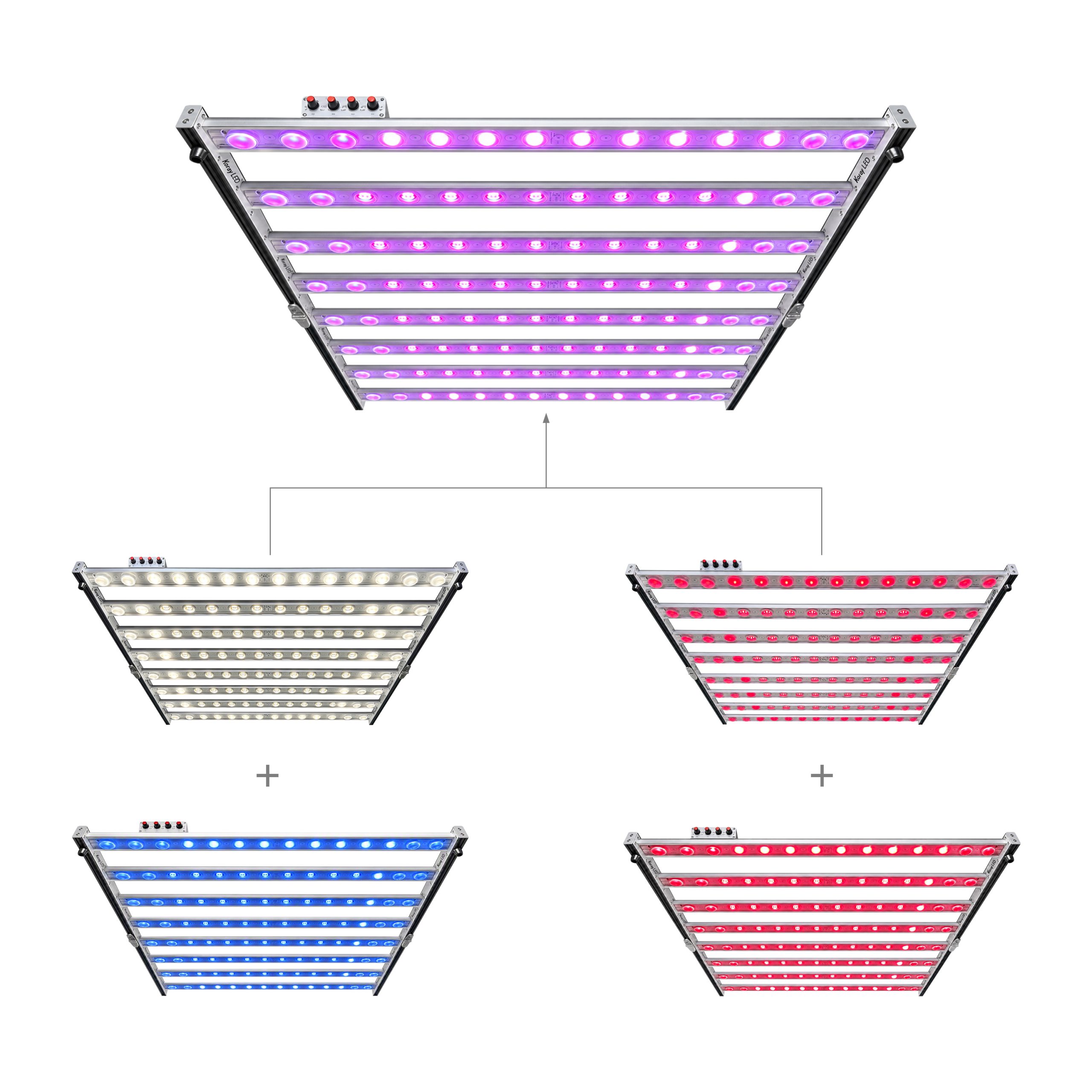
The fixture carries two spectral channels and one combined mode. CH1 WR is a white-plus-red mix built from warm white 3000 K, blue 5000 K and deep red 660 nm emitters, and is quoted at up to 2.7 µmol/J with Samsung LEDs. CH2 FR is the independent far-red channel, built on 730 nm emitters. F100 is the mode in which both channels operate together. PPFD values are quoted at 16 in (0.51 m), measured in a 5 ft × 5 ft test tent, and all light and electrical figures carry a tolerance of ±10%; the datasheet states that its data is for reference only, which is the reference discipline this article follows.
Mechanically and environmentally, the fixture is rated for an operating temperature of −30 °C to 40 °C, has a stated lifespan of 50,000 hours at an ambient temperature (Ta) of 25 °C, carries CE, RoHS and FCC marks, and is covered by a three-year warranty. Dimming is handled by a supplied DM25 dimmer; the datasheet notes that the dimmer is not waterproof and that its switch has an O side for a fixture used as a sub-lamp and an I side for the fixture that carries the dimming signal. Multi-fixture connection dimming is compatible with the Horti Guru control system, which the datasheet marks as requiring additional purchase.
Channel Comparison Table: How CH1, CH2 and F100 Differ
The table below sets out the three operating modes side by side, with the datasheet conditions kept in the same row as the values so that no figure is read without them.
| Mode | Spectral content | PPF (µmol/s) | PPFD at 16 in / 0.51 m (µmol/m²/s) | Power (W) | Datasheet comment |
|---|---|---|---|---|---|
| CH1 WR | Warm white 3000 K + blue 5000 K + deep red 660 nm | 1640 | 1005 | 610 | Vegetative growth |
| CH2 FR | Far red 730 nm | 16 | 8 | 50 | Flowering starts |
| F100 (CH1 + CH2) | Both channels together | 1765 | 1013 | 660 | Flowering scion |
Three observations follow directly from the numbers. First, the main channel carries almost all of the photon flux: 1640 of 1765 µmol/s, about 93% of the fixture’s total PPF. Second, the far-red channel is a modifier rather than a light source in its own right – at 16 µmol/s and 8 µmol/m²/s at 16 in it sits far below any standalone growth requirement, which is exactly what a spectral-signal channel should do. Third, the three modes sum consistently: 610 W plus 50 W gives the 660 W combined figure, and 1640 µmol/s plus 16 µmol/s gives 1765 µmol/s. The CH1 efficiency of up to 2.7 µmol/J is consistent with 1640 µmol/s divided by 610 W. All values carry the datasheet tolerance of ±10%.
Mounting Height, Coverage and Average PPFD in One View
Coverage and uniformity on this fixture are published with their own conditions, and the conditions differ between rows, so the table below keeps each row self-contained rather than presenting a single headline figure.
| Mounting height to canopy | Published footprint | Uniformity change vs previous generation | Average PPFD change vs previous generation | Stage use |
|---|---|---|---|---|
| 40 in / 1.02 m | 6 ft × 6 ft tent | Not published for this height | Not published for this height | Vegetative growth |
| 20 in / 0.51 m | 4 ft × 4 ft tent | +18% (measured at 4 ft × 4 ft, 20 in) | +4% (previous generation averaged 697 µmol/m²/s at U1 35%) | Flowering stage |
| 18 in / 0.46 m | 5 ft × 5 ft tent (uniformity test) | +36% (measured at 5 ft × 5 ft, 18 in) | +3% (previous generation averaged 562 µmol/m²/s at U1 14%) | Uniformity test condition |
Read the table in two directions. Moving from a 40 in vegetative setting down to a 20 in flowering setting buys intensity and concentrates the fixture’s output into a 4 ft × 4 ft area. The uniformity measurements published by the manufacturer were taken at a different pair of conditions – 5 ft × 5 ft at 18 in, and 4 ft × 4 ft at 20 in – and the gains are reported only against those test geometries. The 5 ft × 5 ft test compares the board with a previous generation fixture that averaged 562 µmol/m²/s at a U1 of 14%, and reports a 36% uniformity improvement with a 3% increase in average PPFD. The 4 ft × 4 ft test compares against a previous generation fixture averaging 697 µmol/m²/s at a U1 of 35%, and reports an 18% uniformity improvement with a 4% increase in average PPFD. The same literature also carries third-party reference points: a UR-series fixture averaged 588 µmol/m²/s at U1 19% in the 5 ft × 5 ft test, and a U-series fixture averaged 784 µmol/m²/s at U1 41% in the 4 ft × 4 ft test.
The reason the percentage gains in uniformity are larger than the gains in average PPFD is structural: the corner-dense arrangement redistributes photons from the over-lit centre towards the under-lit perimeter. Average output barely moves; the distribution becomes markedly flatter.
Choosing a Mounting Point and a Channel Strategy
For a room planned around this fixture, the published conditions translate into a small number of decisions. A vegetative room can use the 40 in (1.02 m) plane over a 6 ft × 6 ft footprint with CH1 alone at 610 W. A flowering room can use the 20 in (0.51 m) plane over a 4 ft × 4 ft footprint with F100 at 660 W, keeping the far-red channel available as a stage tool rather than running it continuously from transplant. Where the flattest possible distribution across a 5 ft × 5 ft area is the priority, the published 18 in (0.46 m) uniformity test condition is the closest published reference point for that geometry.
Channel strategy follows the same logic. Because CH2 is independently controlled, the red-to-far-red ratio can be changed without touching the main channel: CH1 alone for vegetative development, CH1 plus CH2 (F100) when flowering begins, and the far-red portion modulated afterwards to manage morphology. Because the far-red channel contributes only 16 µmol/s, it should be treated as a spectral control input rather than a photon source, and the main channel remains responsible for meeting the PPFD and DLI targets.
Two installation details come from the official datasheet and should be respected. The supplied DM25 dimmer is not waterproof and must be sited accordingly; when several fixtures are linked for multi-light dimming, the sub-lamp connects on the O side of the dimmer switch and the fixture carrying the signal on the I side. The Horti Guru control system that the datasheet mentions for app-based multi-light control is listed as requiring additional purchase.

Conclusion
Fixture selection for an indoor room reduces to two canopy-level numbers – average PPFD and the evenness with which it is spread – and both are functions of mounting height and emitter arrangement as much as of wattage. The RX-G6000 2H addresses the second number structurally, using an arrangement that is dense at the four corners and sparse at the centre, and reports its uniformity gains against explicit test geometries: a 36% uniformity improvement and a 3% average PPFD increase at 5 ft × 5 ft and 18 in, and an 18% uniformity improvement with a 4% average PPFD increase at 4 ft × 4 ft and 20 in. Its independent FR730 channel adds a spectral control dimension that a fixed-spectrum fixture cannot offer, at 16 µmol/s of far-red output alongside 1640 µmol/s in the main channel. Read together with the published coverage planes – 6 ft × 6 ft at 40 in for vegetative growth and 4 ft × 4 ft at 20 in for flowering – those figures are enough to plan a room rather than to guess at one.
FAQ
What is the difference between CH1, CH2 and F100 on the RX-G6000 2H?
CH1 WR is the main channel, a mix of warm white 3000 K, blue 5000 K and deep red 660 nm, quoted at up to 2.7 µmol/J, 1640 µmol/s and 610 W. CH2 FR is the independent far-red 730 nm channel at 16 µmol/s and 50 W. F100 is both channels operating together, at 1765 µmol/s and 660 W. All PPFD values are quoted at 16 in (0.51 m) and carry a ±10% tolerance.
How much does the RX-G6000 2H improve light uniformity?
The official measurements are conditional. At 5 ft × 5 ft and 18 in (0.46 m) the uniformity improvement is 36% with a 3% increase in average PPFD; at 4 ft × 4 ft and 20 in (0.51 m) it is 18% with a 4% increase. The gain comes from a corner-dense, centre-sparse LED arrangement rather than from higher total output.
What mounting height should be used for vegetative growth and flowering?
The published footprint for vegetative growth is 6 ft × 6 ft at 40 in (1.02 m) to the canopy, and for flowering it is 4 ft × 4 ft at 20 in (0.51 m). The uniformity tests that accompany the datasheet were run at 5 ft × 5 ft and 18 in (0.46 m), so height, footprint and uniformity should always be recorded together.
What is the photon efficacy and rated lifespan of the RX-G6000 2H?
CH1 efficiency is quoted at up to 2.7 µmol/J with Samsung LEDs, which is consistent with 1640 µmol/s at 610 W. The rated lifespan is 50,000 hours at an ambient temperature of 25 °C, with an operating range of −30 °C to 40 °C and a three-year warranty.
Can the RX-G6000 2H far-red channel be used on its own?
CH2 can be operated and dimmed independently, but at 16 µmol/s and 8 µmol/m²/s at 16 in it is a spectral control channel rather than a photon source. The main CH1 channel remains responsible for meeting PPFD and daily light integral targets, while CH2 adjusts the red-to-far-red balance.
Why Choose Koray
Zhongshan Koray Opto-Electronic Co., Ltd. manufactures the RX-G6000 2H and the wider G-series of horticultural LED fixtures, with 17 years of experience in LED grow-light manufacturing and 300+ domestic and foreign patents. Every figure in this article is traceable to the official RX-G6000 2H datasheet or the official product page on koraylights.com.




Leave A Comment