
What Grow Light Setup Works Best for a Succulent Shelf?
Building a dedicated succulent shelf is one of the most rewarding projects for indoor plant enthusiasts. A well-designed shelf setup lets you grow dozens of specimens in a compact footprint, maintain precise control over light and watering, and create a stunning display piece in your home. The single most important component of this setup is the grow light system, as it directly determines whether your succulents will maintain their compact form and vivid colors or gradually deteriorate into stretched, green shadows of their former selves.
This comprehensive guide covers everything you need to know about designing an effective grow light system for a multi-tier succulent shelf, from choosing the right LED fixtures to calculating spacing, hanging height, and electrical requirements.
What Type of LED Grow Light Is Best for a Succulent Shelf?
For a standard 4-tier metal wire shelving unit (typically 120cm long x 40-60cm deep x 150cm tall), the most effective lighting solution is LED bar-style fixtures mounted horizontally under each shelf. Bar lights provide uniform linear coverage across the full width of the shelf, eliminate the hotspots common with point-source bulbs, and fit within the tight vertical clearance between shelves.
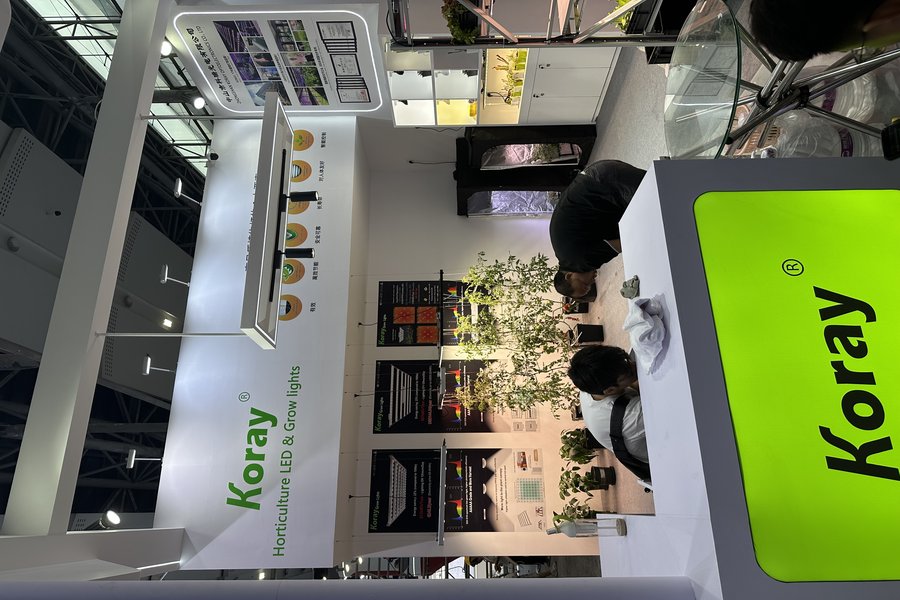
The Koray GE35 series LED horticultural bars are specifically engineered for this type of installation. The GE35-120T-K6 model is the ideal choice for succulents. At 1200mm length and 80W power consumption, it delivers an impressive 760 umol/m2/s PPFD at just 0.2 meters distance, thanks to its 45-degree focused lens and the K6 spectrum optimized for flowering plants, succulents, and carnivorous plants. The IP64 waterproof rating protects against accidental water splashes during plant care.
For budget-conscious growers or smaller setups, the Koray RX-PAR38-60D is another excellent option. This screw-in PAR38 spotlight uses an E27 base and can be mounted in simple socket fixtures above each shelf. Its 60-degree beam angle provides good coverage for a 40cm-wide shelf, and the S91 warm full-spectrum output renders succulent colors beautifully while delivering approximately 500 umol/m2/s at 0.3 meters.
How Many LED Bars Do I Need Per Shelf?
For a standard 120cm-long shelf that is 40 to 50cm deep, one GE35-120T-K6 bar centered under the shelf provides excellent coverage. The 1200mm length of the bar spans nearly the entire shelf length, and the 45-degree lens distributes light evenly across the 40-50cm depth. If your shelf is 60cm deep or you want more uniform edge-to-edge coverage, consider installing two GE35-90T-F175 bars (900mm each) running front-to-back instead.
For a 4-tier shelf, this means you need 4 bars total, one per shelf. The total power consumption would be 4 x 80W = 320W for the GE35-120T-K6 setup, or 4 x 40W = 160W for the GE35-90T-F175 setup. Both options deliver sufficient PPFD for succulent cultivation, but the K6 spectrum model will produce more vivid coloration in your plants.
If you are using PAR38 spotlights instead of bars, plan for 2 to 3 fixtures per shelf, spaced evenly along the shelf length. Each RX-PAR38-60D covers roughly a 30cm diameter circle at 0.3m distance, so overlapping coverage is necessary to avoid dark gaps between fixtures.
What Is the Ideal Shelf Spacing for Succulents?
Shelf spacing (the vertical distance between shelves) determines how much room you have for both the plants and the light fixtures. For most succulent collections, a vertical clearance of 30 to 40 centimeters between shelves is ideal. This provides enough headroom for plants in 10-15cm pots while leaving 15-20cm for the LED bar and its light distribution pattern.
The Koray GE35-120T-K6 has a profile of just 38x40mm, meaning it takes up minimal vertical space. Mounted with simple aluminum channel brackets under the shelf, the total fixture height adds only about 5cm. This leaves 25-35cm of actual plant space, which accommodates most succulent varieties including taller types like columnar cacti and Aloe species.
If you grow a mix of compact rosettes and taller specimens, consider making the bottom shelf height adjustable or leaving the top shelf open without a light fixture for taller plants that can tolerate slightly lower light levels.
How Do I Calculate the Right Light Intensity for Each Shelf?
The target PPFD for most succulents is 300 to 600 umol/m2/s, with a DLI of 10 to 20 mol/m2/day. To verify your setup meets these targets, you can use the PPFD values provided by Koray Lighting in their product specifications and adjust the hanging height accordingly.
For the GE35-120T-K6 at 80W, the PPFD at 0.2 meters is 760 umol/m2/s. If your plants are sitting 0.2 meters below the shelf above (where the light is mounted), they will receive this intensity. Running the light for 14 hours per day at this PPFD gives a DLI of approximately 38.3 mol/m2/day, which is higher than most succulents need. You can reduce the photoperiod to 8-10 hours or raise the light to 0.3 meters where PPFD drops to approximately 530 umol/m2/s, giving a more moderate DLI of about 18.9 mol/m2/day at 14 hours.
A PAR meter is a worthwhile investment for serious succulent growers. It allows you to measure the actual PPFD at various points across your shelf, verify uniformity, and fine-tune the height and dimming settings for each species.
What About Heat Management on a Succulent Shelf?
One of the biggest advantages of LED grow lights over traditional fluorescent or HPS fixtures is dramatically lower heat output. The Koray GE35 series converts most of its energy into light rather than heat, and the aluminum housing acts as a heatsink to efficiently dissipate the small amount of waste heat that is generated. At 80W per bar, the heat output is comparable to a single incandescent light bulb, which is easily managed by the natural air circulation in an open shelving unit.
That said, in warm climates or during summer months, you may want to add a small USB-powered oscillating fan to the shelf to improve air movement. This helps prevent heat buildup around the light fixtures, provides fresh CO2 to the plants, and reduces the risk of fungal issues from stagnant humid air. Succulents prefer good air circulation, and a gentle breeze also strengthens their cell walls.
Should I Use a Timer or Smart Controller?
A timer is essential for any succulent shelf setup. Consistency in photoperiod is critical for maintaining healthy growth patterns. A simple plug-in digital timer programmed for 12 to 14 hours per day is the most cost-effective solution. Set it and forget it.
For more advanced control, the Koray G80 and G50 series are compatible with the Horti Guru smart controller app, which allows you to create custom light recipes, simulate sunrise and sunset transitions, and adjust intensity based on the season. While the GE35 bars do not have built-in smart connectivity, they support 0-10V dimming, so you can pair them with an external controller for automated intensity adjustments throughout the day.
For the best results with a succulent shelf, start with a simple and reliable setup: four Koray GE35-120T-K6 bars on a standard 4-tier shelf, a digital timer set to 14 hours daily, and an ambient temperature between 18 and 28 degrees Celsius. Water your succulents thoroughly but infrequently, allowing the soil to dry completely between waterings. Within weeks, you will see your collection develop the compact, colorful growth that makes succulents so rewarding to grow.

Leave A Comment