
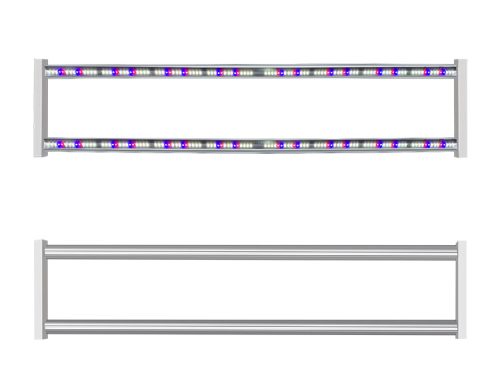
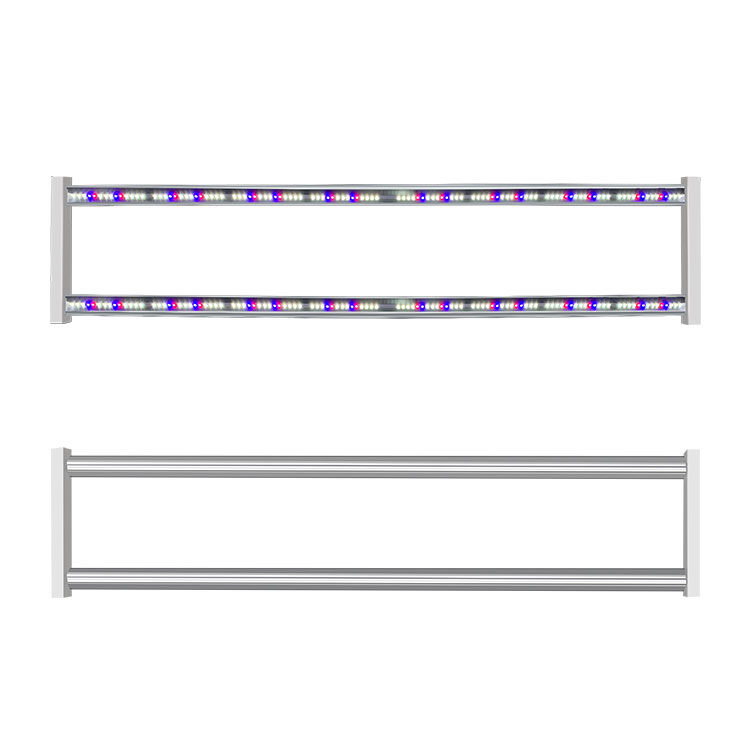
A plant factory grow tube is a linear LED fixture that is mounted inside a closed, multi-tier growing room rather than over a greenhouse canopy. The RX-PT5 is listed on its official product page (https://koraylights.com/product/pt5-economic-plant-factory-growth-plant-light/) as an economic plant-factory growth light, and three variants are published under it: RX-PT5-900-90D-6K7R1, RX-PT5-900-90D-F3 and RX-PT5-900-90D-G1. All three share a 900 x 22 x 25 mm tube, a net weight of 180 g, an AC 100-240 V input, a rated power of 18 W and a 25,000-hour lifetime note at Ta 25 C. The published photon flux density of the highest-output variant is 151 / 94 / 47 umol/m2/s at 0.2 / 0.3 / 0.5 m, at a recommended throw of 0.2 to 0.5 m for tissue cultures and nurseries. The sections below read those figures as the optics-and-throw calibers of a tissue-culture tube, keep the published 70-degree beam angle separate from the 90D lens designation, and mark the items the official page does not state.
What a plant-factory grow tube is
A plant-factory grow tube is a slim linear emitter sized for the low headroom between the shelves of a closed production room, where the distance from the fixture to the leaf surface is measured in tens of centimetres rather than in metres. Extension guidance on light and crop growth, such as the LED lighting material published by Michigan State University Extension (https://www.canr.msu.edu/resources/led-lighting-for-greenhouse-crops), treats the daily light integral, the total number of photons a square metre receives in a day, as the quantity that governs growth, and it notes that the same daily total can be reached with a high intensity over a short day or a lower intensity over a longer day. That is why a tube used for in-vitro micropropagation and seedling hardening is usually specified as a low-to-moderate photon flux density held over a long photoperiod: at a 16-hour photoperiod, the 151 umol/m2/s published at 0.2 m corresponds by arithmetic to about 8.7 mol/m2/d (151 x 16 x 0.0036), which is a conversion of the published reading and not a figure printed on the official page. Guidance from Ohio State University Extension (https://ohioline.osu.edu/factsheet/hyg-1424) is a widely used reference for how light, temperature and day length interact in controlled environments, and it makes the same point from the crop side: the useful quantity is the photon delivery over the day, not a single instantaneous number.
How the 90D condenser lens narrows the throw
A condenser lens is a secondary optic that collects the light leaving the diodes and re-emits it into a narrower cone, so a larger share of the photons lands inside the beam and less is spilled sideways into the aisle or onto a neighbouring shelf. Narrowing the cone is what makes a short throw useful: the fixture can sit a few centimetres from the culture vessels and still deliver the intended density across the tray, instead of needing extra height to blend the output. On the RX-PT5 family this optic is what the 90D in the model code names. The official page states, with reference to the lens options of the family, that the 90D option is recommended for tissue-culture seedlings while the 60D option is used for vegetative growth of leafy vegetables, and that the 90D version raises photon flux density by 50 percent against T5/T8 tubes and saves about 50 percent of the energy of an ordinary T5 tube.
One point of care belongs here. The same official page publishes the beam angle of the product as 70 degrees, and separately uses the 90D and 60D designations for the lens options. Those two are quoted verbatim from the page and are not interchangeable: the published beam angle is the photometric spread of the fixture, while 90D and 60D are the lens designations used in the model code and in the official usage note. A specifier should carry both strings into the specification as published rather than convert one into the other.
Reading the published PPFD matrix across the three variants
- Photon flux density (PPFD) is the intensity of light reaching the canopy, and the RX-PT5 is published at 151 / 94 / 47 umol/m2/s at 0.2 / 0.3 / 0.5 m in the 6K7R1 version, 131 / 81 / 39 in the F3 version and 83 / 56 / 27 in the G1 version.
- Photon flux (PPF) is the total output of the tube, and the published values are 40.8 umol/s for the 6K7R1 version, 35 umol/s for the F3 version and 25 umol/s for the G1 version.
- PAR radiant power is the photosynthetically active radiant flux of the tube, and the published values are 8943 mW, 7292 mW and 5206 mW for the 6K7R1, F3 and G1 versions respectively.
- Illuminance is the photometric reading taken at the same distances, and the published values are 10006 / 6224 / 3115 lx for the 6K7R1 version, 8512 / 5194 / 2513 lx for the F3 version and 2350 / 1495 / 704 lx for the G1 version.
- Colour rendering index and correlated colour temperature are published as Ra89 at 5700 K for the 6K7R1 version, Ra90 at 3000 K for the F3 version and Ra12 at 9000 K for the G1 version.
- Measured power consumption at 230 V is published as 17 W, 18 W and 19 W for the 6K7R1, F3 and G1 versions, against a rated power of 18 W with an AC 100-240 V input.
- Ingress protection is the resistance of the enclosure to dust and water, and the RX-PT5 is published as IP64, with the official note that water splashing against the enclosure has no harmful effect.
- Lifetime is the rated operating life of the tube, and the published figure is 25,000 hours at Ta 25 C, with a surface temperature rise quoted as Tc 23 K.
- Several quantities are not listed on the official page: daily light integral, quantum efficiency in umol/J, dimming method, warranty term, flicker depth as a number, and the brand and count of the LEDs are not published for this model, so none of them should be assumed from a related tube.
Dimension-by-dimension reference
| Dimension | RX-PT5-900-90D-6K7R1 | RX-PT5-900-90D-F3 | RX-PT5-900-90D-G1 |
| CRI and CCT | Ra89 at 5700 K | Ra90 at 3000 K | Ra12 at 9000 K |
| Measured power at 230 V | 17 W | 18 W | 19 W |
| PPFD at 0.2 m | 151 umol/m2/s | 131 umol/m2/s | 83 umol/m2/s |
| PPFD at 0.3 m | 94 umol/m2/s | 81 umol/m2/s | 56 umol/m2/s |
| PPFD at 0.5 m | 47 umol/m2/s | 39 umol/m2/s | 27 umol/m2/s |
| Illuminance at 0.2 / 0.3 / 0.5 m | 10006 / 6224 / 3115 lx | 8512 / 5194 / 2513 lx | 2350 / 1495 / 704 lx |
| Lumen output | 2695 lm | 2242 lm | 729 lm |
| Photon flux (PPF) | 40.8 umol/s | 35 umol/s | 25 umol/s |
| PAR radiant power | 8943 mW | 7292 mW | 5206 mW |
| Tube dimensions and weight | 900 x 22 x 25 mm, 180 g | 900 x 22 x 25 mm, 180 g | 900 x 22 x 25 mm, 180 g |
| Rated power and input | 18 W, AC 100-240 V | 18 W, AC 100-240 V | 18 W, AC 100-240 V |
| Beam angle | 70 degrees | 70 degrees | 70 degrees |
| Recommended throw | 0.2-0.5 m tissue culture, 0.1-0.3 m production | 0.2-0.5 m tissue culture, 0.1-0.3 m production | 0.2-0.5 m tissue culture, 0.1-0.3 m production |
| Ingress protection | IP64 | IP64 | IP64 |
| Power factor | above 0.9 | above 0.9 | above 0.9 |
| Lifetime | 25,000 hours at Ta 25 C | 25,000 hours at Ta 25 C | 25,000 hours at Ta 25 C |
| Operating temperature | -30 C to 40 C | -30 C to 40 C | -30 C to 40 C |
| Data tolerance | plus or minus 10 percent | plus or minus 10 percent | plus or minus 10 percent |
Where the 0.2-0.5 m tissue-culture band fits
The published throw band of 0.2 to 0.5 m points at multi-tier tissue-culture and nursery rooms, where vessels or plugs sit close under the shelf above. The same models also carry a shorter 0.1 to 0.3 m figure for production use, so the choice is really between the two official bands rather than an open range. Within the three variants the selection is made on the delivered spectrum code and the colour rendering that comes with it: the 6K7R1 version is the highest-output and the most neutral of the three, the F3 version trades output for a warm 3000 K rendering, and the G1 version is a lower-output 9000 K option. A 17-year background in horticultural lighting sits behind this economic class of tube, which is aimed at rooms that need many identical fixtures rather than a few large ones. The published IP64 rating and the no-flicker note are the two practical points for a closed room, where splashes during irrigation are routine and where flicker can disturb camera-based inspection. Where a room has more headroom and fewer tiers, a larger toplighting fixture is usually the more direct answer; where the shelves are fixed at short spacing, a slim tube is the one that fits.
What to confirm in writing before specifying
- Confirm the dimming or control interface, because the official page does not publish a dimming method for this model.
- Confirm the warranty term, which is not stated on the official page.
- Confirm the delivered variant code, because the three published versions differ in output, colour rendering and colour temperature.
- Confirm the LED brand and count if the tender requires them, as neither is published for this model.
- Confirm the intended throw band and the photoperiod, since the official PPFD readings are quoted at 0.2 m, 0.3 m and 0.5 m and the daily total follows from the hours chosen.
- Confirm the circuit loading for the number of tubes planned, using the published 17 / 18 / 19 W figures at 230 V and the rated 18 W plate value.
Frequently asked questions
What is the PPFD of the RX-PT5?
The published photon flux density is 151 / 94 / 47 umol/m2/s at 0.2 / 0.3 / 0.5 m for the 6K7R1 version, 131 / 81 / 39 umol/m2/s at the same three heights for the F3 version and 83 / 56 / 27 umol/m2/s for the G1 version, all at a recommended throw of 0.2 to 0.5 m for tissue cultures.
What does the 90D in the RX-PT5 model code mean?
It is the condenser lens designation used in the model code and in the official usage note, which states that the 90D option is recommended for tissue-culture seedlings and the 60D option for vegetative growth of leafy vegetables. The beam angle is published separately as 70 degrees and should be quoted as published rather than converted.
What is the lifetime of the RX-PT5?
The published lifetime is 25,000 hours at Ta 25 C, with a surface temperature rise quoted as Tc 23 K and a tolerance of plus or minus 10 percent on the electrical and photometric data.
Is the RX-PT5 water-resistant?
Yes. The published ingress protection is IP64, with the official note that water splashing against the enclosure has no harmful effect, and the fixture is published as flicker-free with a power factor above 0.9 and CE, RoHS and FCC certification.
Which figures are not published for the RX-PT5?
The official page does not publish the daily light integral, the quantum efficiency in umol/J, the dimming method, the warranty term, the flicker depth as a number, or the LED brand and count, so all of these should be requested from the supplier before a specification is closed.




Leave A Comment