
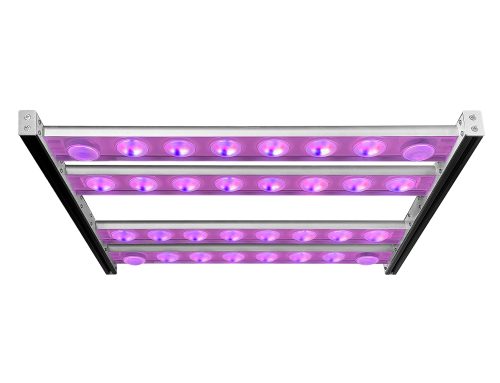
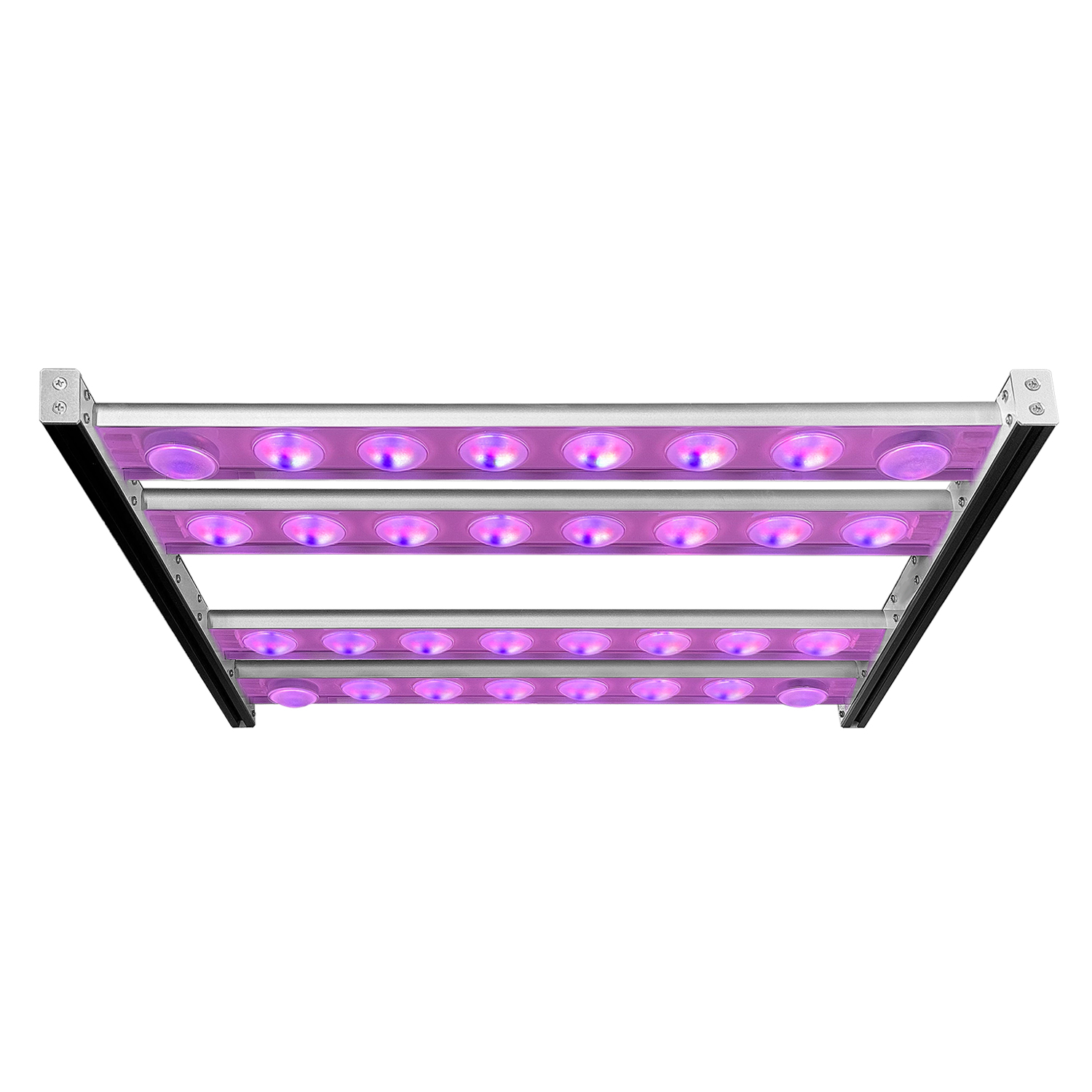
A folding bar grow light is a multi-bar LED fixture whose bars fold together for transport and storage and open into a wide, flat plane over the canopy. The RX-G120L is published on its official product page (https://koraylights.com/product/horticultural-led-folding-led-grow-light-2/) as a 630 W folding bar with a photon efficiency of up to 2.6 umol/J and a photon flux of 1630 umol/s in the photosynthetically active range. The same official page gives 640 W at AC 120 V against 630 W at both AC 230 V and AC 277 V, up to 5904 LEDs, a stated LED total power of 3000 W with the array described as derated for reliability, a peak photon flux density above 1000 umol/m2/s at 0.2 m, a 50,000-hour lifetime, a 3-year warranty and CE, RoHS and FCC certification. The beam angle, the ingress protection rating and the colour rendering figures are not published. The sections below read those numbers as the efficiency, derating and coverage calibers of a folding bar.
What a folding bar grow light is
A folding bar grow light is a high-output fixture built as several linear bars on a hinged frame, so it can be lowered into a tent or a small room through a doorway and then unfolded to span the canopy. Two photometric terms decide most of the specification. Photon flux, quoted in umol/s, is the total quantity of photosynthetically active photons the fixture emits each second, while photon flux density, quoted in umol/m2/s, is the share of that flux arriving at a given surface. University extension material on LED lighting for controlled environments, such as the guidance published by Michigan State University Extension (https://www.canr.msu.edu/resources/led-lighting-for-greenhouse-crops), frames the daily light integral, the total photons delivered in a day, as the target quantity, which means a short-throw fixture with a very high instantaneous density has to be read together with the photoperiod it is run at. At the published peak of just over 1000 umol/m2/s at 0.2 m, a 12-hour photoperiod corresponds by arithmetic to about 43 mol/m2/d (1000 x 12 x 0.0036); that is a conversion of the published reading and not a figure printed on the official page. Guidance from Ohio State University Extension (https://ohioline.osu.edu/factsheet/hyg-1424) covers the same interaction between light, day length and crop response in controlled environments.
Why photon efficiency is read as umol/J
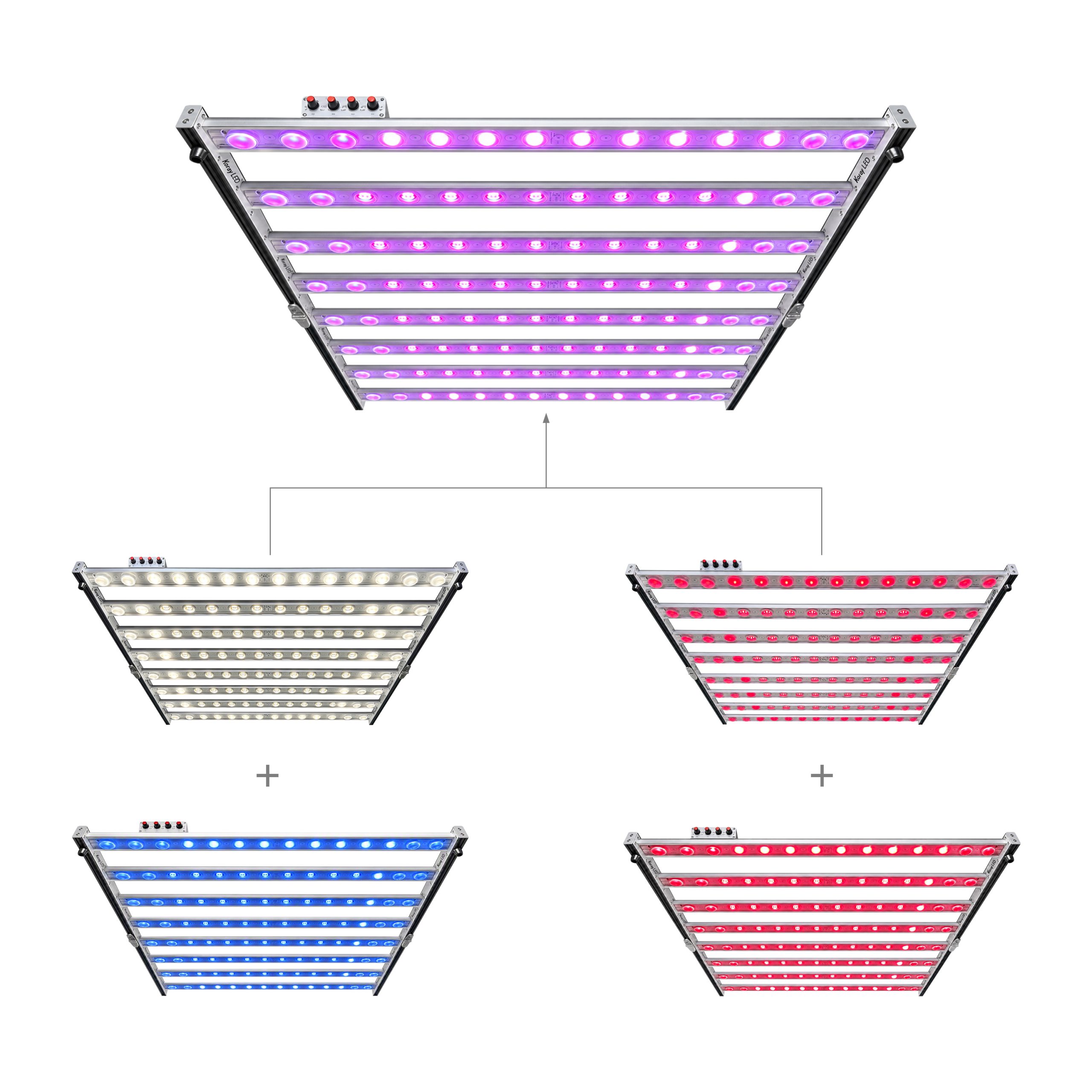
Photon efficiency is the number of photosynthetically active photons produced per joule of electrical energy drawn, so it describes how much of the input energy reaches the crop as useful light rather than as heat or as photons outside the photosynthetic waveband. A published figure of up to 2.6 umol/J places the RX-G120L in the high-efficiency class, and the same page quotes 1630 umol/s of photon flux as the total output at that efficiency. The official page also describes the emitter build as a full spectrum combining Samsung white LEDs with Hyper Red 660 nm horticulture LEDs, and notes in a separate entry that the white emitters may be Samsung or Seoul LED and that the Hyper Red source is a German-brand horticulture LED. The official positioning statement adds two conditions that matter more than the efficiency figure itself: the fixture is aimed at advanced cultivators running a high photon flux density with carbon dioxide enrichment, and it is published as not intended for beginner growers. In a room without enrichment, the same fixture is usually run at a lower dimming level or higher above the canopy, which reduces the advantage of the published peak efficiency.
The derating headroom behind 5904 LEDs
Derating is the practice of running LEDs below their rated current so that the junction temperature stays lower, which slows the decline in light output over the life of the fixture and keeps the emitters further from their thermal limits. It is one of the few levers a fixture designer has for lifetime that does not depend on the driver. The official page for the RX-G120L publishes two numbers side by side: up to 5904 LEDs, which it describes as roughly three times the count of an ordinary fixture, and a stated LED total power of 3000 W that the fixture is described as using at a reduced level for reliability. Those two published figures are not a like-for-like comparison and should not be divided into each other to produce an efficiency claim, because one is a diode-level rating and the other is a mains-level power draw; the useful reading is simply that a large diode array is deliberately operated well inside its rating. The published lifetime of 50,000 hours and the 3-year warranty are the two figures that a specifier can hold the supplier to on this point.
Coverage with and without reflective walls
The official page quotes two coverage sets, and the difference between them is the single most useful planning fact in the document. With a reflective tent walled in reflective material, the published footprint is 6 ft x 6 ft for vegetative growth and 5 ft x 5 ft for flowering. In a darkroom with no reflective surfaces, the published footprint falls to 5 ft x 5 ft for vegetative growth and 4 ft x 4 ft for flowering. Reflective walls return part of the emitted flux and part of the light reflected from the canopy to the crop, so the same fixture fills a larger area when the room has reflective surfaces than when it does not; the darkroom figures are the conservative reading for an open room, a walk-in chamber with matte walls, or any layout where the fixture stands off the wall. Neither coverage set should be stretched by adding fixtures without re-planning the overlap, because two fixtures at the published footprint edges return a lower density than one fixture at the centre.
Dimension-by-dimension reference
| Dimension | RX-G120L (published) | What it decides |
| Mains draw at AC 120 V | 640 W | The highest of the three published mains tiers |
| Mains draw at AC 230 V | 630 W | The common European and Asian mains tier |
| Mains draw at AC 277 V | 630 W | The North American high-line tier |
| Photon efficiency | up to 2.6 umol/J | Photons delivered per joule drawn, not per watt of fixture |
| Photon flux (PAR) | 1630 umol/s | Total photosynthetically active output |
| Peak PPFD at 0.2 m | above 1000 umol/m2/s | Short-throw intensity over a tent footprint |
| LED count | up to 5904 pcs | Published as roughly three times an ordinary fixture |
| Stated LED total power | 3000 W, described as derated for reliability | Diode-level rating, not a mains figure |
| Spectrum build | full spectrum, Samsung white LED plus Hyper Red 660 nm | One fixture for vegetative and flowering stages |
| Coverage, reflective tent, vegetative | 6 ft x 6 ft | Footprint when walls return light |
| Coverage, reflective tent, flowering | 5 ft x 5 ft | Footprint at flowering |
| Coverage, darkroom, vegetative | 5 ft x 5 ft | Conservative no-reflection footprint |
| Coverage, darkroom, flowering | 4 ft x 4 ft | The most conservative footprint published |
| Dimming and control | Multi-Lights Connection Dimming, Horti Guru APP compatible | Group control across several fixtures |
| Lifetime | 50,000 hours | Rated operating life |
| Warranty | 3 years | Commercial cover period |
| Certification | CE, RoHS, FCC | Market access for the published tiers |
| Ingress protection | not published on the official page | Confirm before a washdown or humid installation |
| Beam angle | not published on the official page | Confirm before fixing fixture spacing |
| CRI and CCT | not published on the official page | Confirm if visual inspection of the crop matters |
| Net weight and dimensions | not published on the official page | Confirm against truss or tent-frame loading |
Where a 630 W folding bar fits
A 630 W folding bar with a published peak above 1000 umol/m2/s at 0.2 m belongs in a high-intensity room where the ceiling is tent height rather than building height, and where carbon dioxide is controlled, which is the official use case for this model. The folding frame is the practical part of that: bars that fold let a fixture of this output pass through a doorway and then open to its full span, so it suits a tent or a converted room rather than a purpose-built walk-in chamber with fixed overhead trusses. The published control path, multi-lights connection dimming with app compatibility, is what makes a group of these fixtures usable as a single canopy layer instead of a row of individually set lamps. A 17-year background in horticultural lighting sits behind this class of fixture. Where a room has no enrichment and the plan is a moderate density over a large floor, a lower-output bar run at a longer photoperiod is usually the simpler answer; where the target is a very high density inside a walled tent, a folding bar of this class is the more direct one. Because the official page publishes no ingress protection rating, a fixture in this class should not be specified for a washdown room without confirming that rating with the supplier first.
What to confirm in writing before specifying
- Confirm the ingress protection rating, because no IP figure is published on the official page.
- Confirm the beam angle, because the official page does not publish it and fixture spacing depends on it.
- Confirm the CRI and CCT values if the room is used for visual inspection as well as growth.
- Confirm the net weight and the unfolded dimensions against the frame or truss that will carry the fixture.
- Confirm the driver brand and the control protocol if a building management system has to talk to the dimming input.
- Confirm whether the installation will run on the AC 120 V tier, which is published at 640 W rather than 630 W.
- Confirm that carbon dioxide enrichment and the photoperiod planned match the high-density positioning of the model.
Frequently asked questions
What is the photon efficiency of the RX-G120L?
The published photon efficiency is up to 2.6 umol/J, with a photon flux of 1630 umol/s in the photosynthetically active range and a peak photon flux density above 1000 umol/m2/s at 0.2 m.
How many LEDs does the RX-G120L use?
The official page publishes up to 5904 LEDs and describes that count as roughly three times an ordinary fixture. It also states an LED total power of 3000 W with the array described as derated for reliability, which is a diode-level rating and should not be divided by the mains draw.
What coverage does the RX-G120L provide?
With reflective tent walls the published coverage is 6 ft x 6 ft vegetative and 5 ft x 5 ft flowering. In a darkroom with no reflective surfaces it falls to 5 ft x 5 ft vegetative and 4 ft x 4 ft flowering.
What is the lifetime and warranty of the RX-G120L?
The published lifetime is 50,000 hours and the warranty is 3 years, with CE, RoHS and FCC certification listed on the official page.
Does the RX-G120L list an IP rating or a beam angle?
No. Neither an ingress protection rating nor a beam angle is published on the official page, so both should be confirmed with the supplier before a specification is closed.




Leave A Comment