
A waterproof grow tube is a niche within horticultural lighting, and the PT8 Waterproof (PT8-X) sits squarely in it: its official product page (https://koraylights.com/product/pt8-waterproof-grow-light-for-indoor-vegetable-commercial-cultivation-2/) describes a sealed tube specified as “Waterproof IP66”, offered in named spectrum options, and aimed at “layered hydroponics rack system, vertical agriculture and Plant factory”. For a rack grower the appeal is not raw power but fit: a tube that tolerates wash-down and humid air, that can be daisy-chained along a shelf, and that comes in a spectrum choice rather than a single blend. The sections below read the published specification in the manufacturer’s own wording, explain what each figure means in a rack installation, and separate the numbers a buyer can use today from the ones that still have to be requested.
What a waterproof grow tube is on a layered rack
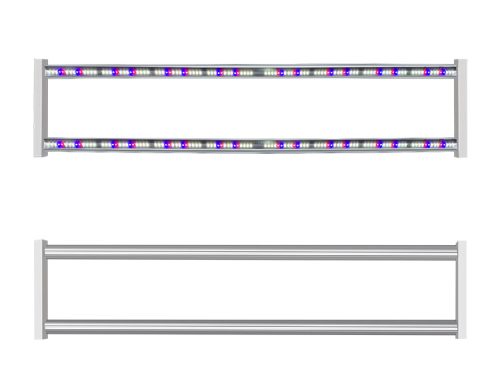
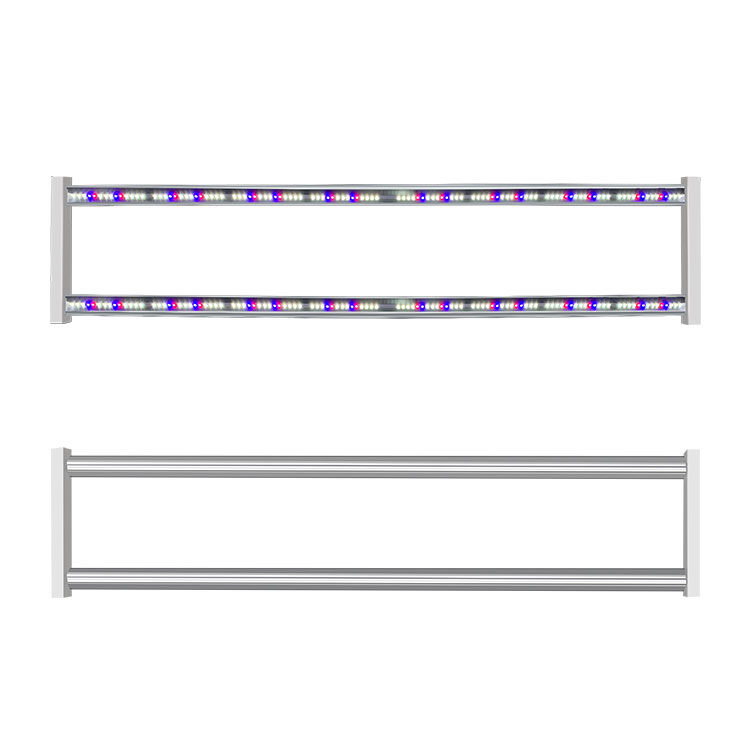
A grow tube is a linear lamp whose cross-section suits mounting along the underside of a shelf, so light is delivered in a line above a row of plants rather than from a single point. In a layered hydroponic rack the tubes run the length of each tier and the tiers are stacked, which changes the selection problem: vertical clearance is fixed by the racking, humidity is high because the crop sits in water, and maintenance happens around wet surfaces.
That combination is why ingress protection, more than wattage, dominates the specification of this class of product. The page names its intended settings as “layered hydroponics rack system, vertical agriculture and Plant factory” and “Commercial shelf hydroponic vegetables, rack system vertical agricultural strawberry cultivation” — all of them places where a sealed tube can be sprayed or wiped down without being removed.
IP66 as the defining mechanical figure
The page states “Waterproof IP66”. Ingress protection is quoted as two digits: the first is resistance to solid objects and dust, the second to water. IP66 therefore means the enclosure is dust-tight and protected against powerful water jets — the rating is IP66 in full, not “IP6” or “IP7”, and it should be quoted that way in a specification. That level of sealing is what allows the tube to be specified in a wash-down or high-humidity position on a rack rather than only in a dry room.
The page pairs the sealed build with a photometric convenience: “no flicker, easy to take photos and observe” and “No flicker, shooting without flicker”. A driver that emits stable, ripple-free light lets a grower photograph or inspect a crop under the lamp without the banding that flicker produces in a camera image, which matters when the lamp is also the working light for a shelf.
Single-tube PPFD of 300 µmol/m²/s at 0.2 m
The page states “One Tube PPFD up to 300µmol/m²/s (heigth 0.2m)”. PPFD is the photon flux density at a surface, in micromoles per square metre per second, and it is quoted here at a plane 0.2 metres below the tube. Two clarifications follow. The first is that “up to” is a ceiling rather than a guaranteed field average, so the figure describes the point of greatest density rather than the mean across a tray. The second is that the height is part of the figure: at 0.2 m the density is high because the measurement plane is close, and it will fall at a greater distance, so a quoted density cannot be re-used at another height without a distribution curve.
The page describes the light shaping as “Koray secondary optical technology … improving light uniformity and PPFD”. Secondary optics are the lenses or diffusers placed in front of the emitters to redistribute light after it leaves the diode, and their purpose here is to spread the density that would otherwise concentrate under the tube toward the edges of the footprint. A uniformity claim is confirmed on a grid of measurements, and the page does not publish that grid, which is not specified in the official datasheet.
F175 and V3 spectrum, and what the savings figures rest on
The page offers a “Preferred plant full spectrum” and then two named options, an “F175 spectrum” and a “V3 spectrum”. A full spectrum is a fixed blend intended to carry a crop across its cycle; the two named spectra are the variants the page quantifies.
The F175 entry states “energy-saving: 24%” and “One tube saves 51kWh of electricity per year”. The V3 entry states “energy-saving: 33%”, “One tube saves 70kWh of electricity per year” and, crucially, a basis for comparison: “0.3m height, avg PPFD 300 µmol/m²/s”. That last clause matters, because an energy-saving figure is meaningless without the light level it is claimed at. For V3 the comparison point is an average density at 0.3 m, which is the kind of statement a grower can test. For F175 the page gives the percentage and the annual kilowatt-hours but does not state the matching light level, which is not specified in the official datasheet.
The page also notes a photoperiod context for its settings, “12 hours/day”. A photoperiod is the number of hours the lamp runs each day, and it is the second half of the daily-light picture: the daily light integral is the accumulation of PPFD across the photoperiod, measured in moles per square metre per day. Michigan State University Extension (https://www.canr.msu.edu/news/led-lighting-for-greenhouse-crops) explains why delivered light is the basis for horticultural lighting comparisons, Greenhouse Grower’s lighting coverage (https://www.greenhousegrower.com/production/lighting/) reports on how fixtures are judged in production settings, and USDA Agricultural Research Service (https://www.ars.usda.gov/) maintains research on controlled-environment production; all three stand behind the practice of converting an instantaneous reading into a daily total.
The 133 W/m² rack figure and the ten-unit series limit
The page states “Power 133W/m²”. A power density expresses electrical load per unit of growing area, so the figure describes how much power a rack fits into each square metre of its growing footprint — the number an installer uses to size the circuits that feed a tier. Read it together with the light output rather than separately, because the trade a grower is making is kilowatts in against photons out, and the page’s energy-saving percentages are the vendor’s own statement of that trade.
The second electrical figure is “Max series connection of 10pcs”, a limit on how many tubes may be daisy-chained on one supply run. A series limit is a current and voltage constraint, so it caps the run length per circuit and therefore the layout of a rack: a tier longer than ten tube-lengths needs a second feed point. The page does not give the single-tube rated power in watts, nor the operating temperature range, nor the physical dimensions — each of these is not specified in the official datasheet, which is why they belong on a request list rather than in a plan.
F175 vs V3 side by side
The table below places the published figures for the two spectra next to each other, so that the choice between them stays visible at the point of decision. It is built from this model’s page only.
| Parameter | F175 spectrum | V3 spectrum |
|---|---|---|
| Stated energy saving | 24% | 33% |
| Stated annual saving per tube | 51 kWh | 70 kWh |
| Stated measurement basis | Not stated on the page | 0.3 m height, average PPFD 300 µmol/m²/s |
| Stated photoperiod context | 12 hours/day | 12 hours/day |
| Single-tube peak PPFD at 0.2 m | Up to 300 µmol/m²/s (shared platform) | Up to 300 µmol/m²/s (shared platform) |
| Waterproof rating | IP66 (shared) | IP66 (shared) |
| Rack power density | 133 W/m² (shared) | 133 W/m² (shared) |
| Max series connection | 10 pcs (shared) | 10 pcs (shared) |
| Secondary optics | Koray secondary optical technology, improving light uniformity and PPFD (shared) | Koray secondary optical technology, improving light uniformity and PPFD (shared) |
| Single-tube rated power, life, dimensions and operating temperature | Not specified in the official datasheet | Not specified in the official datasheet |
| Choosing cue | Lower stated saving; measurement basis to be requested | Higher stated saving with a stated light level at 0.3 m |
Read the table as a selection aid rather than a ranking. The V3 column carries a stated comparison basis — an average density at 0.3 m — while the F175 column states its saving without the matching light level, so the honest position is that the two spectra can be compared in cost terms but that the F175 light level still has to be requested.
Fit-for-purpose scenarios for the PT8 tube
Where the published figures line up with a use case, the PT8 Waterproof from Koray is a reasonable candidate for a layered hydroponic rack, a vertical-farming tier or a plant factory line where the fixtures sit in humid air and benefit from an IP66 sealed tube. Its two spectrum options suit a grower who wants to standardise on one tube body and choose a blend per crop, and the ten-unit series limit and the 133 W/m² density figure give an installer the two numbers needed to begin a circuit layout. The no-flicker build is a practical bonus where the same lamp is used for inspecting or photographing the crop.
Scenarios that call for caution are equally clear. A buyer who needs to size a fixture count should request the single-tube PPF in µmol/s, because it is not specified in the official datasheet and the density figure alone cannot replace it. Anyone comparing the F175 saving against the V3 saving should ask for the light level and photoperiod behind the F175 figure, since only the V3 entry states its basis. And any electrical plan that depends on the single-tube wattage, the operating temperature range or the fixture dimensions should wait for those values, because each is not specified in the official datasheet. None of these cautions is a defect in the tube; they are the ordinary boundaries of a specification whose open items have to be confirmed in writing.
Procurement checklist before the order is placed
- The single-tube photon flux in µmol/s for the chosen spectrum, to convert the 300 µmol/m²/s peak figure into a fixture count.
- The light level, photoperiod and measurement height behind the F175 24% and 51 kWh figures.
- A PPFD distribution across the intended tray at the planned mounting height, in place of a single 0.2 m reading.
- The single-tube rated power and the operating temperature range, to complete the 133 W/m² circuit sizing.
- The fixture dimensions and mass, for rack and tier clearance planning.
- The service life in hours, with the test conditions behind it.
- Confirmation that the intended chain length respects the ten-unit series limit.
A 17-year documentation standard
A 17-year LED grow light manufacturing record is not itself a specification, but it sets an expectation about how questions are answered. With 17 years behind the company, the reasonable expectation is that a published figure can be traced to a measurement and that the numbers behind it can be produced on request rather than improvised. A 17-year supplier can respond to the checklist above with a flux figure, a distribution and a life-test report, and that response is worth more to a rack plan than a longer marketing paragraph. The PT8 tube is sold with CE, RoHS and FCC marks, and buyers choosing between the F175 and V3 spectra should treat the table above as their request list and hold the comparison open until the light levels behind both energy-saving figures arrive.
Frequently asked questions
What is the difference between the F175 and V3 spectrum versions of the PT8 tube?
Both are spectrum options on the same sealed tube. The page states an “energy-saving: 24%” and “One tube saves 51kWh of electricity per year” for F175, and “energy-saving: 33%” with “70kWh” and a basis of “0.3m height, avg PPFD 300 µmol/m²/s” for V3. The V3 entry therefore states the light level its saving is claimed at, while the F175 entry does not, which should be requested before the two are compared.
How much light does one tube deliver, and at what height?
The page states “One Tube PPFD up to 300µmol/m²/s (heigth 0.2m)”, so the density is quoted at a plane 0.2 metres below the tube and represents a peak rather than a field average. At a greater distance the density falls, and the daily total depends on the photoperiod, for which the page notes 12 hours/day in its cultivation settings.
What does the IP66 rating allow on a rack system?
Ingress protection is quoted as two digits, and the page states IP66, so the tube is dust-tight and protected against powerful water jets. That is what makes it suitable for humid, wash-down positions on a layered hydroponic rack. The rating is IP66 in full and should be quoted that way in a specification.
What does the 133 W/m² figure mean for a rack installation?
The page states “Power 133W/m²”, which is electrical load per square metre of growing area — the figure an installer uses to size the circuits feeding a tier. It should be read alongside the single-tube rated power, which is not specified in the official datasheet, so the per-tube wattage has to be requested to finish the circuit calculation.
What should be confirmed in writing before ordering the PT8 tube?
Several items are not specified in the official datasheet: the single-tube rated power, the single-tube PPF in µmol/s, the lamp life in hours, the operating temperature range and the fixture dimensions. Each should be requested along with the light level behind the F175 saving and a PPFD distribution at the intended mounting height.




Leave A Comment