

A horticulture LED module for a plant factory shelf is rarely one product so much as a small family of them. The G45-LM301H-GEN2 is listed on its official product page (https://koraylights.com/product/g45-lm301h-gen2-led-grow-light-horticulture-led-module/) as a linear module built around “Samsung LM301H EVO GEN2 grow light spectrum” and “Osram Horticultural LED”, and the same page splits the model into three optical variants — 60D, 90D and 100D — that share an electrical platform but not a light distribution. Choosing between them is an optics decision as much as a power decision, because the beam shape, the module’s height above the canopy and the delivered photon flux all move together. The sections below read the published specification in the manufacturer’s own wording, explain what each figure means in a multi-layer installation, and separate the numbers that can be used in a shelf plan today from the ones that still have to be requested.
What a horticulture LED module is on a plant factory shelf
A horticulture LED module is a luminaire whose output is specified as photosynthetically active radiation rather than as visible light for the human eye. Photosynthetically active radiation is the 400–700 nm waveband that the photosynthetic apparatus absorbs, and the module’s output inside that band is quoted as photon flux in micromoles per second. Michigan State University Extension (https://www.canr.msu.edu/news/led-lighting-for-greenhouse-crops) summarises why horticultural lighting is compared on delivered light rather than on nominal lamp ratings, and the same reasoning applies one layer down, at the shelf.
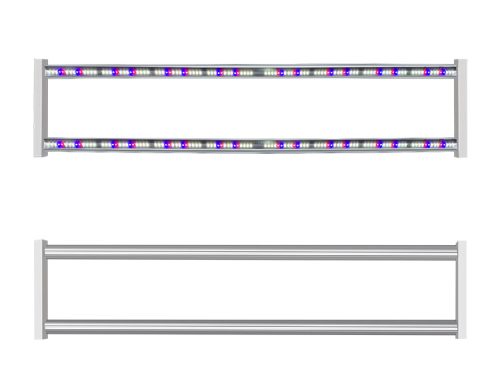
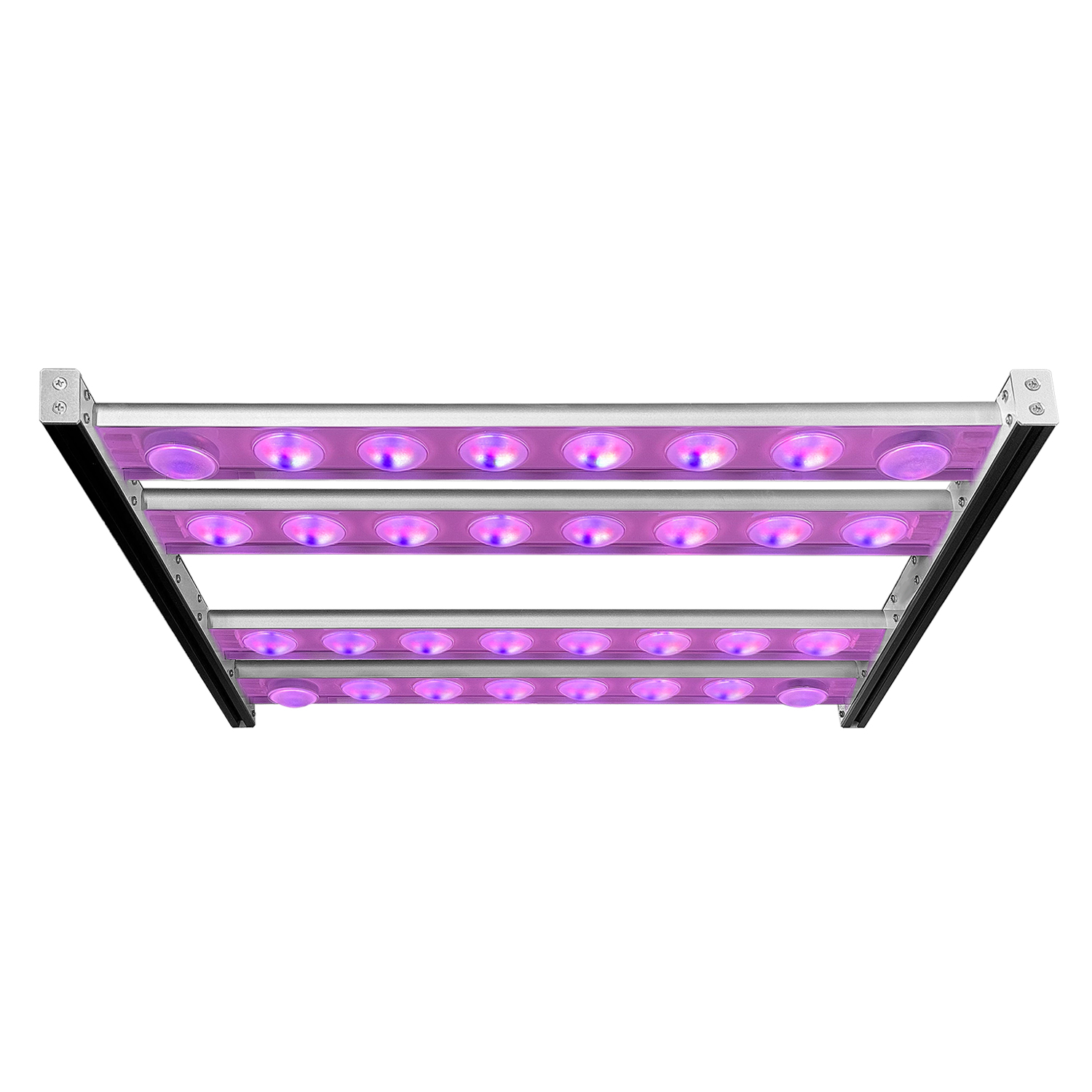
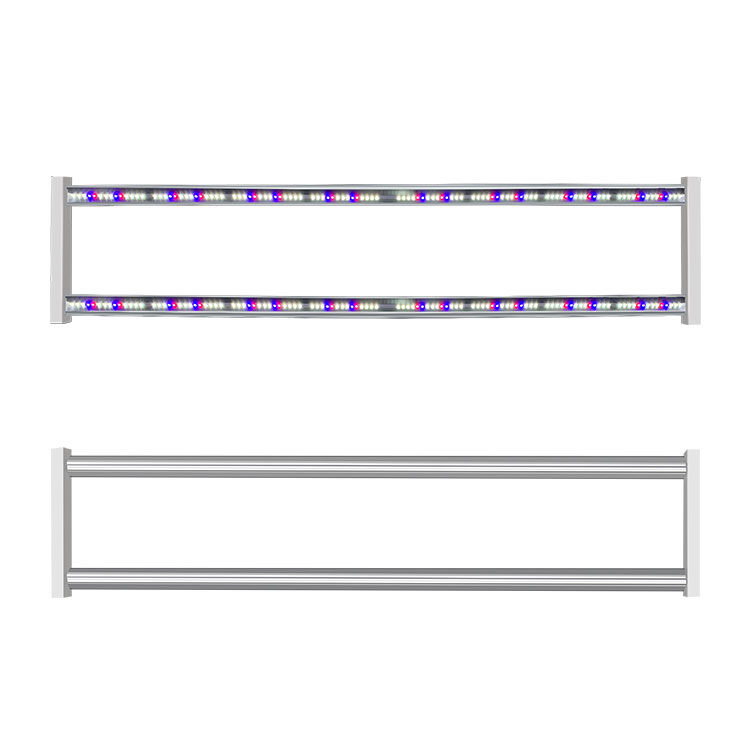
A linear module such as this one is a bar 1205 mm long, sized to span the width or depth of a single shelf rather than to light a whole room. That form factor changes the selection problem. In a room-scale fixture the designer can trade beam angle against mounting height across a large volume; on a shelf, the vertical clearance between tiers is fixed by the racking, so the optic has to work at a short, fixed throw. The G45-LM301H-GEN2 is described on the product page as suited to “leafy vegetables such as lettuce, basil”, “plant factories with high-density shelf structure”, “container hydroponic vegetables, display cabinet cultivation, sightseeing agriculture” — all settings in which the lamp sits close above the canopy and the optic, not the mounting height, does the work of spreading the light.
The three optical variants: 60D, 90D and 100D
The page describes “60D and 90D unique lens structure, uniform spectral radiation, lens + reflector, directional illumination” and notes that the “100D type adopts the reflector method”. The suffix and the optics are therefore not the same construction for all three: the 60D and 90D are lens-plus-reflector assemblies, while the 100D is a reflector.
The variant also changes the physical height of the bar, which matters on a rack where every millimetre of tier clearance has to be paid for. The published dimensions are 1205×48×30 mm for the 60D, 1205×48×21 mm for the 90D and 1205×48×18 mm for the 100D. A beam angle is the angular spread of the emitted light, and it is the single figure that decides how far apart two bars can sit before the illumination between them sags — so the three suffixes are best treated as three answers to the question of how close the canopy is.
The 435–440 nm blue peak and the emitter package
The page states a “blue light peak 435nm-440nm”. A blue peak is the wavelength at which the blue channel of the spectrum is most intense. Blue photons drive vegetative growth and compact plant habit in leafy crops, which is why a defined blue peak is quoted on a module aimed at lettuce and basil rather than a generic white-light figure being offered in its place.
The emitters named on the page are Samsung LM301H EVO GEN2 and Osram horticultural LEDs. Naming the emitter families rather than a chip count is the level of detail the page supplies; a chip count is not specified in the official datasheet, and the mixing ratio between the two emitter types is likewise not published. Peer-reviewed work on spectral effects in controlled-environment production, of the kind published in Frontiers in Plant Science (https://www.frontiersin.org/journals/plant-science), is the appropriate literature for judging whether a given spectrum suits a given crop, and it is the right companion to the manufacturer’s own figures rather than a substitute for the crop-specific trial a grower will still want to run.
The DC constant-current taps: 1 A at 41.7 V and 1.5 A at 42.6 V
The electrical entry on the page is a DC input with two published operating points: “1A @41.7V” and “1.5A @42.6V”. A constant-current driver is a power supply that holds a fixed output current while the voltage settles where the load requires it, and the two taps are therefore two different drive settings rather than two different products. At the lower tap the module draws roughly 42 W; at the higher tap it draws roughly 64 W.
That distinction decides the output figures, which is why the selection has to declare the drive current. The published photon flux is “105 µmol/s (1A)” and “165 µmol/s (1.5A)” for the 60D, “110 µmol/s (1A)” and “170 µmol/s (1.5A)” for the 90D, and “125 µmol/s (1A)” and “183 µmol/s (1.5A)” for the 100D. The same physical bar therefore covers a wide output range simply by being driven harder, and a shelf plan that quotes an output without naming the tap it belongs to is quoting half a specification. The driver model itself is not specified in the official datasheet.
Reading the PPFD figures at their stated height
The page quotes PPFD “at 0.2m” — that is, at a plane 0.2 metres below the module — and the values differ by both variant and drive setting: 680 µmol/m²/s at 1 A and 480 at 1.5 A for the 60D; 480 at 1 A and 700 at 1.5 A for the 90D; 330 at 1 A and 480 at 1.5 A for the 100D. PPFD is the photon flux density measured at a surface, in micromoles per square metre per second, and it is an instantaneous reading rather than a daily dose.
Two habits make the number usable. The first is to keep the height attached to it: 0.2 m is a close measurement plane, and the density will fall as the sensor moves away, so a figure quoted at one height cannot be re-used at another without a distribution curve. That curve is not specified in the official datasheet. The second is to convert the reading into a daily total, because growth responds to the daily light integral — the accumulation of PPFD across the photoperiod, measured in moles per square metre per day. Ohio State University Extension’s Ohioline service (https://ohioline.osu.edu/factsheet/hyg-1421) publishes grower guidance on intensity, photoperiod and the daily light integral in controlled-environment production, and it is the frame in which a 0.2 m PPFD figure becomes a schedule. The page does not state a recommended photoperiod, which is not specified in the official datasheet, so the daily total is planned by the grower from the target crop.
IP67 sealing, operating temperature and the 50,000-hour life
The page states a “Waterproof grade IP67”, and adds that the module is “suitable for harsh environments”. Ingress protection is quoted as two digits: the first is resistance to solid objects and dust, the second to water. An IP67 rating therefore means full dust protection plus protection against temporary immersion — the full rating is IP67, not merely “IP6” or “IP7” — and it is the figure that lets a bar be specified in a wash-down or high-humidity position on a multi-layer rack rather than only in a dry room.
The remaining engineering figures are an operating temperature of -30°C to 40°C, a lifespan of “50,000 hrs” noted at “Ta ≤ 25°C”, and a “Tolerance range for optical and electrical data: ±10%”. A lifespan figure is a projection whose meaning depends on its conditions, and here the condition is an ambient temperature at or below 25°C; where a shelf runs hotter than that, the projection should be confirmed against the fixture’s own thermal test. The ±10% tolerance is the band within which any single unit’s optical and electrical readings may sit, which is why a commissioning measurement can differ from the catalogue value without either being wrong. Coverage area is not specified in the official datasheet, and neither is the photometric test standard behind the PPFD values.
The three optics side by side
The table below places the published figures for the three variants next to each other, so that the trade between height, beam and output stays visible at the moment a variant is chosen. It is built from this model’s page only.
| Parameter | 60D | 90D | 100D |
|---|---|---|---|
| Optical construction | Lens + reflector | Lens + reflector | Reflector method |
| Module size (mm) | 1205×48×30 | 1205×48×21 | 1205×48×18 |
| PPF at 1 A | 105 µmol/s | 110 µmol/s | 125 µmol/s |
| PPF at 1.5 A | 165 µmol/s | 170 µmol/s | 183 µmol/s |
| PPFD at 1 A, 0.2 m | 680 µmol/m²/s | 480 µmol/m²/s | 330 µmol/m²/s |
| PPFD at 1.5 A, 0.2 m | 480 µmol/m²/s | 700 µmol/m²/s | 480 µmol/m²/s |
| Blue light peak | 435–440 nm | 435–440 nm | 435–440 nm |
| Ingress protection | IP67 | IP67 | IP67 |
| Operating temperature | -30°C to 40°C | -30°C to 40°C | -30°C to 40°C |
| Lifespan | 50,000 hrs (Ta ≤ 25°C) | 50,000 hrs (Ta ≤ 25°C) | 50,000 hrs (Ta ≤ 25°C) |
| Beam angle value | Not specified in the official datasheet | Not specified in the official datasheet | Not specified in the official datasheet |
| Coverage area | Not specified in the official datasheet | Not specified in the official datasheet | Not specified in the official datasheet |
Read the table as a selection aid. The closer a canopy sits to the bar, the narrower the optic that will concentrate light without spilling over the tier edge; the higher the bar, the more a wider optic earns its place. Because the published data gives density at a single 0.2 m plane for each variant, the table is a starting point for a spacing calculation rather than the calculation itself.
Fit-for-purpose scenarios for the G45-LM301H-GEN2
Where the published figures line up with a use case, the G45-LM301H-GEN2 from Koray is a reasonable candidate for a high-density rack of leafy greens or herbs, for container or display-cabinet cultivation, and for any multi-tier shelf that runs humid and therefore benefits from an IP67 sealed bar. The 1 A tap suits installations that want to start at a lower output and a lower power draw, while the 1.5 A tap suits shelves that need the higher published PPF; because both taps belong to the same module, a rack can be commissioned at one setting and raised later without changing hardware.
Scenarios that call for caution are equally clear. A shelf whose tier clearance differs greatly from the 0.2 m plane should request a distribution at the intended height before fixing bar spacing, and a room where the ambient around the bars runs above 25°C should confirm the lifespan projection against the actual thermal environment. Any plan that depends on a stated beam angle value or a coverage area should wait for those figures, because each is not specified in the official datasheet. None of these cautions is a defect in the module; they are the ordinary boundaries of a specification whose open items have to be confirmed in writing.
Procurement checklist before the order is placed
- Written confirmation of the drive tap (1 A at 41.7 V or 1.5 A at 42.6 V) intended for the shelf, with the resulting PPF for the chosen variant.
- A PPFD distribution at the intended mounting height and bar spacing, in place of a single reading at 0.2 m.
- The beam angle value for each variant, so bar spacing can be set before installation.
- The recommended photoperiod and the resulting daily light integral for the target crop.
- The coverage area per variant, and the photometric test standard behind the PPFD values.
- Written confirmation of the lifetime projection at the ambient temperature the shelf actually runs at, with the test conditions behind the 50,000-hour figure.
- The emitter mixing ratio and the driver model, neither of which is specified in the official datasheet.
A 17-year documentation standard
A 17-year LED grow light manufacturing record is not itself a specification, but it sets an expectation about how questions are answered. With 17 years behind the company, the reasonable expectation is that published figures can be traced to a test and that unpublished ones can be produced on request rather than improvised. A 17-year supplier can respond to the checklist above with a drawing, a test report and a distribution curve, and that response is worth more to a shelf plan than a longer marketing paragraph. Buyers selecting among the 60D, 90D and 100D variants should use the table above as their request list and hold the choice of optic open until the distribution and beam figures arrive, because on a shelf the optic is the part of the specification that decides how evenly the canopy is lit.
Frequently asked questions
What is the difference between the 60D, 90D and 100D variants of this module?
All three share the electrical platform, but the optics differ: the page describes the 60D and 90D as “lens + reflector” structures and the 100D as using “the reflector method”. The height changes with the optic — 30 mm, 21 mm and 18 mm respectively — and so do the published PPF and PPFD values at 0.2 m. The suffix is therefore an optics and clearance choice as much as an output choice.
Where does the 3.0 umol/J efficiency figure apply?
The product page publishes efficiency up to 3.0 µmol/J at 100D, 1 A at 41.7 V. That figure is attached to the reflector variant and to a stated drive tap, so it is one operating point within the module’s specification rather than a value that carries across all three optics and both drive settings.
At what height and for how long are the PPFD figures measured?
The published PPFD values are quoted at 0.2 metres below the module — for example 680 µmol/m²/s at 1 A and 480 at 1.5 A for the 60D. That is an instantaneous density at a single close plane. The page does not state a recommended photoperiod, which is not specified in the official datasheet, so the daily light integral has to be planned from the target crop.
What does the IP67 rating allow on a multi-layer shelf?
Ingress protection is quoted as two digits, and the page states IP67, so the module carries full dust protection plus protection against temporary immersion. That is what makes it suitable for high-humidity positions on a rack. The rating is IP67 in full and should be quoted that way in a specification.
What should be confirmed in writing before ordering this module?
Several items are not specified in the official datasheet: the beam angle value per variant, the coverage area, the photometric test standard, the emitter mixing ratio, the driver model and the recommended photoperiod. Each should be requested along with a PPFD distribution at the intended mounting height and the test conditions behind the 50,000-hour lifespan.




Leave A Comment