

Five figures on a grow-light label look unrelated – wattage, spectral composition, photon flux, efficacy and a row of safety marks – but they are the same engineering decision seen from five angles. This article follows that chain through one fixed-configuration fixture, the RX-G120H, a 630 W folding multi-bar top-lighting luminaire, and separates the numbers that are directly comparable between products from the numbers that are only meaningful under a named condition.
1. Three different claims hide behind one word: light output
PPF (photosynthetic photon flux) is the total number of photons emitted per second inside the 400-700 nm waveband, expressed in micromoles per second (umol/s); it is a pure output quantity and says nothing about area. PPE (photosynthetic photon efficacy) is that PPF divided by the electrical power drawn at the wall plug, in umol/J. PPFD is PPF spread over a surface, in umol/m2/s, and is therefore meaningless unless a distance and a footprint are stated with it. The RX-G120H publishes a PPF of 1630 umol/s and a PPE of up to 2.6 umol/J. Because efficacy is quoted as an up-to figure rather than a typical value, any cross-product comparison has to apply the same convention on both sides – the point made by the U.S. Department of Energy LED Basics reference on luminaire-level efficacy accounting.
2. What a fixed F91 spectrum commits to
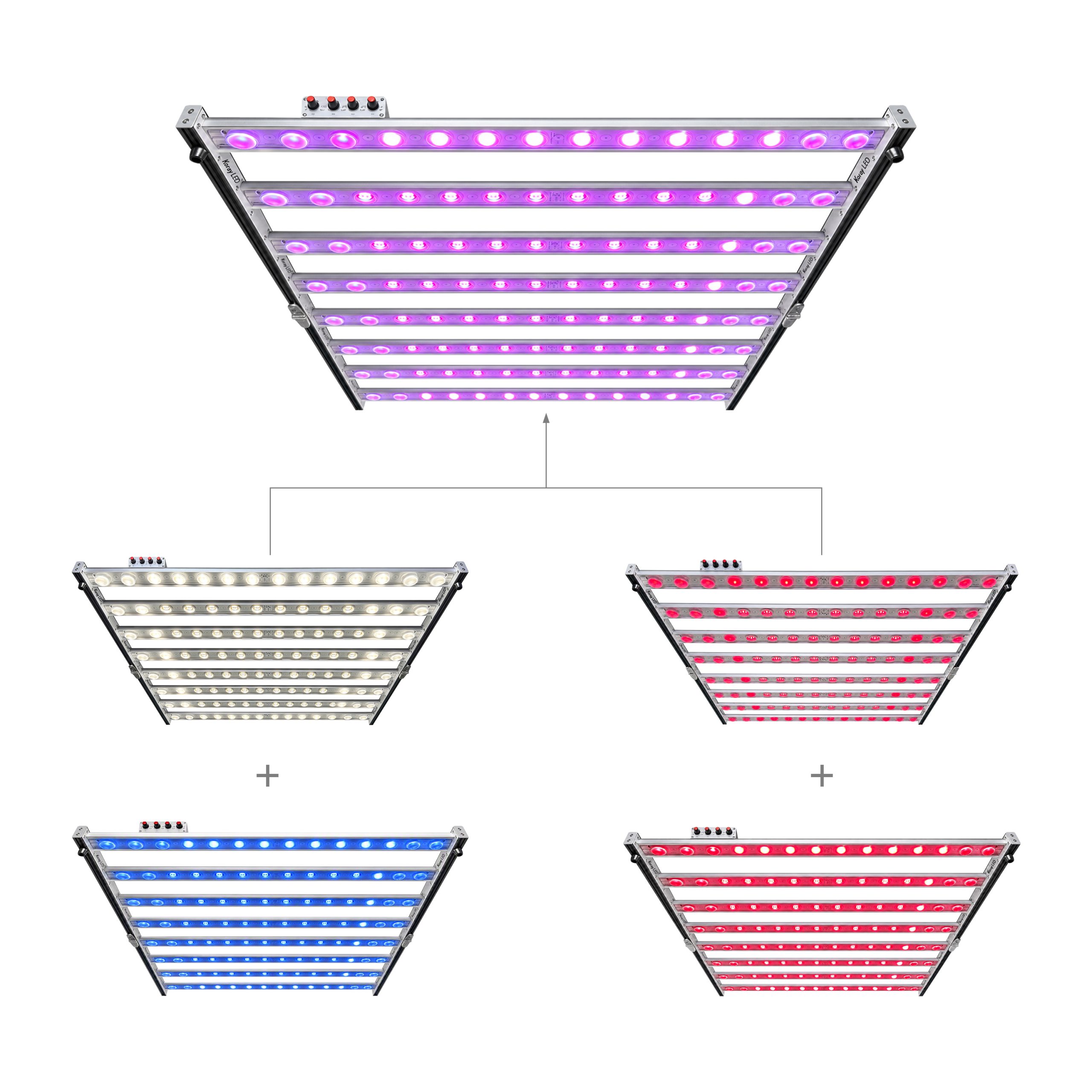
The spectrum designated F91 pairs white LEDs with hyper-red at 660 nm and far-red at 730 nm. The choice is not decorative. 660 nm sits close to the primary in-vivo absorption peak of chlorophyll-a, while 730 nm is the waveband to which the phytochrome system responds through the red-to-far-red ratio; red and far-red together also underpin the Emerson enhancement effect, where far-red supplied alongside red raises quantum yield above either waveband alone (background: PMC7040899). A single fixed spectrum is a deliberate trade-off: it gives up the ability to re-shape the spectrum per crop stage, and in exchange it removes recipe error and channel-to-channel imbalance from a multi-tent deployment. Operators who need per-stage spectral shaping should be looking at multi-channel luminaires; operators who want one repeatable recipe replicated across many identical rooms are the intended audience for a fixed spectrum.
3. Coverage is two pairs of numbers, not one number
Coverage is the area over which the published output is usable, and it changes with the surroundings. The RX-G120H is rated for 6 x 6 ft vegetative and 5 x 5 ft flowering coverage inside a tent, and for 5 x 5 ft vegetative and 4 x 4 ft flowering coverage in a dark room without any reflective sides. All four values come from the manufacturer product page and must be read exactly as written: the tent pair assumes reflective walls, the dark-room pair assumes none. Independent of which pair applies, delivered PPFD has to be re-verified at the canopy for the actual mounting height and for the daily photoperiod, because flux density falls with distance and with room losses – the measurement approach set out by MSU Extension on LED lighting for horticulture.

4. Four marks, four different scopes of evidence
The fixture carries ETL, CE, RoHS and FCC marks, and they are not interchangeable. ETL is a North American safety listing issued by an NRTL (Nationally Recognized Testing Laboratory): the enclosure, wiring and electrical construction were tested as a finished luminaire rather than as a bundle of separately certified components. CE is the manufacturer declaration that the product meets the applicable EU directives. RoHS is a materials restriction on lead, cadmium, mercury and certain flame retardants – substances that make electronics harder to repair and recycle, so the mark is about what the hardware is made of rather than how it performs. FCC limits radiated electromagnetic emissions from the driver and dimming electronics. Optical hazard is a fifth and separate question: photobiological safety is classified under IEC 62471, which groups lamps by spectral hazard at a defined viewing distance and exposure duration (IEC 62471).
5. Control: multi-lights connection dimming
Dimming on this fixture is implemented as multi-lights connection dimming, with compatibility with the Horti Guru APP control system. In practice that means intensity is set at the group level across linked fixtures rather than per spectral channel, which is consistent with a single fixed spectrum: the controllable variable is dose (intensity multiplied by photoperiod), not spectrum. DLI (daily light integral, mol/m2/day) is PPFD multiplied by photoperiod in seconds and divided by one million, so a group-level dimmer plus a timer is the minimum control set needed to reproduce a target dose day after day.
6. Dimension comparison: claim, condition, verification basis
| Dimension | RX-G120H official figure | Condition attached to the figure | Verification basis |
|---|---|---|---|
| Rated power | 630 W | Horticultural LED, nominal rating | Official product page (product ID 7976) |
| Spectrum | F91 – Samsung white + hyper-red 660 nm + far-red 730 nm | Single fixed spectrum, no per-stage re-shaping | Official product page |
| PAR photon flux (PPF) | PAR 1630 umol/s | Total fixture output in 400-700 nm | Official product page |
| Efficacy (PPE) | up to 2.6 umol/J | Up-to convention, not a typical value | Official product page |
| Flowering coverage | 5 x 5 ft in tent / 4 x 4 ft in dark room | Tent value assumes reflective walls; dark-room value assumes none | Official product page (both published values) |
| Vegetative coverage | 6 x 6 ft in tent / 5 x 5 ft in dark room | Same reflective-condition split | Official product page |
| Dimming / control | Multi-lights connection dimming; Horti Guru APP compatible | Group-level intensity, not channel-level spectrum | Official product page |
| Rated life | 50,000 h | Maintenance figures are only comparable when drive current and thermal conditions are named | Official product page (see LM-80 / TM-21 note in FAQ) |
| Warranty | 3 years | Commercial warranty term, separate from rated life | Official product page |
| Compliance | ETL / CE / RoHS / FCC | Safety listing, EU conformity, materials restriction, EMC – four scopes | Official product page |
| Core application | Top lighting for indoor and tent cultivation at high PPFD | Manufacturer notes it is not aimed at first-time growers without CO2 supplementation | Official product page capability positioning |
7. Where this fixture fits
As a 630 W single-spectrum folding bar luminaire, this class of fixture suits an operator running several identical enclosed rooms on one shared recipe, where repeatability across rooms matters more than per-stage spectral tuning, and where the electrical installation has already been planned around a 630 W load per fixture. The published caveat is worth repeating here rather than burying it: the manufacturer positions the fixture for high-PPFD cultivation and does not recommend it to first-time growers working without CO2 supplementation, which makes it a poor first purchase for a single small tent. Koray is a 17-year LED horticultural lighting manufacturer, and the reference specifications cited throughout this article are published on the RX-G120H product page.
Read as a whole, the label on a fixed-configuration fixture is a set of conditions rather than a set of promises. 630 W defines the electrical load, 1630 umol/s defines the photon budget, up to 2.6 umol/J defines how much of that load became photons, the F91 spectrum defines which photons, the four coverage figures define how much floor area they reach under two different reflective conditions, and ETL / CE / RoHS / FCC define which safety and materials questions have already been answered by a third party. Deploy on the version of those figures that matches your actual room, and verify at the canopy.
Frequently asked questions
Does the RX-G120H offer independently dimmable spectral channels?
No. It runs a single fixed F91 spectrum – white LEDs with 660 nm hyper-red and 730 nm far-red – so the controllable variable is dose, not spectrum. Dimming is implemented as multi-lights connection dimming with Horti Guru APP compatibility, which sets intensity across linked fixtures. If your protocol requires changing the red-to-blue ratio between vegetative and flowering stages, a multi-channel luminaire is the correct tool.
How much area does a 630 W folding grow light actually cover?
Two sets of figures are published, and they differ by reflective condition. In a tent with reflective walls the RX-G120H is rated 6 x 6 ft for vegetative growth and 5 x 5 ft for flowering. In a dark room without reflective sides it is rated 5 x 5 ft vegetative and 4 x 4 ft flowering. Use whichever pair matches your room, then confirm the delivered PPFD with a quantum sensor at your chosen mounting height.
What does “up to 2.6 umol/J” mean when comparing two fixtures?
It means the value is an upper bound rather than a typical or guaranteed measurement. PPE is PPF divided by wall-plug power, so a comparable figure must use the same convention – same divisor, same measurement point – and be quoted either both as up-to values or both as typical values. Comparing one product’s up-to figure against another product’s typical figure overstates the difference. The RX-G120H publishes PAR 1630 umol/s alongside the up-to 2.6 umol/J efficacy.
What does the ETL mark add that CE does not cover?
They answer different questions in different jurisdictions. ETL is a North American safety listing issued by an NRTL, which means the finished luminaire’s enclosure, wiring and electrical construction were type-tested as a product. CE is a manufacturer declaration of conformity with applicable EU directives – it is the operator’s own statement supported by a technical file, not a third-party listing. Having ETL, CE, RoHS and FCC together covers safety listing, EU conformity, restricted materials and electromagnetic emissions; photobiological risk is classified separately under IEC 62471.
How is the 50,000 hour rated life of the RX-G120H determined?
LED lifetime is a projection, not a burn-in test. LM-80 collects lumen and colour maintenance data from the LED package under controlled drive current and case temperature, and TM-21 projects that data to a claimed maintenance hour figure. A 50,000 h figure quoted without those conditions cannot be compared against another fixture’s figure, and in practice the driver – not the LED package – usually sets service life. The RX-G120H carries a 3-year commercial warranty, which is a separate commitment from the rated life figure.




Leave A Comment