

Most grow-light comparisons collapse into a single number: the wattage on the label. That number says nothing about how much usable light reaches the canopy, how evenly it is spread, how long the fixture holds that output, or whether it is safe to work under. The framework Koray publishes on its 6 Indispensable Elements of Grow Light page names six elements — Effectivity:, High efficiency and energy saving :, Safe and Reliable:, Long-life:, Human perceived comfort:, and Intelligent control: — but names alone do not let you accept or reject a fixture.
This article does not restate that list. It converts each of the six elements into three engineering layers: the criterion (what the element actually claims), the measurement method (how it is obtained, and against which standard), and the threshold band (the range most often used as an acceptance limit in horticultural practice and in third-party listing programmes). Threshold bands are acceptance criteria, not performance guarantees: always validate against the fixture’s own test report at your mounting height and photoperiod.
1. Effectivity: PPFD at a defined distance, plus uniformity
Criterion. Effectivity is a claim about delivered light, so it must be stated as a spatial quantity, not a peak value. The two figures that carry the claim are PPFD (photosynthetic photon flux density, µmol/m²/s) measured at a named distance, and uniformity across the canopy footprint. A third figure, the daily light integral (DLI), integrates PPFD over the photoperiod:
DLI (mol/m²/d) = PPFD (µmol/m²/s) × photoperiod (h) × 3,600 ÷ 1,000,000
Uniformity is normally reported as U0 = minimum ÷ average (some datasheets use minimum ÷ maximum instead, which flatters the number — check which definition is used before comparing fixtures). For a single fixture over its rated footprint, U0 ≥ 0.80 is a common acceptance target; U0 ≥ 0.90 is achievable with a dense, well-mapped diode array and a low-profile driver layout.
Measurement method. A calibrated quantum sensor (cosine-corrected, spectral response matched to the 400–700 nm range) is moved on a grid — a 5 × 5 or 7 × 7 matrix is typical — at a fixed distance from the fixture (commonly 0.3 m, 0.6 m, and 1.0 m to reveal how the beam degrades with height). Michigan State University Extension explains how PPFD, photoperiod, and DLI interact in LED lighting for horticulture. Two caveats matter: the sensor’s own spectral mismatch adds error under red-heavy spectra, and a single-point reading at the fixture centre can be 30–60 % above the footprint average.
Threshold band (commonly cited). U0 ≥ 0.80 for a single fixture footprint; DLI targets are species-, stage-, and photoperiod-dependent and are usually set as a range rather than a single value, with 18/6 and 12/12 photoperiods pulling the required PPFD in opposite directions for the same DLI.
2. High efficiency and energy saving: µmol per joule, measured at the wall
Criterion. Efficiency for a horticultural fixture is photosynthetic photon efficacy (PPE) = PPF ÷ wall-plug power, in µmol·J⁻¹. PPF is the total photon flux leaving the fixture (µmol/s); the divisor must be the power drawn at the wall plug, not the sum of the diode ratings and not a “rated” number printed on the driver. Substituting a nominal power figure for the measured wall-plug figure is the single most common way an efficacy claim gets inflated by 10–20 %.
Measurement method. PPF is obtained in an integrating sphere or a goniophotometer (the same equipment families used for luminaire photometry); wall-plug power is logged simultaneously with a power meter that also reports power factor. Where an efficacy figure is used for a listing or a rebate, third-party programmes specify the test conditions. The DesignLights Consortium’s Horticultural Lighting Program publishes the technical framework and minimum efficacy requirements a fixture must satisfy to be listed, and it is the reference most often used when a buyer wants a number that is comparable across brands.
Threshold band (commonly cited). High-efficiency white-plus-red fixtures are frequently quoted in the 2.5–3.5 µmol·J⁻¹ band at the wall plug; listing programmes set a floor rather than a ceiling, so a fixture can be “listed” and still be well below the best available efficacy. A related but separate criterion is average PPFD under equal power: two fixtures with identical efficacy can deliver materially different canopy averages once distribution losses are counted, which is why efficacy alone is an incomplete substitute for the delivered-light criterion in element 1.
3. Safe and Reliable: ingress protection and photobiological risk group
Criterion. “Safe and reliable” resolves into three independently checkable items: ingress protection, photobiological safety, and electrical safety/transient withstand.
- Ingress protection (IP code). Defined by IEC 60529, the IEC 60529 publication specifies the IP coding system. A grow space is a humid, dusty, spray-exposed environment, so the first digit (solids) and second digit (water) both need to be stated, not just one.
- Photobiological safety. IEC 62471, published by IEC, classifies lamp and lamp-system optical radiation into risk groups. For fixtures that people work beneath, the relevant question is which risk group the fixture is assigned in the accessible viewing condition, and at what distance that assignment was made.
- Electrical safety and surges. Regional marks (CE, UL, ETL and equivalents) cover construction and dielectric strength; a stated transient/surge withstand rating covers the switching events that a large lighting circuit generates.
Threshold band (commonly cited). IP65 as a practical minimum for humid rooms and IP66/IP67 where direct spray or washdown occurs; RG0 or RG1 for fixtures accessible to workers without eye protection; certification marks corresponding to the destination market rather than a single global mark.
4. Long-life: photon maintenance, not the “50,000 hours” sticker
Criterion. Lifetime for a horticultural fixture should be expressed as photon maintenance — the point at which output falls to a stated fraction of initial value, written L90 (90 % retained) or L70 (70 % retained). The number that matters is the projected hours, not a nominal maximum. The U.S. Department of Energy’s LED basics primer explains why LEDs rarely fail abruptly and instead degrade gradually, which is the reason maintenance percentages, rather than time-to-failure, became the industry convention.
Measurement method. LM-80 collects lumen/photon maintenance data on the LED package over a fixed test duration; TM-21 is the standardised projection method that extrapolates those data to a claimed L90 or L70 hour figure at a stated drive current and case temperature. A projection without a stated test current and temperature is not comparable with another fixture’s projection. Two more practical points: the driver and any fan are usually the real short-life components, and the warranty term is the manufacturer’s own quantified statement about which components it expects to survive.
Threshold band (commonly cited). Listing and procurement programmes commonly require projections such as L90 ≥ 36,000 h or L70 ≥ 50,000 h, with drive current and case temperature specified; a 3–5 year limited warranty is typical for professional fixtures, with longer terms usually accompanied by an explicit operating-temperature condition.
5. Human perceived comfort: turning “flicker free” into numbers
Criterion. Comfort is measurable through three channels: temporal modulation (flicker), glare, and optical radiation exposure. “Flicker free” is a marketing phrase; the engineerable quantities are percent flicker (modulation depth), flicker index, and, for stroboscopic effects, SVM (stroboscopic visibility measure), where a value below 1 is the usual target for comfortable viewing.
Measurement method. Flicker is captured with a photodetector and oscilloscope or a flicker meter at multiple dimming levels, because modulation depth frequently worsens at low dim settings rather than at full output. Glare is assessed through luminance from the viewing position; UV/IR leakage is covered by the same photobiological risk-group assessment used in element 3.
Threshold band (commonly cited). Percent flicker below 5–10 % and/or SVM < 1 for work areas; risk group RG0/RG1 at the worker’s position; and no perceptible glare band at normal eye height, which in practice means the fixture needs a diffusing element or a recessed mounting rather than exposed diodes at eye level.
6. Intelligent control: protocol, channels, and closed loop
Criterion. Control is only as useful as what it can modulate. The checkable items are the control interface (0–10 V, PWM, RS485/Modbus, RJ45 daisy-chain), the number of independently dimmable channels, whether spectrum recipes can be stored on the fixture, and whether the fixture supports closed-loop control against a measured PPFD target rather than an open-loop percentage.
Measurement method. Protocol conformance is verified against the controller’s published interface specification; channel independence is verified by stepping one channel and confirming the others hold; closed-loop capability is verified by placing a sensor in the canopy, changing the target, and logging the time to reach and hold it.
Threshold band (commonly cited). A working checklist: two or more independently dimmable channels for spectral shaping, an interface that matches the site’s existing controller (a 0–10 V fixture cannot be addressed by a Modbus network without a converter), and either onboard recipe storage or a documented external schedule. More control layers add failure points, so protocol simplicity is a legitimate reliability argument.
The six elements are not independently optimisable
The reason a six-element framework is more useful than a ranked feature list is that the elements constrain one another. Maximising one usually taxes another, and the trade-off has to be explicit at design time.
| Tension | What happens if you push one side | Practical resolution |
|---|---|---|
| High PPE ↔ Effectivity (uniformity) | Very high efficacy is often achieved with fewer, more powerful diodes driven hard, which concentrates flux and lowers U0 across the footprint | Accept a slightly lower PPE figure, or use more emitters at lower drive current, to hold U0 ≥ 0.80 |
| High PPFD ↔ Human perceived comfort | Raising on-canopy intensity raises glare and shifts the accessible risk group | Mount higher with wider optics, use diffusion, and re-verify the risk group at worker eye height |
| Long-life ↔ High efficiency | Driving diodes at maximum current raises PPE but accelerates maintenance loss and shortens the driver’s life | Specify L90 at a stated drive current and case temperature, not at any current |
| Intelligent control ↔ Safe and Reliable | Additional control boards, sensors, and connectors add failure points in a humid room | Require the same IP rating for control enclosures as for the fixture body |
| Energy saving ↔ Effectivity (DLI) | Cutting power to save energy lowers PPFD and therefore DLI, which is a yield-side cost | Set DLI from the crop’s requirement first, then optimise PPE to reach it with the least wall-plug power |
Reading a datasheet against this matrix is faster than comparing two rankings of the same six words.
Six elements × quantified criteria — reference table
| Element (official naming) | Criterion definition | Measurement method / standard | Common threshold band |
|---|---|---|---|
| Effectivity: | PPFD at a stated distance, plus uniformity across the footprint; integrated as DLI over the photoperiod | Calibrated cosine-corrected quantum sensor on a 5 × 5 / 7 × 7 grid at 0.3 / 0.6 / 1.0 m; U0 = min ÷ average; DLI = PPFD × h × 3,600 ÷ 1e6 | U0 ≥ 0.80 (single fixture footprint); DLI targets species- and stage-dependent |
| High efficiency and energy saving : | PPE = PPF ÷ wall-plug power; average PPFD at equal power; power factor | PPF by integrating sphere or goniophotometer; simultaneous wall-plug power logging; listing-programme test conditions (DLC Horticultural Lighting Program) | 2.5–3.5 µmol·J⁻¹ common for high-efficiency fixtures; listing programmes set a floor |
| Safe and Reliable: | Ingress protection; photobiological risk group; electrical safety and transient withstand | IEC 60529 (IP code); IEC 62471 (photobiological safety); market safety marks (CE / UL / ETL and equivalents); surge-withstand rating | IP65 minimum in humid rooms, IP66/IP67 for spray or washdown; RG0/RG1 for worker-accessible fixtures |
| Long-life: | Projected photon maintenance (L90 / L70) at stated drive current and case temperature; driver and fan life; warranty term | LM-80 data collection plus TM-21 projection; DOE explanation of gradual LED degradation; component-level lifetime statements | Commonly required projections: L90 ≥ 36,000 h or L70 ≥ 50,000 h; typical warranty 3–5 years |
| Human perceived comfort: | Temporal modulation (flicker), glare, optical radiation exposure at the worker’s position | Photodetector / flicker meter at several dimming levels; percent flicker, flicker index, SVM; risk group assessed at eye height | Percent flicker < 5–10 % and/or SVM < 1; RG0/RG1; no perceptible glare band at normal eye height |
| Intelligent control: | Control interface, independently dimmable channel count, recipe storage, closed-loop PPFD control | Interface-specification conformance; per-channel stepping test; sensor-in-canopy closed-loop step-response test | ≥ 2 independent channels; interface matching the site controller; onboard recipe storage or documented external schedule |

Applying the framework when you are choosing a fixture
The six elements are a filter, not a scorecard: a fixture that fails one element in the environment you intend to use it in is a bad fixture for that environment, however good its other numbers are. A practical order of operations is (1) fix the DLI the crop needs, (2) set the mounting height and footprint, (3) require U0 ≥ 0.80 and a PPE figure measured at the wall plug, (4) confirm IP rating and risk group for the room, (5) confirm the projected maintenance figure is stated at a real drive current and case temperature, and only then (6) compare control options.
Where to apply the six elements in practice:
- Humid or washdown rooms — treat Safe and Reliable: and Long-life: as the gating elements first, because an unsealed enclosure ends every other criterion early.
- Multi-tier or low-headroom racks — Effectivity: (U0) and Human perceived comfort: dominate, since close mounting height magnifies both non-uniformity and glare.
- Rooms with an existing control system — verify Intelligent control: protocol compatibility before anything else, because a protocol mismatch cannot be fixed by better optics.
- Energy-cost-driven operations — compare High efficiency and energy saving : only at equal delivered average PPFD, which is the comparison the six-element set is designed to force.
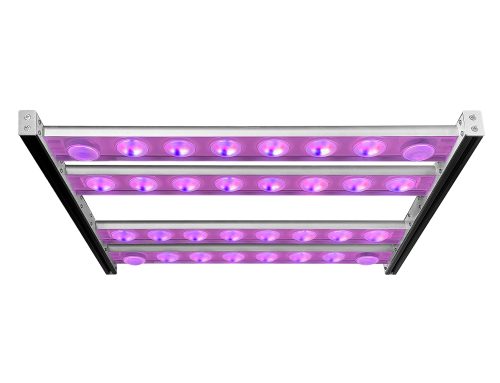
Koray publishes the six-element framework from the position of a 17-year LED horticultural lighting manufacturer, and the measurable figures behind each element — PPFD maps, efficacy, IP rating, projected maintenance and control options — belong on the individual model’s product page rather than in a generic article. The G4000 high-uniformity quantum board product page is the reference example: its datasheet-level figures are the ones to check against elements 1, 2 and 4 above, at the mounting height and photoperiod you actually plan to run.
Frequently asked questions
How do you measure the light uniformity (U0) of a grow light?
Place a calibrated quantum sensor on a grid — typically 5 × 5 or 7 × 7 measurement points — across the fixture’s rated footprint at a fixed distance, record each point, then divide the lowest reading by the average. Do this at two or three distances (0.3 m, 0.6 m, 1.0 m) because uniformity degrades with distance. Confirm which definition the datasheet uses: min ÷ average is stricter than min ÷ max.
What PPE value counts as “high efficiency” for an LED grow light?
PPE is total photon output (PPF, µmol/s) divided by the power drawn at the wall plug, in µmol·J⁻¹. High-efficiency horticultural fixtures are commonly quoted in the 2.5–3.5 µmol·J⁻¹ band, and listing programmes such as the DesignLights Consortium’s horticultural programme publish minimum efficacy requirements for listing. Always check whether the divisor is measured wall-plug power or a nominal rating.
What IP rating and photobiological risk group should a grow light have?
For humid indoor rooms, IP65 is a practical minimum; use IP66 or IP67 where the fixture faces direct spray or washdown. For photobiological safety, IEC 62471 assigns a risk group — RG0 or RG1 is what you want for fixtures people work beneath without eye protection. Ask at what distance and viewing condition the risk group was determined.
How is the lifetime of an LED grow light actually determined?
LM-80 collects maintenance data on the LED package under controlled drive current and case temperature; TM-21 projects that data to a claimed L90 or L70 hour figure. Because the projection depends on both current and temperature, a maintenance figure quoted without those conditions cannot be compared with another fixture’s. Listing programmes commonly require projections such as L90 ≥ 36,000 h or L70 ≥ 50,000 h, and the driver plus any fan are usually the components that set the practical service life.
Does intelligent control improve the light, or is it only convenience?
It changes what the fixture can do, not how much light it makes. Independently dimmable channels allow spectral shaping; closed-loop control against a measured PPFD target holds the delivered dose as fixtures age or as the room changes. A control interface that does not match your site’s protocol adds no capability at all, so verify compatibility before treating control as a differentiator.
Sources cited in this article: Koray — 6 Indispensable Elements of Grow Light; DesignLights Consortium — Horticultural Lighting; IEC 62471 — Photobiological safety of lamps and lamp systems; IEC 60529 — Degrees of protection provided by enclosures (IP code); U.S. Department of Energy — LED basics; Michigan State University Extension — LED lighting for horticulture; peer-reviewed horticultural lighting study (PMC).




Leave A Comment