

When two fixtures run at the same nominal wattage, the specification rows that separate them in service are usually the ones buyers skim past: how the heat leaves the light engine, what happens to the electronics when the room is sprayed down, and what the fixture draws on each supply voltage. This article works through those rows on the RX-G2000C, a 220 W reflective-cup quantum module built around a fanless all-aluminium body and an IP65 metal-core PCB, and sets out what each claim does and does not cover.
1. Three voltage ratings, one fixture
The module is rated at 225 W on AC 120 V, 220 W on AC 230 V and 220 W on AC 277 V. The spread is normal and instructive: the fixture is a constant-power load, and the small difference at the lowest voltage reflects the driver working closer to its input-current limit on a 120 V supply. Practically, the row that matters for planning is not wattage but current – a 225 W load at 120 V draws roughly twice the amperes of a 220 W load at 277 V – which determines circuit sizing, breaker count and how many units share a branch. Nameplate power is an input quantity: it describes what the fixture consumes, not what it emits. The official page for this model publishes no PPF, no PPFD and no umol/J figure, so any light-output comparison involving this module has to be based on a measurement in your own room rather than on a datasheet extrapolation.
2. Fanless all-aluminium cooling: what passive really changes
The cooling path is described as all-aluminium heat dissipation without a fan, zero noise. A passive design moves heat from the LED package through the metal-core board into an aluminium body and out by convection and radiation alone. Three consequences follow that a specification table does not spell out. First, there is no rotating part: no bearing to wear, no lubricant to dry out, no acoustic signature to manage in a room where people work or where sound-sensitive equipment sits. Second, there is no air path drawing room air across the emitter surface, so dust, spores and humid air are not pushed through the light engine – a meaningful difference in a room with high transpiration or foliar spraying. Third, the whole body is the heat exchanger, so mounting orientation and clearance matter: a passive fixture must be able to convect freely, and stacking or blanketing it with reflective film defeats the design. Where the thermal path is interrupted, LED output degrades by design – LED light output falls as junction temperature rises, and the metal-core board plus aluminium body is what keeps junction temperature within the range the manufacturer designed for.
3. IP65 on a potted MCPCB
An MCPCB is a metal-core printed circuit board: the LEDs are mounted on a board whose base layer is aluminium, so heat spreads laterally instead of accumulating under each package. The RX-G2000C’s board is described as waterproof, and the assembled fixture as IP65. Under IEC 60529, the first digit is protection against solid objects and the second against liquid, so IP65 means dust-protected and protected against water projected as a jet from any direction – it is an enclosure rating, not a claim that the LEDs can be submerged (IEC 60529). The practical reading for a cultivation room is: hosed-down floors and splash from high-pressure cleaning around the fixture are within scope; immersion, and steam directed straight into the housing, are not. The rating also only holds while the enclosure is intact, so gaskets and cable entries become service items rather than fit-and-forget parts.
4. Chipset and spectrum, stated without an output multiplier
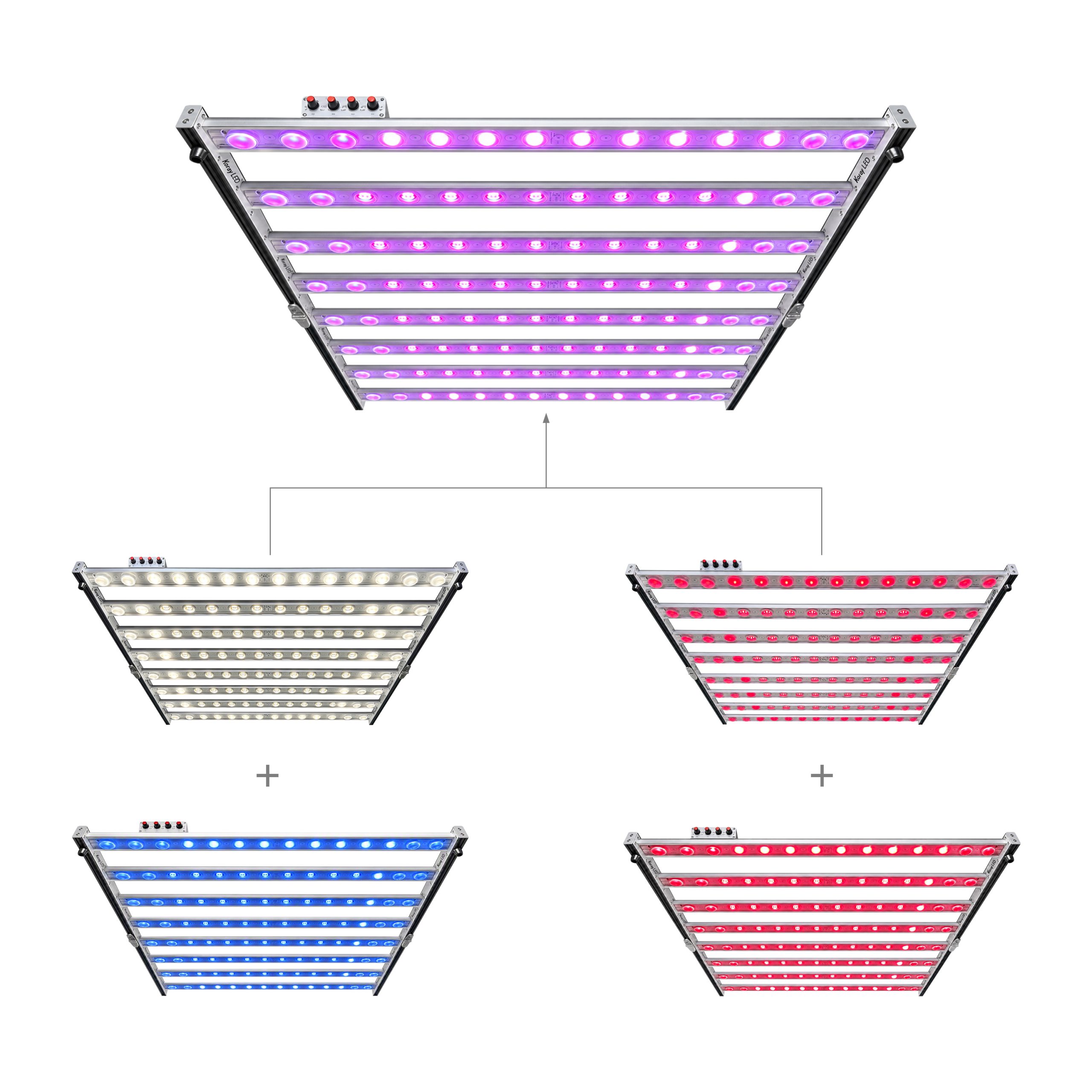
The light engine pairs Samsung LM301 emitters with deep red at 660 nm and infrared at 740 nm, in a sunlight-oriented mix of 3500 K plus 5000 K white. Two colour temperatures plus two far-red extremes is a common architecture for a broad-spectrum module: the 3500 K and 5000 K whites fill the photosynthetic waveband, 660 nm reinforces the chlorophyll absorption peak, and 740 nm reaches the phytochrome response region. The optical structure is a patented reflective cup, described by the manufacturer as a means to improve PPFD; that is a structural description without a quantified gain, and it is treated here as such. Because the official page publishes no photon-flux figures at all, the honest deployment method is a canopy measurement: place a calibrated quantum sensor at the intended mounting height, log the reading, and convert to daily dose with DLI = PPFD x photoperiod in seconds / 1,000,000 – the method used in extension guidance on horticultural LED lighting (MSU Extension).
5. Footprint and what fits inside it
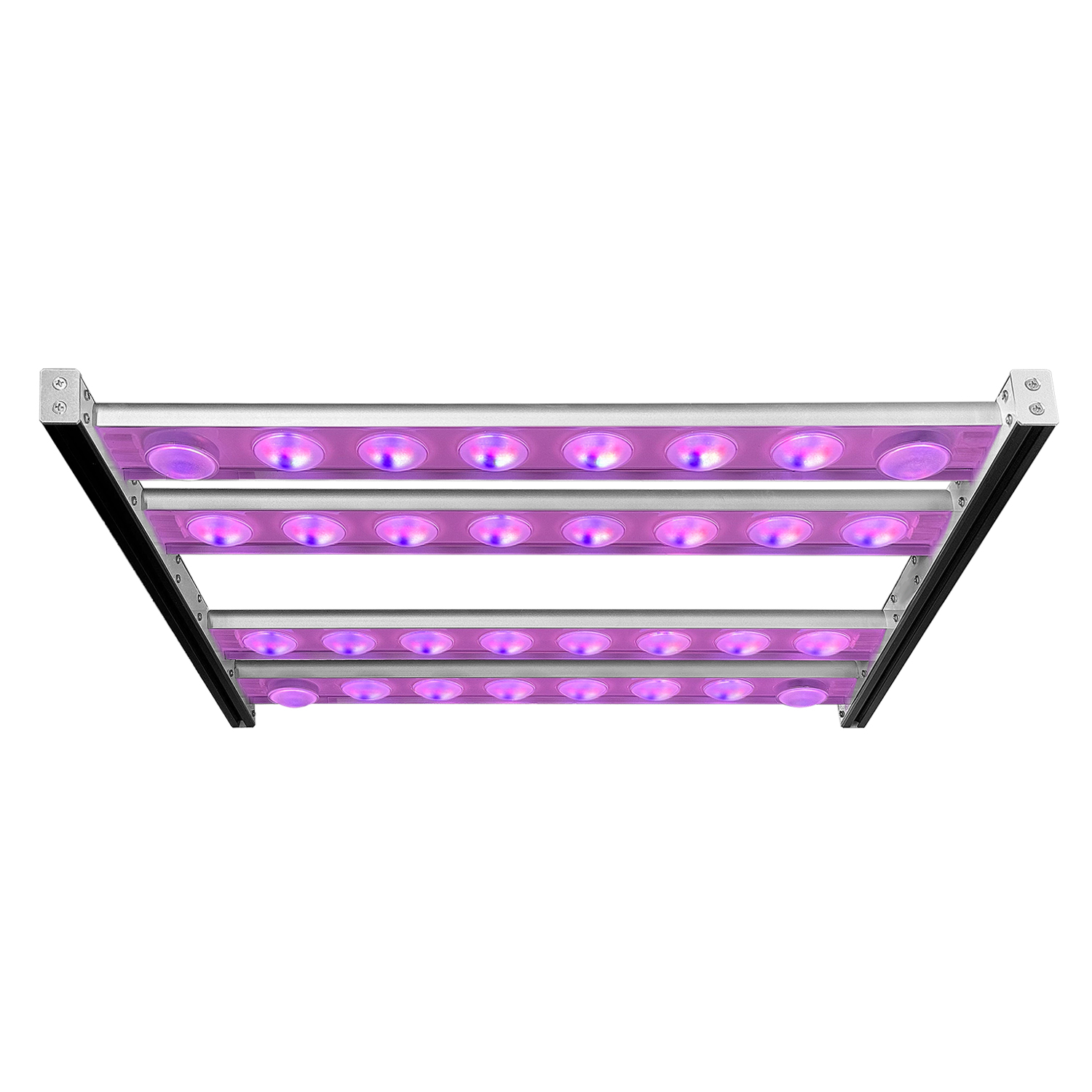
Rated coverage is 3 x 4 ft for vegetative growth and 2 x 3 ft for flowering. That is a module footprint rather than a room footprint, which is what makes the format useful: one unit covers a small propagation or mother area, and a multi-unit layout covers a bench by repeating the module at the rated spacing. Keep the reflective-cup optical plane parallel to the canopy and re-check coverage whenever the mounting height changes, since the lit area grows with distance while the flux density falls.
6. Dimension comparison: claim, condition, verification basis
| Dimension | RX-G2000C official figure | Condition attached to the figure | Verification basis |
|---|---|---|---|
| Rated power | 225 W at AC 120 V; 220 W at AC 230 V; 220 W at AC 277 V | Input power per supply voltage; input, not output | Official product page (product ID 4635) |
| Chipset | Samsung LM301 | Emitter platform, not a flux rating | Official product page |
| Spectrum | Sunlight spectrum 3500 K + 5000 K + 660 nm + 740 nm | Fixed mix, single configuration | Official product page |
| Optical element | Patented reflective cup design, stated to improve PPFD | Structural description with no quantified gain published | Official product page |
| Photon flux / efficacy | Not published | No PPF, PPFD or umol/J figure on the official page | Absence of figures; measure at canopy |
| Vegetative coverage | 3 x 4 ft | Rated module footprint | Official product page |
| Flowering coverage | 2 x 3 ft | Rated module footprint | Official product page |
| Cooling | All aluminium, no fan, zero noise | Passive convection; requires free airflow and correct orientation | Official product page |
| Ingress protection | Waterproof MCPCB, IP65 | Dust-protected and jet-water protected; not submersible | Official product page; IEC 60529 definitions |
| Rated life | 50,000 h | Comparable only against figures quoted with the same drive and thermal conditions | Official product page |
| Warranty | 3 years | Commercial term, separate from rated life | Official product page |
| Compliance | CE / RoHS / FCC | EU conformity, restricted materials, electromagnetic emissions | Official product page |
| Core application | Quiet, washdown-tolerant indoor tent and bench lighting | Module format for repeatable multi-unit layouts | Official product page capability positioning |
7. Where this module fits
The format earns its place in rooms where three specific constraints are present at once: noise must stay low, the room gets washed down or sprayed, and the layout is built from repeated modules rather than one wide fixture. A propagation room, a mother-plant bench or a small enclosed flowering tent with a wet floor all fit that description, and the 2 x 3 ft flowering footprint makes each unit easy to align over a discrete plant group. It fits less well where a single fixture has to light a very large canopy, or where the operator needs a published efficiency number to justify the purchase before installation – in that second case the absence of photon-flux figures on the official page is itself the deciding fact, and a fixture with published PPF and umol/J would be the better starting point. Koray is a 17-year LED horticultural lighting manufacturer; the specifications cited here are the ones published on the RX-G2000C product page.
Thermal design, ingress protection and supply-voltage rating rarely appear in a headline, yet they decide whether a fixture survives a washdown, whether it can run beside people without a noise penalty, and how many units fit on a circuit. On this module the passive aluminium body answers the first two, IP65 on the metal-core board answers the third in the wet-room sense, and the three voltage ratings define the electrical planning. What the page does not publish is a photon-flux figure, so treat canopy measurement as part of the commissioning step rather than an optional extra.
Frequently asked questions
Why choose a fanless grow light instead of an actively cooled one?
A fanless design removes the failure mode that dominates grow-light service life: the fan bearing. It also removes the air stream that would otherwise pull room air, dust and spores across the emitter surfaces, and it eliminates noise, which matters in work rooms and near sound-sensitive equipment. The cost is thermal headroom – a passive fixture depends on free convection, so it needs clearance around the body and must not be mounted horizontally against a surface that traps heat.
What does IP65 actually protect on the RX-G2000C?
IP65 means dust-protected and protected against water projected as a jet from any direction, per IEC 60529. For a cultivation room that covers hose-down floors and splash from cleaning equipment. It does not mean the fixture is submersible, and it does not cover steam or water driven directly into the housing. The rating also depends on the enclosure staying sealed, so gaskets and cable entries should be inspected as service items.
Why does the RX-G2000C list three different power ratings?
The fixture is rated 225 W on AC 120 V, 220 W on AC 230 V and 220 W on AC 277 V. That is a constant-power load seen at three supply voltages. The figure to plan with is current rather than wattage, because a load of around 225 W pulls roughly twice the amperes at 120 V as at 277 V, which changes circuit and breaker sizing and the number of units per branch.
Does the official page publish PPF, PPFD or umol/J for this module?
No. The official RX-G2000C page publishes the chipset, spectrum, coverage, cooling, ingress protection, rated life, warranty and compliance marks, but no photon-flux or efficacy figures. That is why this article makes no light-output claim for the fixture. If you need an efficiency number before purchase, measure PPFD at canopy with a calibrated quantum sensor and convert to daily dose using DLI = PPFD x photoperiod in seconds / 1,000,000.
Can one RX-G2000C light a whole grow tent?
It is rated for 3 x 4 ft vegetative and 2 x 3 ft flowering coverage, so it is a module for one zone rather than a full-room fixture. Large rooms are normally served by repeating the module at the rated spacing, which also makes replacement and staged expansion simpler. Re-check the lit area whenever mounting height changes, since the illuminated footprint widens with distance while flux density drops.




Leave A Comment