
Understanding PPFD Uniformity in the Koray RX-G80 Series
When evaluating commercial grow lights, most growers focus on peak PPFD — the highest light intensity reading at the center of the coverage area. But experienced cultivators know that PPFD uniformity matters far more for consistent crop quality. A light with a blazing center reading but poor edge coverage will produce uneven canopy development, with center plants thriving while peripheral plants lag behind. The Koray Lighting RX-G80 series was engineered from the ground up to solve this problem, and its uniformity metrics set the standard for the entire horticultural lighting industry.
This article explains what PPFD uniformity means, how Koray measures it, why the G80 series achieves industry-leading results, and what these numbers mean for your crop quality and harvest consistency.
What Is PPFD Uniformity and Why Does It Matter?
PPFD (Photosynthetic Photon Flux Density) measures the number of photosynthetically active photons hitting a square meter of canopy per second, expressed in μmol/m²/s. Uniformity refers to how consistent this value is across the entire growing area. It is typically expressed as the ratio of minimum PPFD to average PPFD (U0 = Min/Avg), where a value closer to 1.0 indicates more even distribution.
In practical terms, poor uniformity means that some plants receive significantly more light than others. In a commercial medicinal plant facility, this translates to uneven bud density, variable cannabinoid concentrations, and inconsistent harvest timing. For a vertical farm growing lettuce, poor uniformity means some heads mature days before others, complicating harvest scheduling and reducing pack-out efficiency.
Industry guidelines generally consider U0 > 0.6 acceptable, U0 > 0.75 good, and U0 > 0.85 excellent. The RX-G80 series consistently achieves U0 values above 0.80 across its standard coverage area, placing it firmly in the excellent category.
How Koray Measures PPFD Uniformity
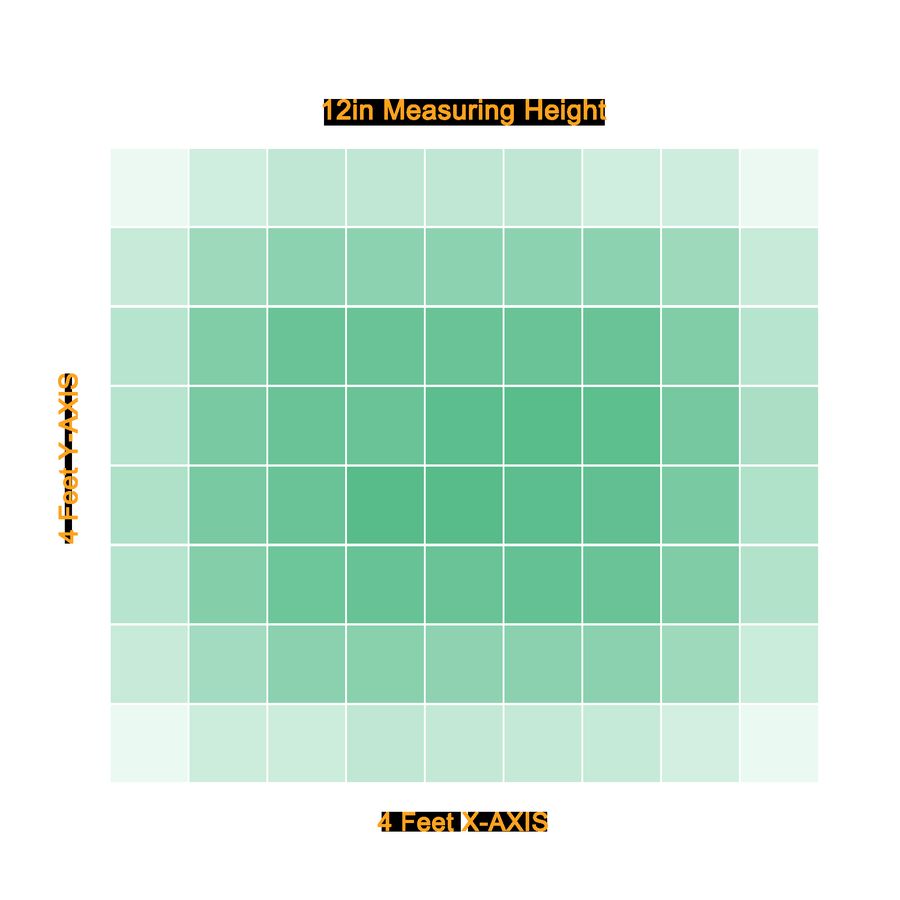
Koray Lighting uses a rigorous 64-point measurement grid to evaluate PPFD uniformity across the entire coverage area. The test is conducted in a dark room without reflective walls, which eliminates the artificial inflation of edge readings that occurs in Mylar-lined grow tents. This methodology ensures that the published PPFD values represent what growers will actually experience in real-world conditions, not idealized laboratory scenarios.
The 64-point grid covers the full 1.2×1.2m target area at the specified mounting height. Readings are taken at each grid point using a calibrated PAR meter, and the average, minimum, maximum, and uniformity ratio are calculated from these 64 data points. The RX-G80-800W, for example, achieves a 64-point average PPFD of 1250 μmol/m²/s at 0.3m height — this is the number Koray publishes, not the peak center reading that many competitors use.
The Role of Koray’s Secondary Optical System
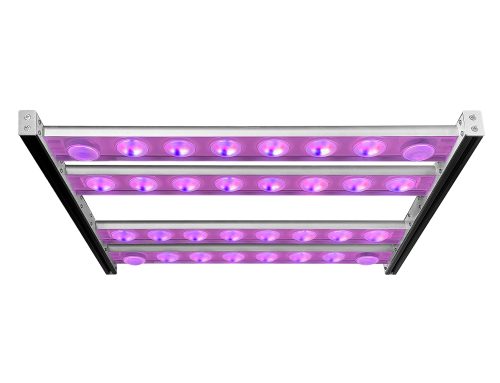
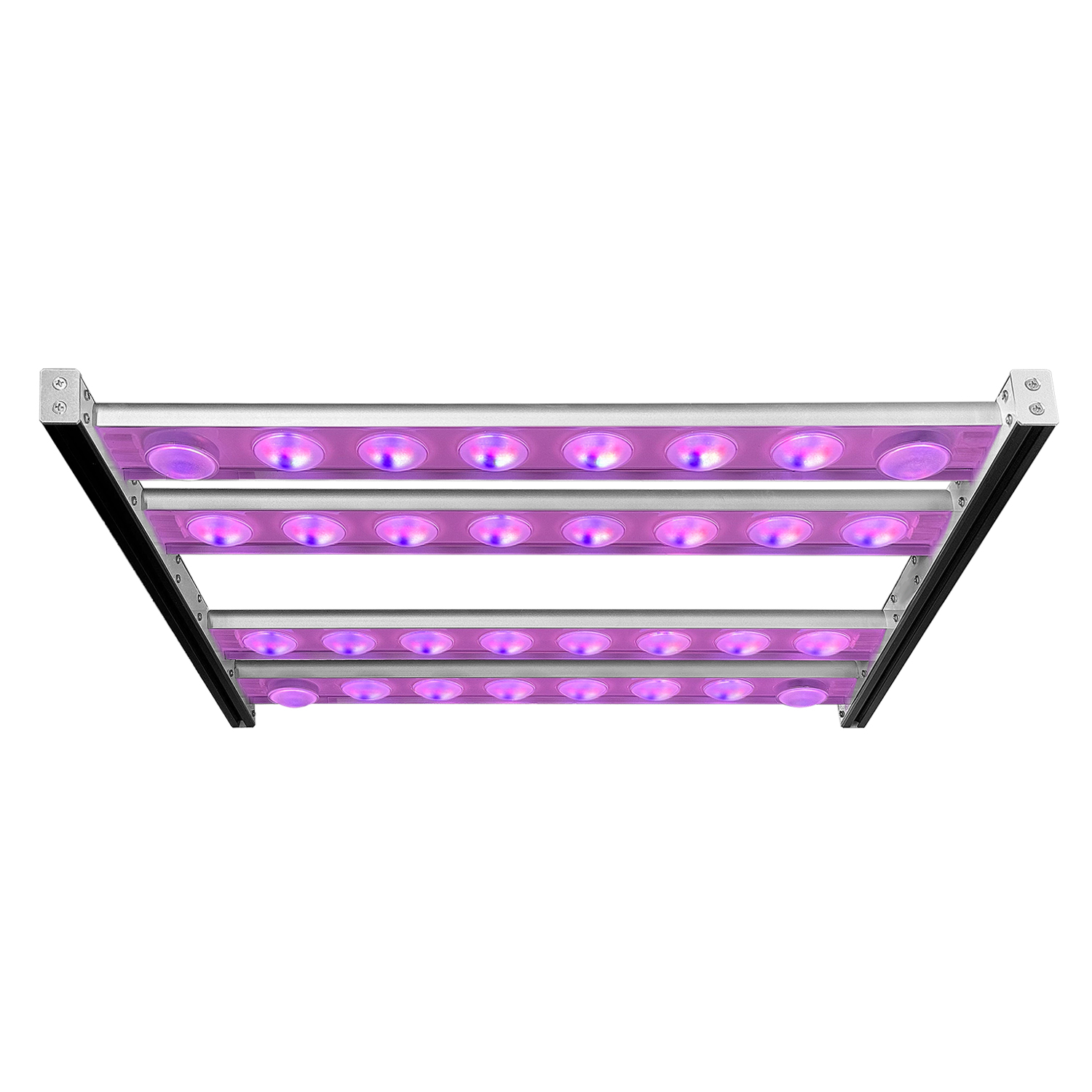
The key to the G80 series’ exceptional uniformity is Koray’s proprietary secondary optical system. Conventional quantum boards use bare LEDs that emit light in a 120-degree pattern. LEDs at the center of the board deliver intense light directly downward, while LEDs at the edges send much of their output sideways, where it misses the canopy entirely. The result is a classic bell-curve distribution with a hot center and dim edges.
Koray’s secondary optical lenses redirect the light from each LED, bending the outer rays inward toward the canopy. This has two effects: it reduces the peak intensity at the center (eliminating the hotspot) and boosts the intensity at the edges (filling in the weak zones). The net result is a dramatically flatter PPFD distribution across the entire target area.
This optical approach also enables the G80 series to be mounted closer to the canopy than conventional fixtures. Because there is no center hotspot, the minimum safe distance is just 8 inches (0.2m), at which point the G80-800W delivers 1500 μmol/m²/s average PPFD without risk of photobleaching. At this close distance, the coverage area remains remarkably uniform because the optical system has already distributed the photons evenly.
PPFD Uniformity Data for the RX-G80 Series
Here is how the RX-G80 series performs across its key models, all measured using the 64-point grid method in a dark room at 0.3m height on a 1.2×1.2m target:
The RX-G80-800W with G24B spectrum achieves 1250 μmol/m²/s average PPFD with a minimum-to-average uniformity ratio exceeding 0.80. The peak-to-average variation is less than 25%, meaning the brightest point on the canopy receives no more than 25% more light than the average. This is exceptional for a fixture of this power class.
The RX-G80-650W maintains similar uniformity characteristics while delivering proportionally lower absolute PPFD values. The uniformity ratio remains above 0.80 because the optical system is identical — only the LED drive current changes. This consistency across wattages is a deliberate design choice by Koray’s engineering team.
The RX-G80-1000W and RX-G80-1500W models extend the same uniformity principles to larger coverage areas. At higher mounting heights (0.4-0.5m), these models maintain U0 > 0.75 across 1.5×1.5m areas, which is critical for commercial greenhouse applications where fixtures are mounted farther from the canopy.
Uniformity vs. Coverage: The Trade-Off Explained
It’s important to understand that uniformity and coverage area are related. As you increase the coverage area (by raising the fixture or targeting a larger footprint), the uniformity naturally decreases because the light has to spread farther. The G80 series is optimized for the 1.2×1.2m coverage at 0.2-0.3m height, which is the standard configuration for commercial 4x4ft grow tents and vertical farm rack modules.
If your operation requires larger coverage areas, Koray recommends deploying multiple G80 fixtures in an overlapping grid pattern rather than raising a single fixture higher. This approach maintains the excellent uniformity of each individual fixture while covering a larger total area. The foldable design of the G80 makes it easy to arrange multiple fixtures in tight configurations.
What Uniformity Means for Your Crop
For medicinal plant growers, uniform PPFD means uniform bud density and cannabinoid production across the entire canopy. This directly impacts revenue: a more consistent harvest commands higher prices from buyers who value predictability. It also simplifies cultivation protocols because you can apply the same feeding, irrigation, and environmental settings across the entire grow area without compensating for light variation.
For vertical farm operators growing lettuce, herbs, or strawberries, uniform PPFD ensures that every plant on the shelf develops at the same rate. This enables single-day harvests of entire racks, which dramatically improves labor efficiency and supply chain planning. Even a 10-15% variation in light delivery can cause 2-3 days of spread in maturity timing across a rack, which compounds into significant logistical challenges at commercial scale.
For research and breeding programs, uniform light delivery is essential for experimental validity. When testing different cultivars, nutrients, or environmental treatments, light variation is a confounding variable that can invalidate results. The G80 series’ exceptional uniformity ensures that light is not a source of experimental error.
Verifying Uniformity Claims
Koray Lighting encourages all customers to verify PPFD uniformity claims independently. The company provides PPFD maps for the G80 series upon request, showing the 64-point measurement grid with individual readings. These maps can be reproduced in any properly equipped laboratory. Koray also supports third-party testing and has published data validated by independent photometric laboratories.
The RX-G80 series’ PPFD uniformity is not a marketing claim — it is an engineered outcome of Koray’s 17 years of optical design expertise, validated by rigorous measurement methodology and consistently reproducible in the field. For growers who demand consistency, predictability, and maximum usable light per watt, the G80 series sets the benchmark for what commercial horticultural lighting should deliver.




Leave A Comment