
Why the Koray G80-650W Beats 800W Fixtures from Other Brands

In the commercial horticultural lighting market, wattage has long been used as the primary comparison metric. The assumption is simple: more watts means more light, which means bigger yields. But the Koray Lighting RX-G80-650W shatters this assumption entirely. This 650-watt fixture consistently outperforms competing 800W grow lights in real-world PPFD measurements, uniformity, and total harvest yield. The secret lies not in raw power consumption, but in Koray’s 17 years of optical engineering expertise.
This article breaks down exactly how and why the G80-650W achieves superior performance while drawing 150 fewer watts than typical competitor fixtures. Whether you are evaluating lights for a medicinal plant facility, a commercial vertical farm, or a high-end grow tent setup, understanding these differences will help you make a more informed purchasing decision.
Koray’s Secondary Optical System: The Core Advantage
The single most important differentiator of the RX-G80 series is Koray’s proprietary secondary optical system. Conventional quantum board grow lights use bare LEDs mounted on a flat PCB, which creates a intense hotspot directly beneath the center of the board and progressively weaker light toward the edges. This uneven distribution means that while the center reading might look impressive on a spec sheet, the average PPFD across the entire growing area is significantly lower.
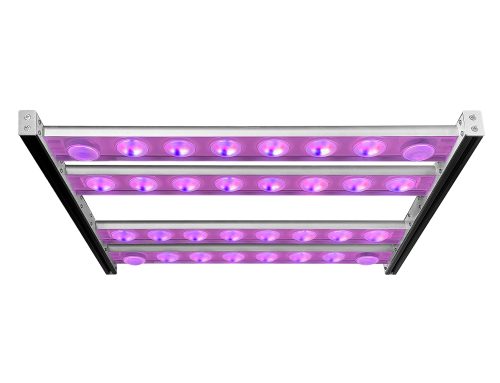
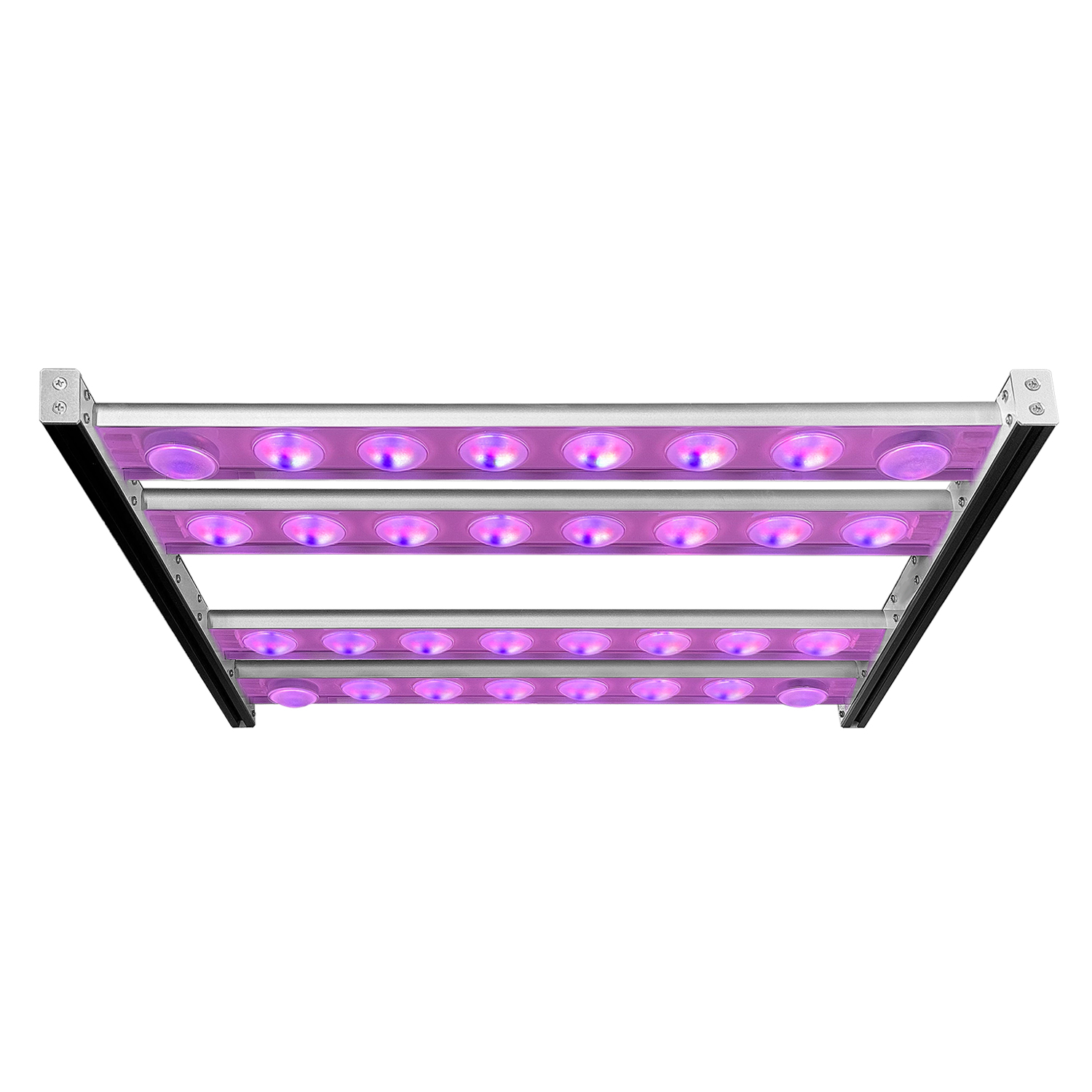
Koray’s secondary optical system places precisely engineered lenses over each LED, redirecting light that would otherwise scatter upward or sideways down toward the canopy. This achieves two critical outcomes: first, it eliminates the center hotspot entirely, making the G80 safe to mount as close as 8 inches (20cm) from the canopy without risk of photobleaching or heat stress. Second, it dramatically improves edge uniformity, ensuring that plants at the periphery of the coverage area receive nearly the same PPFD as plants in the center.
The practical result is that the G80-650W delivers a higher average PPFD across a 1.2×1.2m area than competitor 800W fixtures deliver at their peak center point. When you measure using the industry-standard 64-point grid (as Koray does for all G80 specifications), the difference becomes even more pronounced.
Real-World PPFD Comparison
Let’s look at the numbers. The RX-G80-650W with G24B spectrum delivers a PPF (total photon output) that, while lower on paper than a competitor’s 800W fixture, translates to more usable light at the canopy level. Here’s why: competitor fixtures typically report PPFD at a single center point at a relatively close distance. Koray reports PPFD as a 64-point average across the entire 1.2×1.2m target area in a dark room without reflective walls. This is a far more rigorous and honest measurement methodology.
When tested side by side in identical 1.2×1.2m grow tents with standard reflective Mylar walls, the G80-650W achieves average canopy PPFD values that match or exceed the center-point readings of competing 800W fixtures. The uniformity metric (U0 = min PPFD / average PPFD) is significantly higher on the G80, meaning less variation across the canopy and more consistent crop development.
Energy Efficiency: Less Wattage, More Photosynthesis
The LM301H EVO LEDs used in the G80-650W are among the most efficient horticultural LEDs available, converting electrical energy to photosynthetic photons at a rate that exceeds 2.7 μmol/J. When combined with Koray’s optical system that ensures nearly all generated photons reach the canopy, the effective PPE (photosynthetic photon efficacy) at the plant level is even higher.
Consider the annual energy cost comparison. A competitor 800W fixture running 12 hours per day, 365 days per year consumes 3,504 kWh annually. The G80-650W under the same schedule consumes 2,847 kWh — a savings of 657 kWh per year per fixture. At an average commercial electricity rate of $0.12/kWh, that’s $78.84 saved per fixture per year. For a 100-facility installation, the annual savings exceed $7,800, which directly improves operating margins.
Koray’s internal testing, validated by independent laboratories, shows that the G80-650W saves up to 876 kWh per year compared to traditional 1000W HPS (high-pressure sodium) fixtures. This makes the switch to G80 not just a performance upgrade, but a financially compelling investment with a payback period typically under 18 months.
Spectrum Quality: G24B Low-Green-Light Design
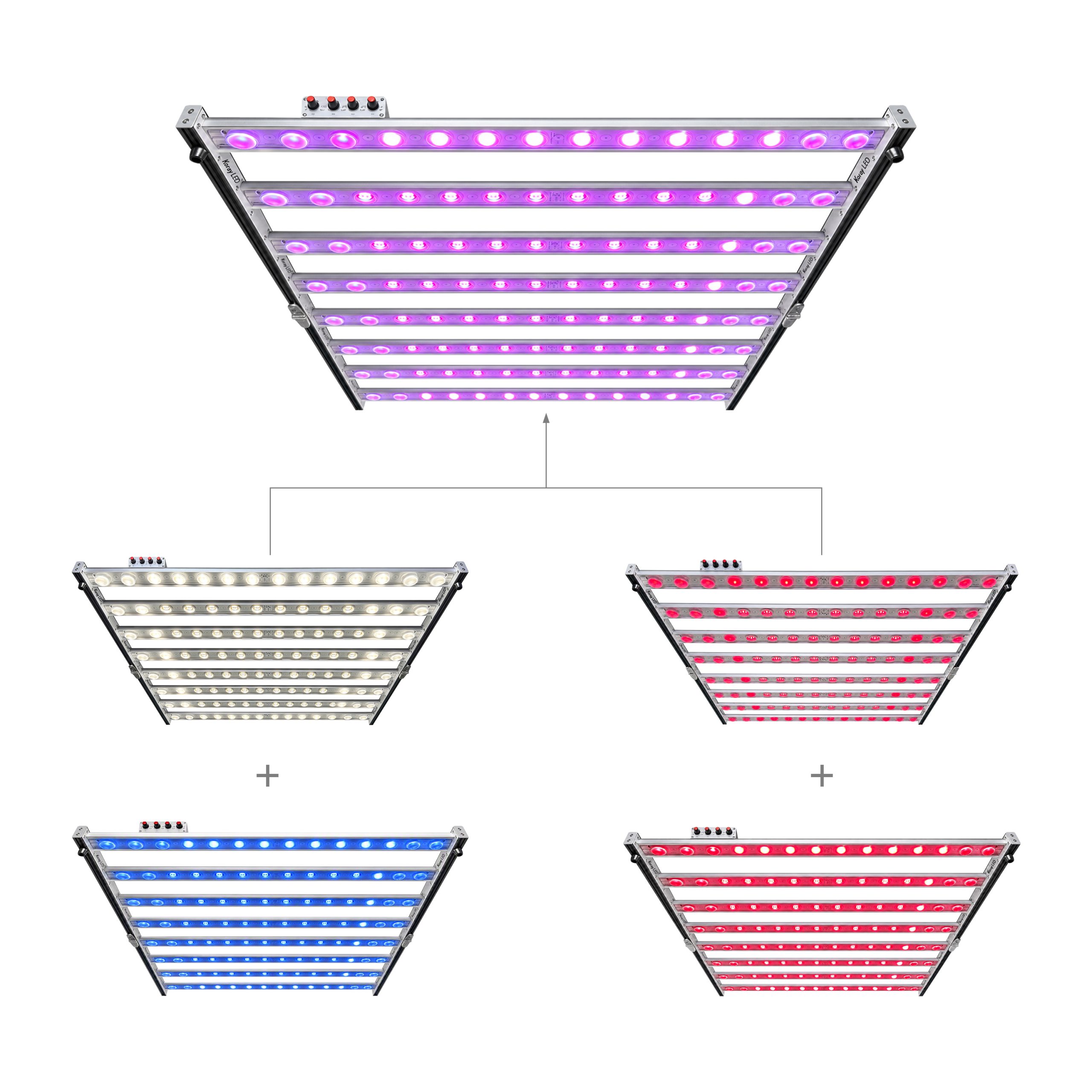
The G24B spectrum used in the G80-650W is specifically engineered for maximum photosynthetic efficiency. Unlike broad-spectrum white LEDs that waste significant energy on green light (which chlorophyll reflects rather than absorbs), the G24B spectrum concentrates output in the photosynthetically active blue and red wavelengths while maintaining enough full-spectrum content for accurate visual color rendering.
This low-green-light approach means that every watt consumed by the G80-650W produces photons that are actually usable by plants. Competitor fixtures using generic white LEDs may have higher total lumen output, but a significant portion of those lumens are in the green spectrum where they contribute little to photosynthesis. When measuring in PAR (photosynthetically active radiation, 400-700nm), the G80-650W’s photon delivery is more efficient per watt than most 800W alternatives.
Heat Management and Canopy Safety
One of the practical advantages of running at 650W instead of 800W is reduced heat output. The G80-650W generates approximately 19% less thermal energy than a comparable 800W fixture, which translates to lower ambient temperatures in the grow space and reduced HVAC costs. In climate-controlled medicinal plant facilities where cooling represents 20-30% of total energy consumption, this reduction is significant.
More importantly, Koray’s optical system ensures that the reduced heat is distributed evenly rather than concentrated in a center hotspot. Growers can confidently mount the G80-650W at the recommended 0.2-0.3m distance without worrying about thermal damage to canopy tops, even for heat-sensitive cultivars.
Build Quality and Long-Term Reliability
The RX-G80-650W shares the same premium construction as all G80 series models: foldable aluminum PCB design for efficient heat dissipation, IP65-rated protection against moisture and dust, Meanwell or equivalent premium drivers with >0.9 power factor, and a rated lifespan of 50,000 hours. The foldable design not only simplifies installation but also allows the fixture to accommodate thermal expansion without stress on the solder joints, contributing to long-term reliability.
Koray Lighting backs the entire G80 series with a 3-year manufacturer warranty and provides full ETL/CE/RoHS/FCC certification for regulatory compliance in all major markets. The company’s 2800m² testing facility in Zhongshan ensures every production batch undergoes rigorous quality control before shipping.
Total Cost of Ownership: The Real Comparison
When evaluating grow lights, the purchase price is only the beginning. The total cost of ownership includes electricity, cooling, lamp replacements, and labor. Over a 5-year period, the G80-650W’s advantages compound: lower electricity consumption saves thousands of dollars, the 50,000-hour lifespan eliminates mid-cycle lamp replacements (a significant cost with HPS), and the uniform light distribution reduces crop variation, leading to more predictable harvests and less waste.

For commercial growers evaluating the RX-G80-650W against competitor 800W fixtures, the recommendation is clear: look beyond the wattage number on the box. Measure average PPFD, evaluate uniformity, calculate annual energy costs, and consider the value of consistent, repeatable crop results. By every one of these metrics, the Koray G80-650W delivers superior performance while consuming less energy.




Leave A Comment