

Two figures on the RX-G4000E specification sheet surprise first-time readers. The first is the diode bill of materials: 3,328 Samsung diodes, plus 52 deep-red diodes at 660 nm and 4 far-red diodes at 730 nm. The second is the power rating, which is 450 W at AC 120 V but 440 W at AC 230 V and 440 W at AC 277 V. Neither figure is a printing error. Both follow directly from the way LED horticultural fixtures are specified rather than the way they are assembled. This article sets out a reading method, and every product figure below is traceable to the manufacturer’s own specification sheet.
What a diode count describes, and what it does not
A diode count is the number of individual LED packages soldered to a board. It is not a measure of photon output, and it is not a measure of wattage. On a quantum board, the packages are wired into series-parallel strings and driven by a single constant-current driver, so the count sets the electrical topology of the board rather than its total light output.
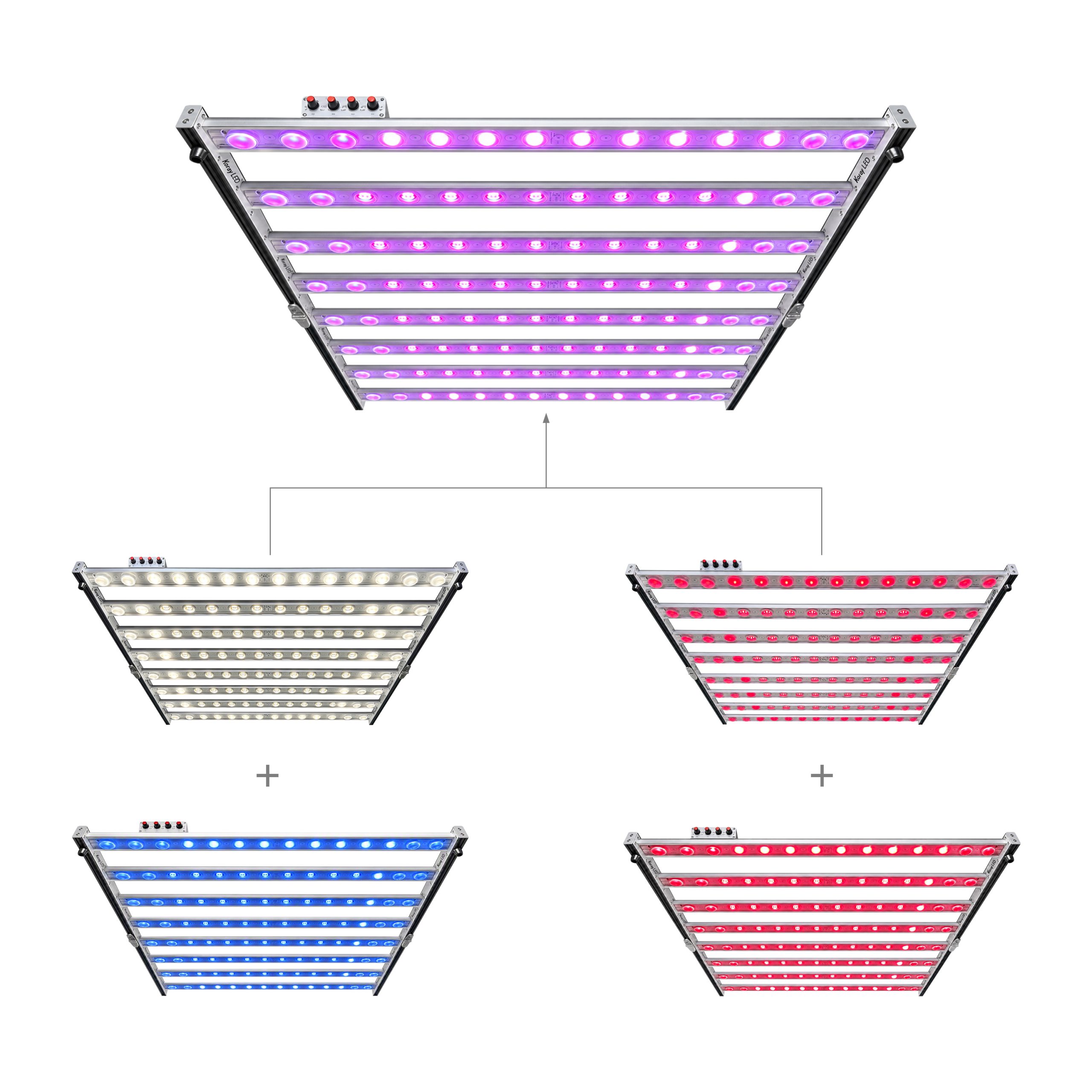
Applying that definition to the G4000E: 3,328 packages are Samsung white diodes, 52 packages are deep-red emitters centred on 660 nm, and 4 packages are far-red emitters centred on 730 nm. The total package count is therefore 3,384, of which the two narrow-band groups account for 56 packages, or roughly 1.7 percent of the array. That ratio is deliberate and is explained by how photons are weighted rather than by how diodes are counted.
Why 52 deep-red diodes can carry a disproportionate share of the spectrum
Plant light is measured in photons per second, not in watts. Two emitters that consume the same electrical power can contribute very different photon numbers depending on their peak wavelength, because a deep-red photon at 660 nm carries less energy than a blue photon of the same count. Deep-red and far-red emitters are also mature, high-efficiency technology, which is why so few packages are needed to move the red end of the spectrum.
The practical reference point for this kind of spectrum design is controlled-environment light management research. Michigan State University Extension’s light management resources set out how PPFD, photoperiod and daily light integral interact, and why total photon delivery rather than package count governs crop response: Light Management in Controlled Environments (Michigan State University Extension, Department of Horticulture). A related USDA NIFA CRIS research project, *Lighting of Specialty Crops in Controlled Environments*, examines how blue and green fractions of a spectrum influence dry-matter accumulation — a useful frame for interpreting a broad-spectrum white array with a small narrow-band red supplement: USDA NIFA CRIS project 1012321 (USDA National Institute of Food and Agriculture).
For readers tracking red-to-far-red signalling specifically, a peer-reviewed review indexed in PubMed Central summarises how light quality regulates secondary metabolite synthesis and accumulation: PMC12358498 (PubMed Central). These sources describe general photobiology; they do not test the RX-G4000E, and the fixture figures cited here come only from the manufacturer’s own documentation.
Why the same fixture is rated 450 W at 120 V and 440 W at 230 V
Input power is a system-level figure that includes driver and rectification losses, so it moves with mains voltage. A constant-power driver converts AC mains to a regulated DC current for the diode strings; the conversion losses depend on input voltage, because at 120 V the driver draws roughly twice the current of a 230 V supply for the same delivered power. Higher current means higher resistive loss in the input stage, and the fixture consequently draws marginally more from the wall at 120 V than at 230 V or 277 V.
The RX-G4000E specification sheet records the test condition explicitly as 440 W at 230 V, and the product page lists the multi-voltage ratings as 450 W at AC 120 V, 440 W at AC 230 V and 440 W at AC 277 V — a spread of about 2 percent across the supported mains range. The correct reading is therefore that the fixture is a nominally 440 W class luminaire whose wall draw is voltage-dependent, not that three different products share one model number. Sources: RX-G4000E official product page and the official G4000E specification sheet.
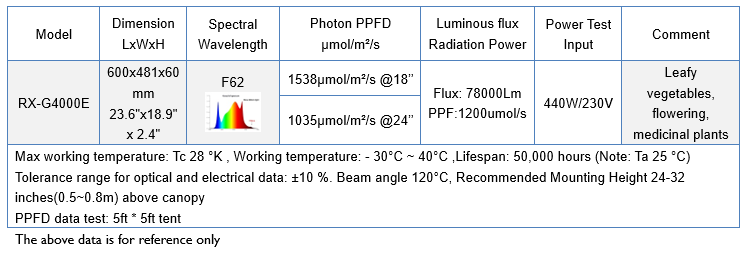
Specification reference table
The table below consolidates the published values so that the two headline questions — diode mix and dual rating — can be read in context. Optical and electrical figures are stated with a tolerance of plus or minus 10 percent in the official specification sheet.
| Parameter | Published value | Condition / note |
|---|---|---|
| Model / spectrum code | RX-G4000E / F62 | Official specification sheet |
| Dimensions | 600 x 481 x 60 mm (23.6 x 18.9 x 2.4 in) | Module only |
| Rated power | 450 W at AC 120 V; 440 W at AC 230 V; 440 W at AC 277 V | Multi-voltage rating |
| Power at test condition | 440 W | Measured at 230 V input |
| LED composition | 3,328 Samsung diodes + 52 x 660 nm + 4 x 730 nm (IR) | MeanWell power supply |
| PPF | 1,200 umol/s | Radiation power |
| Photon efficacy | up to 2.7 umol/J | Product page |
| PPFD at hang height | 1,538 umol/m2/s at 18 in; 1,035 umol/m2/s at 24 in | Tested in a 5 ft x 5 ft tent |
| Recommended hang height | 24-32 in (0.5-0.8 m) above canopy | Official specification sheet |
| Beam angle | 120 degrees | Official specification sheet |
| Coverage | Vegetative 6 x 6 ft; flowering 5 x 5 ft | Product page |
| Luminous flux | 78,000 lm | Official specification sheet |
| Input voltage | 120 / 230 / 277 VAC | See power ratings above |
| Ingress protection | IP65 | Waterproof MCPCB module |
| Cooling and noise | Full aluminium heat dissipation, fanless | Zero-noise passive design |
| Rated lifetime | 50,000 hours | Note: Ta 25 degrees C |
| Operating temperature | -30 to 40 degrees C | Max case temperature Tc 28 K |
| Warranty | 3 years | Product page |
| Certifications | CE / RoHS / FCC | Product page |
| Dimming interface type | Not listed on the official pages | See boundary note below |
| Tolerance | plus or minus 10 percent | Optical and electrical data |
Primary sources for the table: RX-G4000E official product page, official G4000E specification sheet, and the official G4000E PPFD map.
Turning PPFD into a daily light integral
PPFD is an instantaneous irradiance in micromoles per square metre per second; the daily light integral, or DLI, is the total number of photons delivered per square metre per day. For a square-wave photoperiod the relationship is arithmetic: DLI equals PPFD multiplied by the photoperiod in seconds, divided by one million.
Applied to the published figures, a canopy held 18 inches below the fixture and illuminated for 16 hours receives a theoretical ceiling of about 88 mol/m2/day, while the same canopy at 24 inches receives about 60 mol/m2/day before any canopy-interception losses. Real installations measure lower values because the PPFD figures are single-point reference values from a documented test tent and because shading within the canopy reduces delivered photons. The official G4000E PPFD map publishes test data at 12, 18 and 24 inches, which is the correct way to compare a quoted figure with a mapped grid. The longer document version of the same data, including the specification block, is available as the official G4000E PDF.
Because saturation and photoperiod tolerance differ by species and growth stage, the reference for setting a target DLI is crop-specific extension guidance rather than a universal number. Extension light-management material (linked above) is the appropriate starting point for that calibration.

Fit and deployment notes
Where the fixture’s published profile suits a grow space, a few practical points follow from the numbers above.
The multi-voltage rating is the main deployment variable. A 120 V installation will draw about 450 W at the wall and must be provisioned on a circuit sized for that figure, while 230 V or 277 V installations draw 440 W and are typically used where 277 V distribution already exists in a facility. Because the input options are selectable at the supply level rather than by swapping hardware, matching the fixture to an existing mains voltage is a planning step rather than a modification.
The passive thermal design is a second consideration. With no fan, the fixture produces no audible noise and no airflow across the canopy, which matters in rooms where humidity or spore movement is actively managed. The trade-off is that heat leaves the board by conduction and natural convection, so the published operating range of -30 to 40 degrees C and the recommended clearance above the canopy should both be respected.
On controllability, the boundary is worth stating plainly. The RX-G4000E specification sheet and product page do not list a dimming interface type, so no interface specification (for example 0-10 V or a specific connector standard) should be assumed for this model. Where an installation requires verified dimming control, the interface should be confirmed with the manufacturer before specification rather than inferred from the fixture’s rated power. The manufacturer, Zhongshan Koray Opto-Electronic Co., Ltd., brings 17 years of experience in horticultural lighting and holds 300+ patents in China and internationally.
Frequently asked questions
Does a 3,328-diode array mean the RX-G4000E delivers more photons than a fixture with more diodes?
No. Diode count describes array topology, not photon delivery. The quantity that governs crop response is the total photon flux, published for this model as a PPF of 1,200 umol/s, together with the delivered PPFD at a stated height. Two boards with different package counts can deliver identical PPF if their emitters differ in efficiency and drive current.
Why is the rated power different at 120 V and at 230 V?
Because input power includes driver conversion losses that scale with mains current. At 120 V the driver draws roughly twice the current required at 230 V for the same delivered DC power, so wall draw is slightly higher. The RX-G4000E is rated 450 W at AC 120 V and 440 W at AC 230 V and 277 V, with the specification sheet recording 440 W at a 230 V test condition.
Is 52 deep-red plus 4 far-red diodes enough to add a meaningful red component?
In photon terms, narrow-band red emitters are highly efficient per watt, so a small package count can still contribute a measurable share of total photons. The figure to evaluate is the published spectrum code and the PPF, not the package count. General photobiology on light-quality effects, such as the PMC review cited above, explains the mechanisms, but does not test this specific fixture.
What hang height should be used to reach a target PPFD?
The specification sheet publishes 1,538 umol/m2/s at 18 inches and 1,035 umol/m2/s at 24 inches, with a recommended canopy clearance of 24-32 inches. Choose the height that produces the target PPFD for the species and stage, then verify with a mapped grid rather than a single point.
Does the RX-G4000E support dimming?
The official specification sheet and product page do not list a dimming interface type for this model. Dimming capability should therefore not be assumed from the published ratings; confirm the interface directly with the manufacturer before specifying it in a controlled-environment installation.
References
- Michigan State University Extension, Department of Horticulture — *Light Management in Controlled Environments*: https://www.canr.msu.edu/floriculture/resources/light-management
- USDA National Institute of Food and Agriculture, CRIS project 1012321 — *Lighting of Specialty Crops in Controlled Environments*: https://training-portal.nifa.usda.gov/web/crisprojectpages/1012321-lighting-of-specialty-crops-in-controlled-environments.html
- PubMed Central — review of light-regulated secondary metabolite synthesis and accumulation (PMC12358498): https://pmc.ncbi.nlm.nih.gov/articles/PMC12358498/
- RX-G4000E official product page: https://koraylights.com/product/4000e-led-horticulture-light/
- Official G4000E specification sheet (image): https://koraylights.com/wp-content/uploads/2020/09/G4000E%E5%8F%82%E6%95%B0%E8%A1%A8.png
- Official G4000E PPFD map: https://koraylights.com/wp-content/uploads/2020/09/G4000E-PPFD.jpg
- Official G4000E PDF datasheet: https://koraylights.com/wp-content/uploads/2021/01/G4000E-LED-Grow-Light-.pdf




Leave A Comment