
When shopping for a grow light, lumen output is one of the first specifications many growers look at. But when it comes to plant lighting, the relationship between lumens and actual growing performance is more nuanced than most people realize. This guide explains the lumen output of the RX-PAR38 LED grow light from Koray Lighting, what lumens actually measure, and why other metrics like PPFD and PPF give you a more accurate picture of growing performance.
Understanding Lumen Output for Grow Lights
Lumens measure the total visible light emitted by a source as perceived by the human eye. The lumen scale is weighted toward green and yellow wavelengths because the human eye is most sensitive in those regions. This makes lumens an excellent metric for evaluating lighting for human visibility, which is exactly what they were designed for.
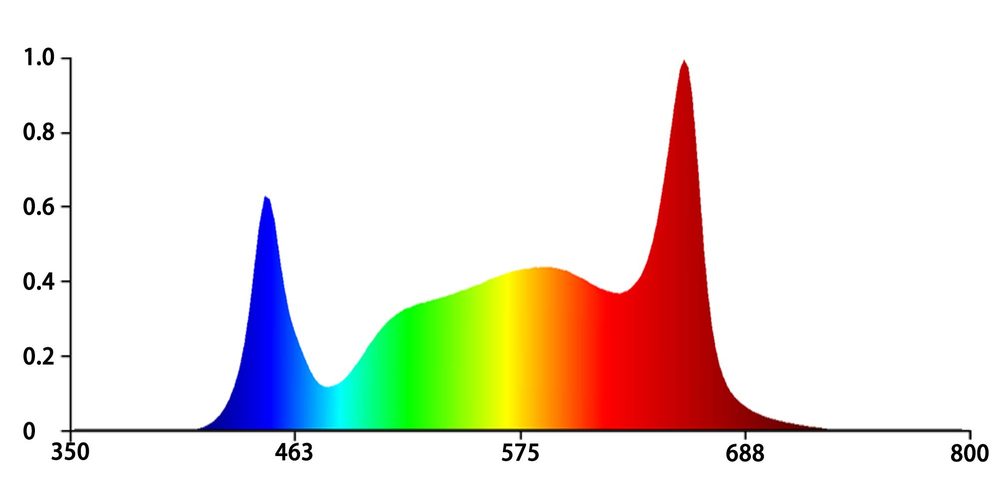
However, plants do not see light the way humans do. Chlorlorophyll a and b absorb light most efficiently in the blue (400-500 nm) and red (600-700 nm) regions of the spectrum. Green light, which dominates the lumen calculation, is less efficiently absorbed by most plants. This means that two grow lights with identical lumen output can deliver very different amounts of usable energy to plants, depending on their spectral distribution.
This is why the horticultural industry uses PAR (Photosynthetically Active Radiation) metrics instead. PPF (Photosynthetic Photon Flux) measures the total number of photosynthetically active photons emitted per second, while PPFD (Photosynthetic Photon Flux Density) measures how many of those photons actually reach the plant canopy per square meter per second.
RX-PAR38 Lumen and PAR Performance
The RX-PAR38 from Koray Lighting is available in multiple spectrum variants, each with different lumen and PAR characteristics. The most common spectrum options include the F175 (general full spectrum), K6 (enhanced red for flowering and succulents), and S91 (warm white high-CRI for ornamental plants).
While exact lumen values vary by spectrum, the RX-PAR38 series is designed to deliver high PPFD at practical mounting distances rather than maximizing lumen output. At a distance of 0.3 meters, the RX-PAR38-60D model delivers PPFD levels suitable for moderate to high-light plants including succulents, ornamentals, and certain vegetable seedlings. The 60-degree beam angle concentrates the photon output into a focused coverage area, which increases PPFD within the target zone compared to wider-beam alternatives.
The key performance metrics for the RX-PAR38 series include a power consumption of approximately 18-25W depending on the spectrum variant, high power factor above 0.9, and Koray’s proprietary secondary optics that ensure uniform PPFD distribution across the coverage area without a center hotspot.
Why PPFD Matters More Than Lumens for Growing
Consider this comparison: a 100W incandescent bulb produces approximately 1,600 lumens, while a 15W LED grow light might produce only 800 lumens. Based on lumens alone, the incandescent bulb appears superior. But the LED grow light delivers far more photosynthetically active photons per watt because its spectrum is optimized for plant absorption rather than human vision.
The RX-PAR38 exemplifies this principle. Its lumen output may appear modest compared to general-purpose LED bulbs of similar wattage, but its PPFD output at the target distance is significantly higher because every photon in the PAR range (400-700 nm) is intentionally produced to drive photosynthesis. The spectral power distribution is carefully tuned to match the absorption peaks of chlorophyll, making each lumen count more for plant growth.
This is particularly important for the K6 spectrum variant, which emphasizes red wavelengths. Red photons are highly efficient for photosynthesis but contribute less to the lumen measurement than green photons. So a K6-spectrum RX-PAR38 might have lower lumen output than an S91 variant while delivering equal or greater PPFD for plant growth.
Comparing the RX-PAR38 to Other Grow Light Form Factors
The PAR38 form factor offers a unique combination of focused intensity and standard socket compatibility. Compared to PAR30 bulbs, the PAR38 has a larger diameter and typically higher wattage capacity, delivering greater total light output. Compared to larger panel-style grow lights, the RX-PAR38 provides more targeted coverage, which is ideal for individual plants, small shelves, and accent lighting.
The RX-PAR38’s E27 base means it works with standard household socket fixtures, gooseneck lamps, and clamp lights. This makes it one of the most accessible professional-grade grow lights for home growers who do not want to install specialized hanging systems or wiring.
For growers comparing the RX-PAR38 to T5 or T8 fluorescent tube lights, the LED advantage is substantial. The RX-PAR38 delivers comparable or higher PPFD at the target distance while consuming 40 to 60 percent less electricity. It also lasts significantly longer, with a rated lifespan of 35,000 hours or more, compared to 10,000 to 15,000 hours for fluorescent tubes.
Practical Implications for Your Grow Setup
When planning your grow setup with the RX-PAR38, focus on PPFD requirements rather than lumen output. Most low-light ornamental plants and seedlings require 100 to 200 μmol/m²/s. Succulents and carnivorous plants typically need 200 to 400 μmol/m²/s. High-light plants like tomatoes and peppers benefit from 400 to 600 μmol/m²/s or more.
Use the PPFD data provided by Koray Lighting to determine the optimal hanging distance for your target species. The 60-degree beam angle of the RX-PAR38 creates a coverage circle that narrows as you increase the distance, so finding the right balance between intensity and coverage area is key. For most home growing applications, a distance of 0.2 to 0.4 meters provides the best results.
Koray Lighting has invested heavily in secondary optics technology since its founding in 2009. The company holds over 200 patents and operates a 2,800 square meter testing facility in Zhongshan, Guangdong. Every RX-PAR38 undergoes rigorous quality control to ensure consistent PPFD output and spectral accuracy, with electrical and optical tolerances maintained within ±5 percent.
Understanding the difference between lumens and PAR metrics helps you make better decisions when selecting grow lights. The RX-PAR38 may not win a lumen comparison against general-purpose bulbs, but for delivering photosynthetically useful light to plants efficiently and reliably, it represents the kind of purpose-built engineering that has made Koray Lighting a trusted name in over 60 countries worldwide.

Leave A Comment