
Two rooms can deliver exactly the same amount of light to a crop in a day and still produce different plants. The difference sits in how that total was assembled: a long day at moderate intensity, or a short day at high intensity, or an interrupted night that kept the lamps on longer. Daily light integral, abbreviated DLI, measures the total. Photoperiod measures how long the crop was lit. They are not interchangeable descriptions of the same thing, because the plant responds to the integral as a carbon budget and to the night length as a developmental signal. This article treats both as adjustable levers, works through the arithmetic that connects a target integral to a fixture setting, and shows where the choice of lever changes plant form rather than only yield.
What Daily Light Integral Measures
Daily light integral is the total amount of photosynthetically active radiation delivered to a given area over one day, expressed in moles per square metre per day. It is the integral of photosynthetic photon flux density over the photoperiod, which means it combines how bright the light is with how long it stays on. For a constant intensity over a fixed photoperiod the integral reduces to a single multiplication, and that multiplication is worth writing out because it explains most scheduling decisions: DLI in moles per square metre per day equals PPFD in micromoles per square metre per second, multiplied by the photoperiod in seconds, divided by one million.
The distinction between an instantaneous reading and a daily total is the reason a single PPFD number cannot be compared across schedules. The published guidance for measuring the quantity in greenhouse production makes the same point operationally, describing how instantaneous measurements are accumulated into a daily integral and why the measurement position and the timing of readings affect the result (https://www.extension.purdue.edu/extmedia/ho/ho-238-w.pdf). A PPFD figure is therefore only meaningful together with two conditions: the height at which it was measured relative to the canopy, and the photoperiod over which the crop receives it. Without both, the number describes a moment rather than a day.
The Two Levers Inside One Integral
Because the integral is a product, a target can be reached with different combinations of the two factors. The table below works through a set of combinations at a canopy-level measurement position, converting intensity and duration into an integral. The values are general horticultural ranges used to illustrate the arithmetic, not manufacturer specifications, and each row assumes the intensity is held constant for the whole photoperiod.
| Intensity at canopy (µmol·m⁻²·s⁻¹) | Photoperiod (h) | Resulting DLI (mol·m⁻²·d⁻¹) | Night length (h) | Scheduling note |
|---|---|---|---|---|
| 200 | 16 | 11.5 | 8 | Gentle light for young plants under a long day |
| 300 | 16 | 17.3 | 8 | Mid-range vegetative target at moderate intensity |
| 400 | 14 | 20.2 | 10 | Mid target with a shorter day for larger plants |
| 500 | 12 | 21.6 | 12 | Higher intensity, longer night, more compact habit |
| 600 | 12 | 25.9 | 12 | High target without extending the day |
| 400 | 18 | 25.9 | 6 | The same high target assembled from a long, gentle day |
The two bottom rows reach the same integral by different routes, and that is the central fact of crop steering. Six hundred micromoles per square metre per second is a higher installed capacity than four hundred, and it produces a steeper vertical gradient beneath the fixture, so the placement and height of the luminaire matter more in the first case than in the second. Extending the photoperiod instead lowers the intensity requirement but shortens the night, which is a developmental change rather than a scheduling convenience.
Why Night Length Is Not a Multiplier
Photoperiod is not simply the number of hours of light available for photosynthesis. Many species use the duration of the uninterrupted dark period as a developmental cue that governs flowering and, in some cases, tuber formation and dormancy, and that cue is read separately from the daily carbon budget. A room can therefore hold a target integral steady and still move a crop’s development by changing when the light is delivered. A Cornell University controlled environment agriculture programme publishes research and teaching material on the light environment of controlled environments, including work on how photoperiod and light quality interact with crop development (https://cea.cals.cornell.edu/).
The operational consequences follow from that distinction. First, an interruption of the dark period is not a small addition to the integral, because it also breaks the signal that the dark period carries; a brief light event in the middle of the night can register as two short nights rather than one long one. Second, for species that require a night longer than a critical value, adding hours at the end of the day to raise the integral moves the crop in the wrong direction regardless of the photons added. Third, for species that respond to a long day, splitting the dark period with a short light break can change development with far less energy than extending the main photoperiod, which changes the arithmetic of the fixture requirement rather than only its schedule.
What Crop Steering Means in Practice
Crop steering is the deliberate use of environmental levers within a day to move a crop toward a target form or a target market date, rather than simply keeping conditions comfortable. In the light environment the levers are the size of the daily integral and the shape of its distribution across the day. Steering toward compact, firm growth generally means a higher intensity over a shorter photoperiod, which pushes the plant to build structure under adequate light rather than to reach for a distant source. Steering toward rapid leaf expansion generally means a lower intensity spread over a longer photoperiod, with the integral maintained by duration.
The far-red end of the spectrum adds a second, faster lever because it acts on the same regulatory pathway as the deep-red component of the mix. A shift of the red to far-red ratio changes phytochrome photoequilibrium and produces a morphological response, and the direction of that response is the reason end-of-day far-red treatment is used as a compactness tool in some facilities while a far-red rich environment can promote extension. Because the response is a signal rather than a food supply, adding far red without changing the integral can still change plant form, which is why a lighting schedule should state spectral share and timing together with the integral.
Working From a Target DLI to a Fixture Setting
The workflow that avoids guesswork is short, and its arithmetic is a rearrangement of the same formula. The steps are:
- Choose the target integral for the species and stage from local trial data or published guidance, rather than from a fixture rating.
- Choose the photoperiod from the species’ developmental class, since the night length constrains the choice before efficiency does.
- Compute the average intensity the target requires: PPFD in micromoles per square metre per second equals DLI in moles per square metre per day, multiplied by one million, divided by the photoperiod in seconds.
- Check that the required intensity is achievable at the chosen hanging height, given the fixture’s own distribution and spacing.
- Confirm the setting with a measurement at canopy level, at the planned height, over a representative day rather than a single moment.
- Log the daily integral so that a dimming adjustment can be made against a recorded trend instead of against an impression.
A worked example ties the steps together. A target of 20 moles per square metre per day over a 16 hour photoperiod requires an average of 347 micromoles per square metre per second, because 20 multiplied by one million, divided by the 57,600 seconds in 16 hours, equals 347. The same target over a 12 hour photoperiod requires 463 micromoles per square metre per second. The two settings deliver the same daily total and differ only in how hard the source is driven and how long the night lasts, which is precisely the choice that steering makes on purpose.
Measuring and Logging: The Part That Makes Steering Real
A schedule that is not measured is a guess with equipment attached. Two measurement habits close most of the gap. The first is position: readings taken at the fixture rather than at the canopy overstate the crop’s exposure and hide the vertical gradient, so a sensor at canopy level under a stated photoperiod is the only reading that maps onto the formula. The second is duration: a daily integral needs a daily record, and a logger that accumulates through the photoperiod captures the effect of dimming, of a stepped schedule, and of daylight contribution in rooms that share light with the sun.
Instrument behaviour also belongs in the protocol. A quantum sensor responds to radiation arriving from a range of angles, and its response falls off for light arriving at a shallow angle, so the same sensor reading taken at different orientations can disagree. A single spot measurement under a linear bar and the same measurement under a broad panel are not comparable without knowing the geometry. For steering purposes, the useful record is a consistent measurement routine with a known instrument and a known position, applied every day, rather than an occasional careful measurement under ideal conditions.
Where the Fixture Arithmetic Is Decided Before the Schedule
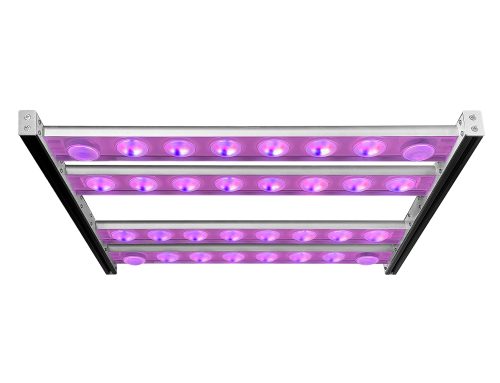
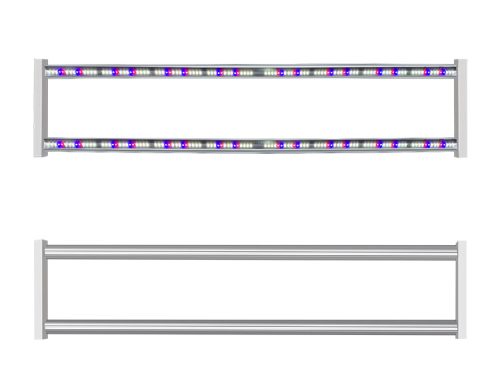
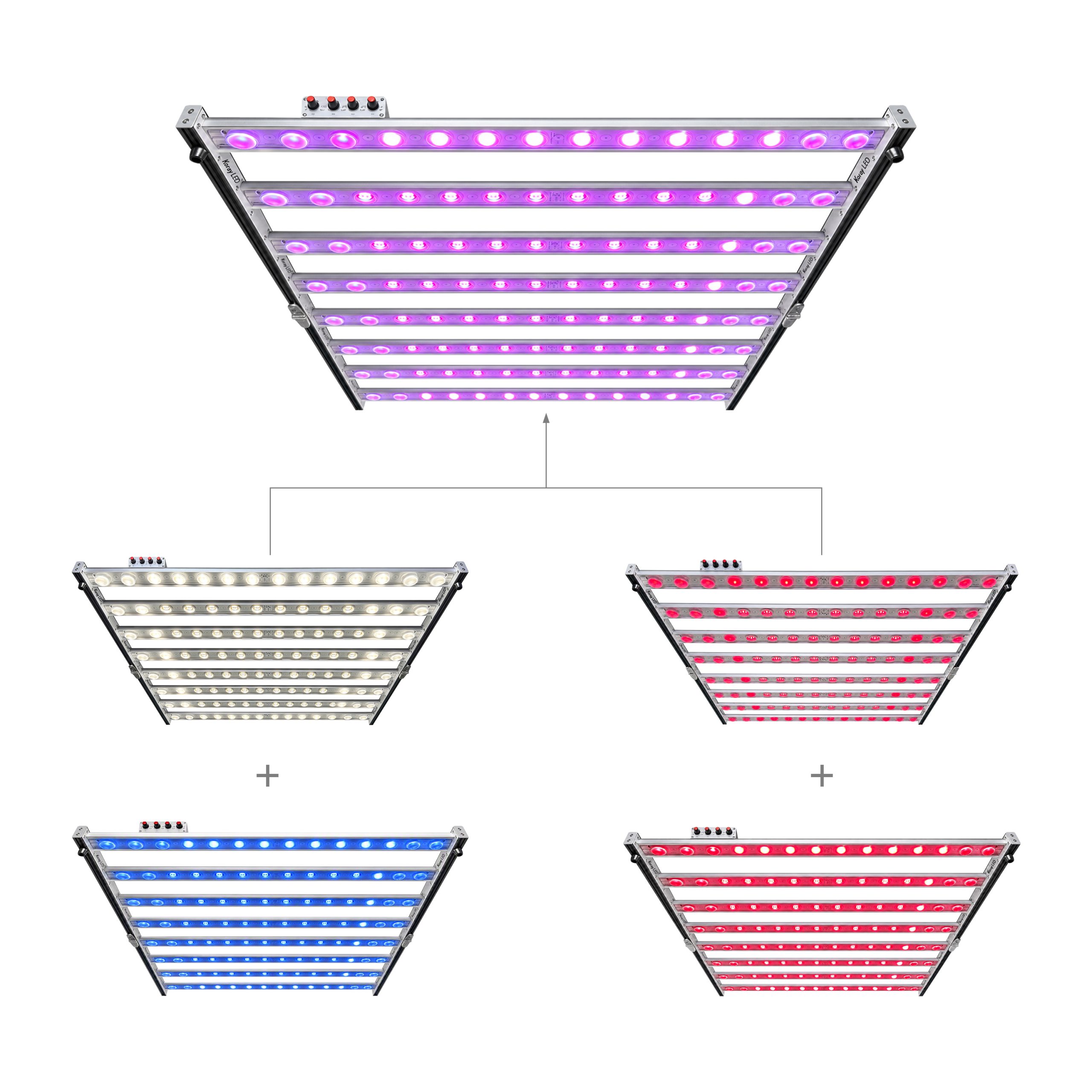
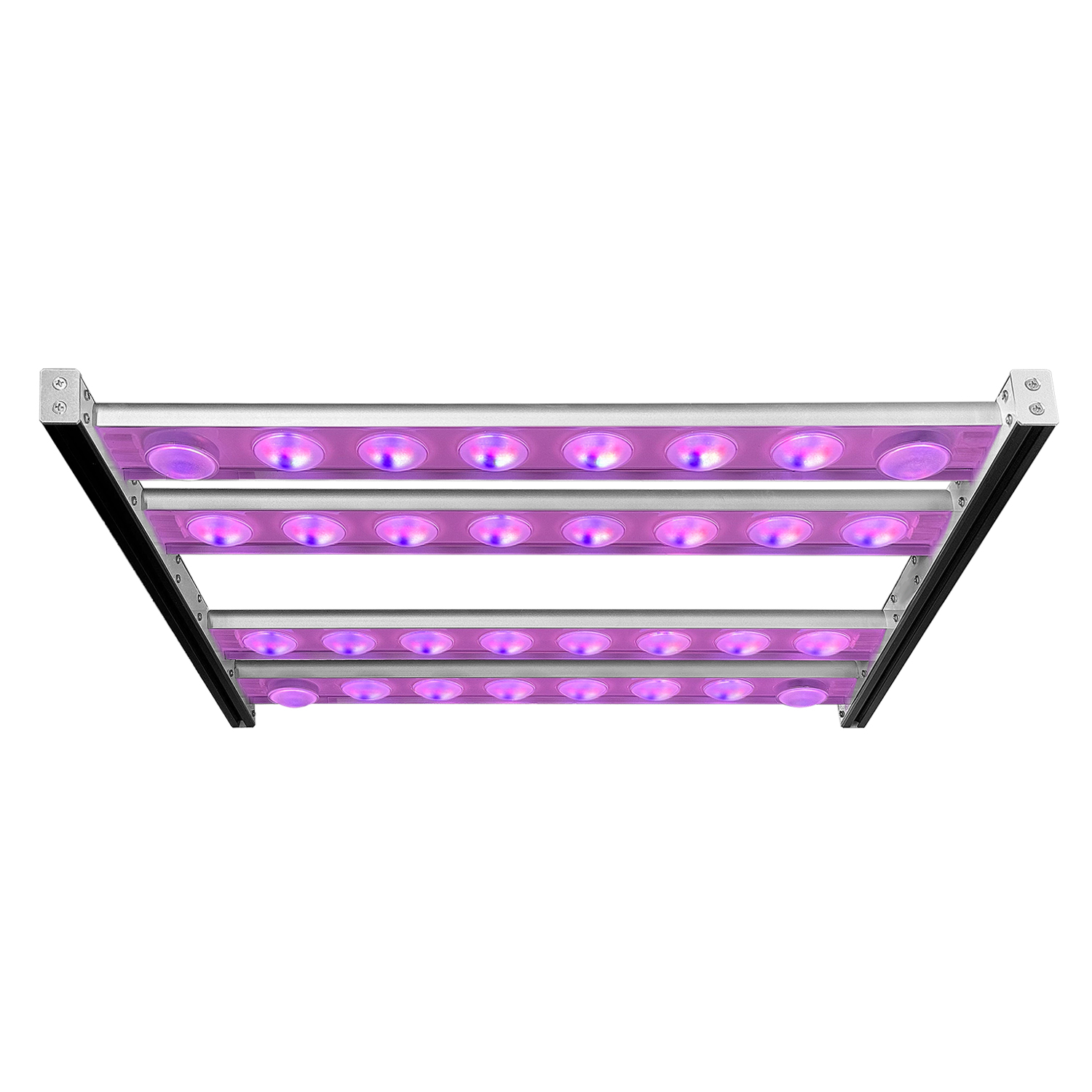
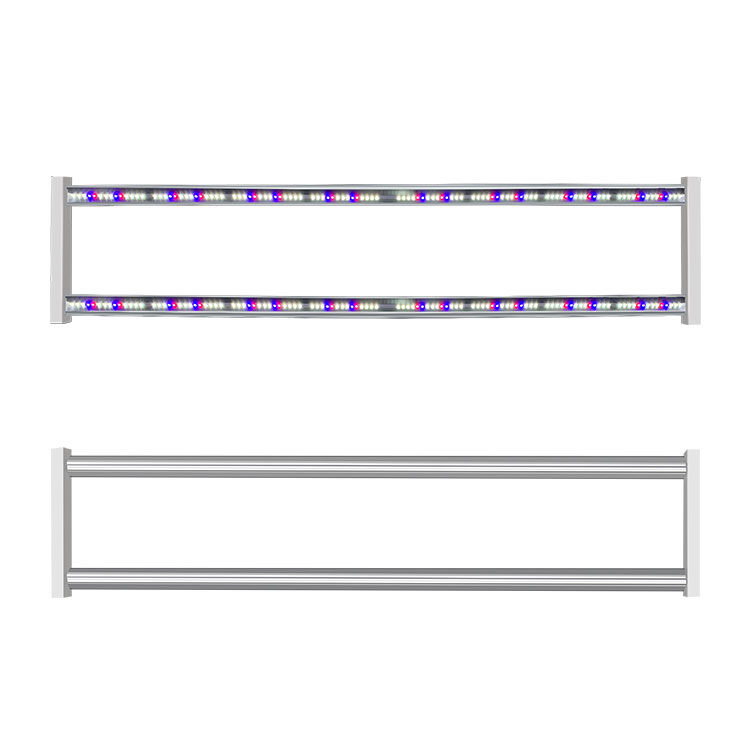
The schedule sets the target, and the fixture decides whether the target is reachable at a height the room can accommodate. A linear bar concentrates its output over a narrow footprint, so its coverage and its recommended hanging height are part of the arithmetic rather than accessories to it. KorayLights publishes linear and bar-shaped horticultural luminaires (https://koraylights.com/), and the official page for the T5025 bar states a coverage footprint of 12 inches by 48 inches, or 0.3 metres by 1.2 metres, together with a hanging height range of 8 inches to 12 inches, or 0.2 metres to 0.3 metres. At that height a small change in distance is a large change in canopy intensity, which is why a quoted PPFD must always travel with its mounting height and photoperiod before it is converted into an integral.
That arithmetic also explains why the same fixture can serve different steering strategies. A bar mounted at the lower end of a recommended range over a narrow bench delivers a high intensity to a small area, which suits a compact, high-integral schedule. Raising the same bar increases the lit area and reduces the intensity, which suits a longer, gentler day for young plants. The governing numbers are the integral, the photoperiod and the height, in that order, and the schedule is the document that fixes the first two.
DLI Targets and Photoperiod Choices Compared
The table below compares typical steering targets by stage, with the intensity and duration that would reach them and the constraint that the night length imposes. The ranges are general horticultural practice intended for planning the arithmetic, and they are not specifications of any product.
| Stage or goal | Typical DLI (mol·m⁻²·d⁻¹) | Working photoperiod (h) | Implied average intensity at canopy (µmol·m⁻²·s⁻¹) | Night length constraint | When to prefer this route |
|---|---|---|---|---|---|
| Propagation and rooting | 8 to 12 | 16 to 18 | 140 to 210 | Long night not required for most species | Young tissue tolerates moderate light over a long day |
| Leafy vegetative growth | 12 to 17 | 14 to 16 | 240 to 340 | Keep the dark period uninterrupted for signal clarity | Cheap installed capacity and even coverage |
| Compact steering | 17 to 22 | 12 to 14 | 400 to 460 | Longer night supports a more compact habit | Height is limited and structure matters more than speed |
| Generative or fruiting target | 20 to 30 | 12 to 14 | 460 to 690 | Night length must match the species’ class | High intensity is available at a safe distance from the canopy |
| Same integral, longer day | 20 to 26 | 18 | 310 to 400 | Short night changes development in sensitive species | Installed intensity is the limiting factor |
Conclusion
Crop steering works because light is two variables wearing one name. The integral is the budget that sets how much growth is possible, and the photoperiod is the clock that sets when the crop is allowed to develop, with the red to far-red ratio of the delivered spectrum acting as a third, faster signal. A schedule that names a target integral without a photoperiod, or a photoperiod without a mounting height, cannot be checked against a measurement, and the six rows of arithmetic above show how far apart two settings can be while still producing the same daily total.
Frequently asked questions
What exactly does DLI measure and how is it calculated?
Daily light integral measures the total photosynthetically active radiation delivered to an area over one day, in moles per square metre per day. It is calculated by multiplying the average photosynthetic photon flux density in micromoles per square metre per second by the photoperiod in seconds and dividing by one million. A target of 20 moles per square metre per day over 16 hours therefore requires an average of about 347 micromoles per square metre per second at canopy level.
Can a longer photoperiod always replace lower light intensity?
No. The integral can be met with either lever, but the photoperiod also carries developmental information through the length of the uninterrupted dark period, and that signal is read separately from the daily carbon budget. An interruption of the night can register as two short nights rather than one long one, and for species with a critical night length the extra hours can move development in the wrong direction regardless of the photons added.
What does crop steering mean in a controlled environment room?
Crop steering is the deliberate use of environmental levers within a day to push a crop toward a target form or market date rather than merely keeping conditions comfortable. In the light environment the levers are the size of the daily integral, the distribution of that integral across the day, and the red to far-red ratio of the delivered spectrum. Steering toward compact growth usually means higher intensity over a shorter photoperiod, while steering toward rapid leaf expansion usually means lower intensity over a longer one.
Why does the mounting height have to be quoted with a PPFD figure?
Because intensity falls as distance from the source increases, so the same luminaire produces different canopy intensities at different hanging heights. A PPFD value quoted without a height and a photoperiod cannot be converted into a daily light integral, and two values measured under different conditions cannot be compared. Coverage and recommended hanging height are therefore part of the arithmetic that decides whether a target integral is reachable in a given room.
How should a daily light integral be measured and logged?
Measure at canopy level rather than at the luminaire, hold the sensor in a consistent position and orientation, and accumulate the readings across the whole photoperiod so that dimming and any daylight contribution are included. Log the total every day, because a trend shows the effect of a schedule change while a single reading does not. Two readings taken with different instruments or in different orientations describe different things even when the crop has not changed.




Leave A Comment