
A quantum board is a horticultural light source in which the diodes are distributed across the surface of a flat board instead of being gathered into a small cluster. The RX-LM301-900255 is such a module, offered as an assembled 240 W kit with no fan and a universal mains input, and its official description makes three claims that are worth examining one at a time: that centre and edge illumination are more uniform through a special arrangement of the diodes, that a 1 by 0.5 metre area is covered, and that the design is silent because it has no fan. This article explains what each claim means in engineering terms, what it implies for a room, and which conditions have to accompany the numbers.
What a Quantum Board Module Is
A quantum board is a horticultural LED module in which many diodes are distributed across a flat, board-shaped substrate, so the emitting surface is a two-dimensional field rather than a line or a point. A module kit is a light source package that arrives assembled and ready to connect to mains power, as distinct from a bare diode array that has to be built into a luminaire first. The RX-LM301-900255 is described on its official specification as a high efficiency grow light module kit with an efficiency of up to 2.7 µmol/J (https://koraylights.com/wp-content/uploads/2020/02/LM301-900255.pdf). It is also described as plug and play, with no assembly required, so that the light is ready to use out of the box.
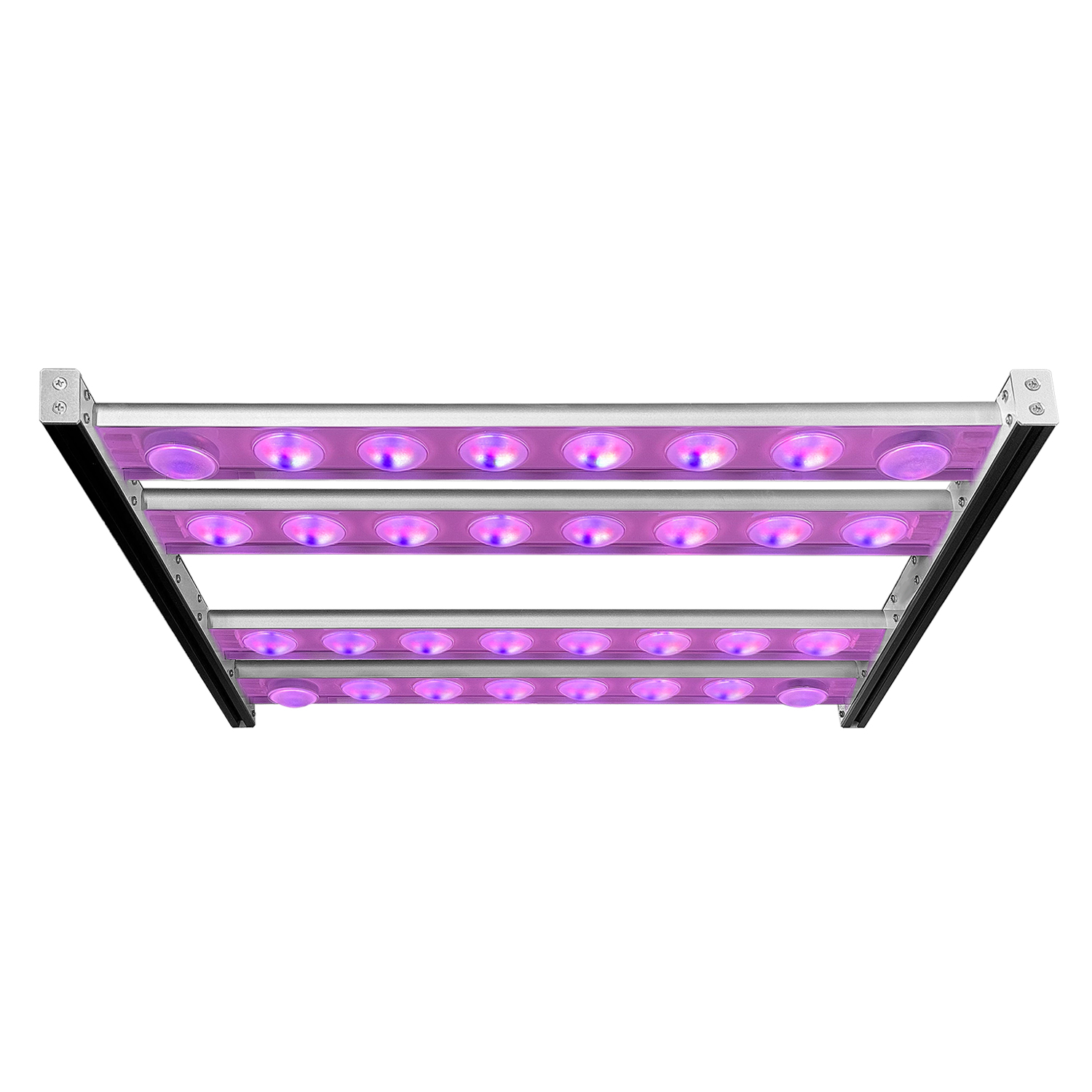
The board geometry is what makes the rest of the specification possible. A bar spreads emitters along one axis, which is useful when light has to be shaped in rows. A board spreads emitters across two axes, which makes it practical for one unit to cover a defined rectangular area, and it is that two-dimensional layout that the uniformity claim depends on.
Centre-to-Edge Uniformity Across a 40 by 20 Inch Area
Uniformity is the ratio of the lowest to the highest, or the lowest to the average, of the illuminance or PPFD measured across a defined area at a defined height. The official description states that a special LED arrangement makes centre illumination and edge illumination more uniform, and it gives the irradiation coverage area as 40 by 20 inches, or 1 by 0.5 metres.
The physics behind that claim is straightforward. A small cluster of diodes produces a bright core and a ring of falling intensity, because intensity from a compact source declines with the square of the distance and the geometry of the falloff is roughly circular. Distributing the emitters across the whole board, with the diode density adjusted toward the perimeter, flattens the profile so that the corners of the footprint receive a similar share of the light to the middle. The practical benefit is agronomic rather than cosmetic. If the edge of a tray receives appreciably less light than the centre, the plants at the edge develop differently, and a single light setpoint cannot serve the whole footprint. A flatter field lets one setpoint apply across the area.
Uniformity is a measurable property, and a claim about it should be accompanied by the conditions under which it was measured. Two conditions matter most. The first is the height at which the readings were taken, because the profile changes with distance from the board. The second is the daily photoperiod, in hours, since the daily light integral delivered to the crop depends on both the instantaneous PPFD and how long it is applied. A PPFD figure quoted without its measuring height and its assumed photoperiod cannot be compared with another, and a uniformity percentage quoted without a stating height cannot be reproduced.
Fanless Cooling: What Removing the Fan Changes
A fanless design is one in which heat leaves the module by conduction into a heat sink and by natural convection into the surrounding air, with no moving air produced by the fixture itself. The official description presents this as working silently and reliably, with a fanless design for a silent growth life.
Removing the fan changes more than the sound level, and every consequence is a trade rather than a pure gain. Because there is no bearing, there is nothing in the fixture that wears by rotating, and because there is no filter or grill, there is no airflow path to clog. Because there is no fan noise, the acoustic contribution of the fixture is close to zero, which matters where several units operate in the same room, since sound levels from identical sources add. The counterweight is that a passive design cannot be turned up: its capacity is set by the radiating area of the heat sink, by the thermal path from diode to case, and by the ambient temperature of the room. A board form factor helps here, because a flat module presents a large, regular surface to which a heat sink can be coupled, and it spreads heat outward rather than concentrating it at one end of a strip. The consequence for a buyer is that fanless is a room-level decision as much as a fixture-level one: the same module in a hot, still room with no air movement will run warmer than the same module in a cooler, ventilated space, and the module cannot compensate.
Universal Mains Input: AC100 to 277 V at 240 W
A universal-input driver is a power supply that accepts a wide range of nominal alternating-current voltages without a voltage selector switch. The official description gives the input as AC100 to 277 V with a power of 240 W.
The value of that range is operational. One model number can be stocked and deployed across regions with 120 V and 230 to 240 V supplies, and inside a single facility the same unit can be connected to a branch circuit at whichever voltage is available, provided the circuit is rated for it. The electrical consequences of the range are worth stating explicitly, because power and current are not the same thing. At 100 to 120 V a 240 W load draws roughly 2 A, while at 277 V the same load draws roughly 0.9 A, assuming a power factor close to unity. The fixture therefore imposes a much smaller current load on a 277 V circuit than on a 120 V circuit, which affects how many units can share a breaker and what conductor size is required. The official specification does not list a dimming protocol, so no control or dimming claim is made here; where dimming is needed it has to be confirmed against the driver actually supplied.
The 660 nm or 730 nm Option: Two Different Jobs
The official description of the module states that it uses an LM301 LED chip with a 660 nm or 730 nm option. Those two wavelengths are not interchangeable, and choosing between them is a decision about what the light is for.
A 660 nm source is deep red at the edge of the photosynthetic action peak, so photons at that wavelength are used efficiently in photosynthesis, and adding a 660 nm option increases the red content of the output within the waveband that defines photosynthetically active radiation. A 730 nm source is far-red, which lies just outside the 400 to 700 nanometre definition of photosynthetically active radiation and acts substantially as a signal rather than as a major energy source, influencing phytochrome-mediated responses such as extension growth and the balance between red and far-red. Choosing the red option is therefore a decision about photosynthetic throughput, while choosing the far-red option is a decision about plant morphology and development.
Because performance claims of this kind are usually verified against a shared specification rather than in isolation, it is worth knowing that horticultural lighting qualification programmes exist to standardise how such claims are stated and tested, including measures of photon efficacy and of how photon output is maintained over time (https://www.designlights.org/). Guidance on LED lighting performance and measurement, including the quantities used to describe output and efficiency, is published by the U.S. Department of Energy (https://www.energy.gov/). Both are useful reference points when a spectrum option has to be justified to a buyer or a reviewer.
Configuring Size, Power, Spectrum, PAR and PPFD
The official description states that the size, power, spectrum, PAR output and PPFD output can all be customized as needed. That sentence describes a supply relationship rather than a product feature, and it changes how a specification should be read.
When a module is configurable, the numbers that matter are the numbers of the configuration actually ordered, not a catalogue average. A written configuration is therefore the working document of the purchase, and it should record five things: the physical size that matches the planned footprint, the power that matches the branch circuit and the intended intensity, the spectral option that matches the crop stage, the target PAR or PPFD, and the conditions under which that target is to be met, meaning the mounting height and the daily photoperiod in hours. Without those conditions a target output figure is not reproducible, and without a written configuration two units of the same model number can differ.
Where a Board Module Fits: Applicable Scenarios
A board module that covers a fixed area of about 1 by 0.5 metres suits situations where the footprint is known in advance. A propagation bench, a small growing cabinet, a mother-plant shelf, and a single tier inside a vertical rack are all cases where one unit can be positioned over a defined rectangle and adjusted in height until the measured uniformity is acceptable. The fanless construction suits rooms where the fixture operates close to people, or where a large number of units would otherwise multiply fan noise, and the universal input suits deployment across regions with different mains voltages or facilities with mixed circuits.
The RX-LM301-900255 fits that description: a 240 W fanless board with universal input, a stated coverage area of 40 by 20 inches, a 660 nm or 730 nm option and a configurable output. Whether it is the right module for a given room depends on the footprint, the target PPFD at the intended mounting height, the daily photoperiod and the ambient conditions around the heat sink, rather than on any single figure. The manufacturer, KorayLights, describes itself on its home page as a 17-year LED horticultural lighting manufacturer (https://koraylights.com/), and the specification sheet for the module is the place to start when confirming a configuration.
Dimension Comparison: Reading a Quantum Board Module Specification
| Design decision | Official specification | What it delivers | Condition or limit |
|---|---|---|---|
| Coverage area | 40 by 20 inches, or 1 by 0.5 metres | A defined rectangular footprint per unit | Mounting height and measured uniformity across the area |
| Diode arrangement | Special LED arrangement for more uniform centre and edge illumination | A flatter PPFD profile than a compact cluster | Uniformity verified only by a grid measurement at a stated height |
| Thermal design | Fanless, for a silent growth life | No bearing wear, no airflow noise, no filter to clog | Capacity fixed by heat sink area and room ambient temperature |
| Mains input | AC100 to 277 V, 240 W | One model across regions and mixed-voltage facilities | Circuit loading varies with voltage, roughly 2 A at 120 V and 0.9 A at 277 V |
| Spectrum option | LM301 LED chip with a 660 nm or 730 nm option | Red photons for photosynthesis or far-red for signalling | Choice has to match the crop stage and the target response |
| Configurability | Customizable size, power, spectrum, PAR output and PPFD output | A module matched to a specific room | The written configuration, not the catalogue value, is the specification |
| Efficiency rating | Up to 2.7 µmol/J | Photons per joule converted by the module | The drive point and measurement conditions behind the rating |
Conclusion
A board module is chosen for the shape of its light rather than for a single number on its label. The RX-LM301-900255 is defined by a footprint of about 1 by 0.5 metres, an arrangement of diodes intended to hold illumination more evenly from centre to edge, a fanless thermal path that trades peak capacity for silence and for the absence of moving parts, and a universal input that allows one unit to serve rooms with different supply voltages. The conditions that accompany each of those properties, the measuring height for uniformity, the daily photoperiod for the light integral, the ambient temperature for the heat sink and the written configuration for a customizable module, are what turn a specification into an installation that can be planned and later reproduced.
Frequently asked questions
What does a quantum board module mean, and how is it different from a bar light?
A quantum board is a horticultural LED module with many diodes distributed across a flat board, so the emitting surface covers two dimensions and one unit can serve a defined rectangular area. A bar spreads emitters along a single axis and is normally repeated in rows to build a coverage plan. The RX-LM301-900255 is a board module with a stated coverage area of 40 by 20 inches, or 1 by 0.5 metres.
How do I verify the claim that centre and edge illumination are more uniform?
Verify it with a PPFD grid measurement: readings are taken at a set of points across the footprint, at a stated distance from the board, and uniformity is the ratio of the lowest reading to the highest or to the average. The measuring height has to be reported with the result, because the profile changes with distance. The official description states that the special LED arrangement makes centre and edge illumination more uniform within the 40 by 20 inch area.
Why does a fanless 240 W grow light run quieter, and what is the trade-off?
A fanless design removes heat by conduction into a heat sink and by natural convection, so there is no fan bearing to wear, no airflow noise and no filter to clog. The trade-off is that a passive design has no way to increase airflow when conditions get worse: its capacity is fixed by the heat sink area and the room ambient temperature. Where several fanless units work together the room stays quiet, but airflow in the room still helps manage temperature.
Can I choose between the 660 nm and 730 nm options, and which should I pick?
The official description states that the module uses an LM301 LED chip with a 660 nm or 730 nm option, so the choice is part of the configuration. A 660 nm source provides deep-red photons at the edge of the photosynthetic action peak and raises red content within photosynthetically active radiation, while 730 nm is far-red, lying just outside that waveband and acting substantially as a signal that influences extension growth. The choice should follow the crop stage and the response being targeted.
What does customizable size, power, spectrum, PAR and PPFD mean for a purchase?
It means the module is supplied as a configurable platform, so the specification that applies is the written configuration and not a catalogue average. The configuration should record the physical size, the power, the spectral option, the target PAR or PPFD, and the conditions under which that target is to be achieved, namely the mounting height and the daily photoperiod in hours. Two units of the same model number can differ if their configurations differ.




Leave A Comment