
A light engine is the part of a grow light that actually emits light, sold as a component rather than as a finished fixture. That distinction decides what a specification sheet can promise, because an engine’s ratings describe an operating point of the light source, while a fixture’s ratings describe an assembled product with a driver, a housing and a mounting system. The LM301H-L56W4 is a horticultural linear light engine, and its published data is short and specific: an efficiency range tied to a drive power, a maximum power, a physical envelope, an electrical input window, and a spectral statement. This article walks through each of those items, explains the engineering behind them, and is explicit about the fields the official specification does not cover.
What a Linear LED Light Engine Is
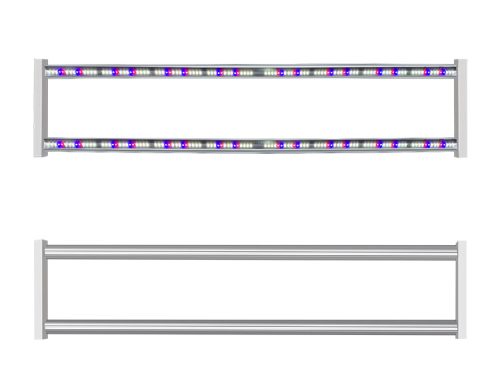
A light engine is a light source module that contains the light-emitting diodes, their mounting substrate and their optical and thermal interface, but not the mains driver and not a finished enclosure. A linear light engine is a light engine whose diodes are arranged along a long, narrow strip, so its emitting surface is a bar rather than a square panel. The distinction between module and fixture is not cosmetic. When a driver, a housing, a heat sink and a mounting bracket are added to an engine, the thermal and electrical environment of the diodes changes, so the same engine can measure differently in two different luminaires.
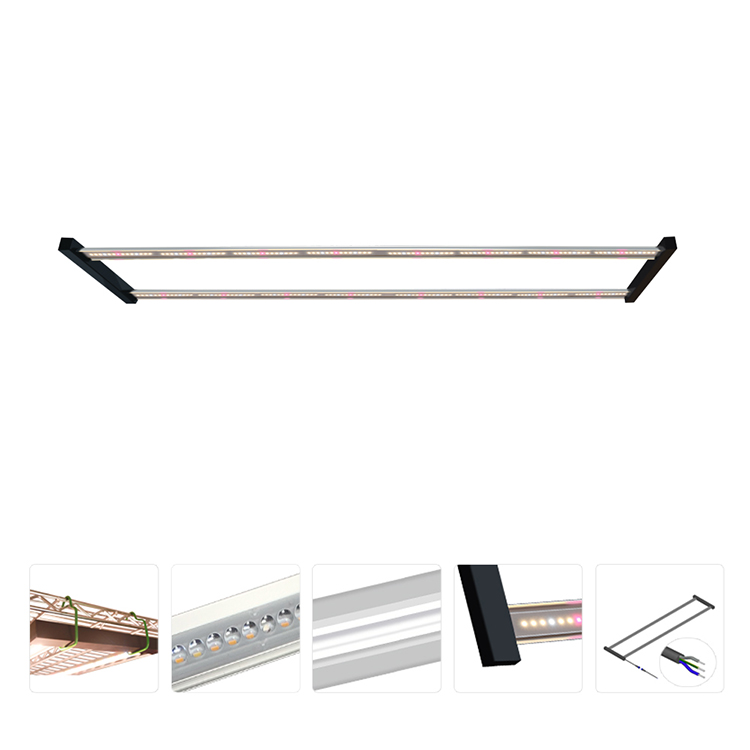
The LM301H-L56W4 is described on its official product page as a horticulture LED light engine: a linear full-spectrum module with additional hyper red 660 nm, intended for plant growth (https://koraylights.com/product/lm301h-l56w4-horticulture-led-linear-full-spectrum-additional-deep-red-more-suitable-for-plant-growth/). Three families of numbers follow from that description, and each answers a different question. The first is how efficiently the module converts electricity into photosynthetic photons. The second is what electrical window a driver must supply. The third is how much space the light source occupies and how it is laid out.
Specifying PPF Efficiency at Its Drive Point
PPF efficiency is the ratio of photosynthetic photon flux, measured in micromoles per second over the 400 to 700 nanometre waveband, to the electrical power drawn by the module at a stated drive point, expressed in micromoles per joule. Because both terms of that ratio move with drive current and junction temperature, the figure is only meaningful together with the power at which it was measured. An efficiency number without a drive point is a label rather than a specification.
The official page publishes two efficiency values for this engine, and they are two operating points rather than a contradiction. The headline rating is stated as high efficiency of up to 2.7 µmol/J. The product description then states a higher value at a lower drive power: PPF efficiency up to 3.1 μmol/J at 20W power. The same description gives the ceiling for the module as a maximum power of 70 W, and the page also carries the statement that the product will only consume 100 W as part of its wider product description. Read together, the pair of numbers describes an efficiency curve that falls as drive power rises, which is normal behaviour for an LED package: increased current density raises junction temperature and reduces the fraction of each watt converted into photons.
The practical consequence is straightforward. Two engines can both be advertised as reaching a similar efficiency figure while behaving very differently at the power a grow room actually needs, because one may reach that value only at a low drive point while the other holds a higher fraction of it at full output. The useful comparison is an efficiency-versus-power curve, or at minimum a table of efficiency at the powers a project will use. The point is that the printed rating has an operating point attached to it, and that operating point has to travel with the claim.
The Drive Electrical Window: 30 to 45 V and 0.24 to 1.6 A
A constant-current driver is a power supply that holds its output current at a set value and allows its output voltage to float within a stated range. The LM301H-L56W4 states its electrical window as an LED module input voltage of 30 to 45 V and an input current of 0.24 to 1.6 A. Those two numbers are the interface between the engine and whatever drives it. Forward voltage is the electrical potential across the diode string at a given current, and it rises with both the length of the string and the current pushed through it, while drive current is the current the driver forces along that string.
Where an engine sits inside the window is a design choice with visible consequences. Near the lower end, at 0.24 A, the diodes run cool for their package, colour and efficiency stay close to their rated values, and the driver supplies a relatively low current at a correspondingly low voltage. Near the upper end, at 1.6 A, the module produces substantially more flux in the same footprint, so fewer engines are needed for a given output, at the cost of a hotter junction and fewer photons per joule. The 30 to 45 V span is wide enough that the string configuration, meaning how the diodes are grouped in series and parallel, decides where in the range a chosen drive current lands.
For a luminaire builder, three requirements follow from the window. The chosen driver’s output voltage range has to cover the string’s forward voltage at the intended current, including the shift that comes with temperature; the driver’s current set-point has to sit inside the stated current range; and the wiring between driver and engine has to be sized for the working current rather than for the headline power, because current and not wattage sets conductor heating.
Form Factor and Coverage Planning: 561 mm by 41 mm
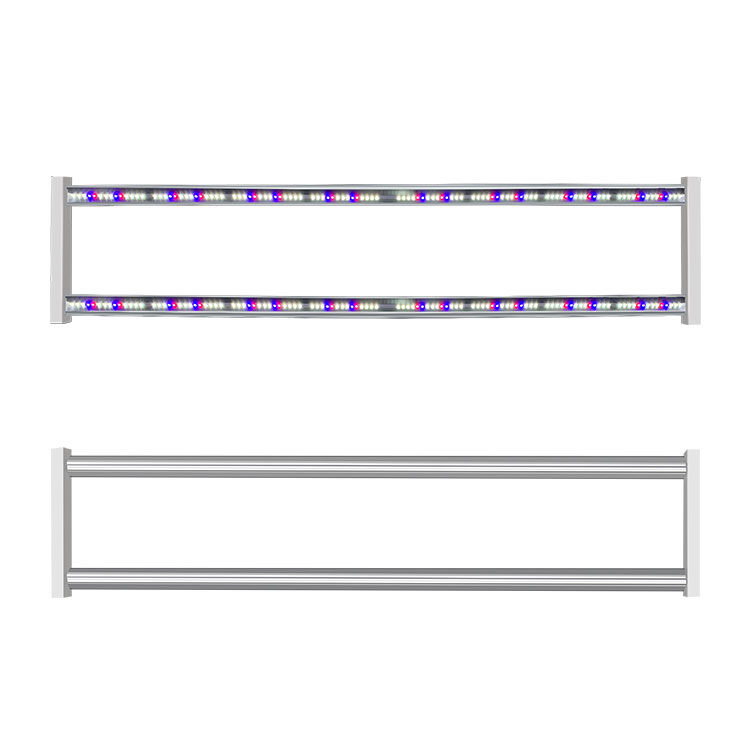
The official physical description is short: a length of 2 ft, or 561 mm, and a width of 1.6 inches, or 41 mm. A two-foot engine with a 1.6 inch cross-section is a strip, and a strip is used differently from a panel. Because the emitter runs in a line, a coverage plan is built from rows: bars are mounted in parallel across a bench or a growing area, and the pitch between rows determines how evenly light is distributed over the canopy beneath them. The narrow cross-section keeps the engine’s own silhouette small, which matters when a fixture has to sit close to the crop or fit into a tier where vertical space is limited.
The geometry also constrains the rest of the luminaire. A 41 mm wide engine leaves little room for the thermal interface inside a narrow housing, and it invites designs in which the driver is remote rather than integrated. For retrofit work, a linear engine maps naturally onto rooms and benches laid out for linear high-pressure sodium rails, because the mounting pattern and the shape of the light distribution are already linear.
One field is deliberately absent from this section. The specification reviewed for this article lists the engine’s length and width but does not publish coverage values, so no footprint area is asserted here. Coverage planning should be done from measured data that carries its conditions. A PPFD figure is meaningful only when it is quoted together with the height at which it was measured and the daily photoperiod, in hours, that it assumes, because PPFD changes with distance from the canopy and daily light integral accumulates with photoperiod. Without those two conditions, PPFD values from two sources cannot be compared and a coverage claim cannot be reproduced.
Spectral Composition as an Evidence-Based Specification
A full-spectrum horticultural source is one that emits across the visible waveband rather than in a small number of narrow bands, and 660 nm is the deep-red band that sits close to the peak of the photosynthetic action spectrum for most crop species. The official description of this engine combines the two ideas, describing a linear full-spectrum light engine with an additional hyper red 660 nm band, and it separately states that the preferred spectrum is based on plant growth experimentation in the laboratory.
Spectral content is not a free parameter that can be assumed to transfer between situations. Published work on the interaction between far-red light and temperature in lettuce, for example, reports that the morphological response to added far-red diminishes once light intensity is high, which means the benefit of a particular spectral addition depends on the other conditions in the room (https://www.frontiersin.org/journals/plant-science/articles/10.3389/fpls.2024.1497672/full). Work published in the Journal of the American Society for Horticultural Science has likewise developed metrics for far-red and phytochrome photoequilibrium precisely because plant response to a waveband is described by ratios and states rather than by a single band in isolation (https://journals.ashs.org/view/journals/jashs/146/1/article-p3.xml). The vocabulary used to describe light itself, including quantities and waveband definitions, is standardised through the publications of the International Commission on Illumination (https://cie.co.at/publications).
Two consequences follow. First, a full-spectrum label describes coverage of the waveband rather than a quantified recipe, and the official page for this engine does not publish band-by-band percentages, so the spectrum should not be treated as though percentages had been given. Second, the sensible way to evaluate a spectral addition is to ask for the trial behind it and the conditions under which that trial was run, which is the standard the official description claims for itself.
Where a Linear Engine Suits a Grow Room
A linear engine earns its place where light has to be shaped in rows rather than poured from a single point. Multi-tier benches, propagation racks and narrow benches all reward a strip that can be repeated at a chosen pitch and positioned close to the plants without shading the neighbouring tier. Rooms converted from rail-mounted discharge lamps also accept a bar-shaped engine with fewer changes to mounting and layout than a panel would require, and installations that need the driver in a separate, accessible location are easier to build around a module.
The LM301H-L56W4 fits that pattern: a 561 mm strip with a stated efficiency range, a wide input window and an added deep-red band. Whether it is the right choice for a particular room is a question answered by the room’s dimensions, the target PPFD at the intended mounting height, and the daily photoperiod the crop is grown under, rather than by a headline efficiency figure on its own. The manufacturer, KorayLights, describes itself on its home page as a 17-year LED horticultural lighting manufacturer (https://koraylights.com/).
What the Official Specification Does Not State
A specification is a list of claims, and the fields that are missing are as informative as those present. The official material reviewed for this engine states efficiency, power, physical dimensions, the drive window and the spectral description. It does not publish a beam angle, an ingress protection rating, a dimming protocol, a warranty term, a certification list, band-by-band spectral percentages or coverage values.
None of those omissions is unusual for a component sold to luminaire builders, but each one moves a question to the buyer’s side of the table. A beam angle or an IES photometric file is what turns a light engine into a layout; an ingress protection rating matters only together with the enclosure and the test configuration under which it was granted; a dimming interface has to match the control system that will drive it; and a warranty is a commercial term that belongs in writing. The practical habit is to request the document rather than to infer the property, and to prefer suppliers who publish the conditions behind each figure.
Dimension Comparison: Reading a Linear Light Engine Specification
| Specification item | Official figure | What it answers | Condition that must travel with it |
|---|---|---|---|
| PPF efficiency, headline | up to 2.7 µmol/J | Photons per joule at the rated drive point | The drive power at which it was measured |
| PPF efficiency, low drive | up to 3.1 μmol/J at 20W power | Best-case efficiency of the same engine | The 20 W drive point and the measurement method |
| Maximum power | Max Power: 70W | The engine’s ceiling for a fixture design | Drive current and thermal interface of the host fixture |
| Electrical window | 30 to 45 V, 0.24 to 1.6 A | The driver interface the engine expects | String configuration and operating temperature |
| Physical envelope | 2 ft or 561 mm length, 1.6 inches or 41 mm width | Row-based coverage planning and mounting | Mounting pitch and height above canopy |
| Spectral description | Full spectrum with additional hyper red 660 nm | The intended spectral role of the module | Trial conditions behind the preferred-spectrum statement |
| Coverage and footprint | Not published in the reviewed specification | Where a PPFD map has to be requested | Measuring height and daily photoperiod in hours |
Conclusion
A linear light engine is specified in a small number of numbers, and each one is a contract with a condition attached. An efficiency rating is only comparable when its drive power is known; an electrical window is an instruction to the driver designer; a physical envelope is a constraint on the fixture; and a spectral statement is as strong as the trial behind it. The value of reading an engine specification carefully is that it separates the questions a component supplier can answer from the questions the finished installation has to answer for itself.
Frequently asked questions
What is the difference between a light engine and a complete grow light fixture?
A light engine is a light source module containing the LEDs, their substrate and their optical and thermal interface, while a complete fixture adds the driver, the housing, a heat sink and the mounting system. Because the fixture’s electrical and thermal design changes the operating point of the diodes, the same engine can measure differently in two luminaires. The LM301H-L56W4 is a linear light engine rather than a finished fixture.
Why does the LM301H-L56W4 have two efficiency ratings, 2.7 µmol/J and 3.1 µmol/J?
They are two operating points of the same module. The official page states an efficiency of up to 2.7 µmol/J as the headline figure and states PPF efficiency up to 3.1 μmol/J at 20W power for the low drive point, because LED efficiency falls as drive current and junction temperature rise. Any efficiency comparison between engines therefore has to use the power at which each figure was measured.
What driver does the 30 to 45 V and 0.24 to 1.6 A window require?
It requires a constant-current driver whose output voltage range covers the string’s forward voltage at the intended current and whose current set-point sits inside 0.24 to 1.6 A. Running near 0.24 A favours efficiency and colour stability, while running near 1.6 A produces more flux per engine and needs fewer modules. Wiring has to be sized for the working current rather than for the headline power.
How should I plan coverage for a 2 ft or 561 mm linear engine?
Plan it in rows. Bars are mounted in parallel across the growing area, the pitch between rows sets how evenly light reaches the canopy, and the 41 mm cross-section keeps the engine out of the way when it is mounted close to the plants. The reviewed specification does not publish coverage values, so a PPFD map should be requested and quoted together with its measuring height and daily photoperiod in hours.
Does a full spectrum plus additional hyper red 660 nm mean the spectrum is quantified?
No. It describes coverage across the visible waveband plus a deep-red addition at 660 nm, and the official page does not publish band-by-band percentages for this engine. The page does state that the preferred spectrum is based on plant growth experimentation in the laboratory, so the useful follow-up question is which trial produced the spectrum and under what conditions it was run.


Leave A Comment