
Do Variegated Succulents Need More Light Than Green Ones?
Variegated succulents are among the most coveted plants in the collector community. With their striking patterns of cream, yellow, pink, and white marbled through the normal green foliage, these plants look almost too beautiful to be real. Varieties like Echeveria “Snow Bunny,” Monstera “Albo,” and variegated String of Pearls command premium prices and inspire devoted followings. But their unique appearance comes with specific cultivation challenges, particularly when it comes to lighting.
The short answer is yes: variegated succulents generally need more light than their fully green counterparts, but the relationship is nuanced. Understanding the biology behind variegation and how it affects photosynthesis will help you provide the right lighting conditions to keep these special plants healthy and vibrant.
Why Are Variegated Succulents More Light-Demanding?
Variegation occurs when some or all of the plant cells lose their ability to produce chlorophyll, the green pigment responsible for photosynthesis. The white, cream, or yellow sectors of a variegated leaf contain cells that cannot photosynthesize at all. This means the plant has less total photosynthetic surface area compared to a fully green specimen of the same size.
To compensate for this reduced capacity, variegated plants need either higher light intensity or longer photoperiods to produce the same amount of energy. A succulent that is 50 percent variegated essentially has only half the photosynthetic tissue, so it needs roughly twice the light exposure to achieve the same growth rate as a fully green individual. In practice, this means targeting the upper end of the PPFD range, around 450 to 650 umol/m2/s, and maintaining a photoperiod of 14 to 16 hours per day.
Without adequate light, variegated succulents face a double penalty. Not only do they grow more slowly, but the plant may also revert to producing all-green leaves as a survival mechanism. Since green tissue is more efficient at photosynthesis, the plant prioritizes its production under low-light conditions, gradually losing the variegation that makes it special in the first place.
Can Variegated Succulents Get Too Much Light?
Paradoxically, yes. The white and cream sectors of variegated leaves lack the protective pigments that green tissue uses to shield against excessive light. This makes them more susceptible to photobleaching and sunburn. Under intense light, the variegated portions may turn brown, crispy, or develop scorched patches while the green areas remain unaffected.
The key is finding the sweet spot: enough light to maintain healthy growth and preserve variegation, but not so much that the non-green tissues get damaged. For most variegated succulents, a PPFD of 400 to 550 umol/m2/s provides this balance. This is slightly higher than what fully green succulents need at the lower end, but below the maximum that green succulents can tolerate.
The Koray RX-PAR38 with the S91 warm full-spectrum output is particularly well-suited for variegated succulents. Its smooth spectral distribution provides ample blue light for compact growth and moderate red for coloration, without the intense peaks that can cause photodamage to sensitive variegated tissue. At a distance of 0.25 to 0.30 meters, the RX-PAR38-60D delivers approximately 450 to 550 umol/m2/s, right in the optimal zone.
What Spectrum Helps Maintain Variegation Patterns?
Light spectrum plays an important role in both maintaining variegation and ensuring the plant looks its best. Blue light (400-500nm) is essential for keeping growth compact and preventing the stretched, leggy appearance that is especially unattractive on variegated specimens where the pattern distortion is very visible.
Red light (600-700nm) and far-red light (700-750nm) influence the expression of pigments beyond chlorophyll. Adequate red light helps maintain the pink, red, and purple tones that often accompany variegation in succulents. The Koray K6C spectrum, available on the GE35-120T-K6 LED bar, provides enhanced red output specifically for plants where coloration matters, including variegated succulents, flowering species, and carnivorous plants.
For a variegated succulent shelf, combining a GE35-120T-K6 bar (for color enhancement) with a standard full-spectrum white LED provides both the spectral diversity and intensity these plants need. Running both light types for 14 to 16 hours per day ensures the DLI stays above 15 mol/m2/day, which is the minimum most variegated succulents require to maintain their patterns without reverting to all-green growth.
How Do Different Types of Variegation Affect Light Needs?
Not all variegation is created equal. The pattern, extent, and type of variegation significantly influence how much light the plant needs.
Marginally variegated plants, where only the leaf edges are white or cream (such as Echeveria “Rainbow” or Crassula “Hobbit Variegata”), have the smallest reduction in photosynthetic area. These plants need only slightly more light than their fully green counterparts, around 350 to 500 umol/m2/s.
Heavily variegated or nearly white plants, such as Monstera “Albo Variegata” or completely white succulent mutations, have the greatest reduction in photosynthetic capacity. These plants may need 500 to 700 umol/m2/s and 16 hours of daily light to compensate. In extreme cases where a plant is almost entirely white, supplemental CO2 and higher nutrient levels can help maximize the efficiency of the remaining green tissue.
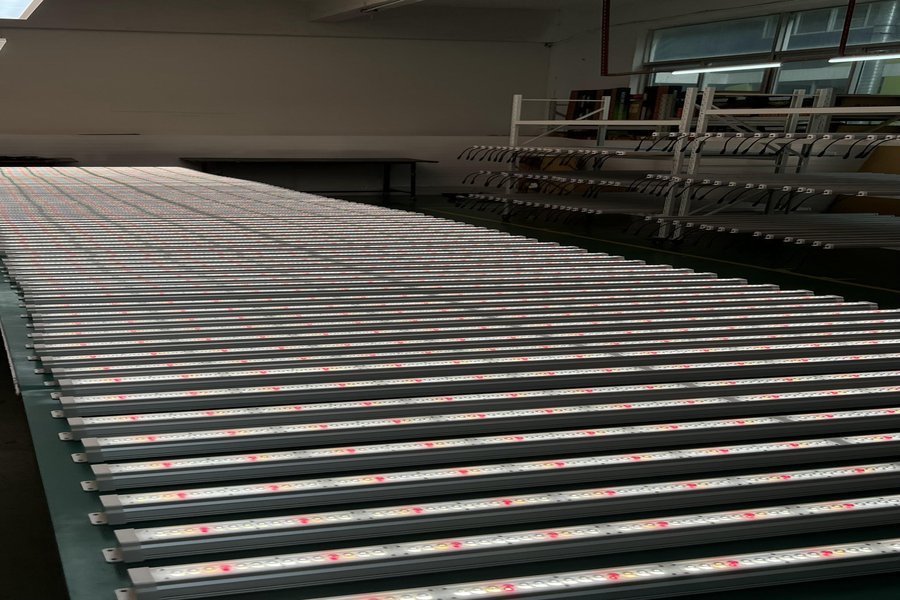
Chimeral variegation, where distinct sectors of green and non-green tissue are clearly separated (common in Echeveria and Graptoveria hybrids), requires the most careful light management. The green sectors can handle higher light levels, but the adjacent white sectors are vulnerable to burning. Providing even, diffused light from a bar-style fixture like the Koray GE35 series, which eliminates hotspots better than point-source lights, helps protect the sensitive areas while still delivering adequate intensity to the green zones.
Practical Tips for Growing Variegated Succulents Under LED Lights
Position variegated plants on the shelf where they receive the most uniform light distribution. Avoid placing them directly under the center of a high-intensity fixture where hotspots may occur. Instead, position them slightly to the side where the PPFD is 10 to 15 percent lower but more evenly distributed.
Rotate your variegated succulents a quarter turn every week. This ensures all sides of the plant receive equal light exposure, preventing one-sided growth where the variegated side faces the light while the green side faces away. Unequal light exposure can cause the plant to produce more green tissue on the shaded side as an adaptive response.
Monitor the variegated sectors closely for signs of browning or crisping, which indicates light stress. If you notice damage, increase the distance between the plant and the light by 5 centimeters or reduce the photoperiod by one to two hours. Conversely, if new growth is coming out all green, increase the light intensity or duration to encourage the plant to maintain its variegated patterns.
Use the Koray GE35-120T-K6 at a hanging distance of 0.25 to 0.30 meters with a 14-hour photoperiod as your starting point. Adjust based on how your specific plants respond over the following weeks. With patience and careful observation, you will find the perfect balance that keeps your variegated succulents displaying their stunning patterns while growing vigorously under LED light.

Leave A Comment