

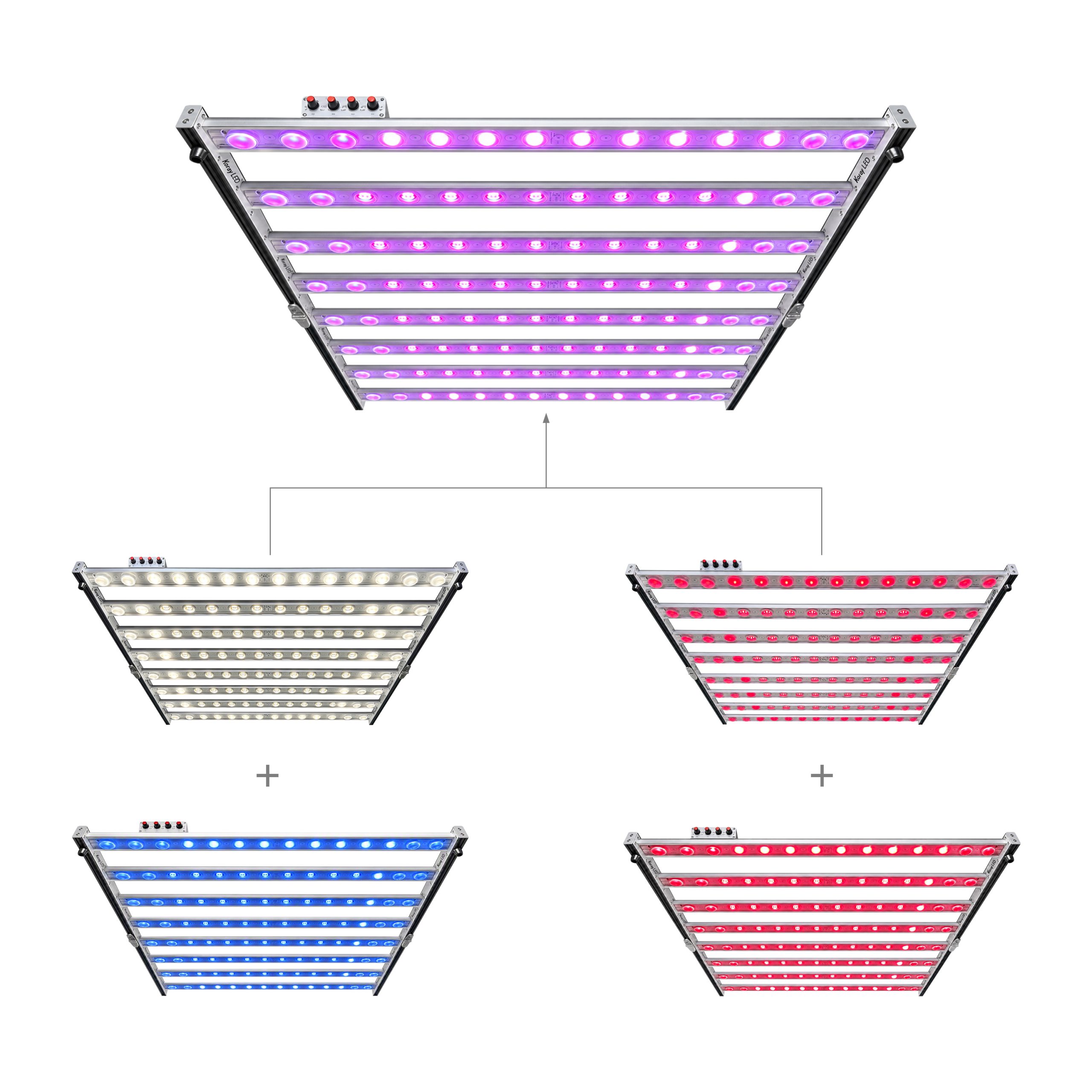
A two-channel grow light is often described as if it were a dimmer with two settings. That reading misses what the fixture actually does. On its official product page, the RX-G80-2H is presented as a folding bar whose output is split into two separately described groups of emitters, and the page is explicit about what each group is for. It states “Channel A, 5000K for Early stage Vegetative growth” and “Channel B, additional dark red 660nm, dedicated to flowering maturity”, and then adds a sentence that carries most of the operational meaning: “The two channels are simultaneously opened, and the PPFD can be provided up to 1200μmol/m²/s”. Read carefully, that sentence says the headline density is a two-channel figure, not a single-channel one. The sections below explain how a channeled fixture is meant to be operated across a crop cycle, why the 1200 μmol/m²/s number belongs to only one of the operating modes, and which figures a buyer still has to request.
Why a two-channel fixture is a scheduling decision
A channel is a separately switched group of emitters inside the same housing. Two channels do not mean two spectra that mix into one blend; they mean two independently addressable light sources occupying the same bar. That distinction is operational rather than cosmetic. A single-spectrum fixture offers one lever: how many hours per day it runs, which sets the daily light integral and, with it, the crop’s daily photon budget. A two-channel fixture offers a second lever, because the ratio of the two channels can be changed as the crop develops while the total on-time is planned separately.
The reason that second lever exists is that a plant’s needs change over its life. Vegetative growth is driven mainly by the blue and green portions of the spectrum, which shape leaf expansion, stem elongation and the architecture of the canopy. Flowering and maturation respond to a different balance, in which the far-red and deep-red end carries more weight, both as a photosynthetic contribution and, in many species, as a developmental signal. Michigan State University Extension (https://www.canr.msu.edu/news/led-lighting-for-greenhouses) publishes grower-facing material on how spectrum and intensity requirements shift across greenhouse crop stages, and it is the right frame for judging what a channeled fixture is for.
Scheduling is therefore the primary use of a second channel. A grower running an eight-week cycle might use Channel A alone during establishment, bring Channel B in partway through, and finish with both channels active; the page’s own description of the two channels maps onto exactly that progression. None of that is a claim about any particular crop response, and it should not be read as one. It is a statement about what can be controlled, and the value of that control depends on the crop, the cultivar and the environment the room already provides.
Reading the RX-G80-2H page exactly as written
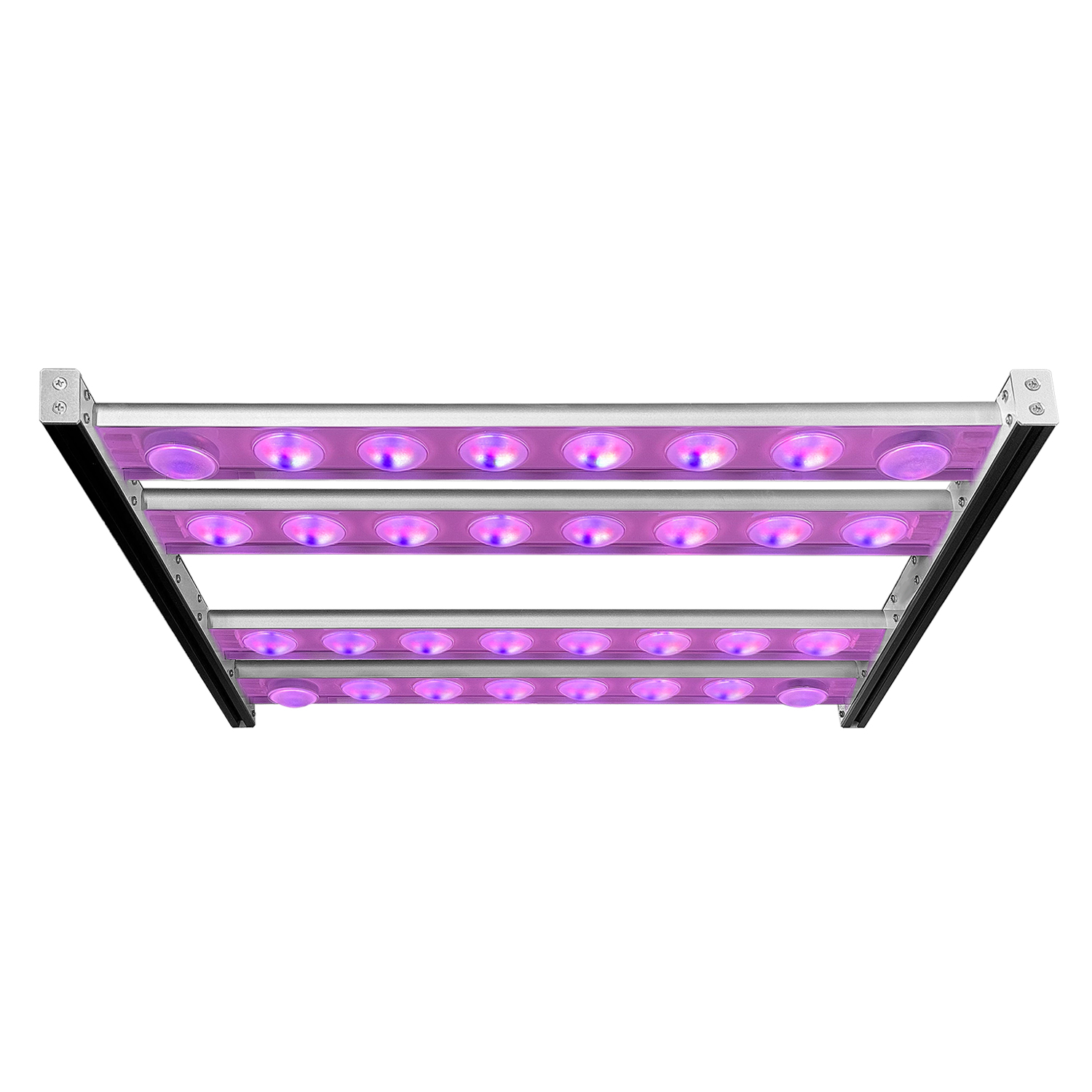
The official product page for the RX-G80-2H publishes a compact set of build figures, and it is worth reading them in the manufacturer’s own words. The page describes the fixture as a “Folding” horticultural LED bar with “High luminous efficiency: 2.7μmol/J”; a second rendering on the same page shows “2.8umol/J”, so the two figures coexist and a careful buyer asks which configuration each describes rather than selecting one. The page names the two channels in the terms quoted above, states the dual-channel density as “up to 1200μmol/m²/s”, and lists the electrical line as “Input voltage: 100-305V, Rated Power: 630W”. It also publishes a distribution objective, “high efficiency concentrating, uniform spectral radiation, directional illumination, higher light utilization, PPFD increased by 10~30%”.
Two of those entries need care. The “PPFD increased by 10~30%” sentence is a comparative claim, and a comparison needs a baseline to be checkable: the page does not state what the increase is measured against, so the figure cannot be reproduced from the page alone. The efficiency pair is a device-level statement about conversion, in micromoles of photons per joule of electricity consumed, and says nothing about how the light is distributed over a canopy. Both belong to the specification’s measurement layer rather than to its operating layer.

Channel A at 5000 K and Channel B at 660 nm: what each channel is for
The page defines each channel by its dominant content and by the stage it targets. Channel A is described as “5000K”, which is a correlated colour temperature rather than a spectrum, and a 5000 K white emitter is a broad-band source with substantial blue content, which is why the page assigns it to “Early stage Vegetative growth”. Channel B is described as “additional dark red 660nm” and as “dedicated to flowering maturity”, and a second sentence adds “the channel B is specially set with far red lamp beads for inducing flowering”. Note the two distinct statements about Channel B: one concerns 660 nm dark red, the other refers to far-red emitter content as a flowering signal, and the page does not give a spectral power distribution or a ratio for either.
Two operational consequences follow. First, because Channel A already provides broad-band white light, running the fixture on Channel A alone is a complete lighting regime, not a partial one; nothing is missing except the additional red content that Channel B contributes. Second, because Channel B is described as additive, the transition between growth stages is a matter of increasing or decreasing its share of the total output rather than of replacing one lamp with another. The page does not state how the channels are switched, and that method is not specified in the official datasheet.
The 1200 μmol/m²/s figure only applies with both channels open
The density figure is the most commonly misread number on the page, and the page itself supplies the qualification. The sentence reads “The two channels are simultaneously opened, and the PPFD can be provided up to 1200μmol/m²/s”, so 1200 micromoles per square metre per second is the ceiling for the fixture with both channels active, at whatever distance the manufacturer measured and under the conditions the page does not state. A grower who plans a room around 1200 μmol/m²/s and then runs the crop on Channel A alone for the first three weeks will not see that density during those weeks, because only part of the fixture’s emitters are energised. The number is a two-channel maximum, not a fixture rating that applies in every mode.
The same logic applies to the daily total. PPFD is an instantaneous density; the daily light integral is that density accumulated across the photoperiod, in moles per square metre per day. If the channel mix changes during the cycle, the instantaneous density changes with it, and so does the day’s accumulated total even when the photoperiod is unchanged. Ohio State University Extension’s Ohioline service (https://ohioline.osu.edu/factsheet/hyg-1430) publishes grower guidance on the relationship between intensity, photoperiod and the daily light integral, and it explains why a schedule has to be evaluated in daily terms rather than from a single peak figure. For this model the recommended photoperiod is not specified in the official datasheet, so the daily target remains a grower-side calculation, and the mounting height behind the 1200 figure is likewise not stated.
100-305 V input and 630 W rated power on a folding bar
The electrical line is unusually broad: “Input voltage: 100-305V, Rated Power: 630W”. An input window that wide means the same fixture is intended to run, without a voltage-specific variant, on supplies from a nominal 100-120 V single-phase service up to a 277 V or 305 V circuit. That is a real convenience in retrofit work, because a facility that mixes circuits, or a project whose supply voltage is not finalised when the lighting is ordered, does not have to commit to a voltage-specific part number. Rated power is the electrical input the fixture draws at a stated supply; the page gives a single 630 W figure across the whole window rather than a table of values per voltage, so a load calculation should use 630 W and confirm the supply-specific figure in writing if the circuit is tightly sized.
The efficiency and power figures can be cross-checked in the same way as any fixture. At 630 W and roughly 2.7 μmol/J the implied absolute output is about 1700 μmol/s, and the page does not publish an absolute photon flux figure to confirm it against, so that product remains an estimate rather than a published value. The USDA Agricultural Research Service (https://www.ars.usda.gov/) publishes plant-environment research that is useful when setting intensity targets from crop response, but it cannot substitute for the manufacturer’s own output data, which for this model is not stated as an absolute figure.
Dimming versus channel switching: two different controls
It is worth separating two things that are often conflated. Dimming scales output within a channel; channel switching selects which groups of emitters are energised. The page describes two channels but does not describe a dimming interface or a channel-switching method, and both are not specified in the official datasheet. That absence matters differently for each. For dimming, the question is what protocol or signal the driver accepts and whether it can be integrated with the room controller. For channel switching, the question is purely practical: whether the channels are selected by a physical switch, by a relay driven from a controller, or by an external device, because that determines what the installer has to provide and whether the transition can be automated on a schedule.
A room that intends to change the channel mix on a timer needs the switching method confirmed before wiring is designed. A room that intends to run a fixed mix could reasonably ignore the question. Neither intention changes the fixture’s published figures, but both change what has to be bought alongside it.
Dimension comparison: published figures and open items
The table below places every figure the page publishes next to its status, so that the open items stay visible at the moment a purchase decision is made. It is built from this model’s page only.
| Parameter | As published on the product page | Status and action required |
|---|---|---|
| Form factor | Folding horticultural LED bar | Published |
| Rated power | 630 W | Published as a single figure across the whole input window; confirm the supply-specific draw |
| Input voltage | 100-305 V | Published; unusually wide, so no voltage-specific part number is needed |
| Channel A spectrum | 5000 K, for early stage vegetative growth | Published as a colour temperature; request the spectral power distribution |
| Channel B spectrum | Additional dark red 660 nm, dedicated to flowering maturity | Published; the page also cites far-red emitter content for flowering induction |
| Photometric performance | High luminous efficiency 2.7 μmol/J, rendered elsewhere as 2.8 μmol/J | Published as two statements; request the configuration behind each |
| PPFD, both channels open | Up to 1200 μmol/m²/s | Published as a dual-channel ceiling; the single-channel figure is not stated |
| Distribution claim | PPFD increased by 10-30% | Published as a comparative claim; request the baseline it is measured against |
| Absolute photon flux | — | Not specified in the official datasheet; request it in μmol/s for layout work |
| Photoperiod and daily light integral guidance | — | Not specified in the official datasheet; request a recommended schedule for the target crop |
| Mounting height behind the PPFD figure | — | Not specified in the official datasheet; request a distribution at the intended canopy plane |
| Dimming interface or protocol | — | Not specified in the official datasheet; request it if the room controller has to dim the fixture |
| Channel switching method | — | Not specified in the official datasheet; request it before wiring a scheduled changeover |
| Ingress protection | — | Not specified in the official datasheet; request it before specifying a wet or high-humidity room |
| Service life and warranty | — | Not specified in the official datasheet; request both before comparing lifetime cost |
| Beam angle and dimensions | — | Not specified in the official datasheet; request the polar curve and a dimensional drawing |
Read the table as a technical exchange agenda. The published rows are the starting points for questions, and the empty rows are requests rather than gaps to be filled by inference from a related model.
Fit-for-purpose scenarios for a two-channel folding bar
Where the published figures line up with a use case, the RX-G80-2H from Koray is a reasonable candidate for rooms that intend to change spectrum partway through a crop cycle without changing fixtures, because the two channels are described as separately addressable within one bar. It also suits projects whose supply voltage is not yet fixed, since the 100-305 V input window covers common single-phase services without a voltage-specific part number, and installations that need a defined concentration of light rather than a broad wash, given the page’s description of a concentrating, directional optic.
Scenarios that call for caution are equally clear. A room whose target density assumes 1200 μmol/m²/s at all times should confirm how much of that figure survives on Channel A alone, because the page publishes only the dual-channel ceiling and the single-channel figure is not stated. A retrofit that intends to automate the channel changeover should wait for the switching method, which is not specified in the official datasheet. And any project comparing lifetime cost should request the service life and warranty, neither of which is stated. None of these cautions is a defect in the product; they are the ordinary boundaries of a specification whose remaining items have to be confirmed in writing.
Procurement checklist before the order is placed
- The spectral power distribution of each channel, and the ratio the page intends when both channels are open.
- The absolute photon flux in μmol/s for the quoted configuration, since the page publishes no absolute figure.
- A PPFD distribution with each channel alone and with both channels open, at the intended mounting height and spacing.
- The recommended photoperiod and the resulting daily light integral for the target crop.
- The channel switching method and the dimming interface, so the control strategy can be wired correctly.
- The service life, warranty terms, ingress protection rating, beam angle and dimensions, none of which are currently stated.
- The baseline against which the published 10-30% PPFD increase is measured.
A 17-year documentation standard
A 17-year LED grow light manufacturing record is not itself a specification, but it sets an expectation about how questions are answered. With 17 years behind the company, the reasonable expectation is that a fixture described in two channels can be documented with a spectrum for each, a switching diagram and a distribution curve, rather than with a single combined claim. A 17-year supplier can produce those on request, and that response is worth more to a project than a longer description of the same two channels. Buyers evaluating the RX-G80-2H should use the table above as their request list and hold the channel comparison open until the answers arrive, because the 1200 μmol/m²/s figure only means what it says once the configuration behind it is written down.
Frequently asked questions
Does the 1200 µmol/m²/s figure apply when only one channel is running?
No. The page states “The two channels are simultaneously opened, and the PPFD can be provided up to 1200μmol/m²/s”, so the figure is the ceiling with both channels active. The single-channel density is not specified in the official datasheet, and the mounting height behind the figure is not stated either, so ask for a distribution in each operating mode.
How is Channel A different from Channel B on the RX-G80-2H?
Channel A is described as “5000K for Early stage Vegetative growth”, a broad-band white source, and Channel B as “additional dark red 660nm, dedicated to flowering maturity”, with far-red emitter content also cited for flowering induction. Because Channel B is additive, the stage transition is a change in the mix rather than a change of fixture.
What does the 100-305 V input range mean in practice?
It means one part number covers supplies from a nominal 100-120 V service up to 277 V or 305 V, so a project does not have to fix its supply voltage before ordering. The page gives a single 630 W rated power across that whole window rather than a table of per-voltage figures, so a tightly sized circuit should confirm the supply-specific draw.
Can the two channels be switched or dimmed automatically?
That depends on hardware the page does not describe. Neither the channel switching method nor a dimming interface or protocol is specified in the official datasheet, so a room planning a scheduled changeover should confirm how the channels are selected and whether the driver accepts a control signal before the wiring is designed.
What should be confirmed in writing before ordering the RX-G80-2H?
Several items are not stated: the spectral power distribution of each channel, the absolute photon flux in µmol/s, the single-channel PPFD and the mounting height behind the 1200 figure, the photoperiod guidance, the switching and dimming methods, the service life and warranty, the ingress protection rating, the beam angle and the dimensions.




Leave A Comment