

A “sunlight spectrum” grow light is usually described by the two wavebands a phosphor-converted white LED cannot produce on its own: deep red near 660 nm and far red near 730 nm. This article explains what each of those two additions does to a plant, why far red sits outside the 400-700 nm photosynthetically active radiation (PAR) window while deep red sits inside it, and how one 100 W quantum board, the RX-G1000L, states those channels next to its 2.7 umol/J efficiency figure. Any figure the official page does not publish is marked as unpublished rather than estimated.
How to read a spectrum: edges, not peaks
Photosynthetically active radiation (PAR) is the 400-700 nm waveband that chloroplasts can use. Photosynthetic photon flux (PPF) is the number of photons inside that band arriving per second, expressed in micromoles per second (umol/s), and photosynthetic photon flux density (PPFD) is that flux spread over a surface area, in micromoles per square metre per second. A “sunlight” or “full” spectrum is not a peak wavelength but a broad distribution across the band, produced in most white-LED fixtures by a blue emitter driving a broad phosphor.
Two pigments decide whether the shape of that distribution matters beyond raw photon count. Chlorophyll absorbs strongly in the blue and in the red, so photons near 660 nm are close to a chlorophyll a absorption maximum and drive photosynthesis directly. Phytochrome, by contrast, reads the ratio between red and far-red light and uses it as a positional signal about neighbouring vegetation. Michigan State University Extension explains the practical consequences of spectrum choice for horticultural LEDs, including how plant morphology responds to the quality of the light it receives, in MSU Extension – LED lighting for horticulture.
Deep red at 660 nm: energy band and signal band at once
Deep red at 660 nm is a wavelength where two roles overlap. As an energy band it sits close to the chlorophyll red absorption region, so adding photons there increases the fraction of the spectrum that is directly photosynthetically useful. As a signal band it converts phytochrome into its active far-red-absorbing form, which is the state associated with normal, unstretched stem growth rather than shade-avoidance elongation. Because a 660 nm addition changes the energy and the signal budget at the same time, it is one of the few spectrum decisions that can move plant form and photon economics in the same direction.
Far red at 730 nm: outside PAR but not outside the model
Lying above the 700 nm upper limit of the PAR definition, 730 nm photons are excluded from PPF and PPFD figures. The photon flux that efficiency programmes verify is therefore counted in a band that stops before the far-red channel begins; the DesignLights Consortium, which sets the technical requirements for its Horticultural Lighting qualified products list, is one example of a programme that qualifies fixtures against defined photon measurements, at DLC – Horticultural Lighting. That exclusion does not make far red inert. The same phytochrome pigment that absorbs near 660 nm switches back when it absorbs near 730 nm, so far red shifts the red-to-far-red ratio a plant perceives. The practical reading for a buyer is that a far-red channel is a morphology and signalling control, while the PPF and umol/J headline figures describe only the 400-700 nm part of the output.
What “up to 2.7 umol/J” covers, and the wattage that defines it
Photosynthetic photon efficacy (PPE) is PPF divided by wall-plug power, which is why it is expressed in micromoles per joule: it is a ratio, not an output. “Up to 2.7 umol/J” therefore marks an upper bound rather than a guaranteed operating point, and a comparable figure has to come from the same drive current and the same case temperature as the source, because the ratio changes when either does. The G1000L page illustrates the second half of that problem clearly: it lists 103 W at AC120 V but 100 W at AC230 V and at AC277 V. The same board draws different wall power from different supplies, so an efficacy figure is only meaningful next to the input voltage it was taken at. The page also does not publish the drive current or the case temperature of its measurement, so the figure should be treated as a published upper bound and re-verified at the operating point you intend to run. Government and university programmes that study plant response to electric lighting, such as the USDA Agricultural Research Service, treat lighting as one variable among several in a controlled environment, which is a useful reminder that a source rating is not a growth result.
Reading the RX-G1000L page line by line
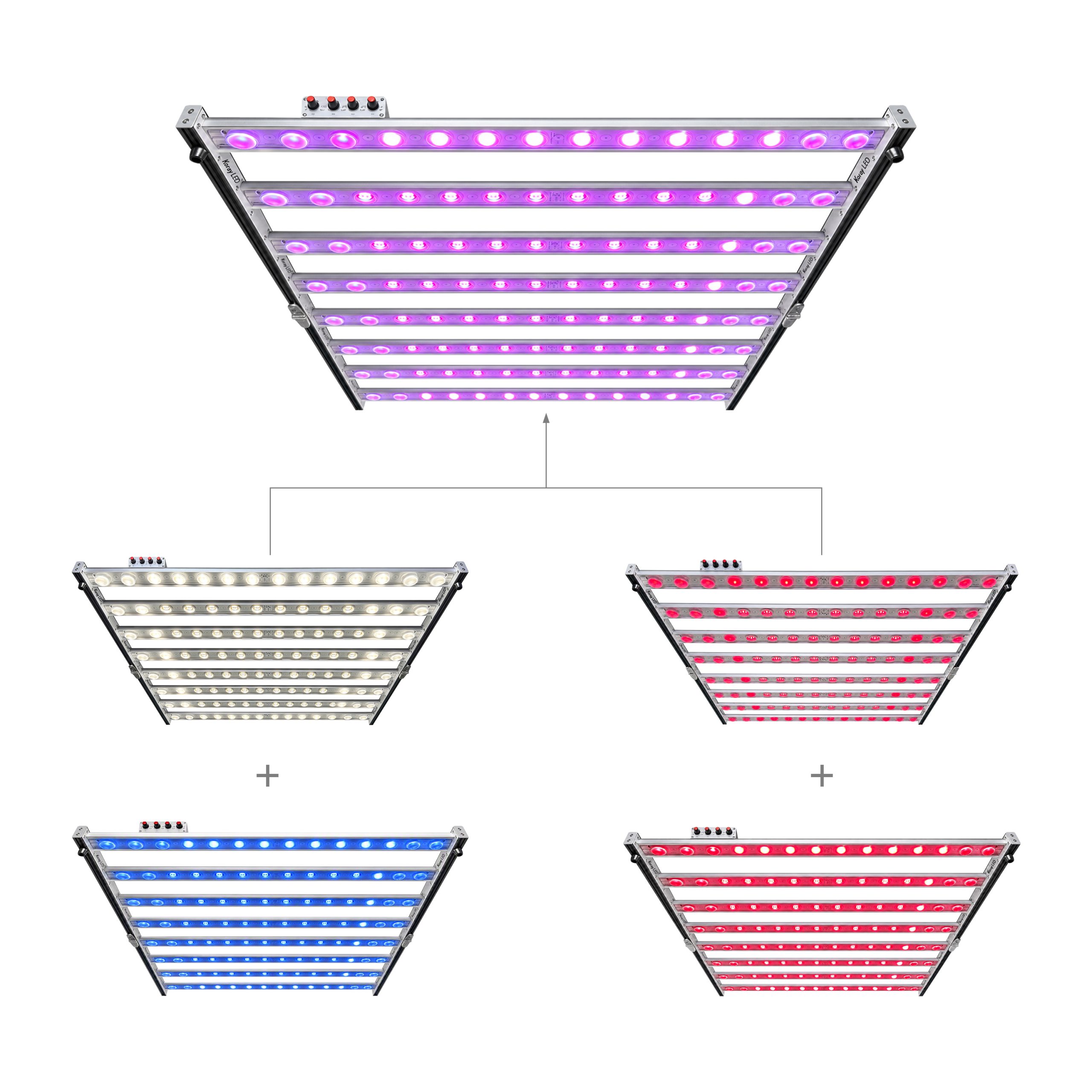
- Sunlight spectrum is the wide-band base output; the page then lists two added channels, deep red 660 nm and IR 730 nm.
- Samsung LM301 is the LED chip family named on the page, and MeanWell is the driver brand named. Neither statement is a count of diodes, so the number of emitters per channel should not be inferred from it.
- Multi-Lights Connection Dimming is a link-level arrangement among fixtures rather than a per-emitter control channel; it changes how a group of boards is operated, not the spectrum mix at each board.
- Lifespan 50,000 hours is a projection from LED lumen-maintenance data collected under controlled drive current and case temperature, not a burn-in test of the finished fixture, so real service life still depends on ambient temperature, dimming level and supply quality.
- CE, RoHS and FCC are the compliance marks listed on the page. They cover electrical product compliance, hazardous-substance limits and electromagnetic emissions; none of them is an ingress-protection rating, and the page publishes no IP code.
- Coverage figures conflict on the official page. The short description states a veg footprint of 3 x 3 ft, the description body states 2.5 x 2.5 ft, and both state a flowering footprint of 2 x 2 ft. The conflict is disclosed here rather than resolved, and no single figure is presented as authoritative.
- PPF (umol/s), PPFD, IP rating and beam angle are not published on the official page.
Deep red versus far red: the same board, two different jobs
| Dimension | 660 nm deep red | 730 nm far red |
|---|---|---|
| Position in the spectrum model | Inside the 400-700 nm PAR band | Above the PAR band |
| Main photoreceptor interaction | Chlorophyll red-absorption region; converts phytochrome to its active form | Phytochrome reversion; shifts the red-to-far-red ratio |
| Primary role | Direct photosynthetic energy plus a growth-form signal | Morphology and signalling control |
| Counted in PPF and PPFD | Yes | No, by the 400-700 nm definition |
| Official page wording | “add the deep red 660nm” | “IR 730nm” |
Read the table as a division of labour rather than a ranking. A deep-red addition is bought for two returns at once, one energetic and one morphological. A far-red addition is bought for the morphological return alone, and it will never appear in a PPF or umol/J figure, so a fixture that lists it can look optically identical to one that does not while behaving differently over a canopy.
Where a 100 W white board with red-band additions fits
For a small veg or flowering space with a limited wall-power budget, a 100 W board built on a wide-band base with a deep-red addition is a reasonable starting point, and link-level dimming suits rooms where several boards are run as one group rather than individually. The RX-G1000L’s published 3 year warranty and its CE, RoHS and FCC listings make it straightforward to place in an export-oriented product line, and the manufacturer states 17 years of LED horticultural lighting experience. Because the page publishes no PPFD, no hanging height and no daily light integral, the mounting distance has to be set empirically: measure with a quantum sensor at the canopy, check evenness across the footprint, and repeat the measurement as the canopy closes on the fixture rather than trusting an extrapolated figure.
Frequently asked questions
Does the RX-G1000L publish PPFD, a hanging height or a daily light integral?
No. The official page publishes efficacy up to 2.7 umol/J, a wattage that depends on input voltage, coverage footprints, the two added red channels, a 50,000 hour lifespan projection and CE, RoHS and FCC listings, but it publishes no PPFD, no hanging height and no daily light integral. Any PPFD figure for this board has to be measured at a stated height and photoperiod with a quantum sensor rather than quoted from official data.
How should “up to 2.7 umol/J” be compared with another fixture’s efficacy number?
Photosynthetic photon efficacy is PPF divided by wall-plug power, so it is a ratio of two numbers and an “up to” figure is an upper bound. A comparison is only valid when both values were taken at the same drive current and case temperature. Because the G1000L page also lists 103 W at AC120 V against 100 W at AC230 V and AC277 V, the input voltage behind any efficiency figure matters; verify the fixture at the voltage and dimming level you will actually use.
What is the difference between the deep red 660 nm and the IR 730 nm channels?
Both act on phytochrome but from opposite sides. Deep red near 660 nm sits inside the 400-700 nm PAR band, so it counts toward PPF and PPFD and also shifts phytochrome toward its active form. Far red near 730 nm sits above the PAR band, so it is not counted in photon-flux figures, and it shifts the red-to-far-red ratio in the opposite direction, which makes it a morphology and signalling channel rather than an additional photosynthesis channel.
What does Multi-Lights Connection Dimming control on this board?
The page describes it as a connection-based dimming arrangement between boards, so it governs how a group of fixtures is dimmed together, not the mix of wavelengths inside one board. Spectrum is set by the board’s build, while the dimming link adjusts output level across the connected group; that distinction matters when a room is zoned and different zones need different photon delivery.
How should the 50,000 hour lifespan and the 3 year warranty be read?
The 50,000 hour figure is a projection from LED lumen-maintenance data collected under controlled drive current and case temperature, not a burn-in test of the finished board, so service life also depends on ambient temperature, dimming level and driver quality. The 3 year warranty is a separate commercial commitment. Note that the official page lists CE, RoHS and FCC but no ingress-protection code, so outdoor or wash-down use is not covered by a published rating.




Leave A Comment