

When a grow-light supplier lists size, power, spectrum, PAR output and PPFD output as customizable, it is offering a menu of five independent variables rather than one adjustable number. Each variable sits at a different level of the engineering model: panel geometry, wall-plug draw, relative photon distribution, total photon flux, and photon flux density at a surface. This article unpacks that menu, shows what changes and what stays fixed when any one item is chosen, and uses one 480 W quantum board, the RX-LM301-312-K4, as the worked reference. Figures the official page does not publish are marked as unpublished rather than estimated.
Why “customizable” is a procurement question before it is a specification
A customization list transfers the burden of definition to the buyer. A supplier can build a board to any requested size, power or spectrum, but it cannot guess which of those values will be measured against, so the buyer has to name both the metric and the conditions before the order becomes unambiguous. The DesignLights Consortium, which publishes the technical requirements behind its Horticultural Lighting qualified products list, is one example of how the industry ties a claim to a defined measurement rather than to a marketing phrase: DLC – Horticultural Lighting. Michigan State University Extension covers the same discipline from the research side, describing how photon flux and spectrum are measured and why two fixtures cannot be compared unless they were measured the same way: MSU Extension – LED lighting for horticulture. A custom order has to reproduce that discipline internally.
The five variables, defined
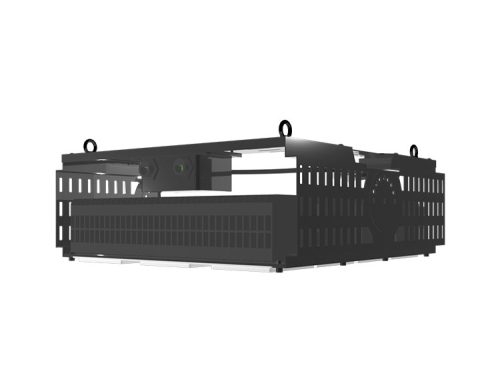
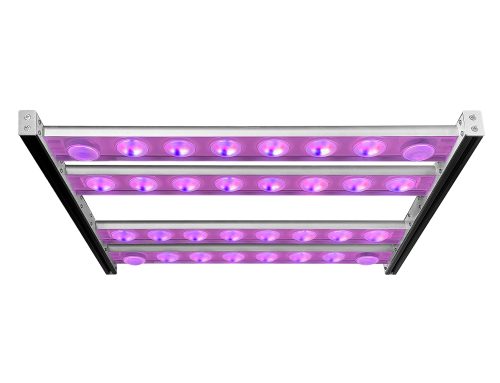
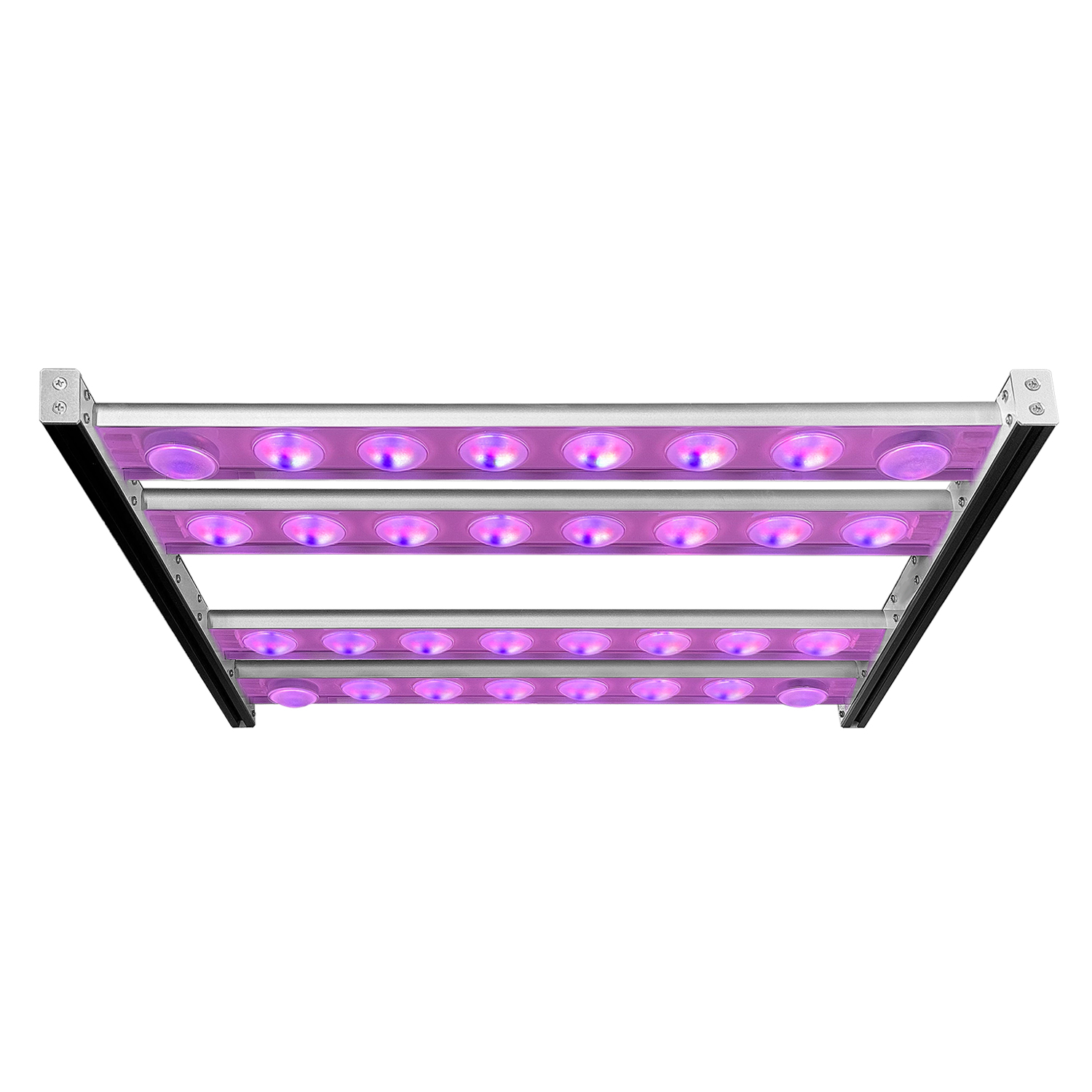
- Fixture size is the physical envelope of the board, and it sets the reference geometry rather than the photon budget. The official page gives 24 in (600 mm) x 24 in (600 mm) x 2.7 in (68 mm) for the reference SKU.
- Rated power is the wall-plug draw of the finished board. The page states 480 W with an input of AC100~277 V, so one SKU covers single-phase 120 V, 208-240 V and 277 V distribution without a step-down transformer.
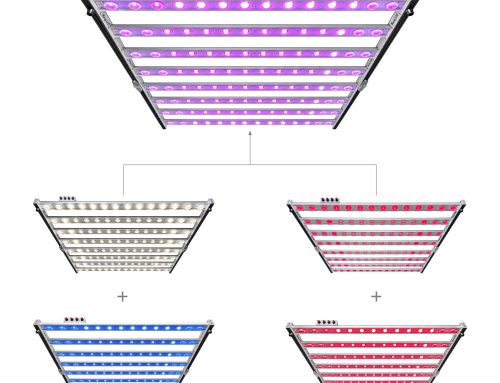
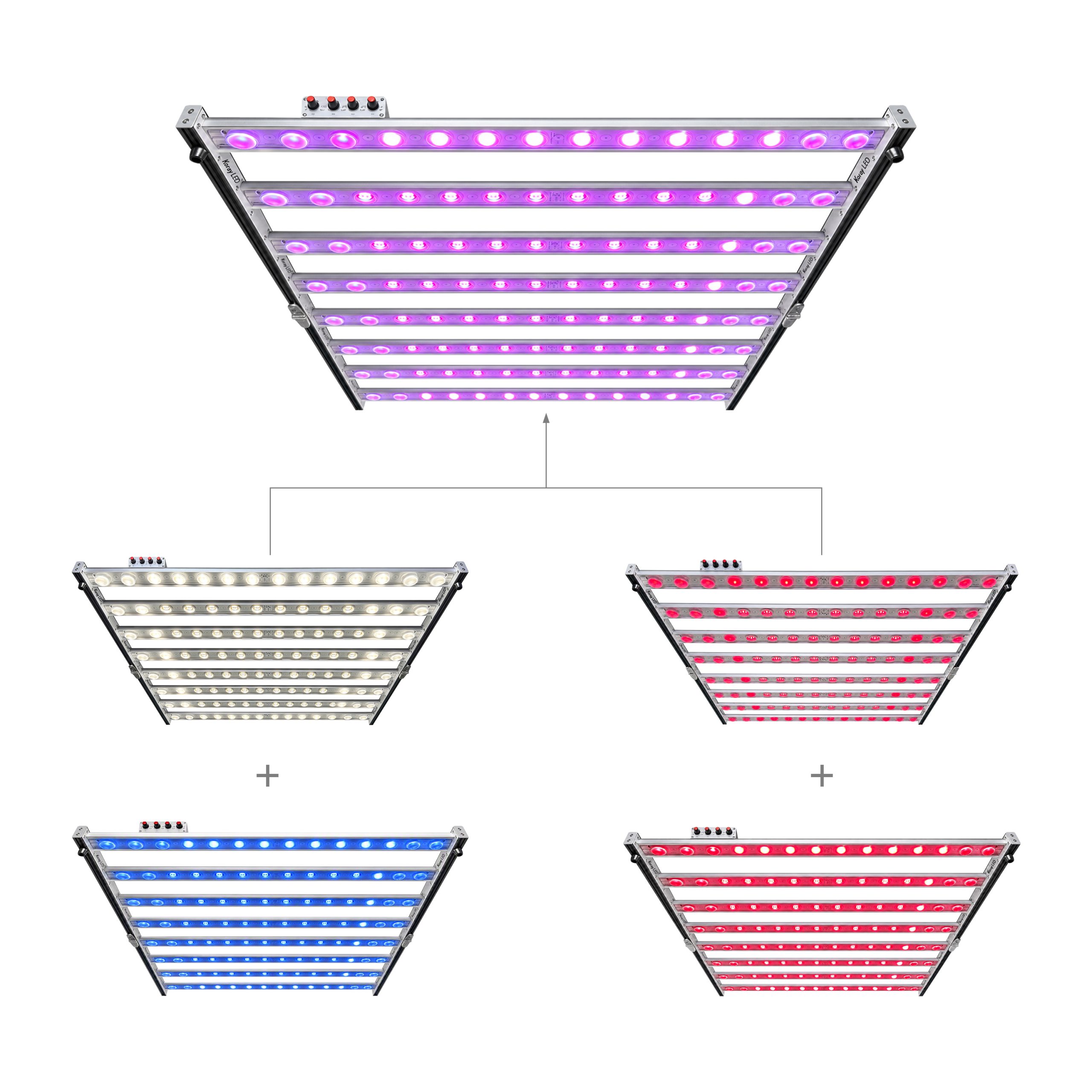
- Spectrum is the relative photon distribution across the waveband. The page describes a real full spectrum with an additional 660 nm deep red channel.
- PAR output is total photosynthetic photon flux in micromoles per second across the 400-700 nm band; it is a source figure.
- PPFD output is photon flux density, that flux divided by area at a stated height, so it is a canopy figure and cannot be specified without also naming a measurement plane and a mounting distance.
The last two items are the pair most frequently confused. PAR output describes the lamp; PPFD output describes a surface under it. Buying a source figure and expecting a canopy result is the same mistake as buying engine power and expecting a lap time.
Two efficiency figures on one page: 2.8 and 3.4 umol/J
The page states efficiency up to 2.8 umol/J for the board and up to 3.4 umol/J for its 660 nm deep-red chip. Both are micromoles per joule and both are ratios, but they are taken at different levels: one describes the finished fixture with its driver and optical path, the other describes an emitter. Efficacy is PPF divided by electrical power, so a chip-level value cannot substitute for a fixture-level value when complete luminaires are compared, and both are upper bounds taken under unnamed drive and temperature conditions. Read the pair as the spread between a top-bin emitter and the finished product, not as a contradiction. The U.S. Department of Agriculture’s research arm, the USDA Agricultural Research Service, studies such lighting variables as one factor among several in a controlled environment, which is a reminder that an emitter figure and a crop result are separated by the whole optical and thermal path.
What stays fixed when the menu is open
A genuinely customizable platform still has a fixed core. On the RX-LM301-312-K4 the page lists a fanless design, reliable MeanWell drivers, a lifespan of 50,000 hours, a 3 year warranty, CE, RoHS and FCC listings, and a plug-and-play connection scheme. Those items are not on the customization list and should be read as the platform’s floor. Two absences matter as much as the presences: the page publishes no PPFD value and no IP code, so a target irradiance and any ingress requirement for a humid room both have to be raised as explicit questions during the order rather than assumed from the listing.
Five variables, five different verification steps
| Variable | What it is | What it moves in the model | What has to be re-verified |
|---|---|---|---|
| Size | Physical envelope of the board | How the fixture grid is laid out over the canopy | Mounting hardware, clearance, and the measurement plane used for PPFD |
| Power | Wall-plug draw at a stated input voltage | Photon output and the efficacy ratio | Branch-circuit capacity, and the voltage at which efficacy was measured |
| Spectrum | Relative photon distribution across the waveband | Plant morphology and signalling, not the photon count | Whether added deep-red or far-red channels are counted in the photon figures |
| PAR output | Total photon flux in umol/s across 400-700 nm | The source-level photon budget | That the figure is source output and not a canopy reading |
| PPFD output | Photon flux density in umol/m2/s at a stated plane | What the canopy actually receives | Hanging height, grid spacing, and measurement with a quantum sensor |
The point of the table is that the five items are not interchangeable settings on one dial. Moving any single row leaves at least one verification step unresolved, and the widest gap between a specification and a result is the bottom row, where geometry and measurement enter the model.
Where the RX-LM301-312-K4 fits as a reference order
For a buyer who needs one platform across several room sizes or power tiers, a board like the RX-LM301-312-K4 is most useful as the reference SKU: 480 W, AC100~277 V input, Samsung LM301b chips, MeanWell drivers, a fanless body, and a published 50,000 hour lifespan projection backed by a 3 year warranty and CE, RoHS and FCC listings, with the manufacturer stating 17 years of LED horticultural lighting experience. Because spectrum, PAR output and PPFD output are all offered as customizable variables, the workable sequence is to fix power and size first, then state the PPFD target together with the height at which it must be met, and only then adjust spectrum, confirming the result at the end with a quantum sensor rather than with an extrapolated canopy figure.
Frequently asked questions
What does it mean that size, power, spectrum, PAR output and PPFD output can be customized?
It means the finished board can be built to a buyer’s own values for five separate variables: the physical envelope, the wall-plug draw, the relative photon distribution, the total photon flux, and the photon flux density target. Each one sits at a different level of the model, so choosing a value for one does not determine the others; the buyer has to state all five plus the measurement conditions before the order is unambiguous.
Why does the page show 2.8 umol/J for the board and 3.4 umol/J for the deep-red chip?
Photosynthetic photon efficacy is photon flux divided by electrical power, and the two figures are measured at different levels. The 2.8 umol/J value describes the finished 480 W fixture including its driver and optical path, while the 3.4 umol/J value describes the 660 nm deep-red chip itself. Both are upper bounds, so the gap between them is the normal difference between an emitter measurement and a system measurement rather than an inconsistency.
Does the RX-LM301-312-K4 publish a PPFD value or a hanging height?
No. The official page publishes 480 W, an input of AC100~277 V, efficiency up to 2.8 umol/J, the higher 660 nm chip figure, the reference enclosure size, a fanless design and a 50,000 hour lifespan projection, but it publishes no PPFD number, no hanging height and no IP code. Any PPFD figure has to be measured at a stated plane and photoperiod with a quantum sensor, which is also why PPFD output is listed as a customizable variable rather than a fixed specification.
Can one SKU run on 120 V and 277 V supplies without a transformer?
Yes. The official page specifies an input of AC100~277 V, so the same board covers single-phase 120 V, 208-240 V and 277 V distribution without a step-down transformer. Branch-circuit capacity, cable routing and local electrical code still determine the installation, and the input voltage matters when reading any efficacy figure because efficacy is a ratio against wall-plug power.
What does the fanless design change in a custom order?
A fanless design removes the moving part most likely to need service, which is one reason a passively cooled board is common in sealed rooms where airborne debris or humidity would shorten fan life. It also means heat leaves through the board body, so mounting orientation, air movement in the room and ambient temperature all influence the case temperature that the 50,000 hour projection assumes. The page lists no IP code, so any wash-down or high-humidity requirement should be raised as an explicit question during the order.




Leave A Comment