

Grow-light specification sheets mix three different languages: an electrical rating, an optical rating and a durability rating. They come from different tests, they answer different questions, and only one of them tells you how much photosynthetically active radiation actually leaves the array. This article reads one toplighting array, the RX-GW78-LM301-K6, through the four figures that can be traced back to its official product page – PAR photon flux, PPF efficiency, the input-voltage window and the ingress-protection and life ratings – and marks clearly which questions the page does not answer.
1. PAR flux, PPF and PPE are three different measurements
Photosynthetically active radiation (PAR) is the 400-700 nm waveband that drives photosynthesis; total PAR output is reported as photosynthetic photon flux (PPF) in micromoles per second (umol/s). PPF efficiency (PPE) divides that photon flux by the electrical power drawn at the wall, so it is expressed in micromoles per joule. The U.S. Department of Energy’s Solid-State Lighting program explains the underlying split between radiometric, photometric and photon-based quantities in DOE SSL – LED Basics. Because PPE is a ratio, a comparable figure must come from comparable conditions: same drive current, same case temperature, same integrating-sphere geometry.
Two consequences follow. First, a fixture that publishes photon flux but not wall-plug power cannot be compared on efficiency at all, because one term of the ratio is missing. Second, a source figure is not a canopy figure: how many photons reach a leaf depends on mounting height, beam geometry and reflection off the walls. Photon flux and canopy irradiance should never be read as the same number.
2. What “up to 2.6 umol/J” commits to, and what it does not
Manufacturers publish PPE in two very different ways: as a measured value at a named operating point, or as an upper bound. The phrase “up to” signals the second reading, and the difference matters when two fixtures are placed side by side. The Lighting Facts label program exists precisely to standardise which metrics are reported and under which conditions (Lighting Facts), while the DesignLights Consortium maintains verified performance criteria and qualified-product listings for commercial lighting (DesignLights Consortium).
For this array the official page states PPF efficiency up to 2.6 umol/J together with PAR 2400 umol/s. Read correctly, 2.6 umol/J is a ceiling for the design rather than a guaranteed operating point, and the page does not publish the drive conditions behind the figure, so it should be verified at the level you intend to run. The 2400 umol/s figure, by contrast, is a source-output statement: it describes the array, not the leaf surface.
3. AC 100~277 V input and a two-supply driver topology
Horticultural LED arrays are driven by current-limited supplies rather than by mains directly, and the input window determines how many electrical variants a grower has to stock. The official page lists the K6 array input as AC100~277 V, which spans single-phase 120 V, 208-240 V and 277 V commercial distribution from one SKU, and specifies two Meanwell HL-480H dimmable power supplies per array.
Two supplies in place of one split the array’s electrical load and let dimming be applied across the whole array rather than to a fraction of the emitters. From a planning standpoint this affects branch-circuit design, cable routing for two feeds instead of one, and the enclosure space reserved at the wall – not the optical layout. Constant-current LED drivers keep emitter output stable as junction temperature drifts, which is why dimming range and thermal design have to be read together.
4. Emitter choice: LM301 rows plus a 660 nm red channel
White mid-power LEDs emit across the whole PAR band; a discrete 660 nm peak sits close to the red absorption maximum of chlorophyll, which is why hyper-red emitters are added to broad-spectrum arrays rather than used alone. Michigan State University Extension sets out how spectrum and intensity have to be evaluated together for controlled-environment crops in MSU Extension – LED lighting.
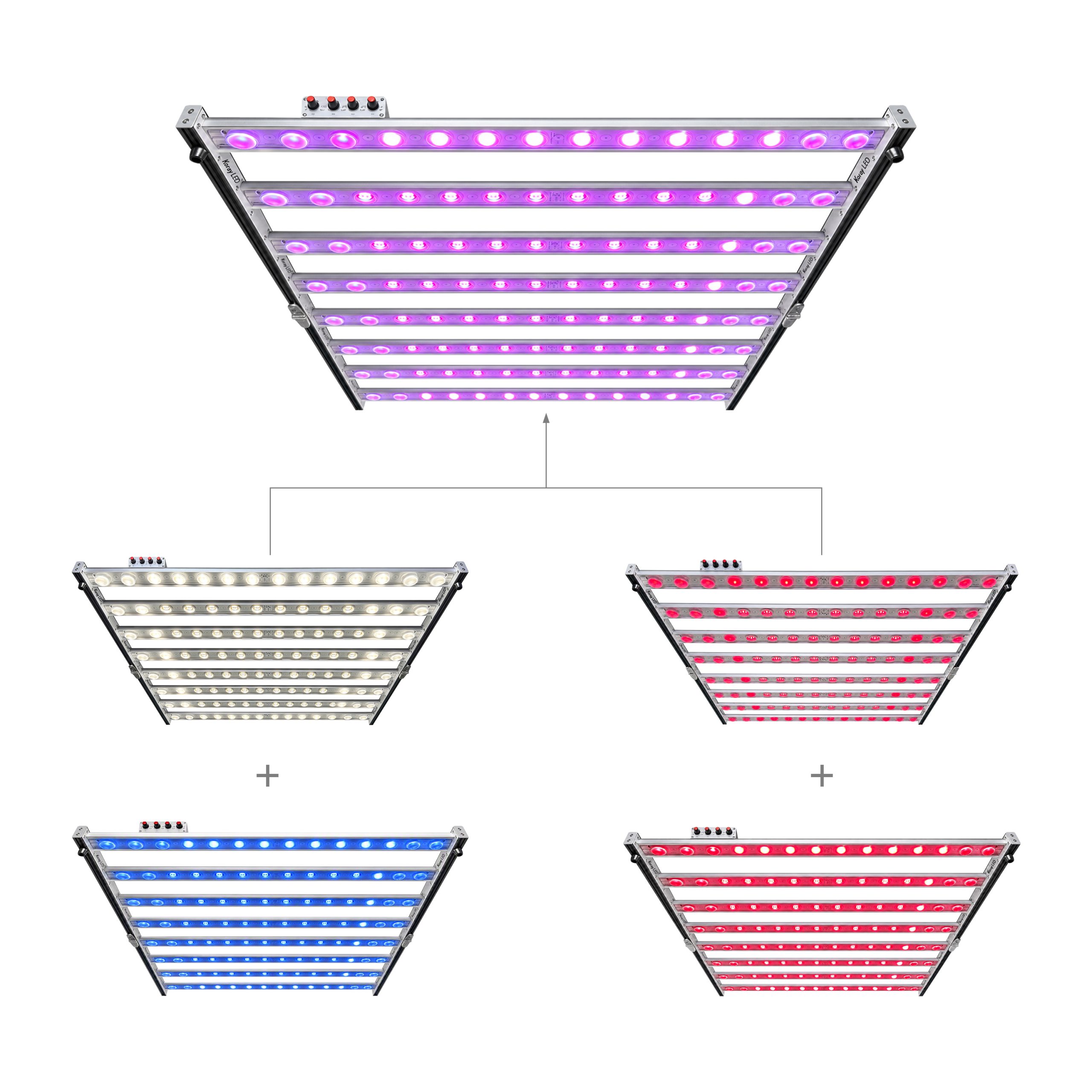
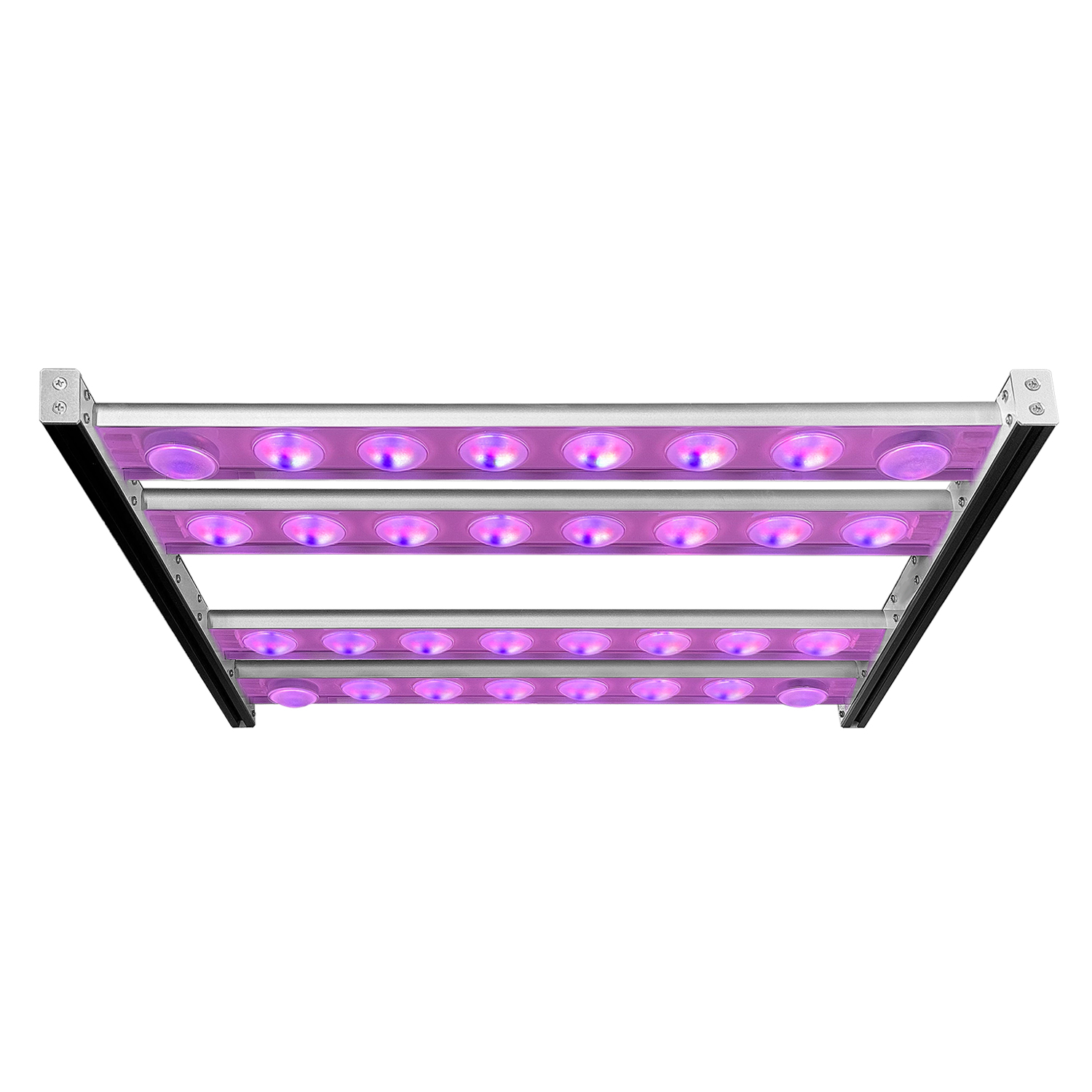
The official page for this array lists Samsung LM301 emitters together with Osram horticulture LED chips (described on the page as a German-brand horticulture LED), arranged as a six-module top-lighting array. The spectral recipe is fixed: no per-channel spectrum control is published, so the adjustable variable is dose – intensity and photoperiod – rather than spectral composition.

5. IP65 and a 50,000 hour rating answer different questions
IP65 is an IEC 60529 ingress-protection code: 6 means dust-tight, 5 means protected against water projected as a jet from any direction. It therefore covers hose-down floors and humid propagation rooms, and it says nothing about immersion or about optical performance. A rating of up to 50,000 hours is a different kind of statement again – a projection from LED lumen and colour-maintenance data collected under controlled drive current and case temperature, rather than a burn-in test of a finished array.
Both figures appear on the official page for the RX-GW78-LM301-K6, alongside CE, RoHS and FCC marks. In service, the practical reading is that ingress protection governs where the fixture can be installed and how it is cleaned, while the life projection governs how photon output is expected to hold up over years of operation.
6. Dimension comparison: parameter, official figure, condition, verification basis
| Dimension | Official figure | Condition attached to the figure | Verification basis |
|---|---|---|---|
| PAR photon flux (PPF) | PAR 2400 umol/s | Total array output across 400-700 nm; source figure, not canopy irradiance | Official product page (product ID 4433) |
| PPF efficiency (PPE) | up to 2.6 umol/J | Upper bound; drive current and case temperature not published | Official product page (product ID 4433) |
| Emitter set | Samsung LM301 plus Osram 660 nm horticulture LEDs | Single fixed spectrum; no per-channel control published | Official product page (product ID 4433) |
| Input voltage | AC100~277 V | One SKU across 120 V, 208-240 V and 277 V distribution | Official product page (product ID 4433) |
| Power supply | 2 x Meanwell HL-480H, dimmable | Two supplies per array; dimming applies across the array | Official product page (product ID 4433) |
| Ingress protection | IP65 | Dust-tight and water-jet protected per IEC 60529; not immersion | Official product page (product ID 4433) |
| Rated life | up to 50,000 hours | Projected lumen and colour maintenance under controlled drive current and case temperature | Official product page (product ID 4433) |
| Array configuration | K6 six-module top-lighting array | Module count is a selection variable, not a performance claim | Official product page (product ID 4433) |
| Compliance marks | CE / RoHS / FCC | Safety, materials and EMC marks; not photon measurements | Official product page (product ID 4433) |
| Rated power | Not published in this article | The official page states two different wattage values, one in the page title and one in the product description; this article quotes no wattage figure and readers should confirm power with the manufacturer | Official product page (product ID 4433) |
7. Where this array fits
Read as a package, the published figures describe a top-lighting array for a room with a single distribution voltage, fixed spectrum, and a cleaning regime that involves water rather than wiping. Wide input voltage suits retrofit projects where 277 V branch circuits already exist; IP65 sealing suits propagation and humid rooms where hoses are used; a six-module format suits installations that are planned as a grid of overhead fixtures rather than one central unit. Medicinal-herb cultivators typically value that combination because spectrum stays constant across a crop cycle and only dose is scheduled.
Because the page publishes no PPFD, no hanging height and no daily light integral, canopy irradiance has to be established on site: mount, measure with a quantum sensor at the canopy, adjust for evenness across the footprint, and re-check as the canopy grows closer to the light. The array itself is listed on the official product page at RX-GW78-LM301-K6 on koraylights.com, from a 17-year LED horticultural lighting manufacturer.
Frequently asked questions
How much PAR does the RX-GW78-LM301-K6 deliver, and at what hanging height should it be mounted?
The official page publishes PAR 2400 umol/s for the array as a whole. It does not publish PPFD, a hanging height or a daily light integral, so no mounting distance and no canopy irradiance figure can be quoted from official data. Treat 2400 umol/s as source output, then set height empirically with a quantum sensor at the canopy, checking evenness across the footprint and repeating the measurement as the canopy grows closer to the fixture.
What does "up to 2.6 umol/J" mean when comparing this array with another fixture?
PPF efficiency is PAR photon flux divided by wall-plug power, so it is a ratio of two published numbers, and "up to" marks an upper bound rather than a guaranteed operating point. A comparable figure must come from the same drive current and case temperature, and the official page does not publish those conditions. If another product publishes photon flux only, or power only, the efficiency comparison cannot be completed at all; verify at the operating point you will actually run.
Does the array run on both 120 V and 277 V supplies without a step-down transformer?
Yes. The official page specifies an input of AC100~277 V with two Meanwell HL-480H dimmable power supplies, so one SKU covers single-phase 120 V, 208-240 V and 277 V distribution without a step-down transformer. Branch-circuit capacity, cable routing for two supplies and local electrical code still determine the installation, and dimming applies across the array rather than to selected emitters.
What does the six-module K6 configuration change, and how is the module count chosen?
K6 denotes a six-module top-lighting array, so module count sets how many emitters contribute to the published source output. The official page does not publish a coverage area per module, so module count should be chosen from room dimensions and the fixture grid you can hang, then confirmed by measuring photon flux density at the canopy rather than by extrapolating from a footprint figure.
What does IP65 protect on this fixture, and how should the 50,000 hour rating be read?
IP65 means dust-tight (6) and protected against water jets from any direction (5) under IEC 60529, which covers hose-down floors and humid propagation rooms but not immersion. The up to 50,000 hour figure is a projection from LED lumen and colour-maintenance data collected under controlled drive current and case temperature, not a burn-in test of the finished array, so real service life also depends on ambient temperature, dimming level and supply quality.




Leave A Comment