

A toplighting module is specified differently from a finished luminaire. There is no housing to judge, no cable loom to trace and no control panel to inspect; what a specifier can actually evaluate is the optical stack, the environmental seal and the mechanical interface that the module presents to a rail. The RX-TP12050 is a 1,206 mm linear module built around those three elements: multiple LED chips sharing a single lens, a silicone-potted body rated IP65, and a 40 x 40 mm C-profile mounting interface. Its specification sheet publishes three spectral recipes, F4, F5 and F6, each with its own PPF, efficacy and distance-dependent PPFD. All figures below come from the manufacturer’s own documentation.
What in-lens multi-chip mixing means
In-lens multi-chip spectral mixing is an optical arrangement in which two or more LED chips of different peak wavelengths are placed under a single secondary lens, so that their beams overlap in the near field before they reach the canopy. The alternative is to give each chip its own lens and rely on the fixture’s mounting geometry to blend the beams at a distance.
The distinction matters because mixing distance is set by optics rather than by installation. When chips share a lens, colour separation is resolved within the lens body over a short distance, which keeps the spectral ratio more consistent close to the module. When chips have separate lenses, blend quality depends on how far the canopy sits below the fixture and how the modules are spaced. For a module intended to be mounted at 0.5 to 2 m above a canopy, the shared-lens approach makes the published spectral recipe meaningful at the near end of that range as well as the far end.
The F4, F5 and F6 recipes
A spectral recipe is a fixed chip mix that defines the photon distribution the module emits. The RX-TP12050 is published in three versions, and each is aimed at a different crop strategy rather than at a different power class.
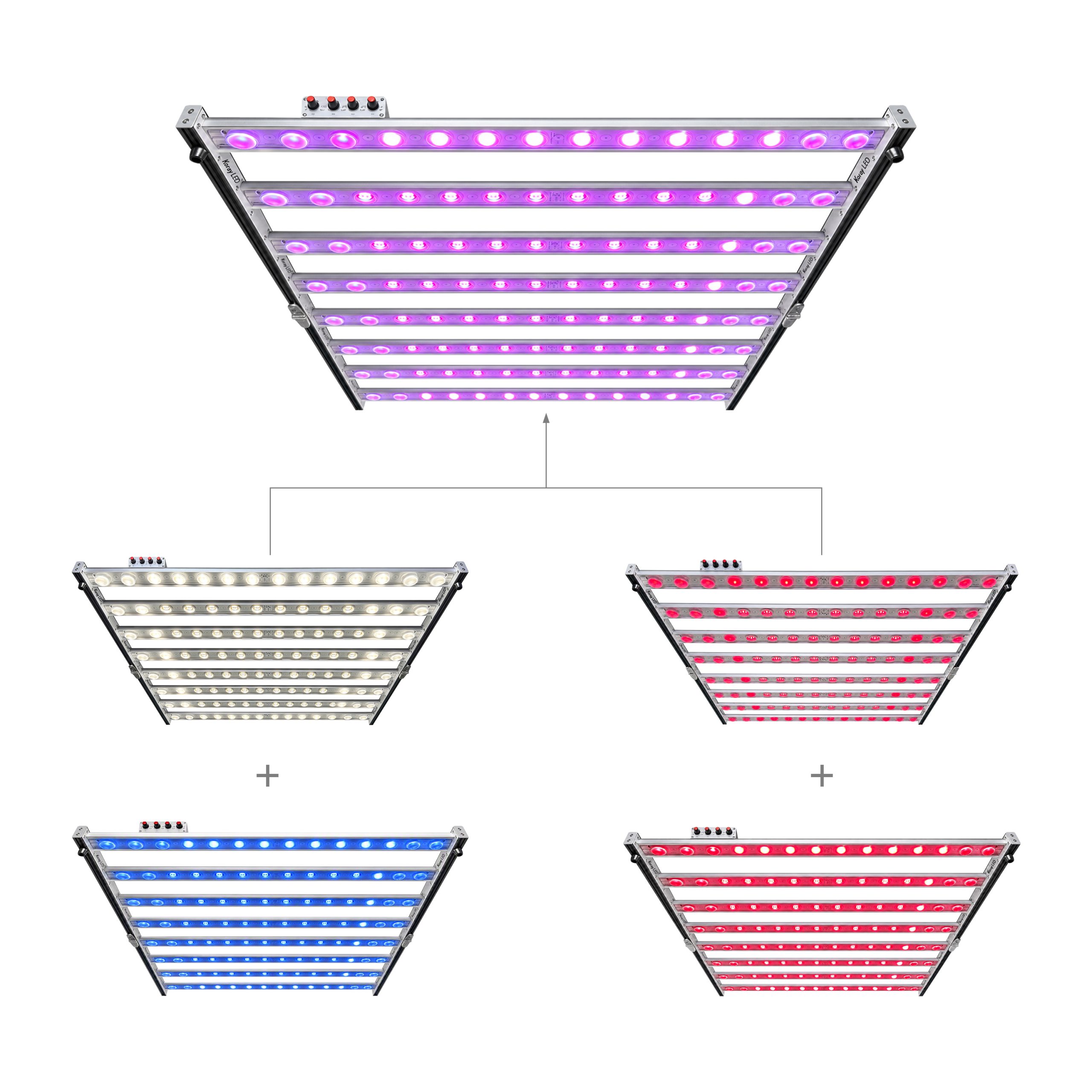
F4 is the white-plus-XTE build, intended for propagation and root and stem crops. It publishes the highest power of the three at 220 W and a PPF of 428 umol/s, giving 2.0 umol/J. F5 is a four-to-one red-to-blue general-purpose build for tomatoes, leafy vegetables and flowers, publishing 469 umol/s at 200 W for 2.3 umol/J. F6 applies the same four-to-one red-to-blue ratio with added far-red at 730 nm, publishing 465 umol/s at 200 W, also 2.3 umol/J. The product page states a whole-light efficacy of 2.3 umol/J for the module family; the per-recipe figures above come from the official RX-TP12050 specification sheet.
For background on how supplemental light intensity and photoperiod are matched to a crop, extension guidance is the practical reference. Michigan State University Extension publishes *Supplemental lighting guidelines for young plants*, which covers intensity and efficiency boundaries for propagation: MSU Extension, Supplemental lighting guidelines for young plants. A companion piece, *Strategies for supplemental lighting*, distinguishes photoperiodic supplementation from high-intensity supplementation — the exact distinction that separates the F4, F5 and F6 use cases: MSU Extension, Strategies for supplemental lighting. For the far-red component specifically, a peer-reviewed review in *Frontiers in Plant Science* summarises how light quality regulates secondary metabolite synthesis and accumulation: Frontiers in Plant Science, light-regulated secondary metabolism review. These are general photobiology sources; they do not test this module.
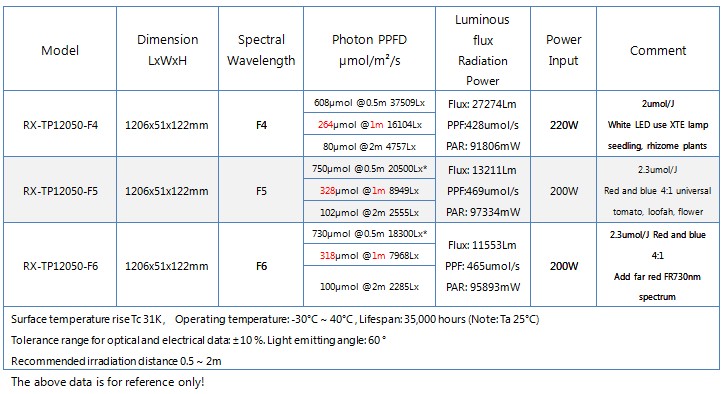
Distance-dependent output: the F4/F5/F6 comparison table
The table below places the three recipes side by side at each published measurement distance, so that the fall-off behaviour can be compared directly. All values are from the official specification sheet, with a stated tolerance of plus or minus 10 percent.
| Parameter | F4 | F5 | F6 |
|---|---|---|---|
| Spectral build | White + XTE | Red:blue 4:1 | Red:blue 4:1 + FR 730 nm |
| Target use (per official sheet) | Propagation, root and stem crops | Tomato, leafy vegetables, flowers | Tomato, leafy vegetables, flowers |
| Power | 220 W | 200 W | 200 W |
| PPF | 428 umol/s | 469 umol/s | 465 umol/s |
| Photon efficacy | 2.0 umol/J | 2.3 umol/J | 2.3 umol/J |
| PAR (radiometric) | 9,186 mW | 9,734 mW | 9,389 mW |
| Luminous flux | 27,274 lm | 13,211 lm | 11,553 lm |
| PPFD at 0.5 m | 608 umol/m2/s | 750 umol/m2/s | 730 umol/m2/s |
| PPFD at 1 m | 264 umol/m2/s | 328 umol/m2/s | 318 umol/m2/s |
| PPFD at 2 m | 80 umol/m2/s | 102 umol/m2/s | 100 umol/m2/s |
| Module dimensions | 1,206 x 51 x 122 mm | same | same |
| Beam angle | 60 degrees | same | same |
| Recommended throw | 0.5 – 2 m | same | same |
| Input voltage | AC 100 – 305 V, PF above 0.9 | same | same |
| Ingress protection | IP65, silicone potted | same | same |
| Lifetime | 35,000 hours (Ta 25 degrees C) | same | same |
| Certifications | CE / RoHS / FCC | same | same |
Primary source: official RX-TP12050 specification sheet, with input voltage, sealing and efficacy statements drawn from the RX-TP12050 official product page.
The arithmetic in the table is worth reading carefully for two reasons. First, the highest-power recipe is not the highest-efficiency recipe: F4 draws 220 W but converts at 2.0 umol/J, while F5 draws less power and converts at 2.3 umol/J. Second, the distance fall-off is steep for all three recipes, because a 60-degree beam angle concentrates photons into a narrowing cone; output at 2 m is between 13 and 16 percent of the value quoted at 0.5 m. This is the practical reason a module’s rated PPFD must always be read together with a distance.
Silicone potting as a sealing method
Silicone potting is a sealing process in which a silicone compound is dispensed over the populated circuit board and cured in place, encapsulating components and solder joints. It differs from conformal coating, which is a thin sprayed or dipped layer that follows the board surface, and from an enclosed housing, which protects the board behind a separate sealed cover.
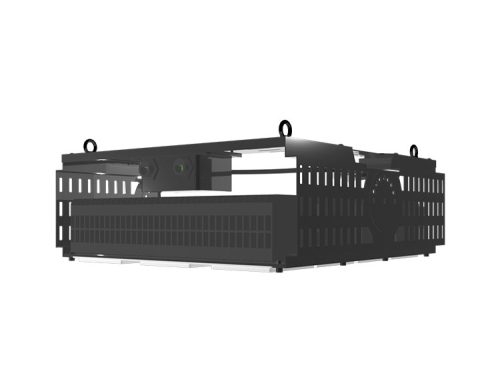
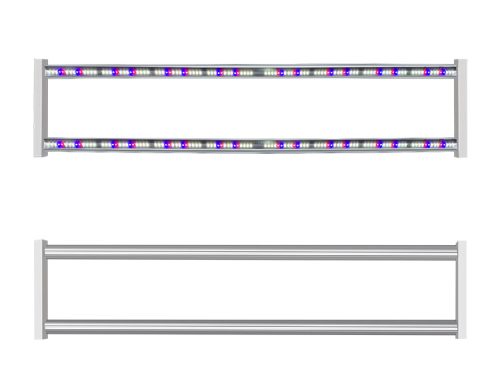
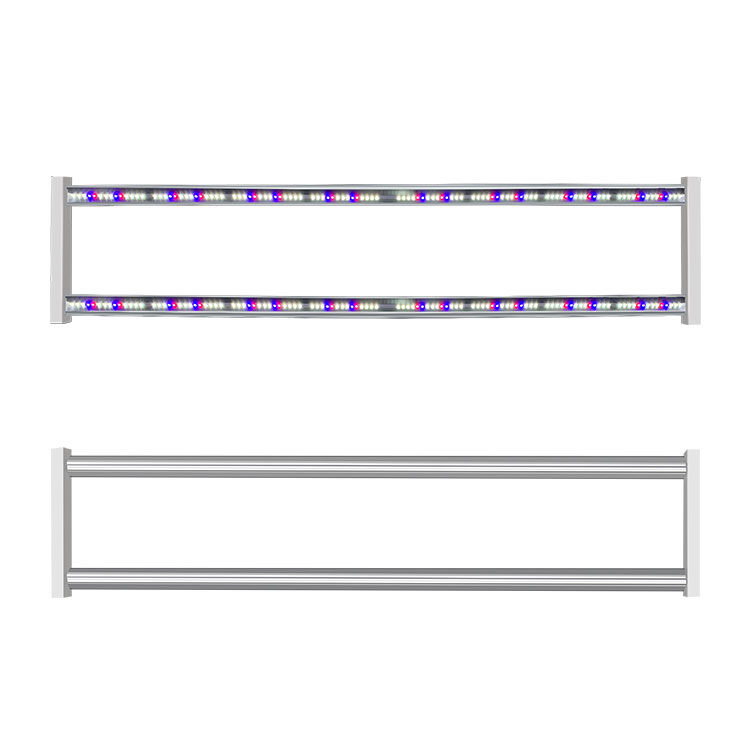
For a horticultural module the relevant difference is the failure path. Water ingress in a wet environment usually begins at solder joints, connector pins and the boundary between the board and its mounting surface. Potting fills those volumes with an elastomer rather than merely covering them, and the cured silicone tolerates the thermal cycling of a fixture that switches on and off across an operating range of -30 to 40 degrees C. The RX-TP12050 combines a silicone-potted body rated IP65 with push-in waterproof connectors, so the seal covers both the board and the cable entry point. The official product photo shows the sealed linear body; the longer documentation is available as the official TP12050 PDF.
The 40 x 40 mm C-profile rail and fanless thermal design
A C-profile is a rail with a channel-shaped cross-section. At 40 x 40 mm it is a standard aluminium extrusion size, which means the module can be clamped to commonly available rail stock rather than to a proprietary bracket.
Two consequences follow from specifying the mounting interface this way. The first is that the extrusion acts as both structural member and heat sink: the module body is aluminium, and clamping it to a 40 x 40 mm rail increases the surface available for convection without adding a fan. The second is serviceability. Modules can be added, repositioned or removed along a continuous rail, which suits installations that are built out in stages.
The design also removes the fan deliberately. The product documentation states that the traditional fan solution is eliminated because fans affect fixture life — a fan is a moving part with a bearing that fails before the LEDs do, and it draws air across the thermal path. Removing it addresses a reliability mode rather than merely a noise complaint. The published case temperature rise is 31 K, with an operating temperature range of -30 to 40 degrees C at a 25 degrees C ambient reference.
Wide-range input and the control boundary
The module accepts AC 100 to 305 V with a power factor above 0.9, which is a wide enough window to cover nominal 120 V, 208 V, 230 V and 277 V distribution without changing the module. For a multi-zone facility this simplifies spares: one module part number serves every supply voltage in the building.
On controllability, the boundary should be stated precisely. The official product page describes the module as dimmable and specifies a MeanWell power supply, but it does not publish a dimming interface type. No specific control protocol — for example 0-10 V, a variable resistor, or a particular connector standard — should be assumed for the RX-TP12050 on the basis of the published material. Where dimming must be integrated into an existing control system, the interface should be confirmed with the manufacturer before specification. Zhongshan Koray Opto-Electronic Co., Ltd. has 17 years of experience in horticultural lighting and holds 300+ patents in China and internationally.
Fit and deployment notes
Where a module rather than a finished luminaire is the right form factor, the published profile points to a few deployment patterns.
A module suits installations where the mounting structure already exists or is being built for other reasons. The 40 x 40 mm C-profile interface means the module is added to rail stock rather than to a dedicated fixture bracket, which is useful when a growing area is retrofitted in phases or when the same rail supports several services.
Recipe selection should follow crop strategy rather than power. For propagation and root or stem crops, the F4 white-plus-XTE build is the published fit, and its 220 W draw is the highest of the three. For fruiting and leafy crops, F5 and F6 share the same 200 W draw and 2.3 umol/J efficacy, and the differentiator is the far-red addition in F6. Where far-red signalling is part of the intended photobiology, F6 is the published option that includes it; the Frontiers review linked above covers the general mechanisms.
Distance planning is the third variable, and the fall-off figures make it non-negotiable. If a target PPFD is required at the canopy, the 0.5 m, 1 m and 2 m rows of the comparison table are the correct design inputs, and the module’s throw range of 0.5 to 2 m brackets the design space.
Frequently asked questions
What is the advantage of putting multiple chips under one lens?
Shared optics resolve colour mixing close to the emitter, so the intended spectral ratio holds at short mounting distances. With separate lenses per wavelength, blend quality depends on module spacing and canopy distance. For modules used from 0.5 m upward, shared optics make the published recipe meaningful across the whole throw range.
Which RX-TP12050 recipe is the most efficient?
F5 and F6 both publish 2.3 umol/J, against 2.0 umol/J for F4. F5 delivers 469 umol/s at 200 W and F6 delivers 465 umol/s at 200 W; the small difference reflects the different chip mix, including the far-red emitters in F6.
How much PPFD is lost when the module is raised from 0.5 m to 2 m?
Substantially all of it. With a 60-degree beam angle, F5 falls from 750 umol/m2/s at 0.5 m to 102 umol/m2/s at 2 m, and F4 falls from 608 to 80 umol/m2/s over the same span. Mounting distance must therefore be treated as a primary design variable rather than a fine adjustment.
Why does the module have no fan?
The documentation states that the traditional fan solution was removed because fans affect fixture life. A fan adds a moving part that fails before the LEDs and pulls air across the thermal path. The module instead relies on an aluminium body, silicone potting and the mounting rail for heat rejection, with a published case temperature rise of 31 K.
Does the RX-TP12050 support a particular dimming interface?
The official product page describes the module as dimmable and lists a MeanWell power supply, but it does not publish a dimming interface type. No control protocol should be assumed from the published material; the interface should be confirmed with the manufacturer before it is specified into a control system.
References
- Michigan State University Extension — *Supplemental lighting guidelines for young plants*: https://www.canr.msu.edu/resources/supplemental_lighting_guidelines_for_young_plants
- Michigan State University Extension — *Strategies for supplemental lighting*: https://www.canr.msu.edu/resources/strategies_for_supplemental_lighting
- Frontiers in Plant Science — review of light-regulated secondary metabolite synthesis and accumulation: https://www.frontiersin.org/journals/plant-science/articles/10.3389/fpls.2025.1644472/full
- RX-TP12050 official product page: https://koraylights.com/product/led-toplight-module/
- Official RX-TP12050 specification sheet (image): https://koraylights.com/wp-content/uploads/2019/12/RX-TP12050-datapic.jpg
- Official RX-TP12050 product photo: https://koraylights.com/wp-content/uploads/2019/12/TP12050.jpg
- Official TP12050 PDF datasheet: https://koraylights.com/wp-content/uploads/2020/07/TP12050.pdf




Leave A Comment