
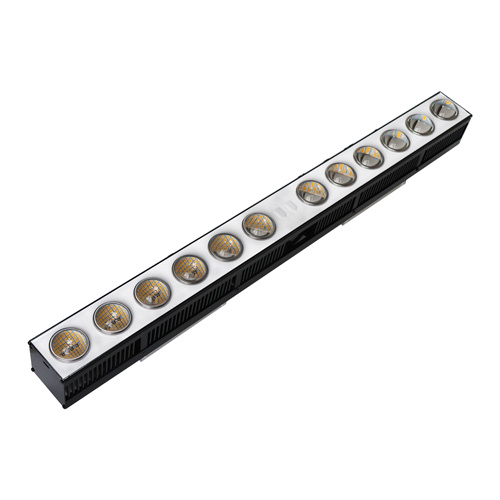
Two 500 W light bars can both print “3 µmol/J” and deliver measurably different photon output, because the number printed on a bare LED package datasheet and the number measured on a finished luminaire are counting different things.
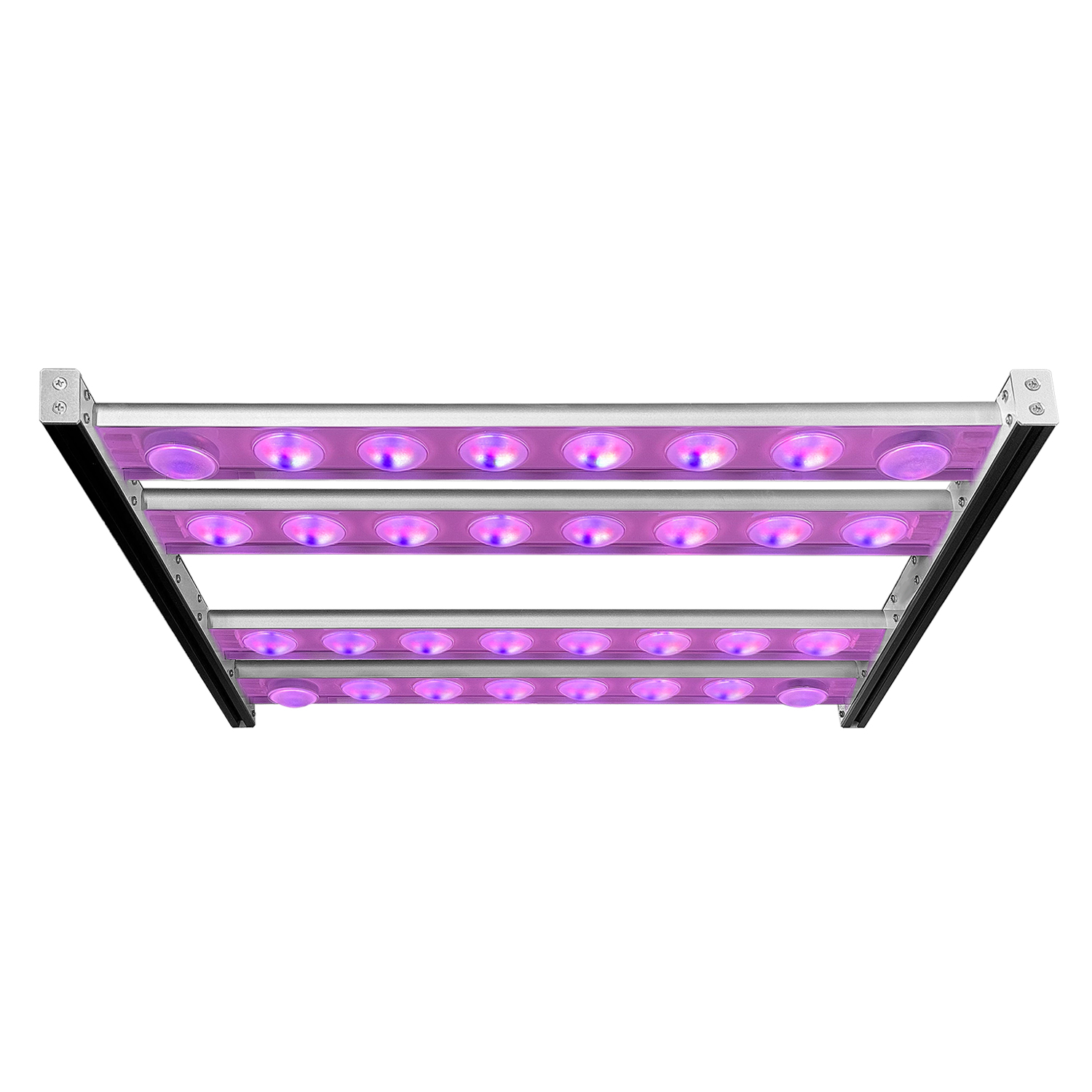
The RX-G600T-500W is a 500 W top-light bar for protected cultivation, built with condensing glass lenses and declared at 2.5 µmol/J including lens loss and power loss. That qualifier is the useful part of the specification: it tells the reader where the accounting boundary sits. This article breaks down what sits inside that boundary, why the bar carries a derating policy for both the LEDs and its driver, and what a 100–305 VAC input and an IP65 enclosure actually buy in a greenhouse.
What PPF efficacy measures
PPF efficacy is the ratio of photosynthetic photon flux to electrical input power, expressed in micromoles per joule. The numerator is the total photon count per second inside the photosynthetically active waveband (400–700 nm); the denominator is the power drawn at the point where the measurement starts. Move that starting point and the number changes.
Because the denominator’s boundary is a choice, the honest reading of any efficacy figure begins with one question: at which boundary? The measurement methods used to answer it — electrical input, integrating-sphere or goniometric photon flux — are the subject of the standard test procedure described on Intertek’s ANSI/IES LM-79 page.
Where the losses go: optics and driver
Two loss blocks separate a bare LED array from a finished bar:
- Optical loss. A lens is a redirecting element, not an amplifier. Every refractive surface reflects or absorbs a fraction of the incident photons, and a glass lens — chosen for stability under heat and UV over a long service life — adds surface reflections at each interface. Photons that lands on the housing instead of the canopy are lost to the crop even though they were counted as emitted power by the LED.
- Power-conversion loss. The AC-to-DC driver dissipates a share of the input power as heat. Some vendors report efficacy at the module’s DC input, which quietly removes that block from the denominator.
Products differ in how they handle the distinction, so the qualifier attached to the figure is more informative than the figure’s size. Comparing a luminaire-inclusive number against a package-level number is a category error, not a performance gap.
The declared basis: 2.5 µmol/J including lens loss and power loss
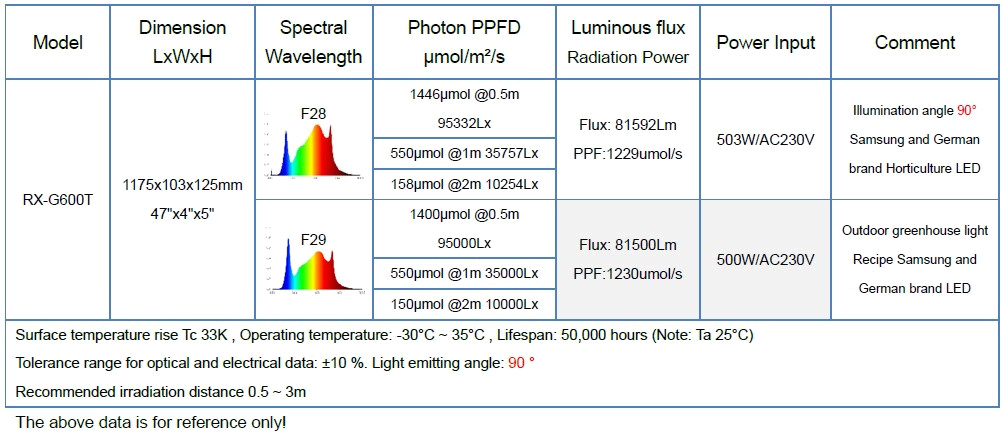
The official page for the RX-G600T-500W states a PPF efficiency of 2.5 µmol/J including lens loss and power loss — that is, the declared number already carries the glass-lens optical loss and the driver conversion loss inside its denominator. It is the number a grower’s energy calculation would use, because it is the number that corresponds to the power meter and to the photons leaving the fixture.
The same page describes condensing glass lenses for directional output, Samsung or German-brand horticulture LEDs with spectrum optimisation by crop requirement, 100–305 VAC input, IP65 enclosure, a 50,000-hour rating, and CE / RoHS / FCC compliance. It does not publish absolute PPF (µmol/s), PPFD at a stated distance, beam angle, spectrum ratios, or a dimming interface. Those items are not listed, and treating them as listed would be reading the specification wrongly.
Derating as a lifetime strategy, not a penalty
Derating is the practice of operating an LED or a power supply below its maximum rated current, voltage or temperature. The RX-G600T-500W applies it on both sides of the power train: the LEDs are derated to raise efficiency and reliability, and the ELGC-300-M-AB driver is likewise operated below its rating to extend service life.
The physics is straightforward. LED output maintenance depends on junction temperature, and junction temperature tracks drive current; running a diode below its maximum current flattens the output-decline curve over time. Electrolytic capacitors in the driver age faster at higher case temperature, so a driver run below its rating reaches the same wear point later. The trade-off is deliberate: a modest share of peak output in exchange for a service profile that suits a greenhouse, where fixtures are expected to run near-continuous duty across multiple seasons.
What 50,000 hours means, and what it does not
A 50,000-hour rating is a projected maintenance figure derived from accelerated testing, not a measured field record. The DesignLights Consortium’s horticultural lighting testing-lab requirements describe the laboratory evidence expected to support lumen- and photon-maintenance claims for LED lamps and light engines, including LM-80-style package-level data. When comparing lifespans across products, the drive current and ambient temperature attached to the claim matter as much as the hours.
100–305 VAC and IP65: two different kinds of tolerance
A wide-input driver is one that maintains regulation across an extended mains range. At 100–305 VAC, the bar tolerates both nominal North American and European supply voltages and the sag and surge that come with a rural or horticultural distribution point — for example long cable runs to a distant greenhouse block, or voltage drop when irrigation pumps and fans start on the same feed. A narrow-input driver simply drops out of regulation under the same conditions.
IP65 is an ingress-protection rating meaning dust-tight and protected against water projected from a nozzle. In a protected-cultivation environment that protects against drip lines, condensation from thermal cycling between night and day, and routine wash-down of gutters and glazing. It is the enclosure rating that makes a bar suitable for the damp overhead zone; it says nothing about photon output and does not trade against efficacy.
Dimension comparison: how efficacy declarations are scoped
| Declaration basis | What is inside the denominator | What it tells a buyer | Example / note |
|---|---|---|---|
| Bare LED package | Chip power only; no optics, no driver | Upper bound of the emitter, not achievable at the wall | Package datasheet condition (binning temperature, test current) |
| Module / board level | Chip power on board, still no lens and no driver | Useful for optical design work | Excludes both loss blocks |
| Luminaire, losses included | LED power + glass-lens optical loss + driver conversion loss | Matches the electricity meter and the photons leaving the fixture | RX-G600T-500W: 2.5 µmol/J including lens loss and power loss (official page) |
Operationally, RX-G600T-500W is a 500 W model; the 250 W member of the same family is designated RX-G600T-1P, and the two should not be specified interchangeably. The official page does not list absolute PPF, PPFD at a distance, beam angle, spectral ratios, mounting dimensions, weight or a dimming interface for either.
Where a 500 W glass-lens bar fits best
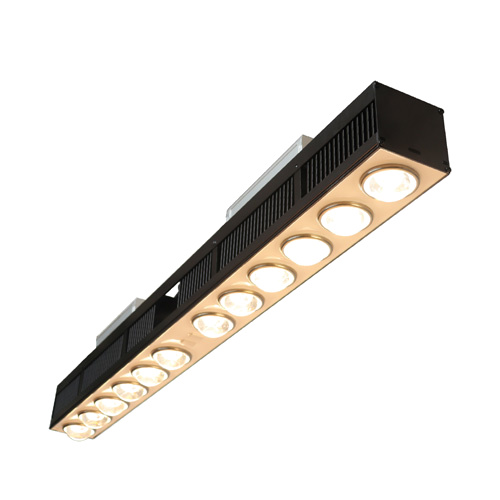
A high-output bar with condenser optics and a losses-included efficacy declaration suits overhead installs where the target zone can be positioned under the fixture: high-wire and trellis crops, cut flowers and ornamental stock, succulent and nursery benches, and controlled cultivation of medicinal plants under research protocols, where spectral stability across long photoperiods matters. It is a weak fit where the fixture must be mounted close to the canopy or hidden inside a structure with no headroom for an overhead bar.
Cultivation research on medicinal plant species repeatedly links spectral conditions and photoperiod to secondary metabolite accumulation — see the *Frontiers in Plant Science* review “Effects of Light on Secondary Metabolite Biosynthesis in Medicinal Plants” (Zhang et al., 2021) — which is one reason a losses-included efficacy figure and a stable lens material matter more in that segment than a headline output number.
Koray Lights has 17 years of experience manufacturing LED horticultural lighting and holds 300+ domestic and international patents. The RX-G600T-500W is documented on its official product page and in the official datasheet PDF, including the 2.5 µmol/J declaration and the derating approach described above.
Frequently asked questions
Why is 2.5 µmol/J lower than numbers seen on bare-LED datasheets?
Because the two figures use different boundaries. The 2.5 µmol/J declaration includes lens loss and power loss, while package-level figures exclude both the optics and the driver.
What exactly is counted in the 2.5 µmol/J declaration?
PPF efficiency with glass-lens optical loss and driver power loss included in the denominator, as stated on the official product page.
What input voltage range does the bar accept?
100–305 VAC, which covers both 120 V and 230 V nominal supplies and gives headroom for line sag on long greenhouse feeds.
What does IP65 mean for a greenhouse bar?
Dust-tight construction with protection against water projected by a nozzle — condensation, drip and wash-down tolerance in the overhead zone. The official page rates the RX-G600T-500W IP65.
Does derating reduce output?
It reduces the peak output the hardware is pushed to, and in exchange raises efficiency and reliability. On this model both the LEDs and the ELGC-300-M-AB power supply are derated to extend service life.




Leave A Comment