
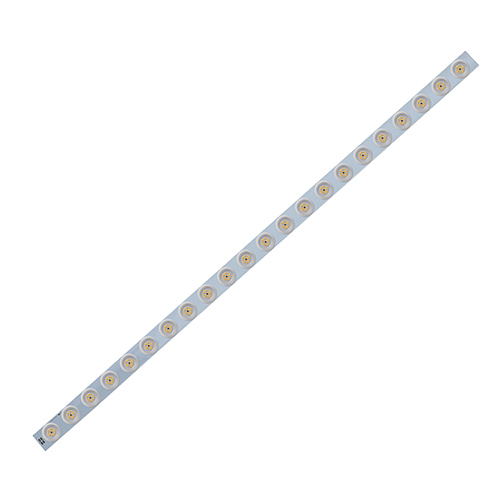
A light engine is an LED assembly that produces light but is not a finished luminaire: it has no mains input stage, no luminaire-level housing, and no integrated driver. A finished grow light is the opposite — a complete luminaire with AC input, a mounted driver and a specified ingress-protection rating.
That single distinction decides how a linear grow-light build gets specified. The numbers that do the deciding are rarely the spectrum claims; they are the module input window (30–52 V DC), the thermal boundary of the heatsink matched to it (G120 for engines below 100 W, G78 for engines below 200 W), and the declared efficiency basis (up to 3.1 µmol/J).
What counts as a light engine, and what follows from that
An LED light engine is a light-producing module that requires an external driver and an external thermal solution. Because the AC-to-DC stage sits outside the product, three specification duties move to the integrator:
- Power conversion — the engine sees DC only; a separate constant-current driver must be matched to its voltage window.
- Thermal management — the published output is referenced to an operating point; the heatsink is a line item in the bill of materials, not an accessory.
- Declaration of performance — electrical and photometric figures are quoted on the measurement basis the standard test method defines. Intertek’s ANSI/IES LM-79 testing page describes the reference method for measuring LED lighting products; reading a module datasheet without knowing which basis was used is how two “3 µmol/J” products end up incomparable.
Why the 30–52 V DC input window is the first number to check
The LM301H-L120W4 accepts a module input voltage of 30–52 V DC (official product page). A window rather than a single figure matters because LED forward voltage shifts with current and junction temperature: a string that sits at 36 V cold can climb several volts at operating temperature.
A constant-current driver is a power supply that regulates output current and lets the voltage float inside a compliance window. For integration, the practical rule is that the driver’s compliance range must enclose 30–52 V with margin at both ends — at the cold end so the driver does not current-limit out of regulation on start-up, and at the hot end so it does not drop out of the window as the module heats up. A driver rated only to 48 V may appear to work on a bench and fail in a warm rack.
Heatsink selection: G120 below 100 W, G78 below 200 W
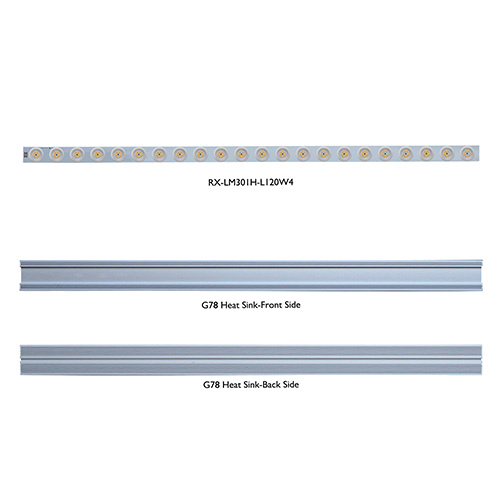
The official page pairs the engine with two heatsink options: G120 is specified for light engines below 100 W, and G78 is specified for light engines below 200 W. The split is a thermal budget statement, not a marketing tier — a longer or higher-output engine spreads the same die area over more thermal mass and needs the larger profile.
Because these are heatsinks for a component, they carry no driver and no optical cover. Airflow direction matters more than fan count in a vertical rack: a linear profile is most efficient when the fin channel is aligned with the rack’s rising air path, and heat-sinking two engines on one profile changes the case temperature of both.
Reading “up to 3.1 µmol/J” correctly
PPF efficiency (µmol/J) is the ratio of photosynthetic photon flux — the total number of photons emitted per second in the 400–700 nm waveband — to the electrical power drawn. The “up to” qualifier means a best-case operating point, not a guaranteed figure across all drive currents and temperatures.
The official page declares up to 3.1 µmol/J, a full spectrum with additional hyper red at 660 nm, a rated lifetime of 50,000 hours, and CE / RoHS / FCC compliance. It does not list absolute PPF (µmol/s), rated wattage, PPFD at a hanging height, beam angle or a photometric distribution curve. Where a figure is unpublished, the defensible route is measurement on the standard basis rather than extrapolating from a sibling model.
Lifetime figures carry the same caveat. A stated 50,000 hours is a rating derived from accelerated maintenance testing; the DesignLights Consortium’s horticultural lighting testing-lab requirements set out the LM-80-style package-level maintenance evidence laboratories are expected to hold for LED lamps and light engines.
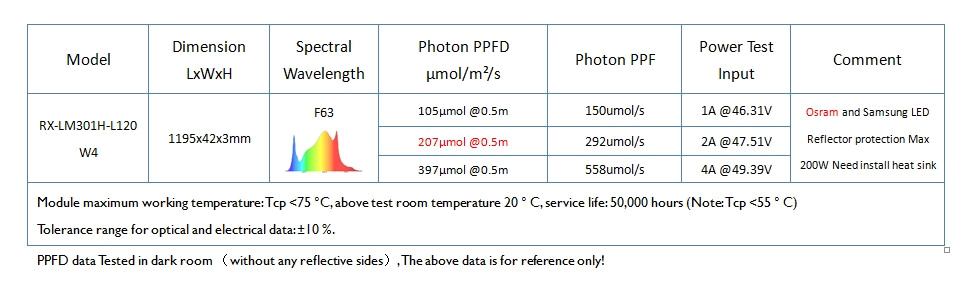
Dimension comparison: engine-level build vs finished luminaire
| Dimension | Light engine build (LM301H-L120W4 + driver + heatsink) | Finished luminaire |
|---|---|---|
| Declared efficiency basis | Module PPF efficiency, up to 3.1 µmol/J (official page) | System-level figure, may or may not include driver loss — basis must be stated |
| Power input | DC only: 30–52 V module input, external constant-current driver required | AC mains input, integral driver |
| Rated power relationship | Absolute wattage not published; heatsink selection governs the ceiling — G120 for <100 W engines, G78 for <200 W engines | Wattage is part of the model designation |
| Thermal solution | Integrator-supplied (G120 / G78 per official pairing) | Included in the housing |
| Ingress protection | Official page does not list an IP rating for the module | Specified per luminaire design |
| Rated lifetime | 50,000 hours (official page) | Typically stated with a drive-current condition |
| Compliance | CE / RoHS / FCC on the module (official page) | Luminaire-level compliance declaration |
| Best-fit use | Retrofit of an existing linear frame, vertically stacked racks, custom bar spacing | Plug-and-grow installation with fixed footprint |
Where a 120 cm light engine fits best
An engine-level build pays off when the frame already exists, when bar spacing must follow a crop-canopy plan rather than a catalogue drawing, or when a greenhouse adds linear supplemental light over a bench that no standard housing fits. It is a poor first choice when the priority is a sealed, mains-ready unit that an installer can hang without a driver design decision.
Koray Lights has manufactured LED horticultural lighting for 17 years and holds 300+ domestic and international patents; the LM301H-L120W4 is offered as a 120 cm linear light engine with the G120 and G78 heatsink options detailed on the official product page, and its full parameter set is available in the official datasheet PDF.
Frequently asked questions
Is the LM301H-L120W4 a complete grow light?
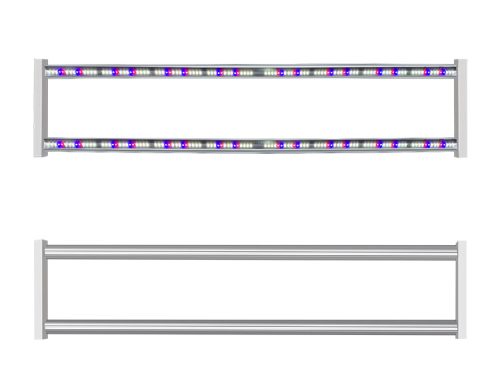
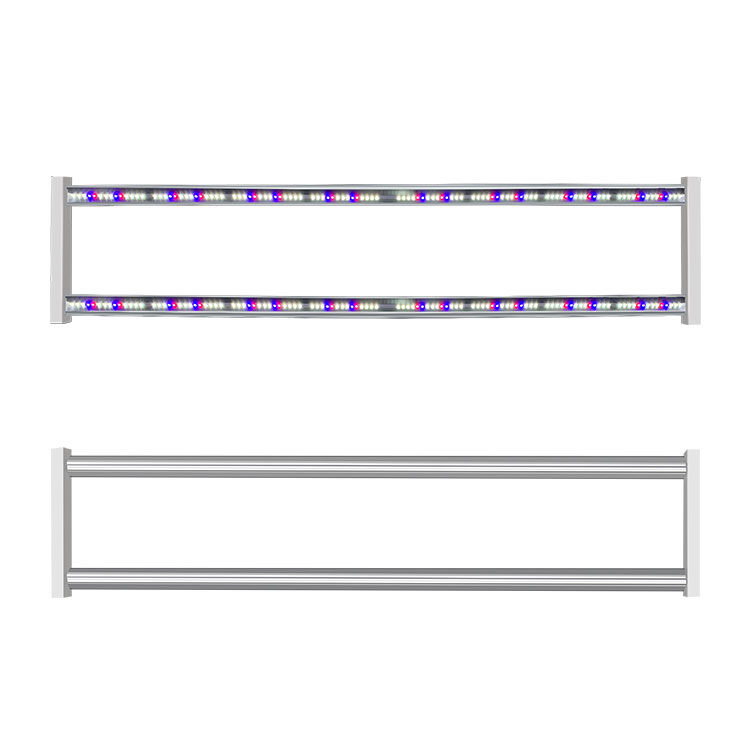
No. It is a horticulture LED light engine — a 120 cm linear DC module. A constant-current driver, a heatsink (G120 or G78) and any mounting frame are supplied separately.
What input voltage does the module need?
30–52 V DC, as stated on the official product page. The matching driver’s compliance window should cover that range with margin at both ends.
Which heatsink should I choose?
G120 is specified for light engines below 100 W and G78 for light engines below 200 W (official page). The choice follows the total drive power you intend to run, not the strip length alone.
What is the rated lifetime?
50,000 hours, per the official page. Module-level maintenance expectations of this kind are tested on the LM-80-style basis described in the DLC horticultural lighting laboratory requirements.
Does the official page state absolute PPF, wattage or PPFD?
No. The official page lists PPF efficiency up to 3.1 µmol/J, the 30–52 V DC input, the G120 / G78 heatsink pairing, the 50,000-hour rating and CE / RoHS / FCC. Absolute PPF (µmol/s), rated wattage, PPFD at a given hanging height, beam angle and IP rating are not published and should not be inferred from other models.




Leave A Comment