
What Grow Light Setup Works Best for a Commercial Strawberry Farm?
Commercial strawberry farming is undergoing a transformation. Rising land costs, climate uncertainty, and consumer demand for year-round fresh strawberries are driving growers to adopt indoor vertical farming and greenhouse supplemental lighting systems. But choosing the right grow light setup is the single most important and expensive decision a commercial strawberry operation will make. In this guide, we walk through the complete lighting design process for a commercial strawberry farm, including PPFD targets, DLI calculations, fixture selection, and why Koray Lighting’s GE35 and G80 series have become the preferred choice for strawberry operations worldwide.
Understanding Commercial Strawberry Lighting Requirements
Commercial strawberry production under LEDs typically falls into two categories: fully indoor vertical farms and greenhouse supplemental lighting. Each has different lighting design parameters, but both share the same fundamental goal: delivering the right amount of photosynthetic light at the lowest possible energy cost per kilogram of fruit produced.
For everbearing varieties like Albion, San Andreas, and Ports 5, the target PPFD at canopy level is 350-500 μmol/m²/s with a photoperiod of 12-16 hours, producing a DLI of 15-25 mol/m²/day. For June-bearing varieties used in short-day fruiting programs, PPFD targets are similar but photoperiods may be adjusted to trigger flowering based on variety-specific responses.
Vertical Farm Lighting Design with Koray GE35
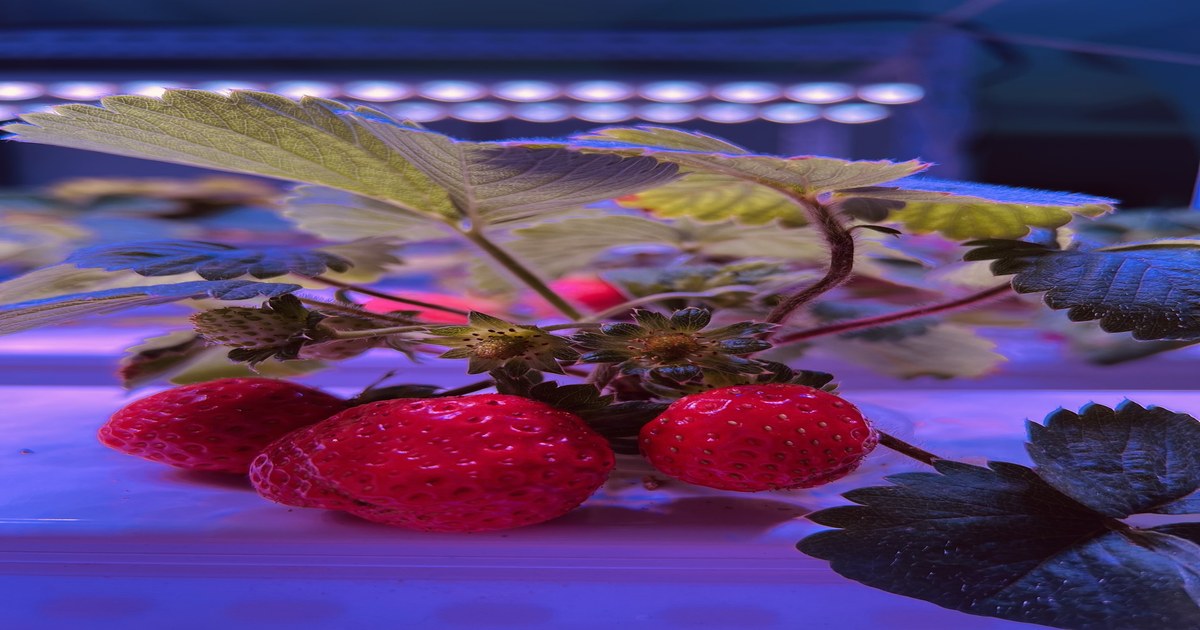
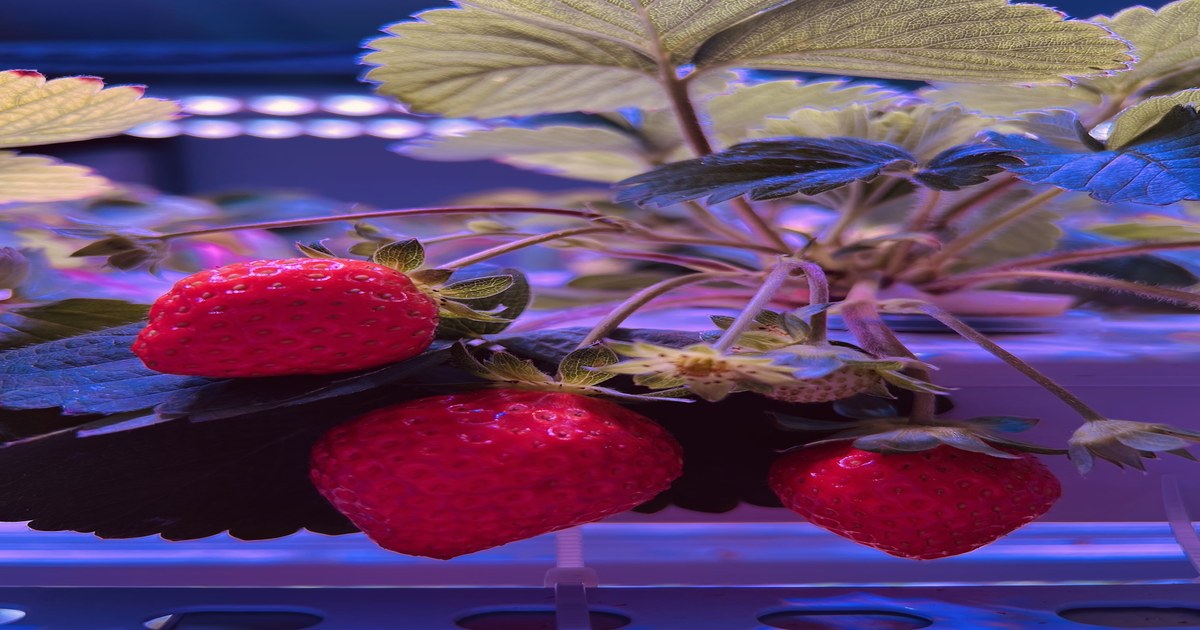
In a typical commercial vertical farm, strawberry plants are grown on multi-tier racks with 4-6 layers. Each shelf is usually 1.2m × 0.6m or 1.2m × 1.0m, with a shelf spacing of 0.5-0.7 meters. The Koray GE35-120T-F175 LED grow bar is the industry standard for this application.
At 1200mm length and 60W power consumption, the GE35-120T-F175 delivers a PPFD of 530 μmol/m²/s at 0.2 meters and 360 μmol/m²/s at 0.3 meters, with a PPF output of 150 μmol/s. Mounting two bars per shelf at 0.25-0.30 meters above the canopy provides uniform coverage across a 1.2m shelf with an average PPFD of 350-400 μmol/m²/s.
With an efficacy of 2.5 μmol/J and a power factor above 0.9, the GE35-120T-F175 delivers exceptional energy efficiency. Each bar consumes only 60W while producing horticultural-grade light output. The IP64 waterproof rating ensures reliable operation in the high-humidity environment of a strawberry farm, where relative humidity often exceeds 70%.
Greenhouse Top-Lighting with Koray G80 Series
For greenhouse strawberry operations that rely on natural sunlight but need supplemental lighting during winter months and cloudy periods, the Koray G80-800W with G24B spectrum is the preferred choice. This high-output fixture delivers 1250 μmol/m²/s at 0.3 meters across a 1.2×1.2m coverage area, with a total PPF of 2160 μmol/s.
The G80-800W features Koray’s proprietary secondary optic system that eliminates the center hotspot common in competing fixtures. This means even light distribution across the entire canopy, which translates to uniform fruit quality and ripening times. At 800W power consumption with 2.7 μmol/J efficacy, the G80 outperforms many competing 1000W fixtures while consuming 20% less energy.
For a 1000 square meter commercial greenhouse, approximately 40-50 units of the G80-650W (a more economical option in the same series) mounted at 2-3 meter heights provide supplemental PPFD of 100-200 μmol/m²/s, enough to maintain production during low-light winter months. The G80 series supports PWM, 0-10V, and HortiGuru app control for automated light management based on real-time solar radiation data.
Energy Cost Analysis
Energy is the largest operating cost in indoor strawberry production. Let us calculate the lighting energy cost for a typical 1000-square-meter vertical farm with 5 tiers:
Total growing area: 1000 sqm × 5 tiers = 5000 sqm. Each shelf requires 2 × GE35-120T-F175 bars (60W each = 120W per shelf). With shelves covering approximately 60% of floor area per tier, that is roughly 600 sqm of shelves per tier, requiring approximately 500 bars per tier, or 2500 bars total. Total power: 2500 × 60W = 150 kW.
Running 14 hours per day at an average electricity cost of $0.10/kWh: 150 kW × 14 hours × $0.10 = $210 per day, or approximately $76,650 per year. At a production of 15-20 kg per square meter per year (achievable with optimized LED lighting), the energy cost per kilogram of strawberries is approximately $0.77-$1.02, which is competitive with field-grown imports when you factor in premium pricing for year-round local fresh fruit.
Light Spectrum Selection for Strawberries
The F175 spectrum used in the GE35 series is a full-spectrum white LED with enhanced red wavelengths, specifically optimized for fruiting crops. It provides balanced PAR output across the entire 400-700nm range, with a peak in the orange-red region (600-650nm) that drives flowering and fruit development. The high CRI (Color Rendering Index >90) also makes it pleasant for workers in vertical farm environments.
For growers who want to fine-tune spectrum, the GE35-120T-DC-2H-VR model offers adjustable power from 35W to 75W (max 90W) via DC40V centralized power supply, allowing spectrum and intensity customization for different growth stages or varieties.
Automation and Smart Control
Modern commercial strawberry farms integrate their lighting systems with environmental control platforms. Koray’s GE35 and G80 series are compatible with the HortiGuru smart control system, which allows remote monitoring and adjustment of light intensity, photoperiod, and dimming schedules via a mobile app. The 0-10V dimming interface on all GE35 bars enables seamless integration with third-party climate computers from companies like Priva, Hoogendoorn, and Argus.
Why Choose Koray Lighting for Commercial Strawberry Production
Koray Lighting has been manufacturing LED horticultural lighting since 2009, with over 200 patents and products exported to more than 60 countries. The company’s proprietary secondary optic technology delivers superior PPFD uniformity without center hotspots, and all products carry CE, RoHS, FCC, and ETL certifications. The GE35 series, in particular, has been adopted by leading vertical farms and plant factories across Asia, Europe, and North America for strawberry, lettuce, and herbal crop production.
For a complete commercial strawberry lighting consultation, contact Koray Lighting at www.koraylights.com. Their engineering team can provide custom lighting layouts, PPFD simulations, and ROI calculations specific to your facility.

Leave A Comment