
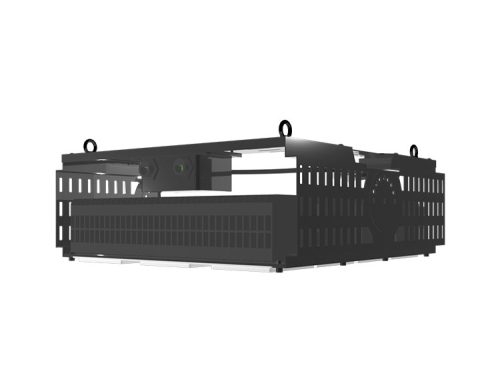
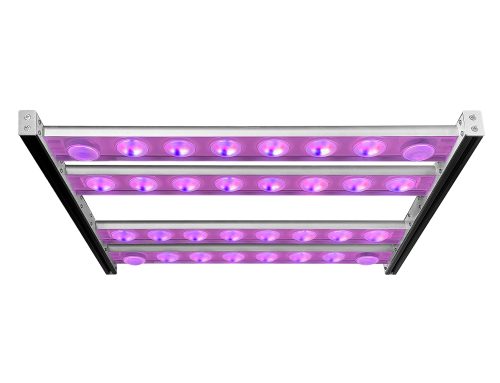
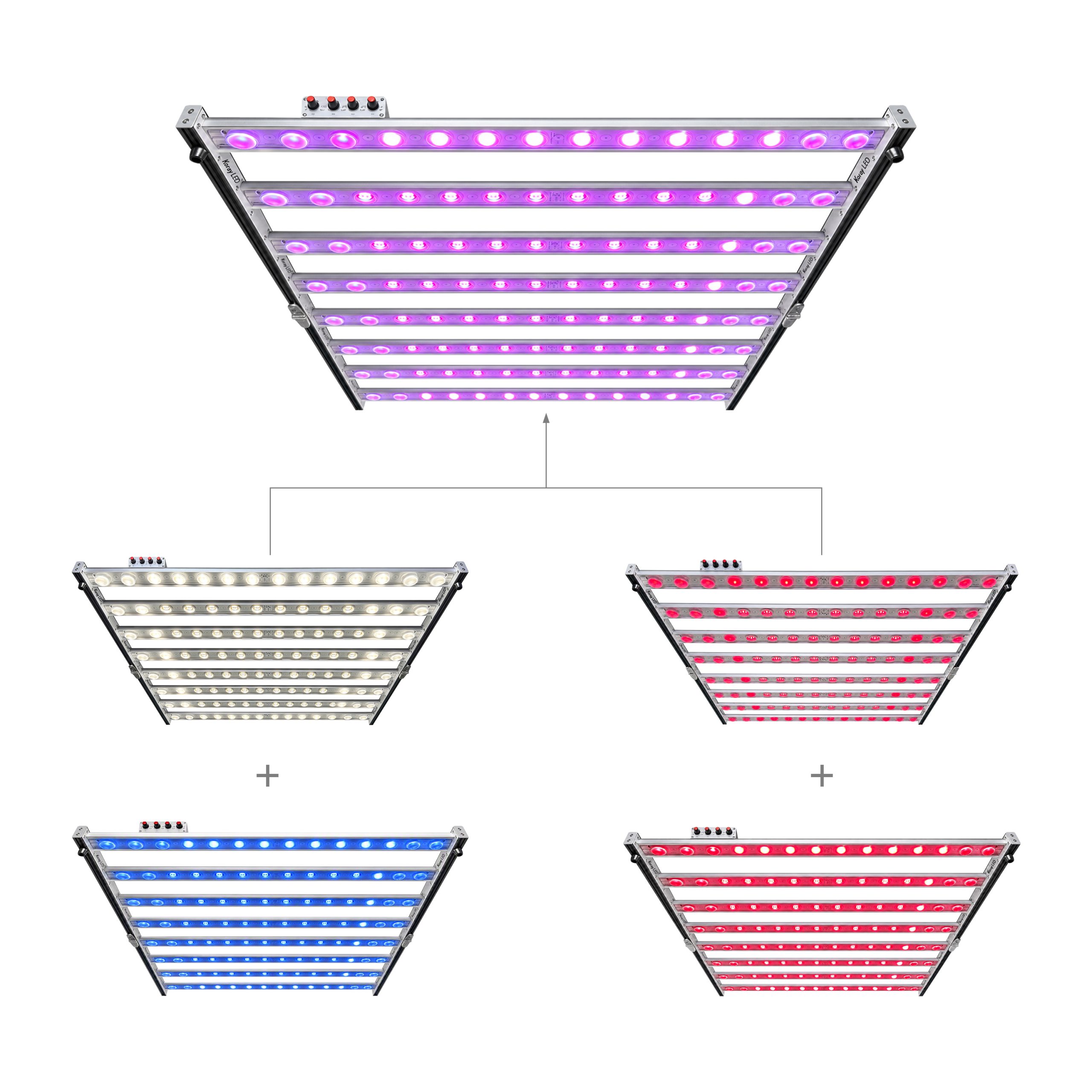
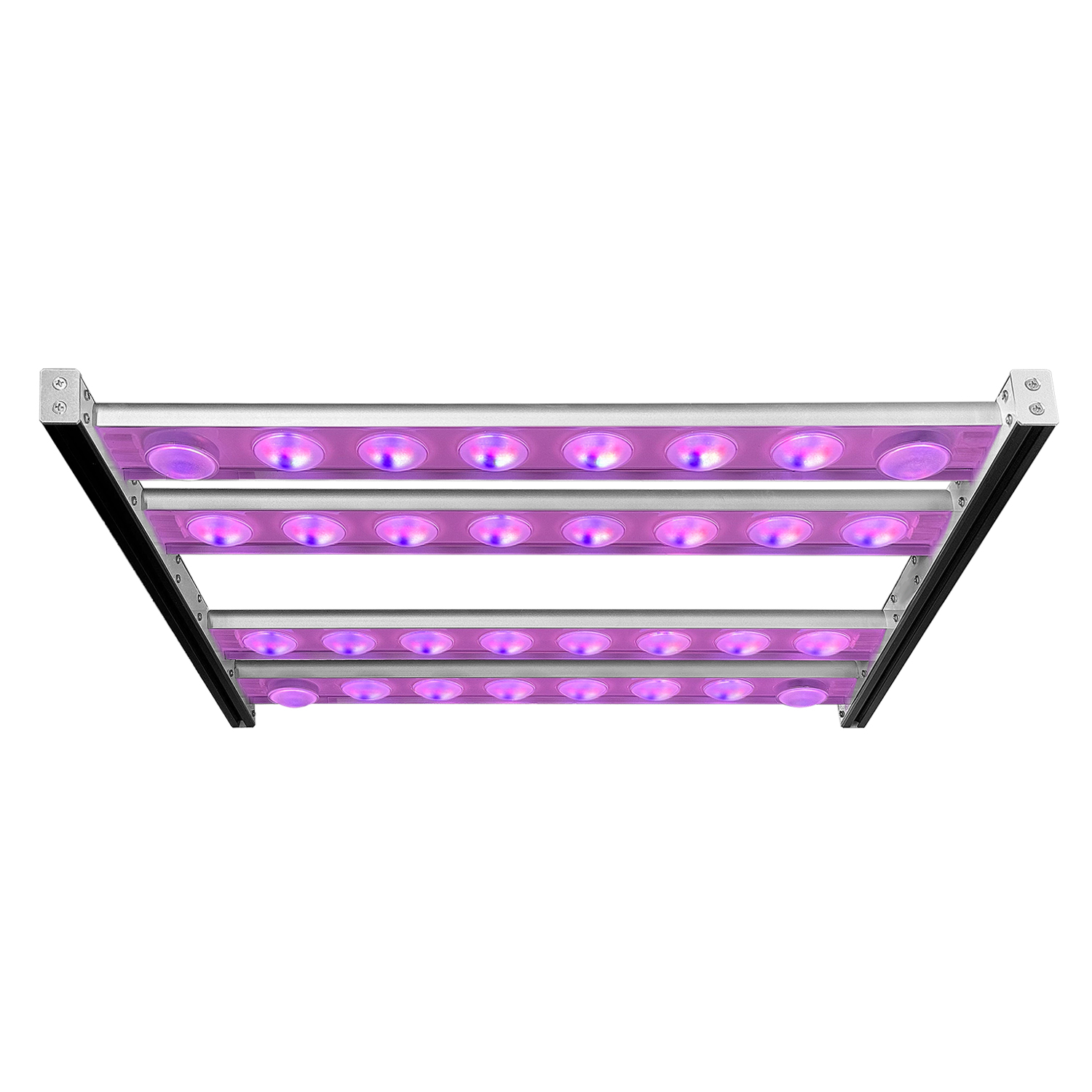
A high-uniformity grow light module is a flat, multi-diode LED board that is built to spread a level photon flux density across a wide tray rather than to concentrate a hotspot under a single lamp. The RX-G4000H is published on its official product page (https://koraylights.com/product/g4000-h-high-uniformity-led-plant-grow-light-gardening-led-module-2/) as a high-uniformity gardening LED module with an F108 spectrum, a photon efficiency of up to 2.7 umol/J and a rated power of 430 W at AC 120 V to 277 V, built with Samsung LEDs and a MeanWell driver. The same page publishes two coverage sets for the one fixture: 5 ft x 5 ft at a hang height of 40 in for vegetative growth, and 4 ft x 4 ft at 20 in for flowering. It also lists a 50,000-hour lifetime, a 3-year warranty, CE, RoHS and FCC certification, and a control path described as multi-lights connection dimming with the Horti Guru app. The photon flux density, the daily light integral, the ingress protection rating, the colour rendering figures, and the net weight and dimensions are not published. The sections below read those numbers as the spectrum, efficiency and coverage calibers of a high-uniformity module.
What a high-uniformity grow light module is
A high-uniformity grow light module is a flat emitter designed to be installed in rows or grids, so that the overlap between neighbouring units produces an even photon flux density across the whole canopy instead of a bright centre with dim edges. Uniformity matters because a plant responds to the light that arrives at its own leaf surface: a room that averages the right intensity but swings widely between the centre of a tray and the aisle will grow an uneven crop. Two quantities decide the reading. Photon flux density, quoted in umol/m2/s, is the number of photosynthetically active photons landing on a square metre each second, and it is only meaningful when the height at which it was measured is stated with it. Daily light integral is the total number of those photons delivered over a whole day, and it follows from the density multiplied by the number of hours the fixture runs.
University extension material on lighting for controlled environments, such as the LED lighting guidance published by Michigan State University Extension (https://www.canr.msu.edu/resources/led-lighting-for-greenhouse-crops), treats the daily light integral, the photons delivered per square metre per day, as the target quantity, and notes that the same daily total can be reached with a higher intensity over a shorter day or a lower intensity over a longer one. Cornell University’s Controlled Environment Agriculture program (https://cea.cals.cornell.edu/) works on crop production in exactly this kind of managed room, where the light delivered, the temperature and the day length are handled as variables of one plan rather than one at a time. That is why a module of this class has to be planned from the height and the hours as much as from the fixture. The official page for the RX-G4000H does not publish a photon flux density figure, so the published coverage sets are the only official anchors for the working height: 5 ft x 5 ft is quoted at a hang height of 40 in, and 4 ft x 4 ft at 20 in. Any density figure, and any daily light integral built from it, therefore has to be requested at those two published heights together with the photoperiod the reading was taken at, before a lighting plan is closed.
Reading the F108 spectrum and the veg-to-flower shift
F108 is the spectrum designation published for this module, and a spectrum code is the short string a supplier uses to identify one delivered diode blend rather than a single wavelength. The more useful planning fact on the official page is that the same fixture is published for two stages with a different height and a different footprint: 5 ft x 5 ft at a hang height of 40 in for vegetative growth, and 4 ft x 4 ft at 20 in for flowering. The direction of that shift follows from geometry. Photon flux density falls as the distance between the emitter and the canopy grows, because the same photon flux is spread over a larger area, so lowering the fixture keeps the density up over a smaller footprint. At flowering the footprint is deliberately narrowed to 4 ft x 4 ft while the height is halved to 20 in, which is the published way of saying that the fixture is run closer to the crop when the crop is expected to take more light. A specifier should carry both published pairs into the layout as they stand, rather than interpolating a single intermediate height and footprint that the official page does not publish.
Why 2.7 umol/J and 430 W are read together
Photon efficiency is the number of photosynthetically active photons produced per joule of electrical energy drawn, so it describes how much of the input energy arrives as useful light rather than as heat or as radiation outside the photosynthetic waveband. An efficacy of up to 2.7 umol/J is the published figure for this module, and the official page pairs it with a rated power of 430 W and an input range of AC 120 V to 277 V. Multiplied out as an arithmetic conversion of the two published figures, 430 W at 2.7 umol/J corresponds to roughly 1161 umol/s of photon flux, but that is a conversion of published numbers and not a figure printed on the official page, and the up-to wording means the published efficacy is the upper bound rather than the value at every dimming level. The published 430 W is the figure to use for circuit loading per fixture, while the efficiency figure is the one to cite when comparing modules of different rated power on the same tray.
What the Samsung LED and MeanWell driver pairing tells a specifier
A driver is the power supply that converts the mains input into the regulated current the diodes need, and on most LED fixtures it is the component that sets the practical operating life, because the diodes themselves age more slowly than the electronics that feed them. The official page names Samsung as the LED source and MeanWell as the driver, which makes both ends of the chain auditable by brand rather than by description. Naming both is also what makes the published 50,000-hour lifetime and the 3-year warranty checkable: those two figures are the ones a specifier can hold a supplier to, and they should be read as a published rating rather than as a measured result for a particular installation. Nothing on the official page states the diode count, so a tender that needs a count has to ask for it.
The control path: multi-lights connection dimming and Horti Guru
Dimming is the reduction of a fixture’s output below its rated level, usually by a control signal sent to the driver. Multi-lights connection dimming is the published arrangement for this module: several units are linked so that one control setting moves the group, which is what turns a grid of modules into a single canopy layer rather than a row of individually set lamps. Horti Guru is the app named on the official page as the control front end for that group. Because the official page publishes a control path but no photon flux density figure, dimming is best planned as a uniformity tool rather than as a substitute for a density reading: at a lower dimming level the same module covers the same published footprint at a lower density, so the density target should be fixed first, at the published 40 in or 20 in height, and the dimming level set afterwards.
Dimension-by-dimension reference
| Dimension | RX-G4000H (published) | What it decides |
| Spectrum code | F108 | The delivered diode blend published for the module |
| Coverage, vegetative | 5 ft x 5 ft at hang height H: 40 in | Footprint and working height for the vegetative stage |
| Coverage, flowering | 4 ft x 4 ft at hang height H: 20 in | Narrower footprint, fixture run closer to the crop |
| Photon efficiency | up to 2.7 umol/J | Photons delivered per joule drawn, quoted as an upper bound |
| Rated power | 430 W | Circuit loading per module |
| Input voltage | AC 120 V to 277 V | The mains tiers the driver is published for |
| LED source | Samsung LED | Emitter brand published on the official page |
| Driver | MeanWell Driver | Power supply brand published on the official page |
| Dimming and control | Multi-Lights Connection Dimming, Horti Guru app | Group control across several modules |
| Lifetime | 50,000 hours | Rated operating life |
| Warranty | 3 years | Commercial cover period |
| Certification | CE, RoHS, FCC | Market access for the published tiers |
| Photon flux density (PPFD) | not published on the official page | Request at the 40 in and 20 in heights with the photoperiod |
| Daily light integral | not published on the official page | Follows from density and photoperiod, so it cannot be derived from the published page alone |
| Ingress protection | not published on the official page | Confirm before a humid, irrigated or washdown room |
| CRI and CCT | not published on the official page | Confirm if the room is also inspected visually |
| Net weight and dimensions | not published on the official page | Confirm against the rail or frame that carries the module |
Where a 430 W high-uniformity module fits
A 430 W module with a published coverage of 5 ft x 5 ft at 40 in for vegetative growth and 4 ft x 4 ft at 20 in for flowering fits a room that is planned as a grid of identical modules over fixed trays, where the goal is an even layer of light rather than a bright centre. The published height change between the two stages is the practical part of that: one fixture type is released for both stages, with the layout lowered and narrowed at flowering instead of a second model being introduced. The published control path, multi-lights connection dimming with app control, is what makes a group of these modules usable as one layer rather than as separate lamps. A 17-year background in horticultural lighting sits behind this class of module, which is aimed at rooms that need many even units rather than a few large ones. Where the ceiling is high and the plan is a small number of high-output fixtures, a bar fixture is usually the simpler answer; where the plan is a grid of similar modules over fixed trays, a high-uniformity module is the more direct one. Because the official page publishes no ingress protection rating, this module should not be specified for a washdown room without confirming that rating with the supplier first.
What to confirm in writing before specifying
- Confirm the photon flux density at the published heights of 40 in and 20 in, together with the photoperiod the reading was taken at, because no density or daily light integral figure is published.
- Confirm the ingress protection rating, because no IP figure appears on the official page and the value decides whether the module suits a humid or washed-down room.
- Confirm the CRI and CCT values if the room is used for visual inspection as well as for growth.
- Confirm the net weight and the module dimensions against the rail, frame or truss that will carry it.
- Confirm the diode count if the tender requires it, since the official page names the LED brand but not the count.
- Confirm the control protocol behind the published dimming arrangement if a building management system has to talk to it.
- Confirm the circuit loading for the number of modules planned, using the published 430 W rating and the AC 120 V to 277 V input tier that will be installed.
Frequently asked questions
What spectrum does the RX-G4000H use?
The official page publishes the spectrum code F108 for this module, with the fixture released for both vegetative and flowering use rather than as separate single-stage models.
What coverage does the RX-G4000H provide?
The official page publishes 5 ft x 5 ft at a hang height of 40 in for vegetative growth and 4 ft x 4 ft at 20 in for flowering, so the footprint narrows and the fixture is run closer to the crop at the flowering stage.
What are the efficacy and power of the RX-G4000H?
The published photon efficiency is up to 2.7 umol/J and the rated power is 430 W at an input of AC 120 V to 277 V, with Samsung LEDs and a MeanWell driver named on the official page.
What is the lifetime and warranty of the RX-G4000H?
The published lifetime is 50,000 hours and the warranty is 3 years, with CE, RoHS and FCC certification listed on the official page.
Which figures are not published for the RX-G4000H?
The official page does not publish the photon flux density, the daily light integral, the ingress protection rating, the CRI and CCT values, or the net weight and dimensions, so all of these should be requested from the supplier before a specification is closed.




Leave A Comment