

A light engine module is the half of a grow light that a manufacturer sells and the half a grower owns. What arrives is a populated board – emitters, spectrum, photon output and a voltage window. What does not arrive is the driver, the heat sink, the wiring, the enclosure and the IP rating, because those are specified by whoever builds the finished luminaire. This article works through the QB648 module on those terms: the four published figures that can be traced to its official product page, the four items the builder has to supply, and the arithmetic that turns a per-module footprint into a module count.
1. A module is specified as a component, not as a fixture
The distinction between a component and a finished luminaire is the single most useful thing to fix before reading any module datasheet. A component datasheet describes electrical and optical behaviour at a defined interface – input voltage range, current limit, emitter population, photon output – while a luminaire datasheet adds the parts that make it installable: driver, housing, thermal solution, ingress protection and safety certification. The U.S. Department of Energy’s Solid-State Lighting program describes the same split in general terms when it separates LED packages and modules from finished luminaires in DOE SSL – LED Basics.
For the QB648 the component contract is short: an input of 52-56 V with a maximum of 3 A, 648 Samsung LEDs plus 18 Osram 660 nm emitters on a PCB, and four Wago terminals (2061 x 2 and 2060 x 2) for the wiring. Everything else is a design decision on the buyer’s side.
2. What “PPF efficiency up to 3.3 umol/J” tells you about a module
Photosynthetic photon flux (PPF) is total PAR output in micromoles per second; PPF efficiency (PPE) is that photon flux divided by the electrical power consumed, in micromoles per joule. On a module, PPE is the figure that decides how much electricity a given photon output costs, which is why module efficiency – not a nominal power figure – drives operating cost across a multi-year crop schedule. Michigan State University Extension treats intensity and spectrum as a pair that must be evaluated together rather than as separate headline numbers, in MSU Extension – LED lighting.
The official page states PPF efficiency up to 3.3 umol/J and describes the board as the brand’s most efficient horticulture LED module. The phrase “up to” makes it an upper bound: the module’s real operating efficiency depends on the drive current a builder selects, on junction temperature and on the heat sink underneath. An upper-bound figure is still useful, but it has to be verified at the operating point the finished luminaire will actually run – which is why measurement discipline matters, and metrology for LED and solid-state lighting is maintained by the National Institute of Standards and Technology (NIST).
3. Thermal budget: the 3 A limit and the 1.5 A threshold
Emitter output falls as junction temperature rises, so a current limit is also a thermal statement. The official page specifies a maximum of 3 A and states that operation above 1.5 A requires an additional heat sink – a single clause that divides the module’s usable range into a passively cooled zone and a zone that needs more metal and more airflow. The recommended thermal partner is the G1910 heat sink, specified for each 120 W LED plant light engine.
The practical planning rule is that current and cooling have to be chosen together. Running near the 3 A limit trades photon output per board against heat that must be removed from the same small PCB area, and in a sealed room the heat ends up in the air the plants breathe. A derated, well-cooled module generally delivers a more stable photon flux over a crop cycle than a board pushed to its maximum.
4. Coverage is a per-module number that multiplies
The official page gives a single-module footprint of 1.5 x 1.5 ft (0.45 x 0.45 m) for vegetative growth and 1 x 1 ft (0.3 x 0.3 m) for flowering. Two footprints rather than one is normal for horticultural modules, because flowering plants are grown at higher photon flux density and therefore at closer spacing between emitters. Turning that into a room plan is arithmetic plus margin: a flowering zone is planned from the smaller footprint, then adjusted for the reflective condition of the walls, for aisle access and for the fact that edge rows usually receive less light than the centre.
A module footprint is also not a promise about canopy uniformity. Uniformity depends on how many boards are hung, at what spacing and height, and it is measured at the canopy rather than derived from the footprint figure.
5. Spectrum: 648 white emitters plus 18 hyper-red
Broad-spectrum white emitters give coverage across the PAR band; a discrete 660 nm peak is added because red photons are absorbed efficiently by chlorophyll and drive the photoreceptor systems that regulate flowering and morphology. Photobiological responses to red and far-red signalling are an active research area, and current work is published in journals such as Frontiers in Plant Science.
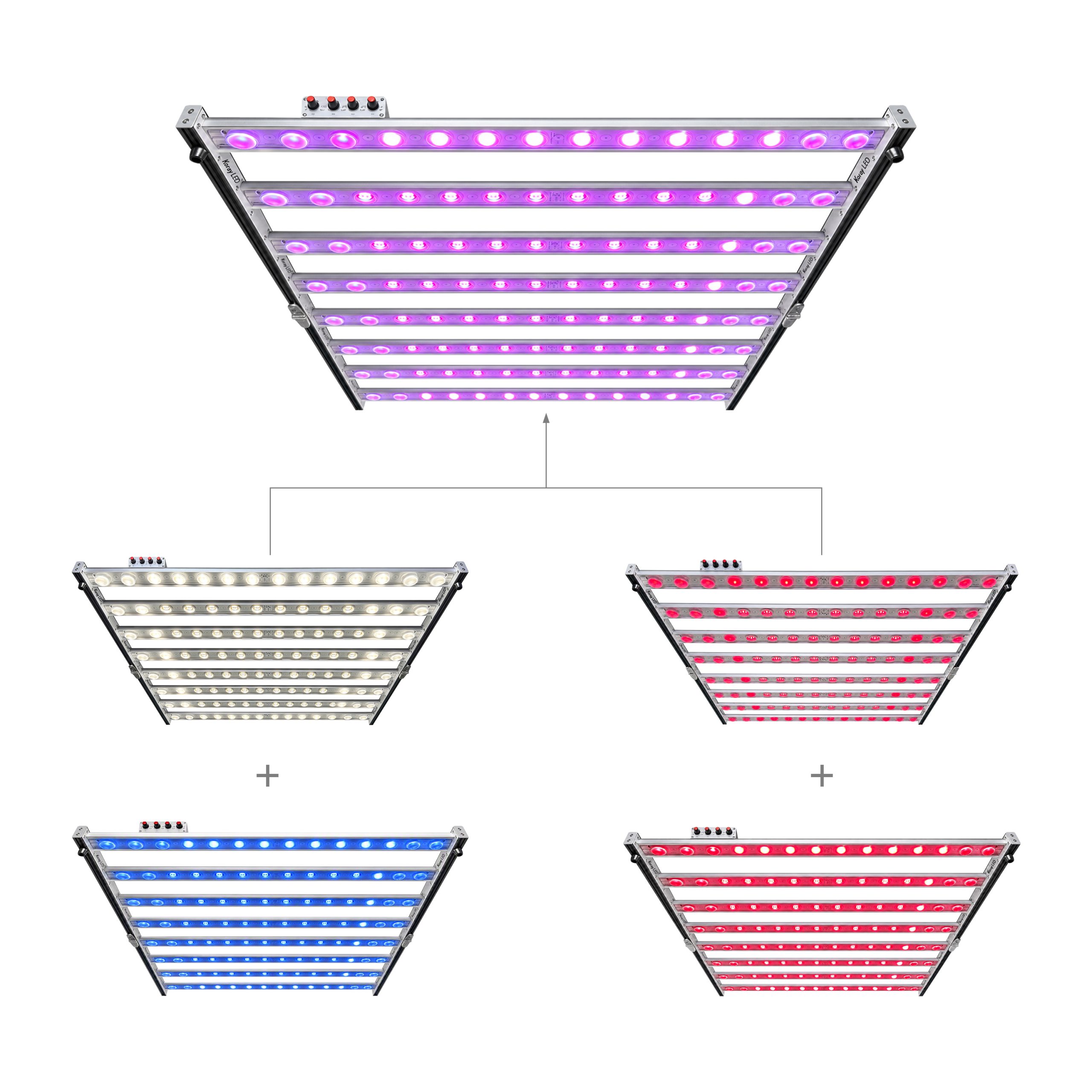
The QB648 combines 648 Samsung LEDs with 18 Osram 660 nm emitters on one board, presented as full spectrum plus added hyper red. The spectrum is fixed at the board level: a builder who wants per-stage spectral change has to combine modules or add separately controlled channels, because the module itself exposes no spectral control – the adjustable variable is dose, set by driver current and photoperiod.
6. Electrical integration: a 52-56 V window and four terminals
Because the module takes a defined DC voltage rather than mains input, drive electronics are chosen by the builder. The official page specifies 52-56 V input at a maximum of 3 A, which lands in the range served by constant-voltage LED supplies and by adjustable current-limiting drivers, and four Wago terminals (two 2061 and two 2060 series) for input and pass-through wiring.
Three checks belong in the commissioning step. Confirm that the chosen supply cannot exceed the module’s voltage window at any dimming level; confirm that current is limited to the module maximum with margin for transients; and confirm the polarity and terminal torque before the board is energised. The official page does not publish a driver model, an IP rating, a certification list or a driver-efficiency figure, so those items cannot be quoted from official data.
7. Dimension comparison: parameter, official figure, condition, verification basis
| Dimension | Official figure | Condition attached to the figure | Verification basis |
|---|---|---|---|
| PPF efficiency (PPE) | up to 3.3 umol/J | Upper bound; drive current and junction temperature not published | Official product page (product ID 6934) |
| Vegetative footprint | 1.5 x 1.5 ft (0.45 x 0.45 m) per module | Single-module coverage, reflective-condition dependent | Official product page (product ID 6934) |
| Flowering footprint | 1 x 1 ft (0.3 x 0.3 m) per module | Single-module coverage at higher target photon flux density | Official product page (product ID 6934) |
| Emitter population | 648 Samsung LEDs plus 18 Osram 660 nm emitters | Fixed full-spectrum board with added hyper red | Official product page (product ID 6934) |
| Electrical input | 52-56 V DC, Max 3 A | Above 1.5 A an additional heat sink is required | Official product page (product ID 6934) |
| Heat sink partner | G1910 | Rated for each 120 W LED plant light engine | Official product page (product ID 6934) |
| Wiring interface | Wago 2061 x 2 plus Wago 2060 x 2 | Input and pass-through terminals on the board | Official product page (product ID 6934) |
| Target applications | Vertical farms, indoor farms, greenhouse supplemental lighting | Module-level use in a built luminaire | Official product page (product ID 6934) |
| Driver, IP rating, certifications | Not published | Official page lists no driver model, IP code or certification list | Official product page (product ID 6934) |
| PPF, PPFD | Not published | Official page publishes efficiency but no flux or canopy irradiance figure | Official product page (product ID 6934) |
8. Where this module fits
As a component, the QB648 suits builders who want to set their own thermal and electrical architecture: a rack or vertical-farm builder planning a grid of small boards at the 1.5 x 1.5 ft vegetative or 1 x 1 ft flowering footprint, and greenhouse operators adding supplemental boards where mains distribution already exists. The 52-56 V window keeps drive electronics in a well-served range, the Wago terminals simplify multi-board wiring, and the fixed full-spectrum plus hyper-red recipe suits schedules that vary dose rather than spectrum. Because official data stops at efficiency, footprint and electrical limits, the finished luminaire’s photon flux density has to be established by measurement at the canopy after commissioning. The module is listed at Koray QB648 on koraylights.com, from a 17-year LED horticultural lighting manufacturer.
Frequently asked questions
Does the official QB648 page publish PPF, PPFD or a wattage figure?
No. The official page publishes the emitter population (648 Samsung LEDs plus 18 Osram 660 nm emitters), full-spectrum plus hyper-red composition, per-module vegetative and flowering footprints, the 52-56 V / 3 A input window, the G1910 heat sink partner and the Wago terminal types – but no PPF, no PPFD, no wattage and no drive-current efficiency point. Only the efficiency upper bound of 3.3 umol/J is published, so a photon flux figure for a finished luminaire must be generated by measurement rather than quoted.
What driver should be paired with a QB648 module?
The official page does not name a driver. What it constrains is the interface: 52-56 V DC input at a maximum of 3 A, so the supply must hold its output inside that voltage window at every dimming level and must limit current to the module maximum with margin for transients. Verify the drive point on the bench before the board goes into a luminaire, and remember that a small over-voltage at low load is the most common way a constant-voltage supply damages a module.
How much heat sinking does one QB648 module need?
The official page specifies a maximum of 3 A and states that operation above 1.5 A requires an additional heat sink, with the G1910 heat sink listed for each 120 W LED plant light engine. That makes 1.5 A the boundary between a passively cooled board and one that needs extra metal and airflow. Because emitter output falls as junction temperature rises, a board run continuously near the current limit needs its thermal path sized for continuous duty, not for a laboratory flash test.
How many QB648 modules are needed for a 4 x 4 ft grow area?
Per the official page each module covers 1.5 x 1.5 ft for vegetative growth and 1 x 1 ft for flowering, so a 4 x 4 ft flowering zone plans out at sixteen nominal 1 x 1 ft positions, and the same area needs fewer boards in the vegetative phase at the larger footprint. Both counts are nominal grid arithmetic: reflective walls, aisle access and edge falloff change the number, and canopy uniformity must be confirmed by measuring photon flux density across the area after commissioning.
Is the QB648 a finished plug-in fixture?
No. It is a horticulture LED light engine on a PCB: the board, its 648 Samsung LEDs and 18 Osram 660 nm emitters, and a 52-56 V / 3 A electrical interface. Driver, heat sink, mounting, wiring and any enclosure or IP protection are supplied by the builder – the official page publishes no driver model, no IP rating and no certification list – so a completed luminaire also needs its own electrical safety assessment before it is used in a wet or humid room.




Leave A Comment