
What a Dimming Range Actually Means on a Horticultural LED Module
A dimming range is the span of electrical power over which a fixture can be operated while it keeps emitting light at a usable intensity. On a luminaire rated at 480 W with a deep dimming floor of 60 W, that span covers roughly 12.5% to 100% of rated power. The figure matters because a grow room is not a fixed electrical load: a tray of cuttings needs a small fraction of the photon flux that the same tray needs once the canopy has closed and flowering has started.
Dimming is not the same thing as switching emitters off. Two engineering routes reach a lower output. The first reduces current through the whole emitter array, lowering photon flux across the entire spectrum proportionally. The second disables selected spectral channels while the remaining emitters run unchanged. A module can use both at once: a continuous main dimming range for the whole array, plus a separate switch for add-on wavebands such as ultraviolet and far-red. When reading a datasheet, the dimming floor normally refers to the main array rather than to every channel independently.
Why a Wide Range Changes Fixture Count, Not Only Brightness
Small rooms are often planned around two luminaires: a lower-output lamp for propagation and a higher-output lamp for flowering, each on its own hanging point. The second luminaire is only part of the cost. There is also the second driver, the second set of connectors, the second suspension point and the labour of swapping hardware at the stage change.
When one module can be turned down to about one eighth of its rated power, a single hanging point can serve both stages. The planning question then shifts from how many lamps to buy to three questions a datasheet can answer: what the dimming curve is, what area the unit covers in each stage, and what the efficiency is quoted at.
Photon Metrics in Plain Terms: PPF, PPFD, Photon Efficacy and DLI
PPF is the total photosynthetic photon flux a fixture emits, expressed in micromoles per second (µmol/s). PPFD is the photosynthetic photon flux density arriving at a surface, expressed in micromoles per square metre per second (µmol/m²/s), and it has no meaning without a stated distance from the fixture. Photon efficacy is the ratio of PPF to input power, expressed in micromoles per joule (µmol/J), and it is only meaningful when the measurement conditions are named. DLI is the daily light integral, the total photons delivered across one photoperiod, expressed in moles per square metre per day (mol/m²/d).
These four terms explain why a dimming range and a coverage figure belong in the same sentence. Lowering the drive power lowers PPF and therefore PPFD. Widening the footprint spreads the same PPF over a larger area, which also lowers PPFD. A stage-by-stage plan should therefore state power, distance and area together, which is the convention used for the official values further down this page.
General guidance on greenhouse and controlled-environment lighting is maintained by public extension and research bodies. Michigan State University Extension publishes an introductory greenhouse lighting explainer at canr.msu.edu/news/greenhouse-lighting, and the USDA Agricultural Research Service documents its controlled-environment and greenhouse crop research programmes at ars.usda.gov. Lighting product terminology, including LED horticultural luminaires, is also catalogued through the national standards information service at std.samr.gov.cn.
Matching Output to Growth Stage: Vegetative and Flowering Footprints
Two footprint figures are normally quoted for a fixture that is designed to serve a whole cycle. The vegetative footprint is the area the unit can illuminate while plants are small and the canopy is sparse. The flowering footprint is the smaller area that keeps photon density high once the canopy closes and daily demand peaks. A larger vegetative figure with a smaller flowering figure is a normal engineering pattern rather than an inconsistency: the same unit is asked to cover more area early and to concentrate on less area later.
That gives a single hanging point two planning numbers. Tray spacing is set to the vegetative figure during propagation, then the trays are consolidated towards the flowering figure when the photoperiod shortens. Because dimming and coverage move together, the drive level is chosen from the growth stage instead of being re-planned from scratch every week.
Official G480C Values and the Conditions Behind Them
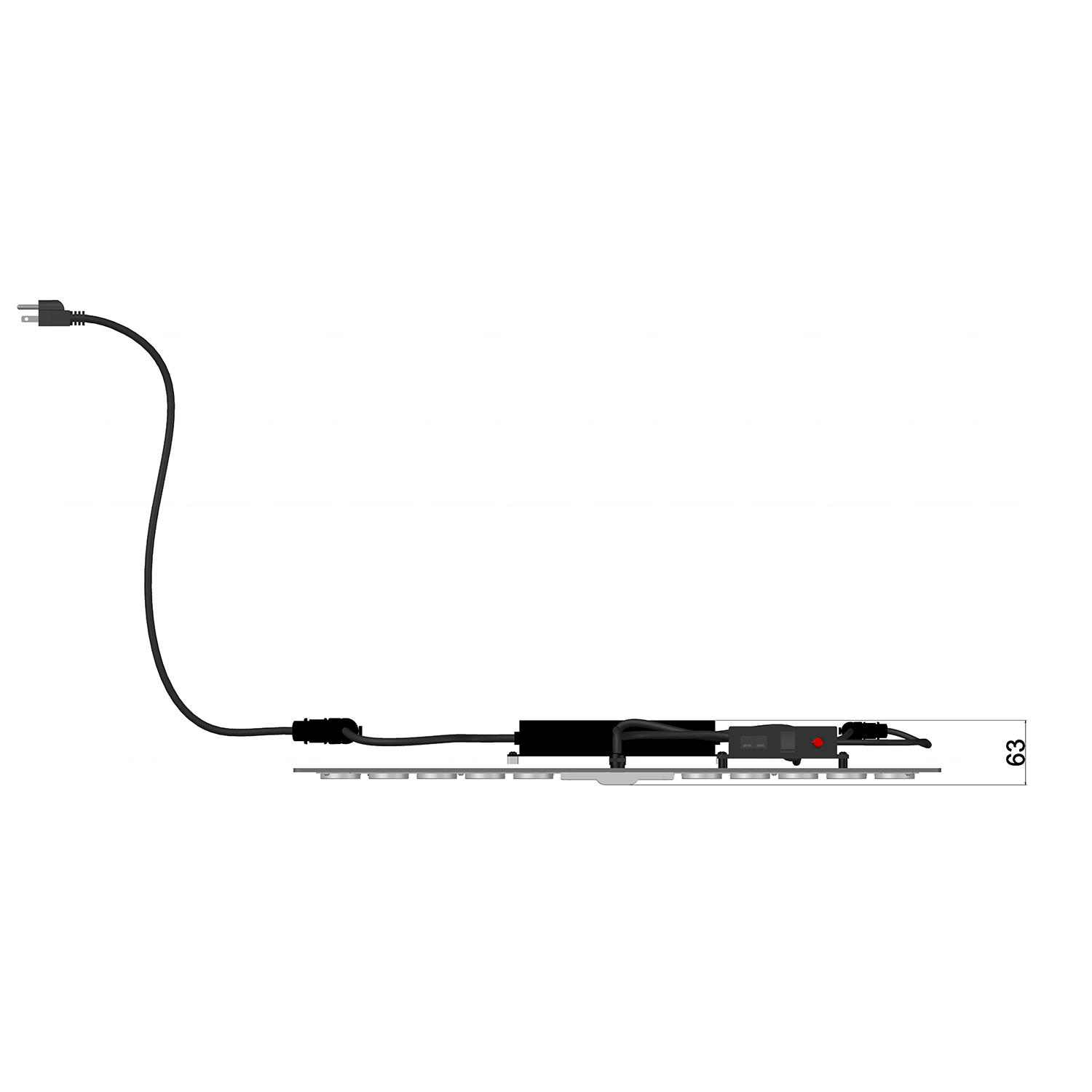
Every figure below is quoted on the official G480C product page at koraylights.com/product/far-red-horticulture-grow-lighting, with the page’s own wording and condition kept alongside it.
| Parameter | Official value | Condition or official wording |
|---|---|---|
| Rated power | 480 W | Input AC90-277 V, power 480 W |
| Dimming range | 60 W to 480 W, about 12.5% to 100% | 480 W power draw, dimmable to 60 W |
| Photon efficacy | up to 2.8 µmol/J | Official condition: quoted without UV and without FR |
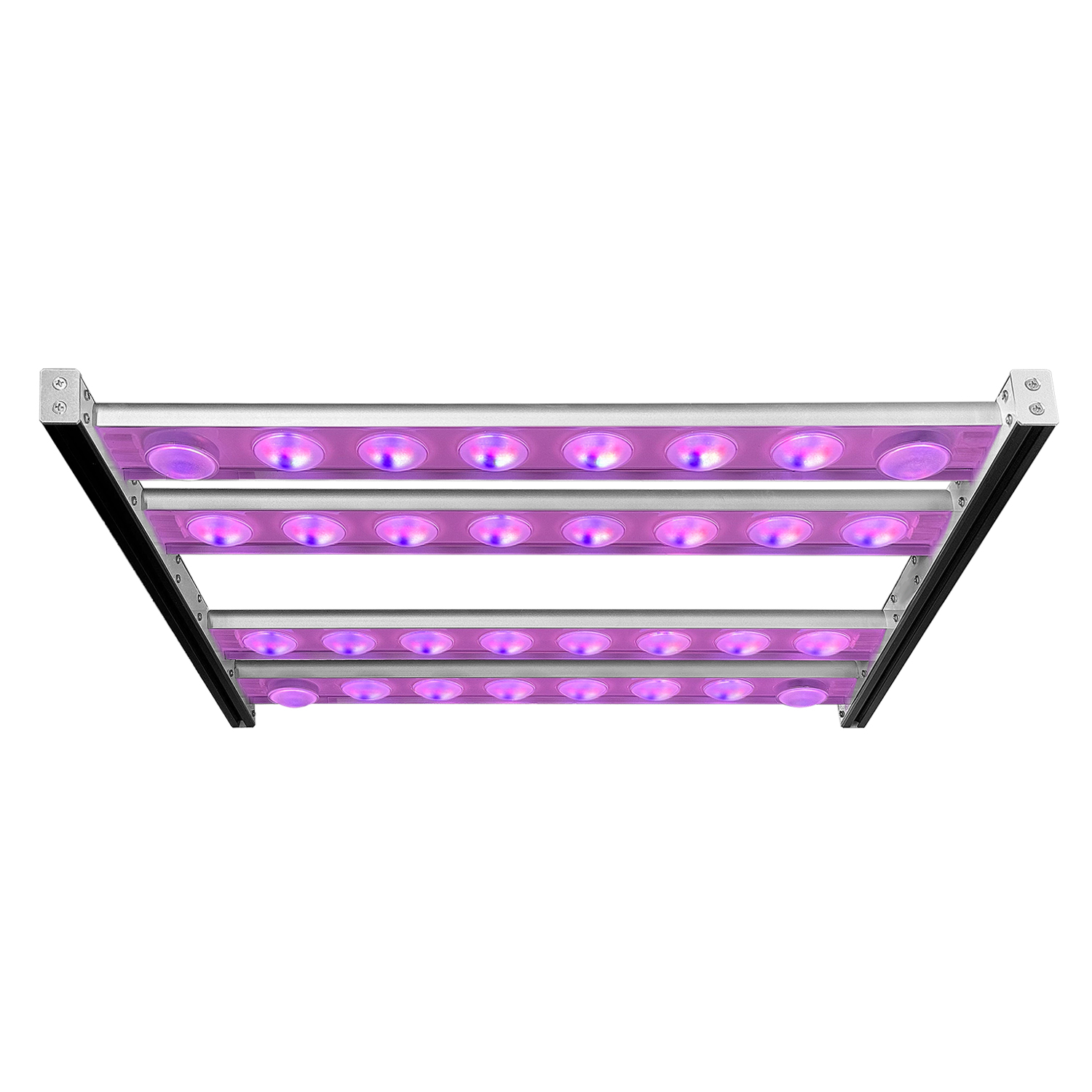
| Emitters | Samsung LM301H, plus 660 nm deep red and 730 nm far red | German-brand 660 nm and 730 nm diodes named on the page |
| Driver | MeanWell | Named on the product page |
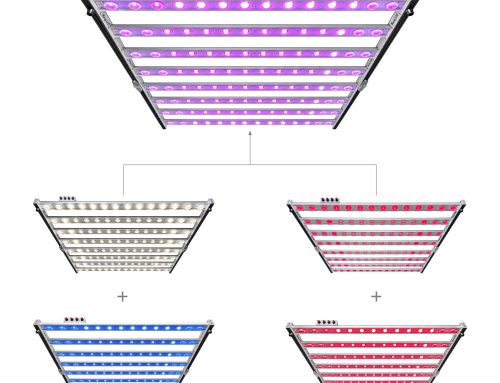
| Flowering switch | Adds UV 395 nm and far-red 730 nm when engaged | Switchable additional channels |
| Footprint | Vegetative 6 x 6 ft; flowering 5 x 5 ft | Both figures quoted on the product page |
| Dimming interface | RJ12 telephone-line series connection, synchronous dimming, dimmer included | Official page states a free dimmer is supplied |
| Ingress protection | IP65 | Official page |
| Input voltage | AC90-277 V | Official page |
| Lifespan | 50,000 hours | Official page |
| Warranty | 3 years | Official page |
| Certification | CE, RoHS, ETL | Official page |
| Beam angle | the official product page does not list a beam angle | Left blank rather than estimated |
| PPF in µmol/s | the official product page does not list a PPF value | Left blank; no figure borrowed from another model |
| PPFD at a stated distance | the official product page does not list a PPFD value | Left blank rather than inferred from the footprint |
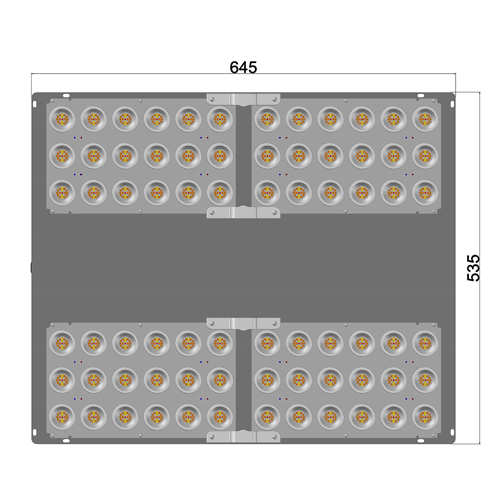
| Module dimensions | the official product page does not list external dimensions | Left blank |
Three gaps are shown deliberately. Beam angle, PPF in µmol/s and PPFD at a stated distance are not published for this module, so no value is offered here and no number is carried over from a different model in the same family. The same page records one further specification entry, a 1000 W SE HID replacement note, which is a datasheet line rather than the subject of this article.
Dimming Range Across Two Growth Stages: A Dimension Comparison
The comparison below sets the official values of one wide-range module against the two-fixture arrangement it replaces. Only the module column carries published figures; the two-fixture column describes the planning properties of that arrangement.
| Dimension | One 60-480 W module on one hanging point | Two single-stage fixtures on two hanging points |
|---|---|---|
| Power available | 60 W to 480 W, about 12.5% to 100% (official) | One low fixed output plus one high fixed output, chosen per fixture |
| Vegetative coverage | 6 x 6 ft (official) | Set by the vegetative fixture |
| Flowering coverage | 5 x 5 ft (official) | Set by the flowering fixture |
| Efficiency basis | up to 2.8 µmol/J, quoted without UV and FR (official) | Two separate published figures, each with its own condition |
| Spectrum | Samsung LM301H with 660 nm and 730 nm, plus switchable UV 395 nm and far-red 730 nm | Typically fixed per fixture |
| Control wiring | RJ12 series link with synchronous dimming; dimmer supplied (official) | Depends on each fixture’s control interface |
| Stage-change work | Change the dimmer setpoint | Re-hang or swap hardware |
| Rated life and protection | 50,000 hours, IP65 (official) | Varies by fixture |
| Hanging points to plan | One | Two |
Where a 60-480 W Module Fits: Deployment Scenarios
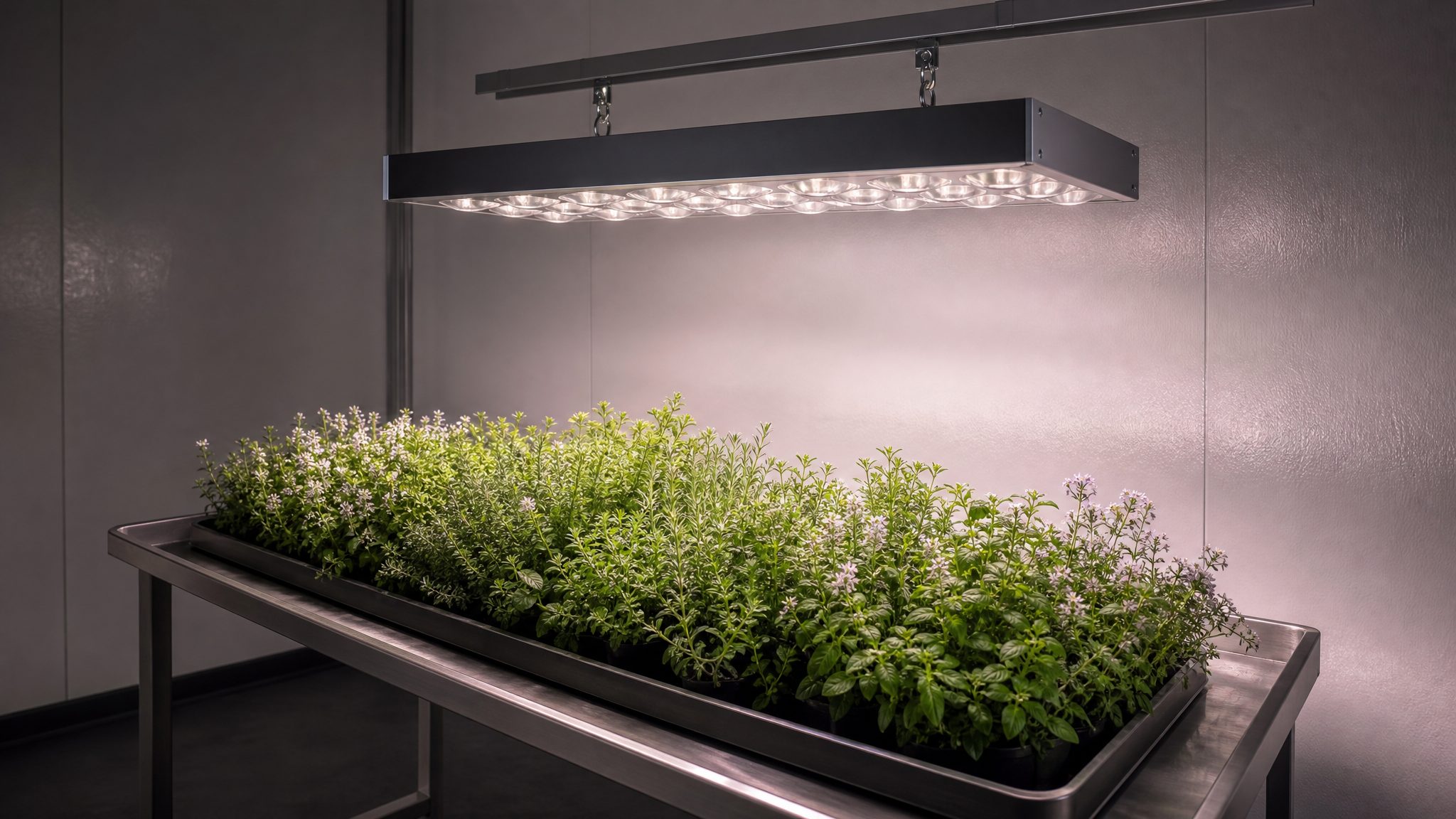
A module whose main array dims down to about one eighth of rated power suits rooms where the same floor area is used for more than one stage. That includes basement and dedicated indoor rooms with a small number of fixtures per bench, test and trial rooms where the light level is varied deliberately between batches, and greenhouses where supplementary lighting is only needed at a fraction of full output for part of the year.
For that kind of layout, three settings are worth recording per crop: the dimmer percentage used in propagation, the percentage used in flowering, and the tray spacing that matches the 6 x 6 ft and 5 x 5 ft figures. Where a room already runs two separate fixtures for the two stages and the only reason for the second luminaire is a lower propagation output, a single wide-range module removes one hanging point, one driver and one hardware swap per cycle.
Conclusion
The useful question about a 480 W module is not how bright it is, but how far down it will dim and which areas it serves at each stage. The G480C answers both with published values: 60 W to 480 W of main-array dimming, a 6 x 6 ft vegetative footprint, a 5 x 5 ft flowering footprint, and up to 2.8 µmol/J quoted without the switchable UV and FR channels. Where the official page is silent, on beam angle, PPF and PPFD, this page stays silent too.
FAQ
What is the dimming range of the G480C?
The official product page states a 480 W power draw that is dimmable to 60 W, which is a range of roughly 12.5% to 100% of rated power on the main array. The UV 395 nm and far-red 730 nm channels are controlled by the flowering switch rather than by the main dimming range.
What areas does one G480C cover at each growth stage?
The official page quotes a vegetative footprint of 6 x 6 ft and a flowering footprint of 5 x 5 ft. Beam angle is not listed, so no PPFD distribution pattern is claimed here.
Does the 2.8 umol/J figure include the UV and far-red channels?
No. The official page states the efficiency as up to 2.8 µmol/J without UV and FR. The UV 395 nm and far-red 730 nm channels are additions that the flowering switch turns on, not standing losses in the quoted figure.
Do several G480C modules need a separate dimming controller?
The official page states that a dimmer is supplied with the module and that RJ12 telephone line can be used to connect units in series for synchronous dimming, so a separate controller is not required for that arrangement.
What are the rated lifespan, ingress protection and warranty of the G480C?
The official page lists 50,000 hours, IP65 ingress protection and a 3-year warranty, over an input range of AC90-277 V, with CE, RoHS and ETL marks.
Why Choose Koray
The G480C is manufactured by Zhongshan Koray Opto-Electronic Co., Ltd., which brings 17 years of experience in LED grow-light manufacturing and 300+ domestic and foreign patents to the G-series. Every performance figure in this article is traceable to the official G480C product page on koraylights.com.




Leave A Comment