
Overview: Why Beam Shape Changes the Bench Plan More Than Wattage Does
Two fixtures can draw the same input power and still leave a bench lit very differently, because the shape of the emitted beam decides whether the output lands on the crop or spreads past it. Beam geometry also sets the trade-off that governs every low-ceiling room: hanging a fixture closer to the canopy raises the intensity on the plane but narrows the useful area, while hanging it higher widens the area and lowers the intensity. A comparison that lists only watts per unit area cannot express that trade-off, which is why optical design and a recommended mounting-height range belong in the specification rather than in the installation notes.
The design problem is documented well outside manufacturer literature. A review of LED illumination for high-quality, high-yield crop growth in protected cropping environments, available through the NIH PubMed Central archive, notes that the LED setup must be designed so that light is distributed uniformly before the plants are illuminated, because a constant plane intensity across the bed is what makes a treatment comparable and a bench productive. The same review treats spectrum and layout as coupled decisions rather than independent ones, which is the frame used throughout this guide.
This article follows one 100 W class square module, the RX-G1000C, through the dimensions that decide how a bench is planned: published beam angle, plane intensity at three mounting heights, the recommended mounting range in metres above the canopy, footprint per unit, thermal design, ingress protection and rated life. Manufacturer values are quoted as published and each numeric claim is linked to the official specification PDF or the official product page.
Official RX-G1000C Figures and the Conditions Behind Them
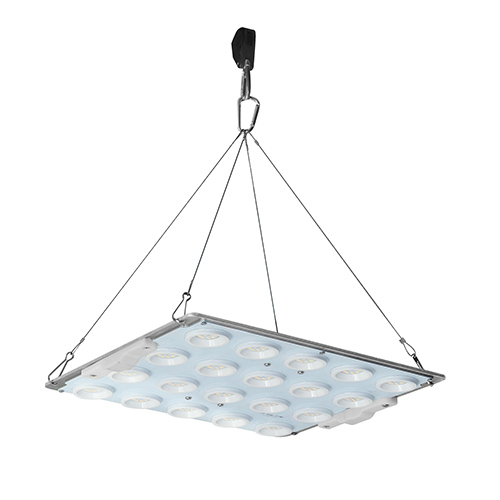
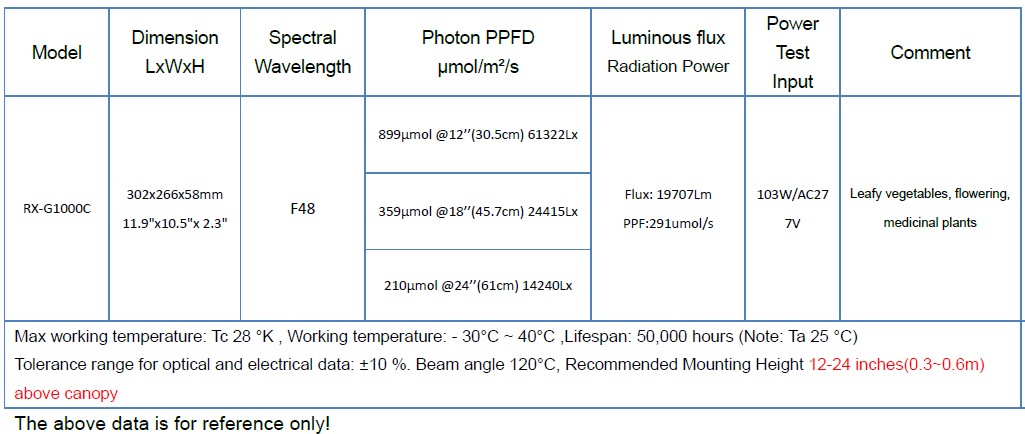
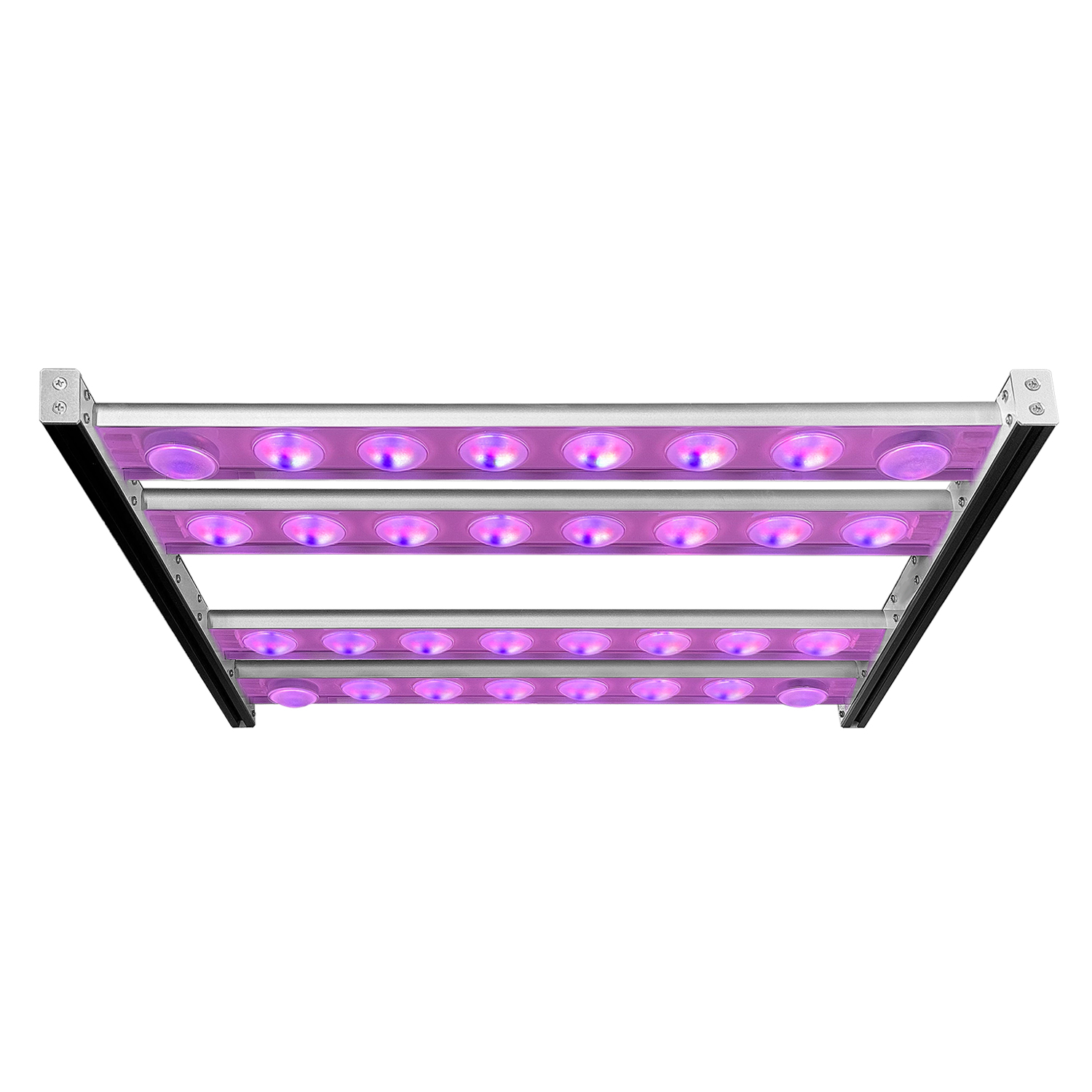
The RX-G1000C is a square quantum module measuring 302 x 266 x 58 mm (11.9 x 10.5 x 2.3 in). Its official specification table lists a photon flux of 291 µmol/s, a luminous flux of 19,707 lm, and plane values of 899 µmol/m²/s at 12 in (30.5 cm), 359 µmol/m²/s at 18 in (45.7 cm) and 210 µmol/m²/s at 24 in (61 cm), with matching illuminance readings of 61,322 lx, 24,415 lx and 14,240 lx. The optical system is described officially as a patented reflective-cup design that raises PPFD for high-light plants, with a published beam angle of 120° and a recommended mounting height of 12 to 24 in, which is 0.3 to 0.6 m above the canopy.
Power is quoted in the 100 W class: the descriptive text lists 100 W at AC230 V and AC277 V and 105 W at AC120 V, while the specification table records 103 W at AC277 V, so the input varies slightly with the supply voltage. The datasheet does not publish a whole-fixture efficacy value in µmol/J, and none is calculated here from photon flux and input power. The spectrum is designated F48 and is described officially as a sunlight spectrum assembled from 3500 K and 5000 K white with 660 nm deep red and 740 nm far red. Cooling is all aluminium and fanless, described as zero noise, the module is rated IP65 on a waterproof MCPCB, the operating range is −30 to 40 °C, the tolerance on photometric data is ±10 %, rated life is 50,000 hours at an ambient temperature of 25 °C, and the fixture carries CE, RoHS and FCC marking with a 3-year warranty.
The published numbers are recorded in the official RX-G1000C series datasheet and on the official product page, and the conditions matter as much as the values: the plane figures are specification-table readings taken directly below the module, not averages over an entire bench, and they describe a single module rather than a multi-unit installation.
| Dimension | Official RX-G1000C value | Test condition / note |
|---|---|---|
| Spectrum | F48: 3500 K and 5000 K white, 660 nm deep red, 740 nm far red | Official spectral designation (datasheet) |
| Optical design | Patented reflective-cup design | Official description: raises PPFD for high-light plants |
| Beam angle | 120° | Datasheet specification table |
| Photon flux (PPF) | 291 µmol/s | Datasheet specification table |
| PPFD at 12 in (30.5 cm) | 899 µmol/m²/s | Specification-table plane reading |
| PPFD at 18 in (45.7 cm) | 359 µmol/m²/s | Same protocol |
| PPFD at 24 in (61 cm) | 210 µmol/m²/s | Same protocol |
| Illuminance | 61,322 lx at 12 in; 24,415 lx at 18 in; 14,240 lx at 24 in | Datasheet specification table |
| Luminous flux | 19,707 lm | Datasheet specification table |
| Input power | 100 W class: 100 W at AC230 V and AC277 V, 105 W at AC120 V (table row: 103 W at AC277 V) | Descriptive text and specification table |
| Recommended mounting height | 12 to 24 in (0.3 to 0.6 m) above the canopy | Datasheet specification table |
| Footprint | 3 ft x 3 ft in the vegetable stage; 2 ft x 2 ft in the flowering stage | Official coverage statement |
| Photoperiod | Operator variable, not fixed by the maker | Daily light integral scales linearly with hours per day (h/day) |
| Body size | 302 x 266 x 58 mm (11.9 x 10.5 x 2.3 in) | Datasheet table and dimension drawing |
| Thermal design | All aluminium, fanless, zero noise | Official description |
| Ingress protection | IP65 | Waterproof MCPCB quantum LED module |
| Operating temperature | −30 to 40 °C | Datasheet specification table |
| Rated life | 50,000 h | Rated at ambient temperature Ta 25 °C |
| Warranty and compliance | 3 years; CE / RoHS / FCC | Datasheet and official product page |
Mounting Height as a Range: What 0.3 m, 0.45 m and 0.6 m Do to the Plane
The official mounting recommendation is a band rather than a single figure, and the plane data explains why. Between 12 in and 24 in the published PPFD falls from 899 to 210 µmol/m²/s, a drop of about 77 %, and the illuminance falls from 61,322 lx to 14,240 lx over the same span. In other words, a module mounted at the top of the recommended range delivers less than a quarter of the plane intensity it delivers at the bottom of the range, on the same electricity input.
| Mounting height above canopy | PPFD (µmol/m²/s) | Illuminance (lx) | Change against 12 in | Daily integral at 12 h/day (mol/m²/day) |
|---|---|---|---|---|
| 12 in (0.3 m) | 899 | 61,322 | baseline | about 39 |
| 18 in (0.45 m) | 359 | 24,415 | −60.1 % | about 16 |
| 24 in (0.6 m) | 210 | 14,240 | −76.6 % | about 9 |
The integral column is arithmetic on the published plane values at 12 h/day rather than a crop recommendation, because the maker does not publish a photoperiod for the module; hours per day is a scheduling decision the operator makes, and the daily total on the canopy scales linearly with it. Read together with the height table, the two variables are substitutes in one direction only: mounting lower multiplies intensity without adding watts, while extending the photoperiod adds daily total at every height. A low-mount installation is therefore not merely a space-saving compromise, it is the configuration in which this module’s published plane values are highest, and the official 0.3 to 0.6 m recommendation marks the band in which that trade-off stays usable.
Dimension-by-Dimension Comparison Table
Modules in the same power class can differ more in how they deliver light than in how much they consume, so the comparison below is organised around the dimensions that decide a bench layout, with the official value beside each and the question it should be tested against.
| Comparison dimension | Official RX-G1000C value | What it should be compared against |
|---|---|---|
| Optical design | Patented reflective-cup design | Whether the alternative is a bare-board module, and what its published plane readings are |
| Beam angle | 120° | The bench width the pattern has to cover and the mounting height it assumes |
| Plane PPFD | 899 µmol/m²/s at 12 in (30.5 cm) | The exact mounting height used for the test, not an unspecified distance |
| Mounting-height range | 12 to 24 in (0.3 to 0.6 m) above the canopy | The headroom available once a hanging system is installed |
| Photon flux | 291 µmol/s | Whether the alternative publishes µmol/s or only a wattage label |
| Input power | 100 W class (100 W at AC230 V; 105 W at AC120 V; table row 103 W at AC277 V) | Measured input watts at the supply voltage in use |
| Photoperiod | Operator variable in h/day | Whether the daily integral was compared at equal hours per day |
| Footprint | 3 ft x 3 ft vegetative; 2 ft x 2 ft flowering | The number of modules a bench of a given length needs |
| Thermal design | Aluminium body, fanless, zero noise | Whether the alternative needs a fan, its noise level and its moving-part service life |
| Body size | 302 x 266 x 58 mm | Module spacing on a frame and clearance above the crop |
| Ingress protection | IP65 | Misting, drip and wash-down conditions in the room |
| Rated life | 50,000 h at Ta 25 °C | Maintenance planning at realistic ambient temperature |
| Compliance | CE / RoHS / FCC; 3-year warranty | Import, tender and after-sales documentation |
Reflective-Cup Optics Versus Bare-Board Optics
The difference between a reflective-cup module and a bare-board module is not extra output; it is where the output goes. Ten millimetres of optical cup per emitter cell reshapes the beam so that more of the emitted flux arrives inside the intended cone instead of leaving the fixture at the grazing angles that never reach the crop. The RX-G1000C uses this approach, officially described as a patented reflective-cup design that raises PPFD for high-light plants, and publishes both the resulting plane values and a 120° beam angle so that the pattern can be planned rather than assumed.
The measurable consequence for a buyer is that plane intensity and layout are linked. Because the recommended mounting band is only 0.3 to 0.6 m above the canopy, a 120° beam at the bottom of that band covers a comparatively small area with high intensity, which is the correct configuration for high-light crops on a narrow bed, while the same module at the top of the band trades intensity for a wider pattern. That is also why a comparison of two modules should not stop at the centre reading. The review of protected-cropping LED design available through the NIH PubMed Central archive makes uniform distribution across the bed the design objective, which in practice means comparing centre PPFD, edge PPFD and the spacing at which neighbouring modules overlap, all at the same stated height.
Spectrum interacts with the same conditions. The F48 designation combines 3500 K and 5000 K white with 660 nm deep red and 740 nm far red, and a study of far-red light and temperature interactions in lettuce, available through the NIH PubMed Central archive, reports that the morphological effects of far-red light diminish at high light intensity and vary with temperature. That is a reason to treat plane intensity, spectrum and room climate as one system, and not to read the 740 nm channel as a result in itself.
Heat, Noise and Enclosure in a Low-Mount Layout
A module that is designed to hang 0.3 to 0.6 m above a canopy sits close to the crop and close to the operator, so the thermal and mechanical details matter more than they would in a high-bay installation. The RX-G1000C uses an all-aluminium body with no fan, officially described as zero noise, which means there is no moving part to wear, no airflow to redistribute spores or dust across a bench, and no acoustic output in a room where people work. Heat leaves the module by conduction and radiation from the aluminium body to the surrounding air, so the fixture’s own operating range of −30 to 40 °C and its 50,000 hour rating at an ambient temperature of 25 °C are the figures that describe that path.
The enclosure is equally relevant at bench level. IP65 protection on a waterproof MCPCB module is what allows the fixture to be used where irrigation splashes, drips from overhead lines or periodic wash-down are normal, and the body measures 302 x 266 x 58 mm with hanging wires at the four corners and a central clip. In a low-ceiling room that 58 mm of panel plus the hanging hardware is the headroom to reserve per level, and the same dimensions decide the spacing between modules on a frame. Compliance documentation for the installation is covered by CE, RoHS and FCC marking; the European Commission’s page on the Electromagnetic Compatibility Directive explains one of the directive families that applies to electrical equipment placed on the EU market.
Selection Guidance: Where a 100 W Module Fits
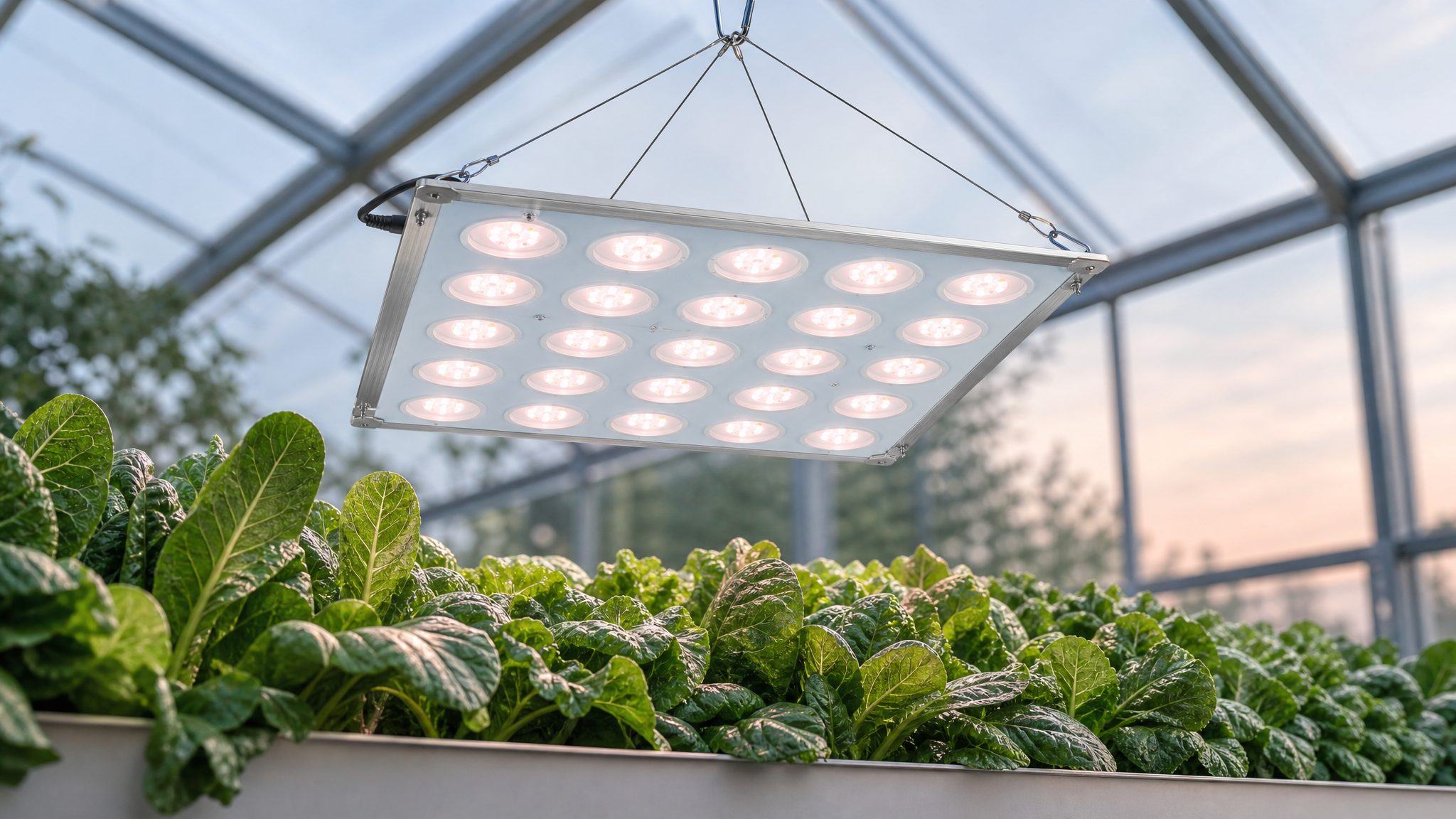
The documented plant groups for this platform are leafy vegetables, flowering crops and medicinal plants, and the official application list covers basement planting and plant tent planting only. The bench arithmetic follows from the coverage figures: one module covers 2 ft x 2 ft in the flowering stage and 3 ft x 3 ft while the crop is vegetative, so a bench of about 2 ft x 8 ft needs four modules at flowering coverage or two at vegetative coverage, and the two counts are not interchangeable in a room that stays in one stage. Because the recommended mounting band is measured from the canopy rather than from the ceiling, the same module can also be re-hung as the crop grows and the canopy rises, which keeps the plane intensity inside the published band without adding hardware.
Three checks are worth making before a bench is specified. Confirm the mounting height in metres above the final canopy, because the published plane values fall by roughly 77 % between 12 in and 24 in and a plan based on the wrong end of the range will not match the datasheet. Confirm the photoperiod in h/day, because the daily total on the canopy is the plane value multiplied by the hours of light. And confirm the layout at the edges, not only at the centre, because a 120° beam over a 2 ft x 2 ft unit area and a wider frame spacing produce different distribution even when the centre reading is identical.
For procurement documentation the manufacturer’s pages state 17 years of experience in plant-lighting development and manufacturing and 300+ domestic and foreign patents, published on the patent and certification and company profile pages, together with export markets listed for EU countries, the USA, Canada, the UK, Israel and Japan. The module belongs to the maker’s grow-tent quantum board family, which is useful context when a bench of identical units is planned, because spare modules and future additions then share the same mounting hardware and body dimensions.
Conclusion
The RX-G1000C is a 100 W class square quantum module measuring 302 x 266 x 58 mm, and its official data makes the optical behaviour measurable: a patented reflective-cup design with a 120° beam, a photon flux of 291 µmol/s, plane PPFD of 899, 359 and 210 µmol/m²/s at 12, 18 and 24 in and illuminance of 61,322, 24,415 and 14,240 lx at the same heights, all with a published tolerance of ±10 %. The recommended mounting height of 12 to 24 in, or 0.3 to 0.6 m above the canopy, is the band in which that intensity range is usable, and coverage of 3 ft x 3 ft in the vegetative stage and 2 ft x 2 ft in the flowering stage sets the module count per bench. An all-aluminium fanless body, IP65 ingress protection, a 50,000 hour rating at Ta 25 °C and a 3-year warranty address the environment the module is specified for, while the F48 spectrum built from 3500 K and 5000 K white with 660 nm deep red and 740 nm far red defines what it delivers. Because the plane figures were measured at stated heights below a single module, they stay comparable only when a comparison fixture is measured the same way.
Frequently Asked Questions
Why does the beam angle matter more than the wattage in a low-mount room?
The 120° beam angle sets how the output is spread, so it decides how much of a bench receives high intensity and how mounting height trades area for intensity. In a room with limited headroom the beam pattern and the 12 to 24 in (0.3 to 0.6 m) mounting band determine the achievable plane PPFD, while the 100 W class input only determines what the schedule costs to run.
What PPFD and illuminance does the RX-G1000C produce at each height?
Official specification-table values are 899 µmol/m²/s and 61,322 lx at 12 in (30.5 cm), 359 µmol/m²/s and 24,415 lx at 18 in (45.7 cm), and 210 µmol/m²/s and 14,240 lx at 24 in (61 cm), with a published ±10 % tolerance on photometric data.
What mounting height is recommended, and where is it measured from?
The datasheet recommends 12 to 24 in, which is 0.3 to 0.6 m, and the range is measured from the canopy rather than from the ceiling, so the module can be re-hung as the crop grows to keep the plane intensity inside the published band.
Does the module need a fan, and how is it cooled?
No. Cooling is all aluminium and fanless, described officially as zero noise, so there is no moving part to service and no fan airflow across the bench. Rated life is 50,000 hours at an ambient temperature of 25 °C, with an operating range of −30 to 40 °C.
What does one module cover and what power does it use?
Official coverage is 3 ft x 3 ft in the vegetable stage and 2 ft x 2 ft in the flowering stage, so a 2 ft x 8 ft bench takes four modules at flowering coverage. Power is quoted in the 100 W class: 100 W at AC230 V and AC277 V, 105 W at AC120 V, with 103 W at AC277 V in the specification table row.




Leave A Comment