
Overview: Why a Wattage Label and a Photon Measurement Answer Different Questions
A grow light can be sold on a number that says very little about the light reaching a canopy. Catalogue lamps are still advertised with headline wattages such as 1000 W or 2000 W that may describe a marketing class rather than electrical input, while the quantity that drives photosynthesis is a photon flux measured in micromoles per second. The difference is not wordplay. The National Institute of Standards and Technology describes photometry as the measurement of light as the human eye perceives it, so lumens and lux are photometric units, while plant response is quantified radiometrically as PPF in micromoles per second and PPFD in micromoles per square metre per second at a stated measurement plane.
Two conditions decide whether a PPFD figure is comparable at all: the distance between the fixture and the plane being measured, and the number of hours per day the fixture actually runs. Photon flux falls as the plane moves away from the source and the same output spreads over a larger area, and the daily light integral accumulated on a canopy scales linearly with the photoperiod. A 12 h/day schedule therefore delivers half the daily total of a 24 h schedule and about two thirds of the total of an 18 h/day schedule at the same plane intensity, which is why hanging height measured in inches or metres and hours per day measured in h/day belong beside any PPFD claim.
The rest of this guide follows one 215 W two-panel quantum board, the RX-G2000L, through the dimensions that carry decision weight when it is placed against another fixture: official photon flux, plane PPFD at three hanging heights, footprint, spectrum composition, serial-dimming scale, ingress protection and rated life. Manufacturer values are quoted as published, and each numeric claim is linked to the official specification PDF or the official product page rather than restated from marketing copy.
Official RX-G2000L Figures and the Conditions Behind Them
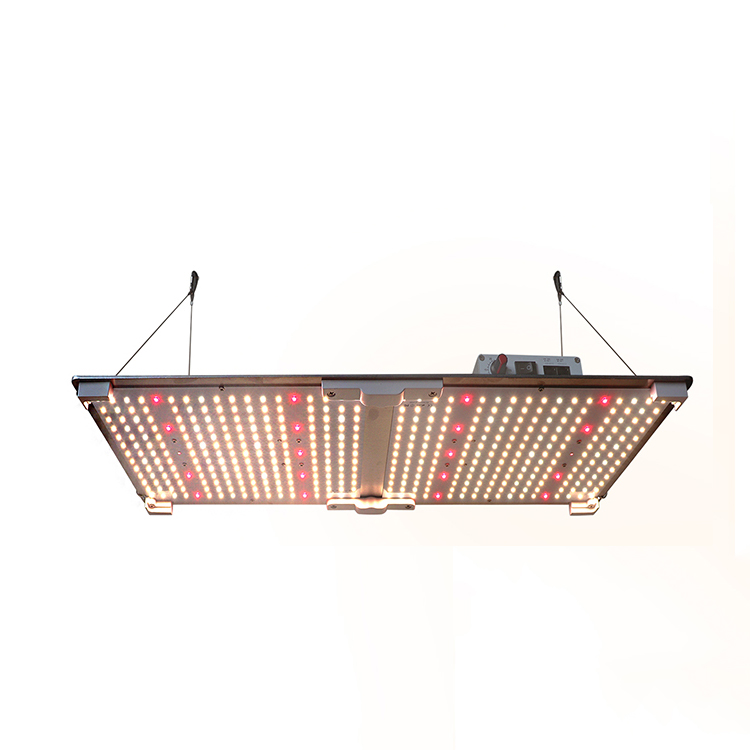
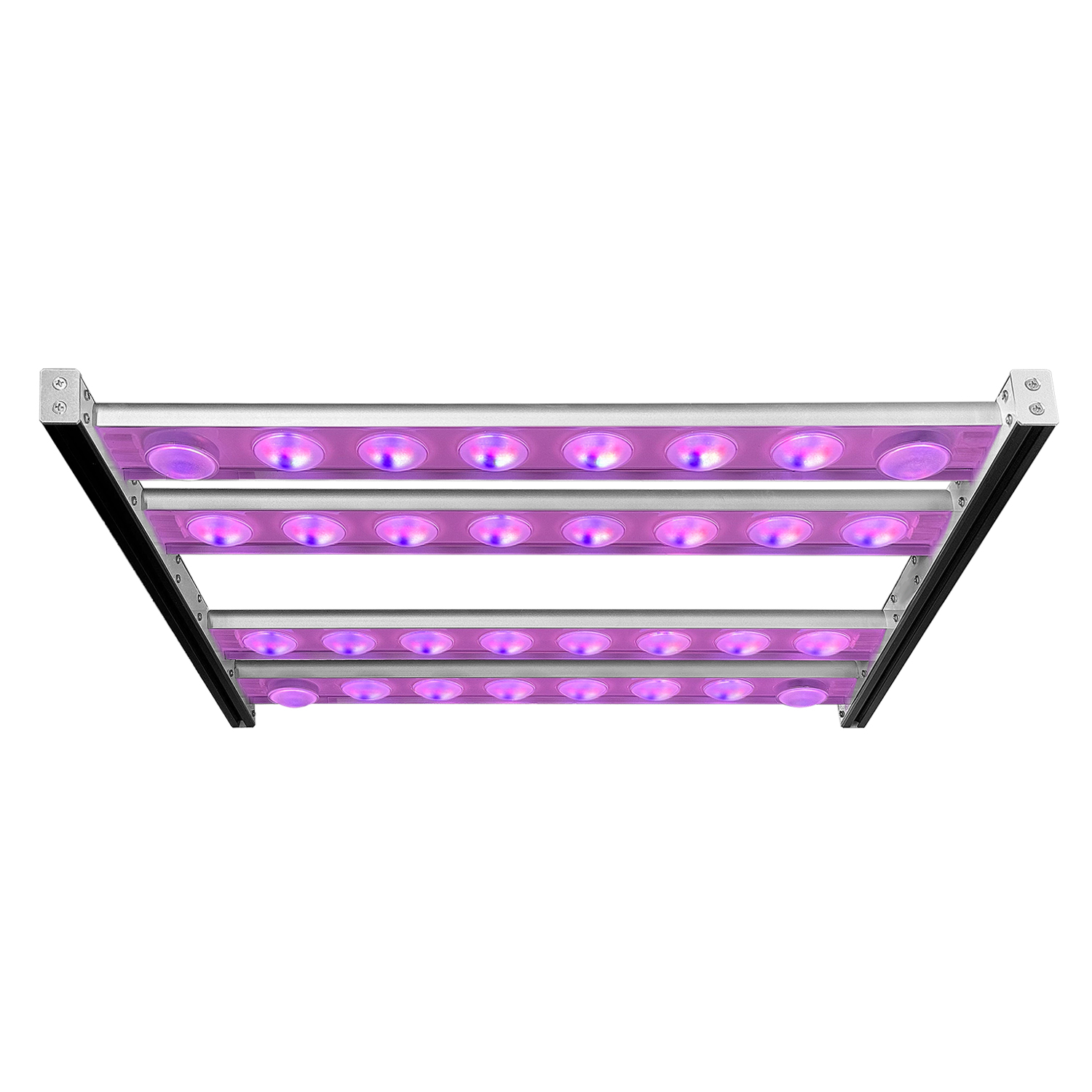
The RX-G2000L is a two-panel rectangular quantum board measuring 600 x 241 x 60 mm (23.6 x 9.4 x 2.4 in). Its official specification table lists a photon flux of 570 µmol/s, a luminous flux of 37,500 lm, an official efficacy of up to 2.7 µmol/J, and an input of 215 W at AC230 V, with 220 W at AC120 V and 215 W at AC277 V. The datasheet also makes a marketing comparison of its own: it states that the fixture consumes about 200 W while being intended to replace lamps sold as 2000 W units. That is a useful reminder in any specification review, because a catalogue wattage and a measured input wattage are two different measurements, and only the second one predicts what a schedule will cost to run.
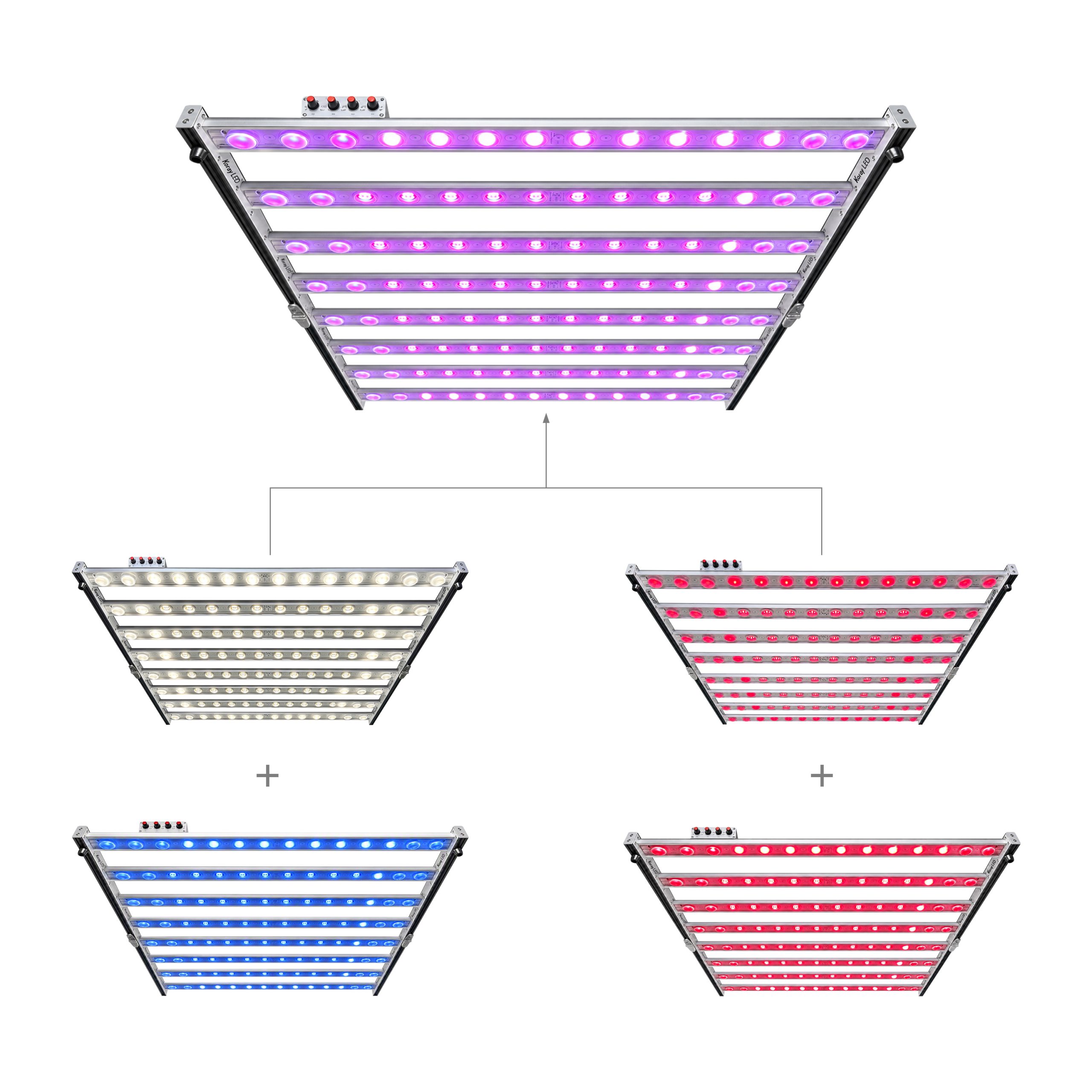
The spectrum is designated F61 and is described officially as a sunlight spectrum assembled from 5000 K cool white, 3000 K warm white, 660 nm deep red and 730 nm far red. The platform pairs 301B-series LED emitters with an externally sourced constant-current driver, which is the economical route through the specification: a widely available emitter bin and a standard driver instead of a new-generation emitter at a premium. Ingress protection is IP65 on a waterproof MCPCB module, rated life is 50,000 hours at an ambient temperature of 25 °C, the operating range is −30 to 40 °C, the published tolerance on photometric data is ±10 %, and the fixture carries CE, RoHS and FCC marking with a 3-year warranty.
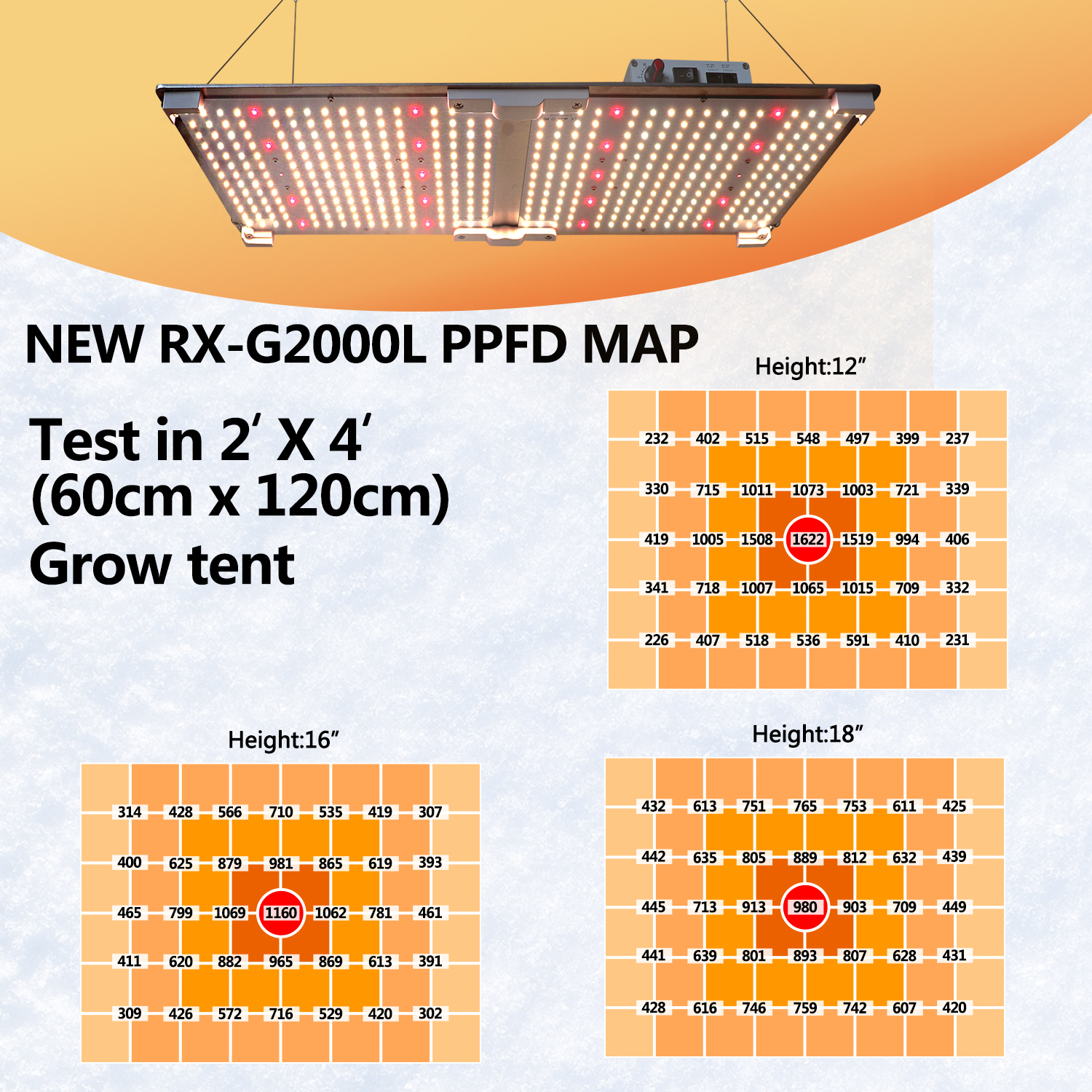
All of those values are published in the official RX-G2000L series datasheet and on the official product page. The plane measurements carry a condition that is easily lost in a comparison table: they are centre values measured inside a 2 ft x 4 ft grow tent at 12 in, 16 in and 18 in, and the datasheet marks the set as reference data. Values taken in a reflective, bounded tent are not the same as values taken in an open room, so they stay comparable only when the same protocol is applied to whatever they are compared with.
| Dimension | Official RX-G2000L value | Test condition / note |
|---|---|---|
| Spectrum | F61: 5000 K cool white, 3000 K warm white, 660 nm deep red, 730 nm far red | Official spectral designation (datasheet) |
| Photon flux (PPF) | 570 µmol/s | Datasheet specification table |
| PPFD at 12 in (0.30 m) | 1622 µmol/m²/s | Centre value in a 2 ft x 4 ft grow tent |
| PPFD at 16 in (0.41 m) | 1160 µmol/m²/s | Same tent protocol |
| PPFD at 18 in (0.46 m) | 980 µmol/m²/s | Same tent protocol |
| Luminous flux | 37,500 lm | Datasheet specification table |
| Input power | 215 W at AC230 V; 220 W at AC120 V; 215 W at AC277 V | Datasheet table; datasheet text also cites about 200 W |
| Efficacy | up to 2.7 µmol/J | Official figure, quoted as published, not recalculated here |
| Footprint | 3 ft x 4 ft in the vegetable stage; 2 ft x 4 ft in the flowering stage | Official coverage statement |
| Photoperiod | Operator variable, not fixed by the maker | Daily light integral scales linearly with hours per day (h/day) |
| Body size | 600 x 241 x 60 mm (23.6 x 9.4 x 2.4 in) | Datasheet table and dimension drawing |
| Dimming chain | up to 12 lights connected in one chain; optional app control system | Datasheet multi-light connection page |
| Ingress protection | IP65 | Waterproof MCPCB horticulture LED module |
| Operating temperature | −30 to 40 °C | Datasheet specification table |
| Rated life | 50,000 h | Rated at ambient temperature Ta 25 °C |
| Warranty and compliance | 3 years; CE / RoHS / FCC | Datasheet and official product page |
Hanging Height, Photoperiod and Footprint: Three Planes and Two Canopies
Plane data is where a single headline figure usually breaks down, so the three published heights are worth reading side by side. The datasheet gives 1622 µmol/m²/s at 12 in, 1160 µmol/m²/s at 16 in and 980 µmol/m²/s at 18 in, all as centre values inside a 2 ft x 4 ft tent. The same table also lets the effect of a photoperiod be calculated directly, because the daily light integral is the plane intensity multiplied by the seconds of light per day.
| Hanging height | PPFD (centre, µmol/m²/s) | Change against 12 in | Daily integral at 12 h/day (mol/m²/day) | Daily integral at 18 h/day (mol/m²/day) |
|---|---|---|---|---|
| 12 in (0.30 m) | 1622 | baseline | about 70 | about 105 |
| 16 in (0.41 m) | 1160 | −28.5 % | about 50 | about 75 |
| 18 in (0.46 m) | 980 | −39.6 % | about 42 | about 64 |
The integral column is arithmetic on the published plane values rather than a crop recommendation: the maker does not publish a photoperiod for the fixture, because hours per day is a scheduling decision the operator makes. What the arithmetic shows is the size of that decision. Raising the board from 12 in to 18 in gives up about 40 % of the plane intensity, which is equivalent to shortening a 18 h/day schedule to roughly 11 h/day at the same height. Moving the board up instead of extending the day is therefore not a neutral change, and a room with low headroom is not automatically at a disadvantage.
Footprint follows the same logic in two stages. The official coverage is 3 ft x 4 ft while the crop is vegetative and 2 ft x 4 ft once the crop is in the flowering stage, so a bench sized for one unit at 2 ft x 4 ft can carry the same hardware over a wider area earlier in the cycle. Planning a room from the coverage figures rather than from the wattage label keeps the unit count tied to the canopy that actually exists at each stage.
Dimension-by-Dimension Comparison Table
Quantum boards with different emitter generations can look similar on a specification sheet, because one row may match while the conditions behind it do not. The table below lists the dimensions that decide performance and what the official data states for each, so the same questions can be put to whichever fixture is being compared.
| Comparison dimension | Official RX-G2000L value | What it should be compared against |
|---|---|---|
| Photon flux | 570 µmol/s | Whether the other fixture publishes µmol/s, or only a wattage label such as 1000 W or 2000 W |
| Plane PPFD | 1622 µmol/m²/s at 12 in (0.30 m) | The hanging height and the enclosure used for the test, here a 2 ft x 4 ft tent centre value |
| Photoperiod | Operator variable in h/day | Whether the comparison was made at the same hours per day, since the daily integral scales linearly |
| Input power | 215 W at AC230 V; 220 W at AC120 V | Measured input watts at the supply voltage in use, not the class name in the product title |
| Efficacy | up to 2.7 µmol/J (official figure) | Output per watt at the maker’s stated conditions, not a value derived from a marketing wattage |
| Footprint | 3 ft x 4 ft vegetative; 2 ft x 4 ft flowering | The bench or tent area actually planned for each stage |
| Spectrum | F61: 5000 K + 3000 K white, 660 nm deep red, 730 nm far red | Waveband composition published by the maker, not a colour description |
| Dimming chain | up to 12 lights in one connection chain | How many units a room needs to adjust together |
| Body size | 600 x 241 x 60 mm | Ceiling clearance, rack spacing and headroom per layer |
| Ingress protection | IP65 | Whether the room involves misting, drips or wash-down |
| Rated life | 50,000 h at Ta 25 °C | Maintenance and replacement planning at realistic room temperature |
| Compliance | CE / RoHS / FCC; 3-year warranty | Import, tender and after-sales documentation |
Scaling a Room: Serial Dimming for up to Twelve Units
A single board is easy to adjust. A room of them is not: if every unit sits on its own knob, neighbouring canopies drift to different intensities, and comparing two lighting treatments in the same room stops being a fair test. The RX-G2000L addresses that with multi-light connection dimming that supports up to 12 lights in one chain, with an optional app-based control system for rooms that want scheduling and grouping without walking the aisles. For experimental work the practical value is repeatability, because a chain holds several boards at one setting instead of relying on repeated manual adjustment.
That control architecture is also where physical layout starts to matter. Each board is 600 x 241 x 60 mm with a control box on top of the panel carrying the dimming knob, a switch and the connection ports, and a central support ridge running between the two LED panels. Hanging is by wires at the four corners with the emitting face pointing down. In a low basement or a racked bench, the panel depth plus the control box is the headroom that has to be reserved per layer, and the 2 ft x 4 ft flowering footprint is the spacing that keeps each unit over its own canopy.
Spectrum, Colour Rendering and the Limits of a Data Sheet
The F61 designation resolves into four parts: two white channels at 5000 K and 3000 K plus narrow bands at 660 nm and 730 nm. That combination is a sunlight-shaped approach rather than a single-peak one, and the reasoning behind broadband spectra is well documented outside the manufacturer’s literature. A review of wavelength effects in agricultural plants, published in the journal Plants and available through the NIH PubMed Central archive, surveys how individual wavebands act on plant metabolism and quality traits, while a study of far-red responses through a phytochrome model, also in the NIH PubMed Central archive, describes how 700 to 750 nm light interacts with the red-to-far-red signalling balance that influences plant morphology. Neither paper is about this fixture; they explain why the 660 nm and 730 nm bands in the designation are treated as functional channels rather than cosmetic additions.
Two boundaries are worth stating plainly. First, the maker publishes no crop performance claim for this board, and none is repeated here: PPF, PPFD, footprint and spectrum describe the light delivered, not the harvest obtained. Second, the units in the datasheet are not interchangeable. Photometry, as defined by NIST, measures light as people see it, which is what the 37,500 lm figure describes; photosynthesis is measured in micromoles, which is what the 570 µmol/s figure describes. When a catalogue lists only lumens, or only a marketing wattage, the two figures that would allow a real comparison are both missing.
For operators who do want to connect the electrical side to an environmental one, the published input power is the starting point. The US Environmental Protection Agency Greenhouse Gas Equivalencies Calculator converts electricity consumption into emissions equivalents, so a schedule built from input watts and hours per day can be translated into an environmental figure as well as an electricity bill. Efficacy is quoted officially as up to 2.7 µmol/J; the article uses that published figure and does not substitute a value recalculated from photon flux and input power.
Selection Guidance: Where a 215 W Two-Panel Board Fits
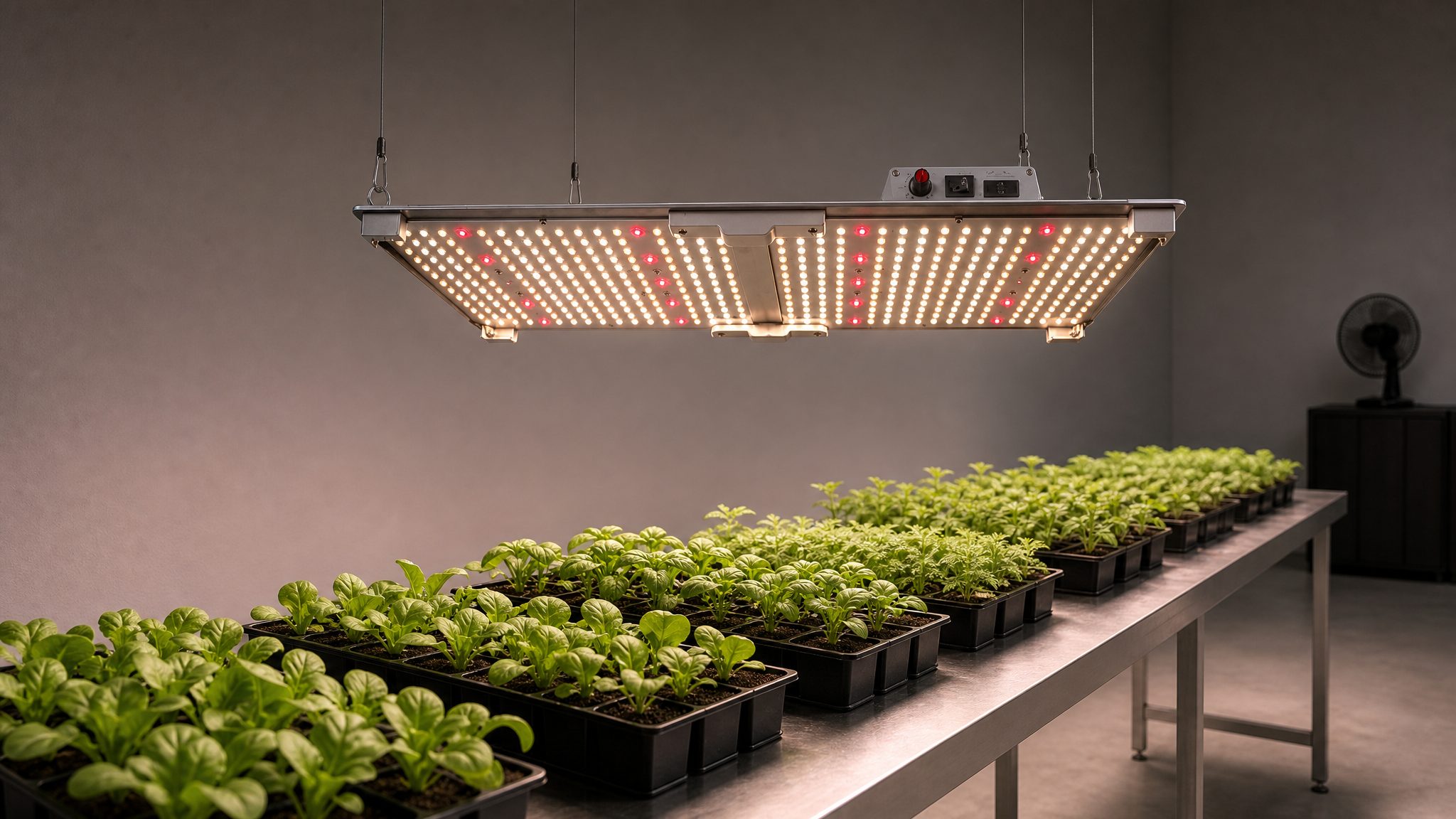
The official application list for the platform covers basement planting, plant tent planting, experimental planting and greenhouse planting, and the documented plant groups are leafy vegetables, flowering crops and medicinal plants. The sizing logic follows directly from the two coverage figures: a bench of about 2 ft x 4 ft suits one unit in the flowering stage, a 3 ft x 4 ft area suits one unit while the crop is vegetative, and a room or tent that measures roughly 4 ft x 8 ft therefore needs two to four units depending on the stage being planned for. Because up to 12 units can share one dimming chain, a single 4 ft x 8 ft group and a larger room of three such groups can be run from one control setting instead of separate adjustments.
Three checks are worth making before a room is specified. Confirm which measurement the quoted intensity describes, because the official plane values are 2 ft x 4 ft tent centre readings at wall-referenced heights of 12 in, 16 in and 18 in rather than open-room averages. Confirm the photoperiod in h/day, because the daily total on the canopy is the plane value multiplied by the hours of light and no fixture can compensate for a schedule that is too short. And confirm the physical fit, because a 600 x 241 x 60 mm panel with a top-mounted control box needs vertical space in any stacked layout.
For procurement documentation the manufacturer’s pages state 17 years of experience in plant-lighting development and manufacturing and 300+ domestic and foreign patents, published on the patent and certification and company profile pages, alongside export markets listed for EU countries, the USA, Canada, the UK, Israel and Japan. The platform belongs to the maker’s grow-tent quantum board family, which is relevant when spare units or later expansion are planned around the same hanging hardware.
Conclusion
The RX-G2000L is a 215 W two-panel quantum board measuring 600 x 241 x 60 mm, and its official data answers the questions that a 2000 W style label does not: photon flux of 570 µmol/s, plane PPFD of 1622, 1160 and 980 µmol/m²/s at 12, 16 and 18 in measured at the centre of a 2 ft x 4 ft tent, luminous flux of 37,500 lm, an official efficacy of up to 2.7 µmol/J, and an F61 spectrum built from 5000 K and 3000 K white with 660 nm deep red and 730 nm far red. Coverage of 3 ft x 4 ft in the vegetative stage and 2 ft x 4 ft in the flowering stage, together with up to 12 units on one dimming chain, sets both the per-unit plan and the way a room scales, while IP65 protection, a 50,000 hour rating at Ta 25 °C and a 3-year warranty cover the environmental side. Because the plane values are tent centre readings at stated heights, they remain comparable only when the same height, enclosure and hours per day are applied to the alternative being considered.
Frequently Asked Questions
What does the RX-G2000L actually draw from the supply?
The official datasheet lists 215 W at AC230 V, 220 W at AC120 V and 215 W at AC277 V, and its descriptive text also states that the fixture consumes about 200 W. The input figure therefore depends on the supply voltage and on which statement is being quoted, which is exactly why an input wattage should be read separately from a catalogue label such as 2000 W.
What PPFD does the fixture produce at each hanging height?
Official centre values inside a 2 ft x 4 ft grow tent are 1622 µmol/m²/s at 12 in (0.30 m), 1160 µmol/m²/s at 16 in (0.41 m) and 980 µmol/m²/s at 18 in (0.46 m), with a published tolerance of ±10 % on photometric data.
How many units can be linked on one dimming chain?
Up to 12 lights can be connected in a single multi-light dimming chain, and an optional app-based control system can be added for scheduling and grouping, so a row or a whole bench can follow one setting.
What footprint does one unit cover, and how does photoperiod change the plan?
The official coverage is 3 ft x 4 ft while the crop is vegetative and 2 ft x 4 ft in the flowering stage. Photoperiod is set by the operator, and the daily integral scales linearly with it: at 12 in the published 1622 µmol/m²/s plane accumulates roughly 70 mol/m²/day over 12 h/day and roughly 105 mol/m²/day over 18 h/day.
What do the IP65 rating and the 50,000 hour figure cover?
IP65 is the ingress protection of the waterproof MCPCB module, relevant to rooms with misting, drips or wash-down. The 50,000 hour rated life is specified at an ambient temperature of 25 °C, with an operating range of −30 to 40 °C and a 3-year warranty.




Leave A Comment