
The question sounds like it should have a product-specific answer, and that is the first mistake. A grow light’s heat output is not a property of its spectrum, its housing temperature or its marketing copy; it is a property of the electricity flowing into it. Once the fixture is inside the controlled volume, every joule it draws leaves that volume as heat — directly from the fixture as radiation and convection, or indirectly as latent heat carried by water vapour the crop transpired. The only escape routes are deliberate ones: a ducted exhaust or a water loop rejecting heat outside the room.
What differs between an LED bar and the HPS fixture it replaced is the form and location of the heat, and the heat per mole of delivered photons. Those differences change how a room feels and how much of the load the air handler sees, not the load per watt.

The One-Line Answer: Watts In, BTUs Out
One watt of electrical input becomes 3.412 British thermal units per hour of heat. That is not an approximation for lighting; it is a unit conversion, and NIST publishes the factors that make 1 W equal 3.412 Btu/h.
Apply it and the answer is immediate. A 630 W LED bar at full output releases 630 × 3.412 ≈ 2,150 Btu/h into the room. A 430 W module releases about 1,470. A 56 W container strip releases about 190. A 1,000 W HPS drawing roughly 1,080 W at the wall including ballast losses releases about 3,690. None of those values depends on spectrum, colour temperature, driver topology or housing temperature.
The caveat is where the heat lands. A sealed, ducted fixture exports its convective portion; a water-cooled fixture with an external loop exports part of the load. Absent either arrangement, the whole electrical input is a load on the space — which is how extension guidance treats supplemental lighting: University of Alaska Fairbanks Cooperative Extension Service discusses greenhouse lighting in terms of both light delivered and heat added, with the engineering shorthand of about 3.41 Btu per watt.
Why “LED Runs Cool” Is a Lumen-World Claim, Not a Load Claim
The claim is true in a narrow sense: an LED package converts more of its input into visible radiation and less into conducted heat at the die. None of that changes the room-level balance. Photons leaving the fixture are absorbed by leaves, benches, walls and floor, and every absorbed photon ends as heat. A fixture emitting half its input as radiation and half as convection still delivers 100 percent of that input as heat; the split only decides where the heat appears.
The lumen framing makes it worse: lumens are weighted to an eye that peaks near 555 nm and is nearly blind at 660 nm, so a deep-red fixture can rate modestly in lumens and strongly in photons. Photon flux in µmol/s and input in watts are the numbers that matter; the cooler feel of a broad, low-plume fixture does not change the Btu/h.
Watt-to-BTU Math: 3.412, 12,000 and the Ton
Three constants cover most of the arithmetic. The first is 3.412 Btu per watt: for 30 kW of installed lighting, 30,000 × 3.412 ≈ 102,400 Btu/h.
The second is 12,000 Btu/h per ton of refrigeration, the North American convention for cooling capacity. ASHRAE publishes the standards framework in which that convention sits, including the load-based approach that treats lighting power as an internal gain. Dividing the load above by 12,000 gives about 8.5 tons from lights alone, before envelope, solar gain, people, pumps or dehumidification.
The third is the kilowatt-hour, the billing unit for the electricity that produced all of it. US Energy Information Administration explains how consumption is measured and billed in kWh, which turns a schedule into an operating cost: 30 kW for 12 hours is 360 kWh per day, about $43 at an illustrative $0.12/kWh, or roughly $15,700 a year. The same 360 kWh is about 1.23 million Btu of heat delivered daily.
Where the Heat Goes: Radiant vs Convective Split and Canopy vs Plenum
Total load is fixed by wattage; the split between radiation and convection decides where the load sits.
Three consequences follow. A higher radiant fraction puts more load into the canopy and less into the ceiling, so a bar at close spacing behaves differently from a high-bay point source at the same wattage. The plenum is not free storage: a room that controls well at low output can hit a ceiling limit at full output while the canopy sensor reads normal. The split is not fixed by technology, so assign 100 percent of input to the room and apply a documented radiant fraction as a credit.
Sensible Load: The Part Your Air Handler Sees
Sensible load changes air temperature without changing moisture content. Lighting is the cleanest case: photons warm a bench, the bench warms the air, the coil removes the rise. In a sealed room essentially all of the fixture’s input eventually appears as sensible load, less whatever fraction transpiration converts into latent heat.
That clause is why sensible load is not simply watts × 3.412: evaporating water consumes heat that would otherwise raise air temperature, and the coil sees the mixture of temperature and moisture.
A room’s sensible heat ratio — sensible divided by total — falls as the crop grows: a young crop might run near 0.9, a mature canopy toward 0.6, at which point a unit selected on sensible capacity satisfies the thermostat while the room gets wetter. Size the coil on peak sensible load with a young crop, and the dehumidifier on peak latent load with a mature canopy.
Latent Load: Transpiration Turns Light Into Water Vapor
Latent load is the part of the heat budget that hides. It does not register on a thermometer, it does not change when fixtures are added, and it stays invisible until the walls condense.
The quantities are larger than expected. A 60 m² room transpiring 20 kg per day moves 49,000 kJ, about 13.6 kWh of latent heat per day: an average near 570 W, about 1,900 Btu/h, with peaks two to three times higher mid-photoperiod. That is comparable to two 430 W fixtures running continuously, but it arrives as moisture, and it scales with anything that raises light integral, opens stomata or adds leaf area — including a higher blue fraction.
One asymmetry matters when comparing fixtures. A more efficient fixture delivering the same photon flux uses fewer watts, so it produces less total and less sensible heat, but the crop transpires the same water for the same growth, because transpiration follows the light integral and not the electricity bill. An efficiency upgrade therefore lowers sensible load while leaving latent load roughly unchanged, which raises the latent share and makes the dehumidifier, not the chiller, the binding constraint.
Worked Example: A 60 m² Room at 500 W/m² Installed Load
Take a sealed 60 m² room with 500 W/m² of installed lighting: 30 kW connected, a realistic density for a high-output fruiting room on dense racks.
Lighting load: 30,000 × 3.412 = 102,360 Btu/h, or about 8.5 tons from the lights alone. Add fans and pumps at 2 kW for 6,800 Btu/h and internal transfers and envelope gain of 3,000 Btu/h, and the sensible block load reaches roughly 112,000 Btu/h, about 9.3 tons.
Diversity: at 85 percent average output during a 12-hour photoperiod the average lighting load is about 87,000 Btu/h while the peak stays at 102,000. Equipment is sized on the peak, consumption on the average.
Latent: about 1,900 Btu/h average at 20 kg/day, with peaks three times higher mid-photoperiod, so peak coil load is roughly 114,000 Btu/h at a sensible heat ratio near 0.9. A unit selected at 9.5 tons sensible would hold temperature and let humidity drift; select for latent capacity at the entering-air condition plus a dehumidifier.
Efficacy Changes the Heat per Mole, Not the Heat per Watt
Efficacy in µmol/J decides how much light a watt buys. It does not decide how much heat a watt makes, because 100 percent of that watt becomes heat in the room regardless of how many photons it produced on the way.
What efficacy changes is heat per mole of delivered light. For a fixed photon flux, 2.6 µmol/J takes a certain wattage and 3.0 µmol/J takes about 13 percent less, since 2.6/3.0 = 0.867; heat falls by the same 13 percent, and so does the bill. At a fixed installed wattage instead, the heat is unchanged and only light output rises.
Sizing Checklist: Block Load, Diversity Factor, Dehumidification and Setback
1. List connected load by circuit in watts, including drivers, from nameplate or measured wall draw. 2. Convert to heat: watts × 3.412 = Btu/h, the bound for an unducted installation; deduct only a documented radiant or ducted fraction. 3. Add other internal gains — fans, pumps, dehumidifier compressor heat, people, process heat. 4. Compute block load at peak coincident conditions, then a diversity factor from the real dimming schedule. 5. Compute latent load at 2,450 kJ/kg with a measured peak-to-average ratio, and size dehumidification on the peak with lights on. 6. Check the sensible heat ratio for both crop conditions; below roughly 0.75, plan dedicated dehumidification. 7. Plan staged dimming — 60 percent at the end of the photoperiod cuts lighting heat by 40 percent — and verify after commissioning with a clamp meter and a logging hygrometer.
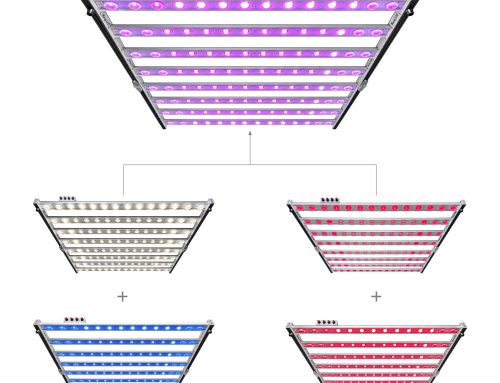
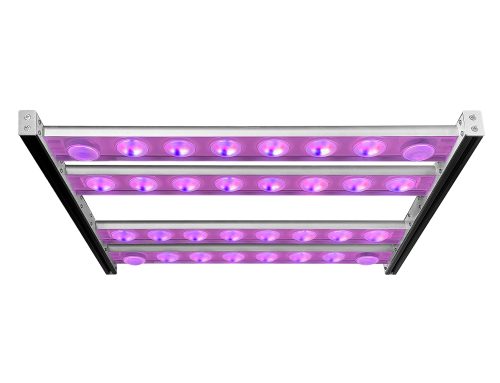
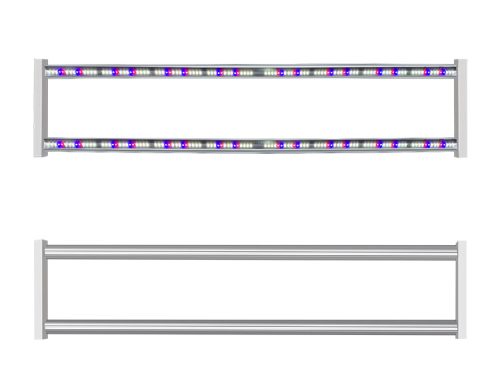
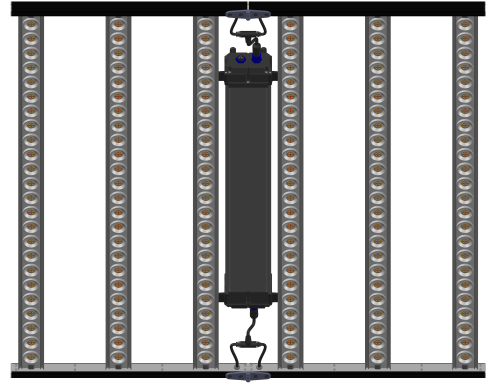
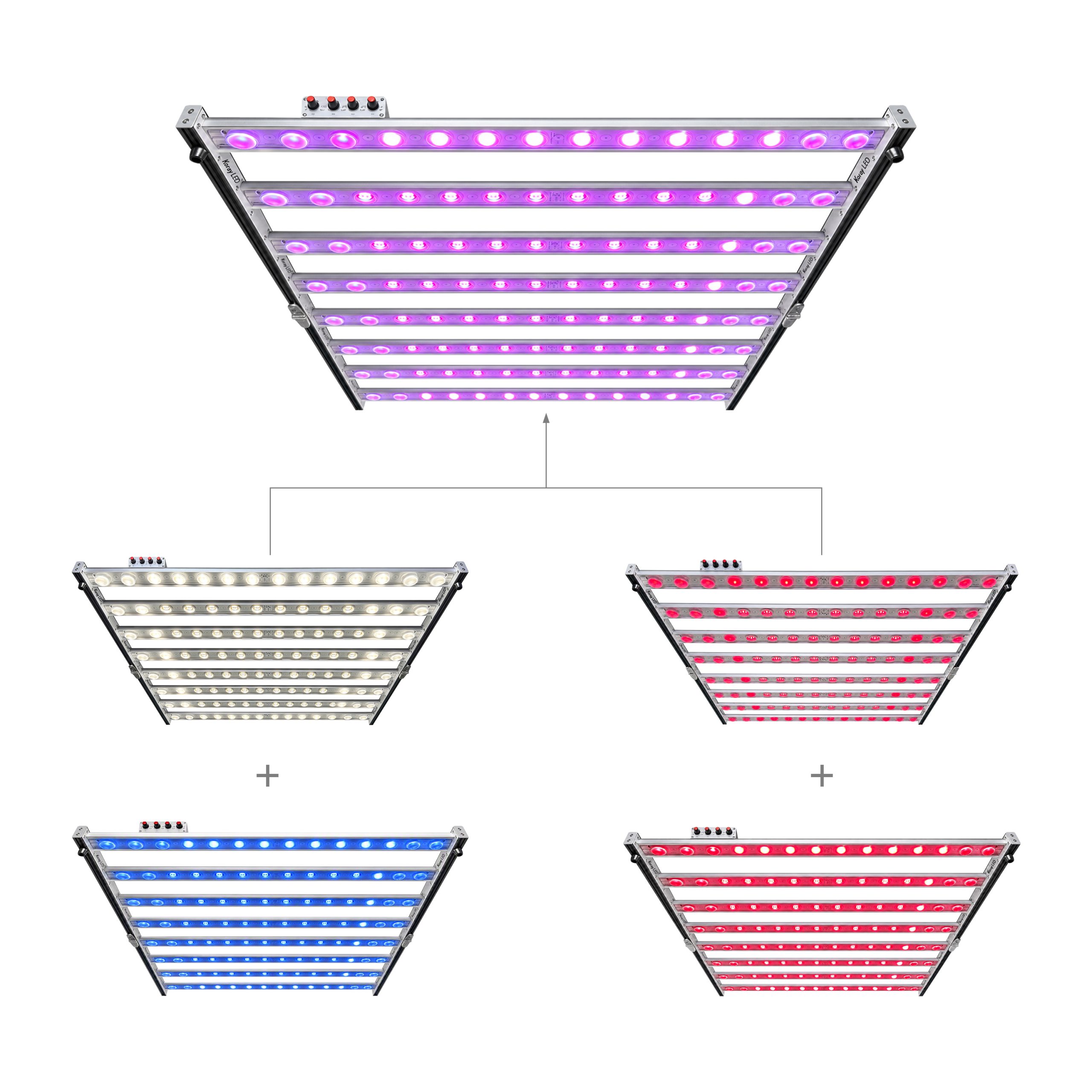
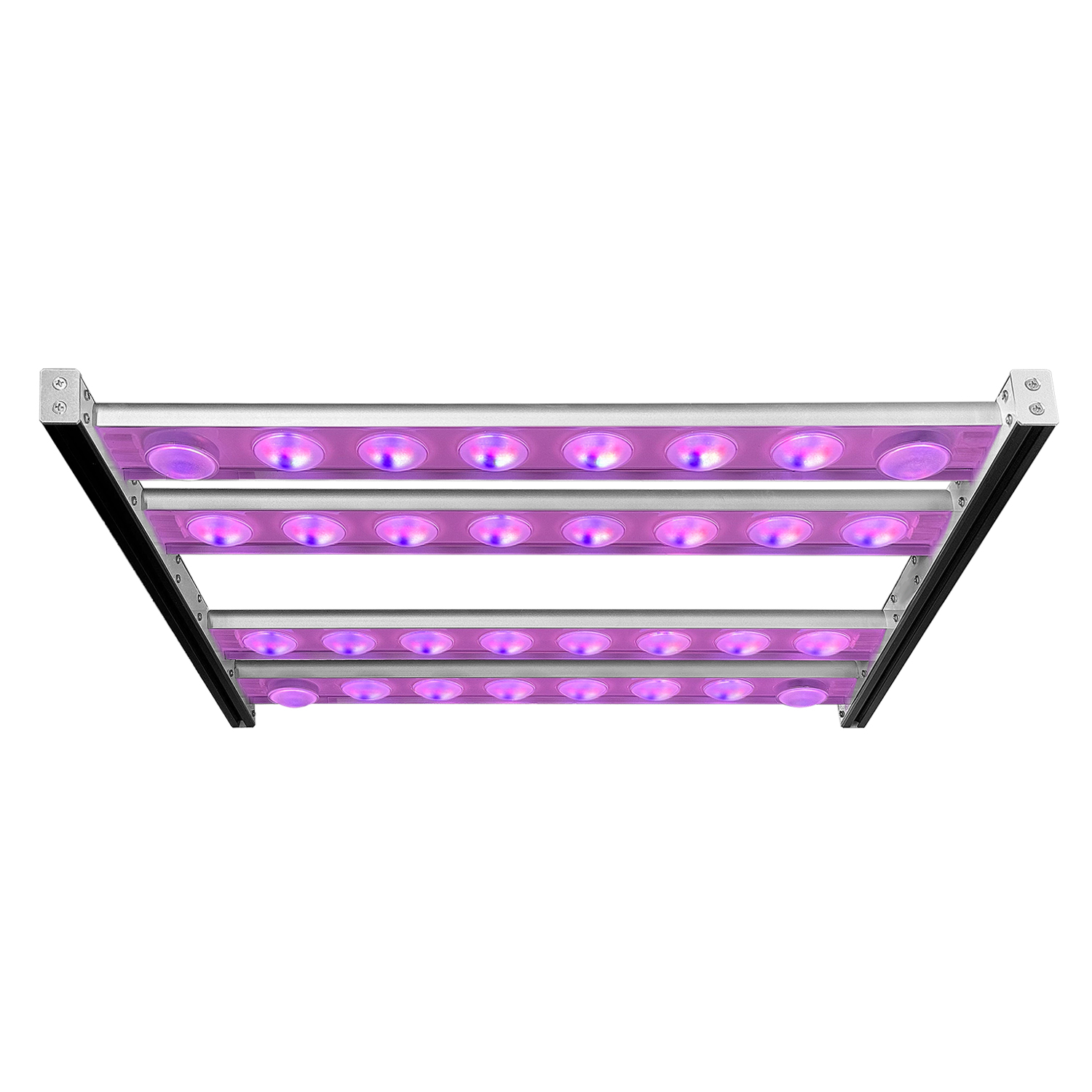
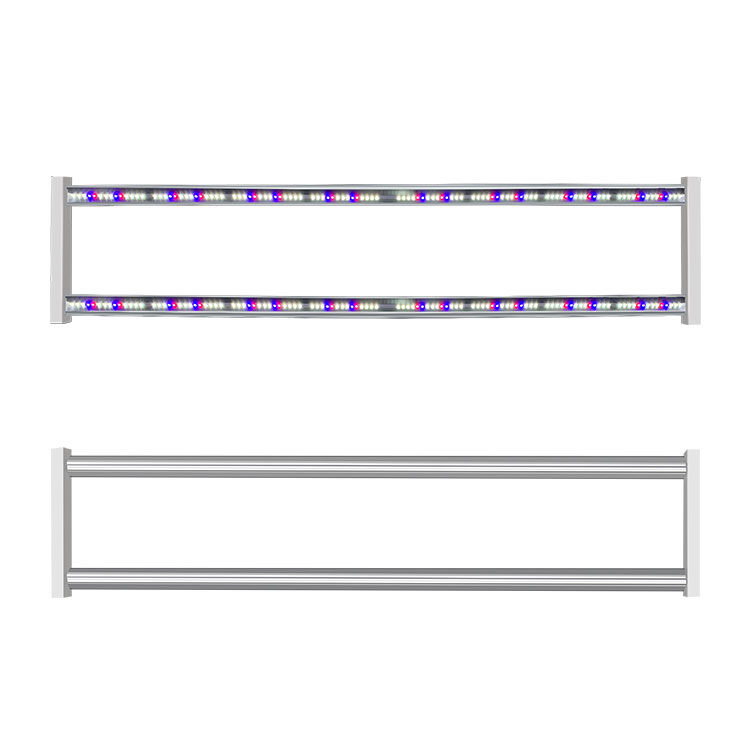
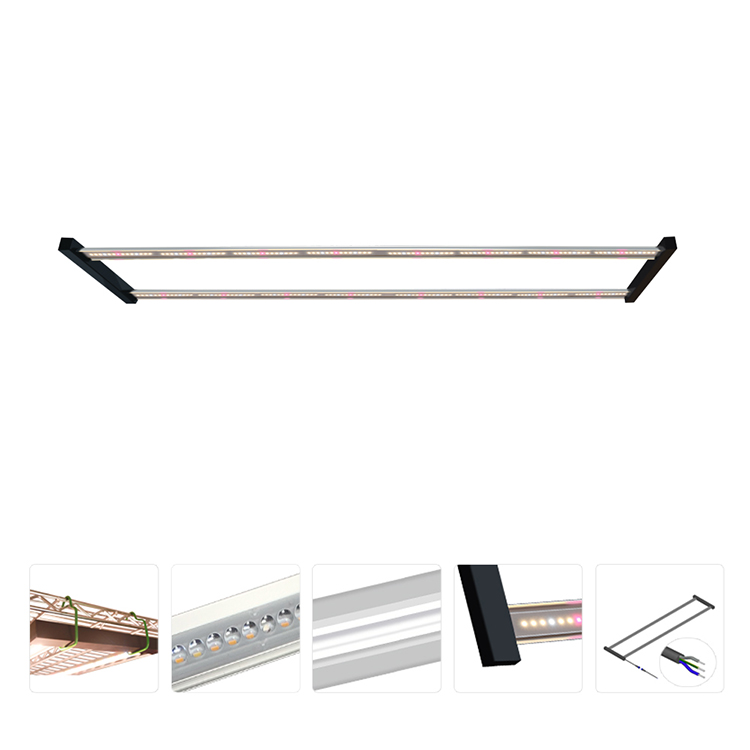
Application fit. The load maths matters most where the room is sealed and lighting density is high: insulated grow rooms, container farms, multi-tier racks and plant factories, with no roof vent to dump heat and no outside air to dilute moisture; in a vented greenhouse much of the load leaves with the exhaust air. Vendor selection follows the arithmetic — a foldable bar suits a repeated grid, a wide module suits benches close to the canopy, a narrow strip suits racks with limited headroom — and the wattage that enters the calculation is the one on that model’s page at your mains voltage. Zhongshan Koray Opto-Electronic Co., Ltd. has manufactured LED horticultural lighting since 2008 and documents each format on its official product pages and in its company profile.
Five Sources of Load, One Energy Balance
The table follows one path for four fixture classes and for the latent load that has no electrical input: input, radiant-convective split, total load, handling. Radiant fractions are planning assumptions and must be replaced with manufacturer data or site measurement before selection.
| Source | Electrical input | Radiant fraction (assumed) | Convective to room | Total load (Btu/h) | Handling |
|---|---|---|---|---|---|
| HPS 1000 W, with ballast losses | ≈1,080 W | ≈0.60 | ≈0.40, strong plume to the ridge | ≈3,690 | High-level return or ducted exhaust; pronounced hot layer under the ceiling |
| 630 W LED toplight, bar class | 630 W | ≈0.50 | ≈0.50, spread over a large emitting area | ≈2,150 | Block load plus canopy-height air movement; check plenum temperature at full output |
| 430 W LED module, close to canopy | 430 W | ≈0.50 | ≈0.50, low plume velocity | ≈1,470 | Sensible load mostly at the canopy; verify leaf-to-air difference and VPD response |
| 56 W container or rack strip | 56 W | ≈0.45 | ≈0.55, confined volume | ≈190 | Multiplied by rack count; treat the aggregate as one block load |
| Crop transpiration (latent, no electrical input) | 0 W | not applicable | not applicable — moisture, not temperature | ≈1,900 average at 20 kg/day | Dedicated dehumidification sized on the peak, with lights on |
Read down the electrical column and the totals follow linearly; read across the middle columns and the handling changes completely — the load is arithmetic, the handling is design. A 630 W LED and a 1,080 W HPS differ by about 1,500 Btu/h per fixture, or 12.5 tons across 100 fixtures, and that saving comes from drawing fewer watts for the same photons.

The short version. Compute lighting load as watts × 3.412 and treat it as heat gain unless the fixture is ducted or water-cooled with documented export. The radiant-convective split changes where the heat lands, not the total. Add latent load at 2,450 kJ/kg and check the sensible heat ratio for both crop conditions. Use efficacy to cut watts per mole of light, not to claim less heat per watt.
Frequently asked questions
Is an LED grow light actually cooler than HPS?
At the same input wattage, no: both deliver 100 percent of their electrical input to the room as heat, and one watt is 3.412 Btu/h either way. An LED delivering the same photon flux usually draws fewer watts, so the room load is lower for the same crop target, and the heat arrives with a different split and a weaker plume. The fixture feels cooler; the Btu/h per watt is identical.
Should I size HVAC on 3.412 × input wattage or on the manufacturer’s heat output?
Start with 3.412 × input, the correct bound for an unducted fixture, then apply a credit only if the manufacturer documents a radiant or ducted fraction under stated conditions. A vendor heat-output value below the electrical input almost always describes the convective share or a ducted configuration, so using it as the total understates the room.
Why is dehumidification easier to underestimate than cooling?
Because transpiration converts sensible heat into latent heat without removing energy from the room. The thermometer can look perfect while the moisture load climbs, and a coil selected on sensible capacity satisfies its setpoint while humidity drifts upward. Latent load also grows with the crop, so the worst moisture case arrives weeks after commissioning, at the same time as peak lighting.
Can a more efficient light reduce HVAC capital cost?
Only if it lets you install fewer watts for the same photon flux. If a higher-efficacy fixture reaches the same PPFD with about 13 percent less power, the lighting heat and the cooling load fall by about 13 percent. Swap fixtures one-for-one at the same installed wattage and the load is unchanged — you get more light, which may push the crop harder and raise latent load instead.


Leave A Comment