
Microgreens are harvested so early that the usual lighting instinct — buy the brightest lamp and hang it low — produces stretched, pale, flopping trays rather than dense ones. The crop spends its entire life inside a two-to-three-week window, most of it inside a canopy that shades itself. This guide separates the light variables that actually decide stem length: a dark period at the start, a total daily light budget in the middle, and evenness across the tray at the end. Every number below is stated with its condition, because a PPFD figure without a hanging height and an hours-per-day figure is not a specification at all.
What Makes Microgreens Different from Other Crops
A microgreen crop is harvested at the cotyledon stage or just as the first true leaf unfolds, typically 7 to 21 days after sowing depending on species. Three properties follow from that, and each one changes how light should be applied.
The first is density. Seed is sown at roughly 1.5 to 3 times the rate used for baby leaf, so several hundred seedlings share a 10 by 20 inch tray. Once the canopy closes, the light received by a seedling is decided less by the lamp’s output than by its neighbours’ height. The second is the absence of a filling phase: there is no rooting period, no vegetative bulk-up, no flowering trigger. All growth is expansion of tissue that already exists in the seed. The third is that the harvested product is the stem plus cotyledons, so stem elongation is not a side effect — it is the quality defect growers care about most.
Because the cycle is short and the canopy is self-shading, the cumulative light delivered over the whole cycle explains stretching better than any single instantaneous reading. That is why the useful unit for planning is DLI, the daily light integral, and why a wattage figure on a box tells you very little on its own.
The Blackout Phase: Why Darkness Comes First
The blackout phase is a period of two to four days after sowing during which trays receive no light at all, usually achieved by stacking trays or covering them with a weighted board. It is a deliberate stage, not an accident or a shortcut.
During germination, the seedling’s only job is to push its hypocotyl upward through the substrate. In darkness, the hypocotyl elongates quickly and the cotyledons stay folded; the plant is spending stored reserves to reach the light. This response is reversible while reserves last, and it is the reason a short dark period produces the upright, uniform stand that harvests cleanly. The same word, however, describes the opposite failure. If a tray stays in low light after the cotyledons have opened, the plant continues the same elongation response with no reserves left to support it, and the result is thin, pale, permanently floppy stems that never recover.
The two situations are mechanically identical and agronomically opposite: darkness before emergence is a signal to reach, and insufficient light after emergence is a signal to keep reaching when reaching no longer helps. The practical rule is a hard boundary in time. Blackout runs from sowing until the hypocotyl has lifted the seed coat clear of the medium, usually 48 to 96 hours, and it ends the moment the tray goes under light — permanently. Extending blackout past emergence trades a slight gain in height for a large loss in colour and firmness.
Two conditions matter during blackout. Air movement must continue, because a covered tray at 20–24 °C and 50–65% relative humidity is a favourable environment for fungal growth; covers should be vented or lifted once daily. And trays must not be watered heavily under cover, since evaporation is suppressed and waterlogging during this window is a common cause of damping-off.
PPFD, DLI and the Arithmetic That Explains Legginess
PPFD is photosynthetic photon flux density, the number of photons in the 400–700 nm waveband arriving on a square metre each second, expressed in µmol/m²/s. It is an instantaneous, point measurement — it describes the light at one spot on one tray at one moment. DLI is the daily light integral, the total number of those photons delivered over a full day, expressed in mol/m²/d. DLI is the integral of PPFD over the photoperiod.
The conversion is simple enough to do on a phone: DLI = PPFD × hours of light × 0.0036. A tray held at 150 µmol/m²/s for 16 hours therefore receives 150 × 16 × 0.0036 ≈ 8.6 mol/m²/d. The same tray at the same PPFD for 12 hours receives 6.5 mol/m²/d, a 25% reduction with no change to the fixture. This is the single most useful calculation in microgreen lighting, because it shows that hours and intensity are interchangeable inputs to the same budget.
Targets by stage, with the conditions attached:
| Stage | PPFD (µmol/m²/s) | Photoperiod (h) | DLI target (mol/m²/d) | Main risk |
|---|---|---|---|---|
| Blackout, day 0–3 | 0, fully covered | 0 | 0 | Mould under a sealed cover |
| First light, day 4–6 | 100–150 at 15–20 cm | 14–16 | 5.0–8.6 | Stretch if DLI stays below 5 |
| Bulk growth, day 7–10 | 150–200 at 15–20 cm | 14–16 | 7.6–11.5 | Leaf-edge damage at high humidity |
| Pre-harvest, final 3–5 days | 200–300 at 20–25 cm | 12–14 | 8.6–15.1 | Tip drying and wilting at low humidity |
| Warm room, 26–28 °C | 120–160 at 15–20 cm | 12–14 | 5.2–8.1 | Soft, elongated growth |
| Cool room, 18–20 °C | 180–250 at 15–20 cm | 14–16 | 9.1–14.4 | Slow, uneven germination |
The warm-room row deserves attention because it is where most home setups fail. At 26–28 °C the plant respires faster and produces softer tissue for the same light dose, so a schedule written for a 21 °C room will visibly stretch in a 27 °C one. Light and temperature are one variable, not two. The effect of photoperiod and light quality on such responses in controlled environments is documented by Michigan State University Extension, whose floriculture lighting materials describe how daily light and spectrum interact with temperature to set extension growth. Broader treatments of photobiology and the distinction between instantaneous intensity and daily dose are collected by the Crop Physiology Laboratory at Utah State University.
Photoperiod: How Many Hours Before More Hours Stop Helping
Photoperiod is the number of hours per day that the fixture runs, and for microgreens the practical range is 14 to 16 hours on with 8 to 10 hours off. The dark interval is not idle time to be eliminated; it is when carbohydrate export, cell wall thickening and, in many species, stem-length regulation proceed.
Pushing to 18 hours or beyond rarely produces a proportional gain. Once the daily carbon budget is met, additional hours add photons the plant cannot use productively, while raising leaf temperature, accelerating water loss and increasing the risk of tip burn and algal growth on the medium surface. The gain also depends on conditions that many growers do not control: at ambient CO₂ and moderate temperature, the response saturates; the same extension of hours becomes more useful only when CO₂, nutrition and airflow are already optimised. For a tray that is already at 10–12 mol/m²/d, adding four hours at the same PPFD mainly adds electricity.
Continuous 24-hour lighting is worse than merely inefficient. It removes the dark period entirely, and in a dense canopy it also removes the interval in which the canopy dries. The result is usually pale colour, thin stems and a higher rate of fungal problems — the opposite of the dense, upright tray the extra hours were meant to produce.
Hanging Height and Canopy Uniformity
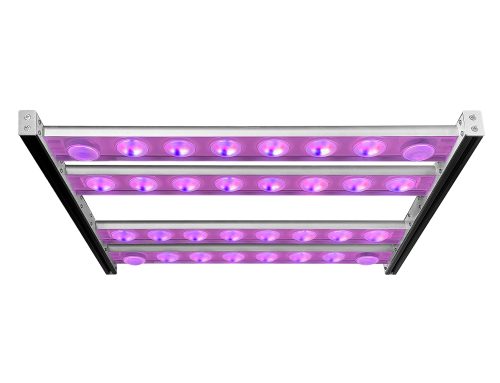
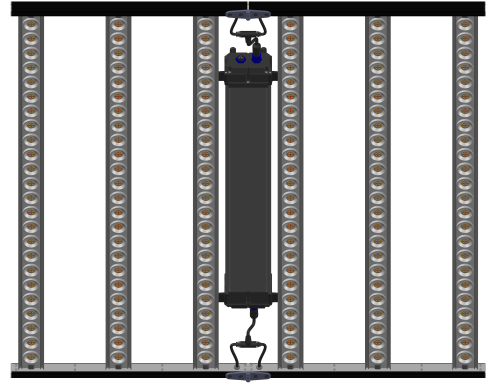
On a microgreen tray, hanging height controls evenness more than it controls intensity. A bar-style fixture hung 10–20 cm above the canopy delivers a narrow, bright band directly beneath it and falls off steeply toward the tray edge; a panel or quantum-board fixture at 30–45 cm spreads the same output over a wider footprint with a gentler gradient. These are starting ranges, not universal settings: the correct height for a specific model is the one in that model’s installation instructions, because beam angle, lensing and diode layout change the distribution completely.
The measurable symptom of a height problem is a PPFD difference across the tray. When the reading at the tray corner is more than about 30% below the reading at the centre, the edge seedlings receive a different daily budget than the centre ones, and the tray responds by stretching at the margins while the middle stays compact. The visual signature is unmistakable: a dense centre with pale, leaning outer rows, all from one sowing and one watering schedule.
Two fixes work better than raising the fixture. Repositioning or adding a second bar so that footprints overlap at the tray edge evens out the gradient, and rotating trays by 180° at mid-cycle averages the difference over the short crop. Raising the lamp to fix an edge problem usually just reduces the whole tray’s DLI.
Diagnosing Legginess: Light, Temperature or Density
Stretching has at least four distinct causes, and they require different corrections. Working through them in order avoids the common mistake of adding light to a problem that is actually thermal or spatial.
If the stems are long, pale and weak across the entire tray, the daily light integral is too low for the room temperature — check DLI first, then temperature. If the stems are long only at the edges, the problem is distribution, not total output. If the tray is uniformly tall but well coloured and firm, the sowing rate is too low and seedlings are competing for space rather than for light; the fix is more seed per tray, not more photons. If the stems are short but the cotyledons are small and cupped, the light is excessive relative to humidity and the plants are protecting themselves rather than growing.
A fifth pattern is often misread as a light problem: uneven emergence. Patches that come up days late receive light while their neighbours are still under the cover, and they stretch to catch up. That is a sowing-depth or watering issue, and no change to the fixture will correct it.
A Practical 12-Day Light Schedule
A workable schedule for a 10 by 20 inch tray in a 20–24 °C room, using a bar fixture at 15–20 cm, runs as follows.
Days 0–3 are blackout: the tray is covered, unlit, vented once a day, and kept at 20–24 °C. Days 4–6 are the transition to light: 100–150 µmol/m²/s for 14–16 hours, with the fixture raised slightly to avoid a hard edge on newly opened cotyledons. Days 7–10 are bulk growth: 150–200 µmol/m²/s for 14–16 hours, which lands near 8–11 mol/m²/d, with the fixture kept level and the tray rotated once. Days 11–12, or the final three to five days before harvest, may be pushed to 200–300 µmol/m²/s for 12–14 hours to firm up colour and texture, provided humidity stays in the 50–65% band.
The schedule is a template, not a prescription. A tray grown at 18–20 °C needs more of the budget, a tray at 27 °C less, and a summer room with high humidity should not be pushed to the top of the pre-harvest range at all.
Common Mistakes That Produce Stretched Trays
Four errors account for most disappointing trays. The first is leaving the cover on too long, converting a useful dark period into permanent etiolation. The second is specifying a fixture by wattage — a 40 W bar at 10 cm and a 40 W panel at 40 cm produce entirely different canopy doses.
The third is treating the dark period as wasted time and running the fixture around the clock. The fourth is ignoring the tray edge. Because the deficiency is local, the grower often responds by increasing total output, which over-lights the centre and leaves the margin unchanged.
Measuring Instead of Guessing
A quantum sensor reading taken at canopy height at three points — centre, mid-edge and corner — converts all of the above from theory into a number for a specific shelf. Take the readings with the tray in place, since a closed canopy intercepts light that an empty shelf would receive. Multiply the average PPFD by the hours and by 0.0036 to get DLI, and compare it with the ranges above.
Phone-based light meters calibrated to a reference sensor are adequate for relative comparisons such as centre versus corner. They are not adequate for absolute PPFD claims, because their spectral correction is approximate and LED spectra vary. Where a decision depends on an exact figure — sizing a fixture for a commercial rack, for example — a calibrated quantum sensor is the instrument to use. Reviews of measurement practice and of the relationship between spectrum, intensity and plant response are available through PubMed Central.
Application Notes: Matching a Fixture to Tray Size and Room
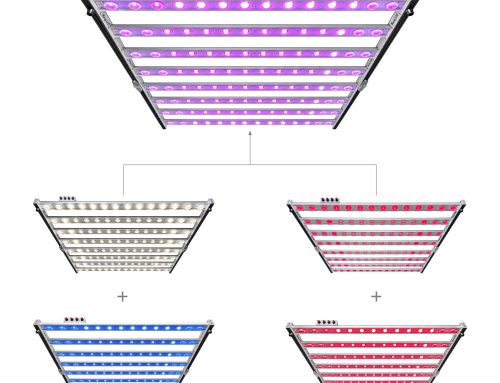
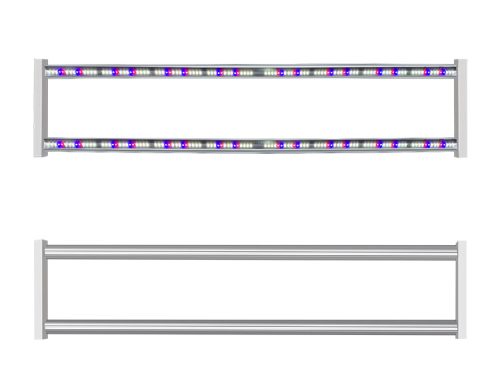
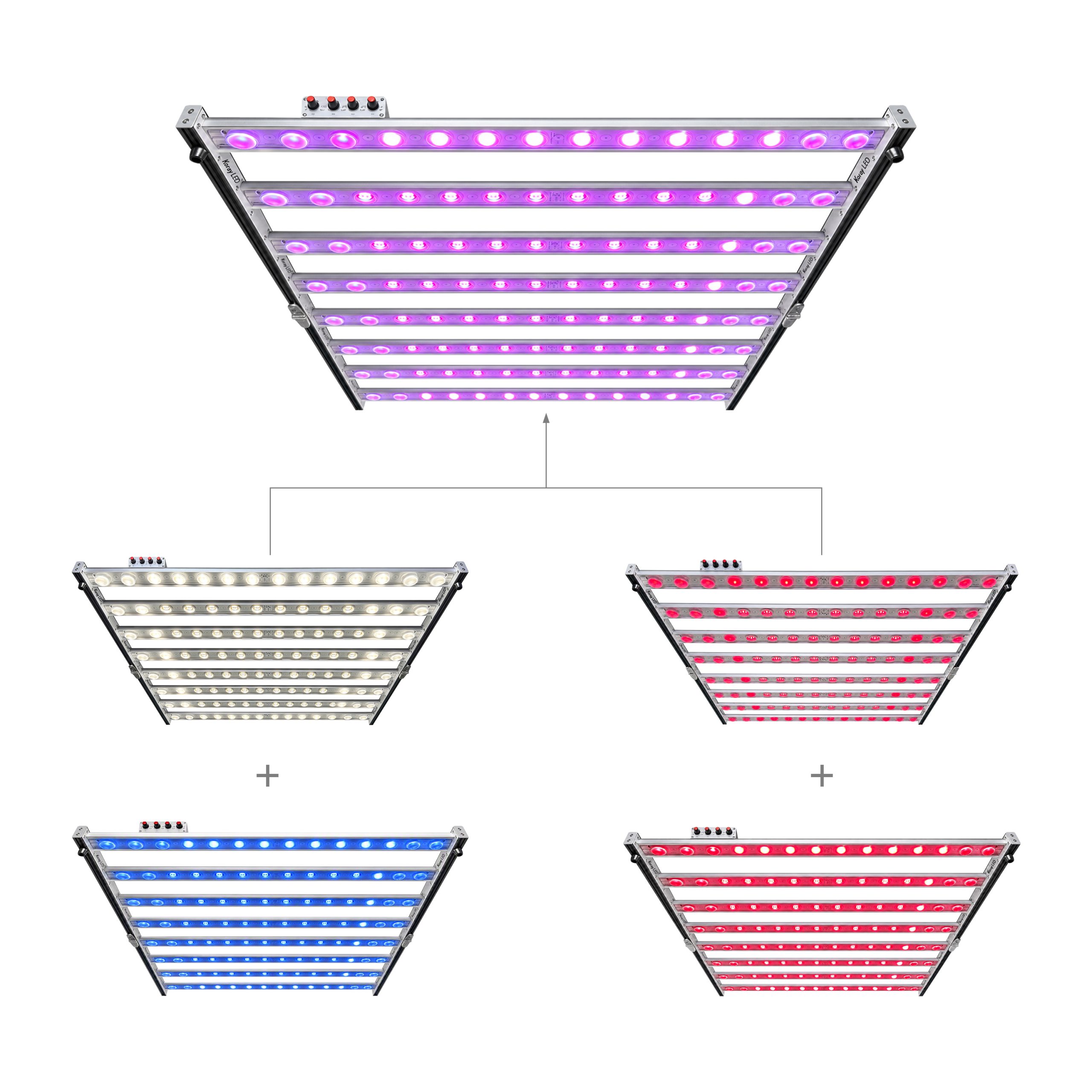
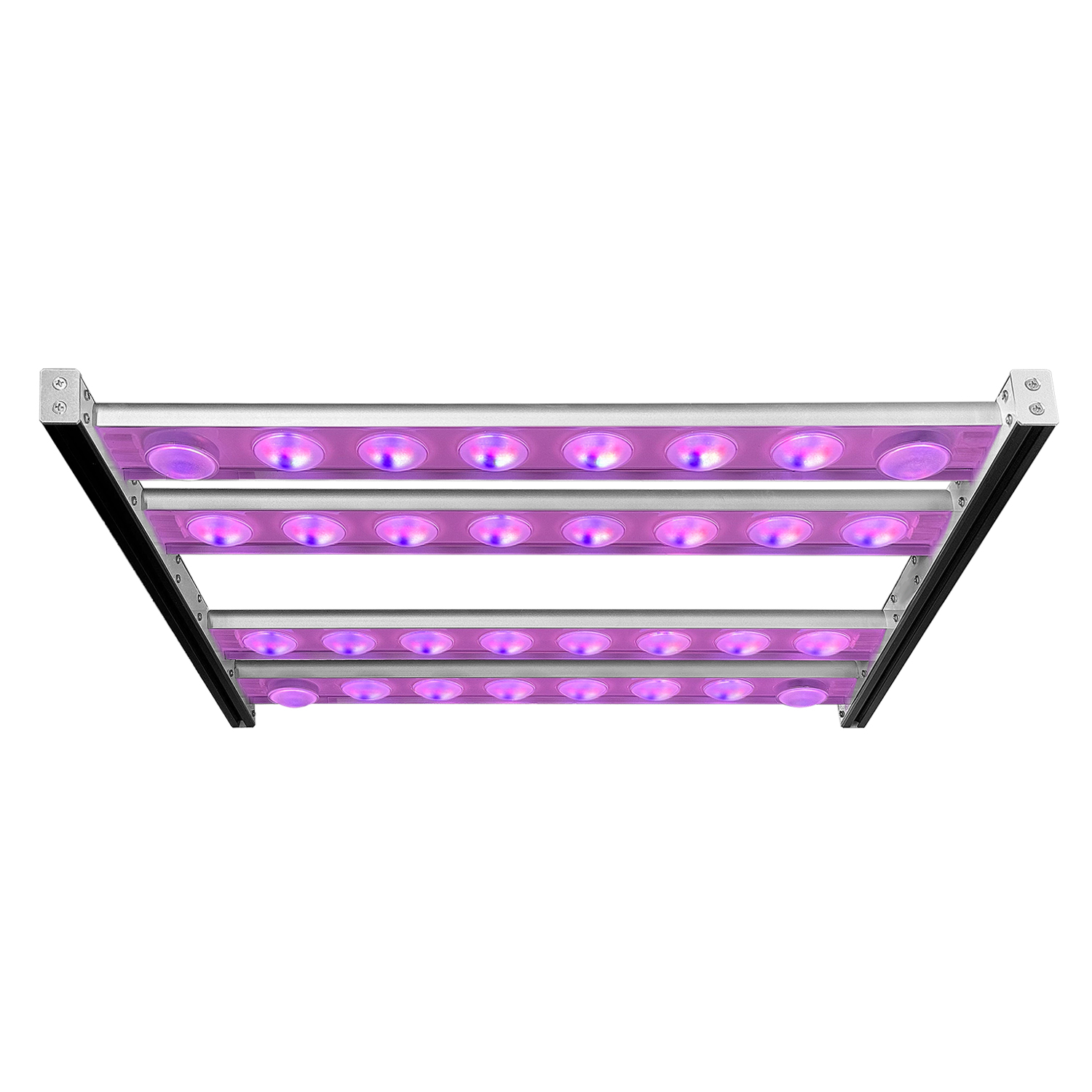
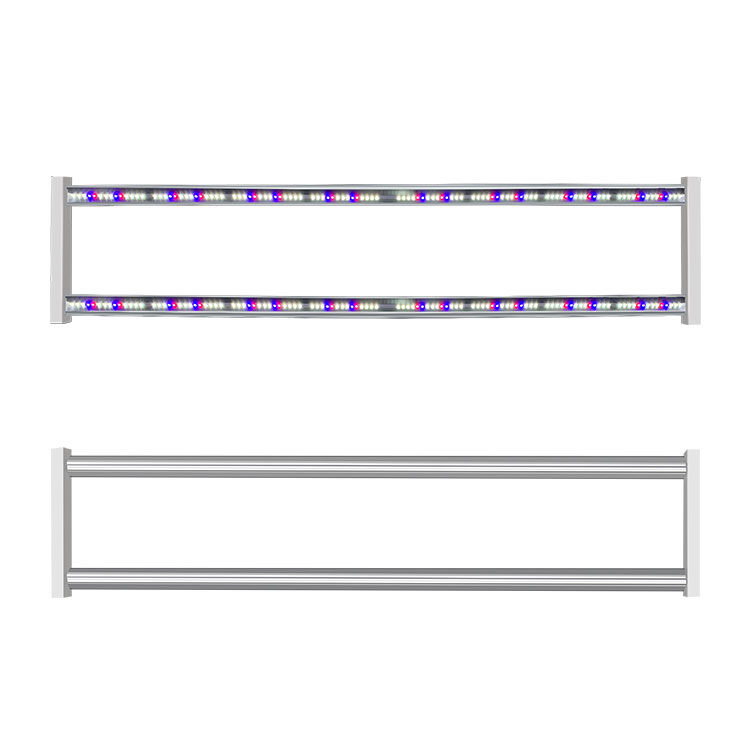
The choice between fixture formats follows from the tray geometry rather than from a preference for one technology. For a single shelf of 10 by 20 inch trays, a bar or strip format at 10–20 cm gives the most photons per watt because the light lands on the canopy instead of the aisle. For a multi-tray rack where several shelves share one fixture plane, a panel at 30–45 cm is the practical option, since a bar at close range cannot cover that width evenly.
For a microgreen shelf, the questions worth putting to any supplier are the PPFD map at the intended hanging height, the beam angle and the recommended mounting distance for that specific model; Koraylights has built LED horticultural fixtures for controlled-environment growers for 17 years, and those three figures are the ones its specification sheets publish. Ask for the map at the tray plane, not at 30 cm in open air, because the canopy is what receives the light.
Two operational notes complete the setup. Timers should be set on the light circuit only, with airflow on continuously, so that the dark period still dries the canopy. And any change to photoperiod should be made one variable at a time, with a two-tray comparison, because a microgreen cycle is short enough that a single bad test costs less than a week.
FAQ
How much PPFD do microgreens need?
After the blackout phase, 100–200 µmol/m²/s for 14–16 hours is the working range at 20–24 °C, which gives roughly 5–11.5 mol/m²/d. The final three to five days before harvest can go to 200–300 µmol/m²/s for 12–14 hours, provided relative humidity stays at 50–65%.
Do microgreens really need complete darkness for the first three days?
They need darkness until the hypocotyl lifts the seed coat clear of the medium, which usually takes 48–96 hours. Full darkness is not a rule for its own sake: the cover is removed as soon as emergence is complete, because light withheld after the cotyledons open produces pale, permanently weak stems rather than taller usable ones.
Can I run microgreens under 24 hours of light to speed them up?
No. Beyond about 16 hours the daily carbon budget is already met, so extra hours add heat and water loss rather than growth, and removing the dark period also removes the interval when the canopy dries. The usual result is paler colour, thinner stems and more fungal pressure.
Why are only the outer edges of my tray leggy?
Because the PPFD at the tray edge is lower than at the centre, typically by more than 30% with a single close-hung bar. The edge seedlings receive a smaller daily light integral and stretch. Overlap two fixtures at the tray margin or rotate the tray mid-cycle rather than raising the lamp, which would reduce light across the whole tray.



Leave A Comment