
When choosing plant grow lights, is PPE or PPFD the key indicator?
Many people focus solely on photosynthetic photon efficiency (PPE) when choosing plant grow lights, even believing that “the higher the PPE, the better the lighting effect.” However, those who actually operate plant factories know that relying solely on PPE can easily lead to various problems.
What plants truly need is not a specific parameter, but rather the number of effective photons reaching their canopy. This leads to a key indicator that more accurately reflects actual results—photosynthetically active radiation (PPFD).
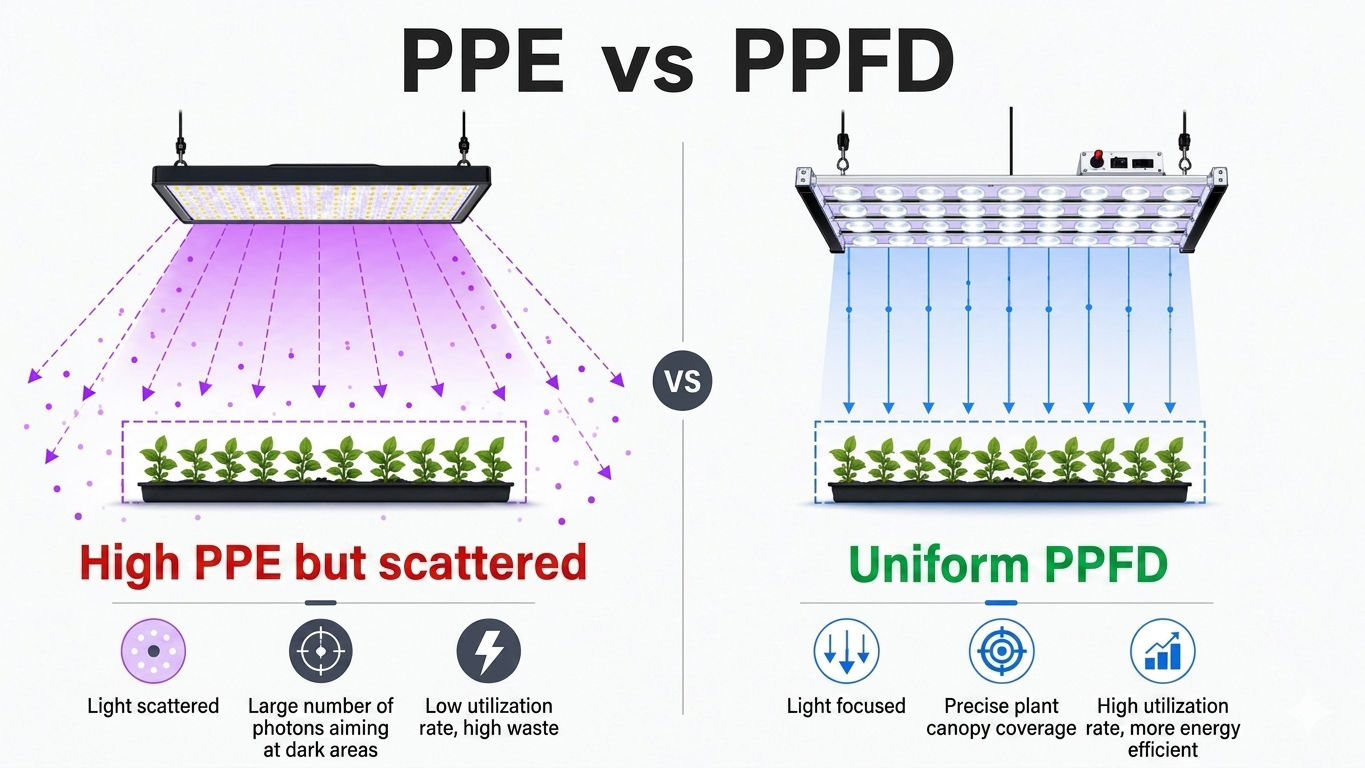
What is PPE?
PPE measures the efficiency with which a luminaire converts electrical energy into photosynthetically active photons (400-700nm), measured in μmol/J. The higher the value, the more energy-efficient it is theoretically. Therefore, some manufacturers like to advertise “ultra-high PPE” as a selling point.

But the key point is:
Light being emitted does not equate to plants receiving it. If the light is severely diffused, a large number of photons will be wasted outside of walkways and shelves, and the actual light received by the canopy will be far lower than the theoretical output.
What is PPFD?
PPFD represents the number of effective photons received per square meter per second in a plant canopy, measured in μmol/m²/s. Simply put: PPE indicates how efficient the light source is, while PPFD indicates how much the plant actually absorbs. PPFD is directly related to plant growth—leafy vegetables typically require 150-250 μmol/m²/s, while tomatoes need 600-1200 μmol/m²/s during flowering.

(G80PPFD test spectrum)
High PPE content ≠ Actual energy savings
This is the most easily overlooked problem. A single light source may have a high PPE (Potential Physical Value), but if the light is diffused and unevenly distributed, the actual PPFD (Potential Physical Value Displacement) of the plants will be far lower than expected. To achieve the target PPFD, the only options are to increase the number of lights or increase their wattage, resulting in higher electricity bills and a greater load on air conditioning.

The design concept of KERI plant lights is to precisely control light through secondary optical lenses, improve the light interception rate of the canopy and the uniformity of PPFD, and truly transform high PPE into high PPFD.
Which is more important?
PPE is a benchmark for energy efficiency in lighting fixtures, determining whether the electricity bill is worthwhile.
PPFD is the actual amount of light a plant receives, which determines whether it grows well.

The industry has long been focusing on a deeper concept – “canopy light interception rate,” which is the proportion of photons actually captured by leaves and used for photosynthesis. Optimizing light distribution and uniformity is more meaningful than simply piling up PPE.
Future Trends: From Looking at Parameters to Looking at Output
Early users only looked at power output, then they looked at PPE (polyethylene terephthalate). Future high-level plant factories will increasingly emphasize PPFD uniformity, light utilization, and energy consumption per unit yield.

Profit is not determined by the parameters themselves, but by how much output is generated from each unit of electricity.
In conclusion: PPE is the threshold indicator, determining the upper limit of energy saving; PPFD is the outcome indicator, determining the planting effect. The two complement each other. An excellent plant light should truly convert high PPE into high PPFD in the canopy.

G80 tent for growing tomatoes


Leave A Comment