
What PPFD Do Strawberries Need for Fruiting? The Complete Guide to Light Intensity for Indoor Strawberry Growing
When growing strawberries indoors, one of the most critical factors that determines whether your plants produce abundant, sweet fruit is the Photosynthetic Photon Flux Density (PPFD) — the amount of photosynthetically active light that actually reaches your plant canopy. Unlike leafy greens that thrive under moderate light, strawberries are heavy feeders when it comes to photons, and getting the PPFD right is the difference between a bountiful harvest and disappointing, sour berries.
In this guide, we break down exactly what PPFD levels strawberries need at each growth stage, how to calculate your DLI (Daily Light Integral), and which grow light solutions deliver the right intensity for maximum fruit production.
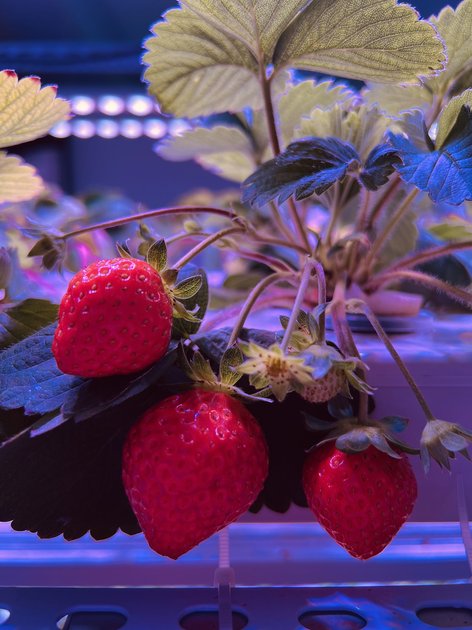
Understanding PPFD Requirements for Strawberries at Each Growth Stage
Strawberries have different light intensity needs depending on where they are in their growth cycle. Here is a detailed breakdown:
Seedling stage (PPFD 100–200 μmol/m²/s): Young strawberry seedlings are delicate and cannot handle intense light. During the first 2 to 3 weeks after germination, keep PPFD in the 100 to 200 range. This gentle light level encourages root development without stressing the tiny leaves. A DLI of 6 to 10 mol/m²/day is ideal at this stage.
Vegetative stage (PPFD 200–400 μmol/m²/s): Once the plant has established 3 to 5 true leaves, it enters the vegetative phase where it builds the canopy that will eventually support fruit. Increase PPFD to 200 to 400 μmol/m²/s, targeting a DLI of 12 to 15 mol/m²/day. This is when strong root and leaf development happens, and adequate light ensures the plant stores enough energy for flowering.
Flowering and fruiting stage (PPFD 400–600 μmol/m²/s): This is where PPFD truly matters for your harvest. Strawberries need 400 to 600 μmol/m²/s at the canopy during flowering and fruit development. The DLI target rises to 15 to 20 mol/m²/day. At these levels, photosynthesis operates at peak efficiency, producing the sugars that make strawberries sweet and flavorful. Research from leading agricultural universities confirms that strawberries grown under 500 μmol/m²/s produce up to 30% more yield than those under 300 μmol/m²/s.
How to Calculate DLI for Your Strawberry Grow Setup
DLI (Daily Light Integral) is the total amount of photosynthetic light your strawberries receive in a single day, measured in moles per square meter per day (mol/m²/day). It is the metric that commercial growers use to fine-tune their lighting strategy.
The formula is straightforward: DLI = PPFD × hours of light × 3,600 ÷ 1,000,000
For example, if your grow light delivers 400 μmol/m²/s and runs for 14 hours: DLI = 400 × 14 × 3,600 ÷ 1,000,000 = 20.16 mol/m²/day. This is right in the sweet spot for fruiting strawberries.
If you increase the PPFD to 500 μmol/m²/s but reduce the photoperiod to 12 hours, you get: DLI = 500 × 12 × 3,600 ÷ 1,000,000 = 21.6 mol/m²/day — still excellent for fruit production, with an energy-saving shorter photoperiod.

Why PPFD Uniformity Matters as Much as Peak Intensity
Many growers focus solely on the center PPFD number, but strawberries are particularly sensitive to uneven light distribution. If some plants receive 600 μmol/m²/s while others at the edge of the canopy only get 200 μmol/m²/s, you end up with berries ripening at completely different rates — making harvest planning difficult and reducing overall yield consistency.
This is where Koray Lighting’s secondary optics technology makes a real difference. The Koray GE35 series LED grow bars use specialized lens designs that spread light evenly across the entire growing area. The GE35-120T-F175 model, for instance, delivers PPFD of 530 μmol/m²/s at 0.2 meters with a uniform coverage width that eliminates the harsh center hotspot typical of point-source LEDs. This means every strawberry plant in your vertical rack receives the same quality of light, producing uniform berries that ripen together.
The Role of Light Spectrum in Strawberry Fruiting
PPFD tells you how much light reaches your plants, but spectrum tells you what kind of light. For strawberry fruiting, the spectrum matters enormously:
Red light (600–700nm) drives flowering and fruit development. A spectrum rich in red wavelengths — like Koray’s F175 spectrum — triggers the phytochrome system that signals the plant to produce flowers and set fruit. The F175 spectrum used in the GE35-120T-F175 provides a balanced full-spectrum output with enhanced red content specifically tuned for fruiting crops.
Blue light (400–500nm) controls vegetative morphology. Adequate blue light prevents leggy growth and ensures compact, sturdy plants that can support the weight of developing berries. Too little blue light results in weak stems that droop under fruit weight.
Far-red light (700–750nm) can accelerate flowering through the Emerson effect, where the combination of red and far-red photons boosts photosynthetic efficiency beyond what either wavelength achieves alone.

Recommended Hanging Distances for Target PPFD
Achieving the right PPFD depends heavily on the distance between your grow light and the strawberry canopy. Here are practical guidelines using the Koray GE35-120T-F175 (60W, 1200mm bar):
At 0.2 meters (8 inches): PPFD reaches approximately 530 μmol/m²/s at center — ideal for the fruiting stage. Coverage width is approximately 0.4 meters, making it perfect for single-layer shelf growing.
At 0.3 meters (12 inches): PPFD drops to approximately 360 μmol/m²/s — suitable for the vegetative stage or for maintaining fruiting DLI with a longer photoperiod (16 hours). Coverage width expands to approximately 0.6 meters.
At 0.5 meters (20 inches): PPFD falls to approximately 200 μmol/m²/s — adequate for seedling propagation or supplemental lighting in a greenhouse setting.
For commercial strawberry vertical farming, mounting the GE35 bars at 0.2 to 0.3 meters above the canopy on each shelf delivers the optimal PPFD range while keeping energy consumption manageable at 60W per bar.
Common PPFD Mistakes Indoor Strawberry Growers Make
Mistake 1: Using only center PPFD to evaluate a light. Always ask for a multi-point PPFD map. A light that claims 600 μmol/m²/s at center but drops to 150 at the edges is far less effective than one delivering a consistent 400 across the entire area.
Mistake 2: Ignoring the inverse square law. Doubling the distance from your light does not halve the PPFD — it quarters it. Moving from 0.2m to 0.4m means your strawberries go from 530 to roughly 133 μmol/m²/s. Always measure or calculate PPFD at your actual growing distance.
Mistake 3: Not adjusting PPFD between growth stages. Running full intensity on seedlings will stunt or burn them. Running vegetative-level light on fruiting plants will produce small, sour berries. Use dimmable lights like the GE35 series (compatible with 0-10V dimming) to adjust intensity as your plants grow.
Koray GE35 Series: Purpose-Built for Strawberry Production
The Koray Lighting GE35 series was engineered with commercial strawberry and vertical farming applications at its core. With models ranging from 30W (606mm) to 80W (1200mm with K6C high-red spectrum), the GE35 line offers a solution for every strawberry growing configuration.
Key advantages for strawberry growers include IP64 waterproof rating for humid growing environments, high power factor (PF>0.9) for efficient energy use, and Koray’s proprietary secondary optics that eliminate center hotspots while boosting PPFD uniformity. The GE35-120T-F175 at 60W delivers 150 μmol/s total PPF at 2.5 μmol/J efficacy — producing more usable light per watt than traditional T5 fluorescent replacements while lasting 50,000 hours.
Whether you are setting up a small home strawberry shelf or designing a commercial vertical farm, getting your PPFD right is the single most impactful decision you can make for fruit quality and yield. Start with the numbers in this guide, measure your actual canopy PPFD with a PAR meter, and adjust your light height and duration to hit your DLI target consistently.

Leave A Comment