
Understanding Lumen Output and PPFD: What the Numbers Mean
When evaluating a plant grow light, two metrics dominate the conversation: lumens and PPFD (Photosynthetic Photon Flux Density). Lumens tell you how bright a light appears to the human eye, while PPFD measures the actual number of photosynthetically active photons landing on your plant canopy per square meter per second. For the Koray RX-PT8 F175 spectrum, both numbers tell a compelling story about efficiency and growing performance.
This article breaks down the lumen output of the PT8 F175, explains how it translates into real-world PPFD values at different mounting distances, and shows why these figures matter for growers looking to maximize crop yield while minimizing energy costs.
PT8 F175 Lumen Output: 5,200 Lumens from 32 Watts
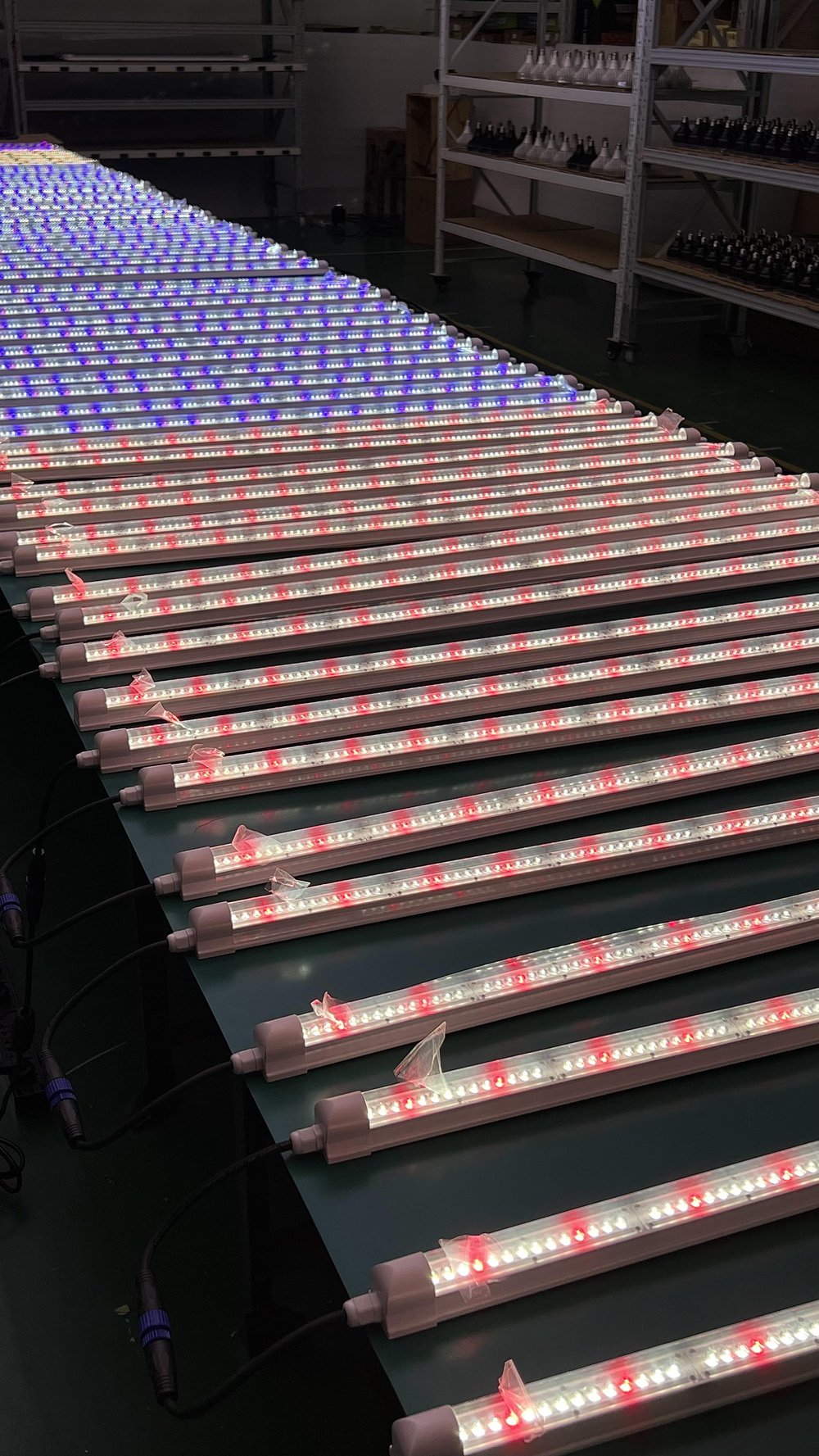
The PT8 F175 delivers 5,200 lumens from a single 1200mm tube consuming just 32 watts of power. To put this in perspective, a standard 36W T8 fluorescent tube typically produces between 2,600 and 3,200 lumens. The PT8 F175 therefore produces roughly 60% to 100% more visible light output than a fluorescent tube while actually consuming 4 watts less power.
But lumens alone do not tell the full story. The lumen scale is weighted toward green-yellow light (around 555nm) where the human eye is most sensitive. Plants, however, use the entire 400-700nm PAR (Photosynthetically Active Radiation) range relatively evenly. A light source can have high lumen output but still underperform if its spectral distribution does not align with plant photosynthesis needs. The F175 spectrum is specifically engineered to deliver strong output across the full PAR range, making its lumen numbers an even more impressive indicator of total photon output.
The PT8 F175’s luminous efficacy works out to approximately 162.5 lumens per watt, which is excellent for a horticultural full-spectrum LED tube. Compare this to fluorescent tubes at roughly 80-100 lumens per watt (including ballast losses), and the efficiency advantage is clear.
PPFD Performance at Key Distances
While lumens describe total light output, PPFD tells you what your plants actually receive. The PT8 F175 delivers the following PPFD values at standard mounting distances:
- 0.15 meters (6 inches): 365 μmol/m²/s
- 0.20 meters (8 inches): 275 μmol/m²/s
- 0.30 meters (12 inches): 185 μmol/m²/s
These readings are taken directly below the center of the tube. With Koray’s secondary optics technology, the light distribution is remarkably uniform along the entire 1,200mm length of the tube, meaning plants at either end of the bar receive nearly the same PPFD as those in the middle. This uniformity is a significant advantage over conventional LED tubes that lack optical engineering, where PPFD can drop by 30-40% at the tube ends.
For context, most leafy greens and herbs thrive at PPFD levels between 200 and 400 μmol/m²/s, while fruiting crops like tomatoes and peppers benefit from 400-600 μmol/m²/s. At the recommended mounting distance of 0.2 to 0.3 meters, the PT8 F175 delivers PPFD levels well-suited for a wide range of crops.
Multi-Bar Coverage: The 1.2×1.2m PPFD Map
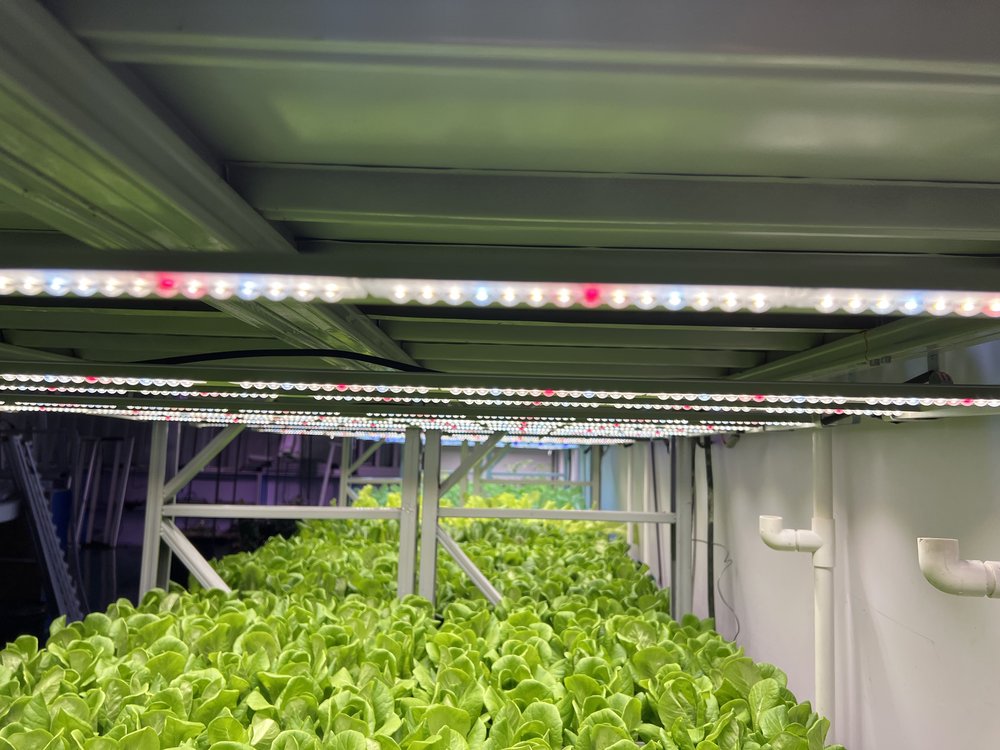
A single PT8 bar provides excellent output directly beneath it, but real growing setups require multiple bars to cover an entire shelf or growing area. Koray has published a detailed PPFD map for a six-bar configuration covering a 1.2×1.2 meter area at 0.3 meters height.
With six PT8 F175 bars spaced evenly across the 1.2m width, the average PPFD across the entire growing area is 300 μmol/m²/s. The total power consumption for this setup is approximately 133 watts per square meter (6 bars × 32W = 192W over 1.44m²). This is an efficient power density that balances strong light delivery with manageable energy costs.
The uniformity of this multi-bar layout is enhanced by the PT8’s optical design. Each bar’s light pattern overlaps with its neighbors, filling in the valleys between adjacent tubes and creating a consistent canopy-level PPFD. With fluorescent tubes, the omnidirectional light pattern creates more overlap waste and less uniformity, requiring more tubes to achieve the same average PPFD.
Comparing F175 Output to Other PT8 Spectra
The PT8 series offers three spectrum variants, each with different lumen and PPFD characteristics. Understanding the differences helps growers choose the right tube for their specific crop and growth stage.
The F4K spectrum (36W) produces the highest lumen output at 6,600 lumens, with PPFD of 270 μmol/m²/s at 0.15m and 126 μmol/m²/s at 0.3m. Its spectrum is optimized for seedling propagation and tissue culture, where high light visibility and balanced wavelengths support early-stage development. The higher wattage reflects the broader spectral output needed for this application.
The V3 spectrum (32W) produces 3,880 lumens with PPFD of 416 μmol/m²/s at 0.15m and 210 μmol/m²/s at 0.3m. While its lumen output is lower than the F175, its PPFD is actually higher. This is because the V3 spectrum concentrates more energy in the red and blue wavelengths that drive photosynthesis, at the expense of green light that contributes heavily to lumen measurements but less to plant growth. The V3 achieves an industry-leading efficiency of 2.9 μmol/J, making it the most photon-efficient option in the PT8 lineup.
The F175 spectrum sits in the middle: 5,200 lumens with balanced PPFD performance across the full PAR range. It is the most versatile option, suitable for most vegetables, herbs, and leafy greens, with excellent color rendering that makes it pleasant for visual inspection of crops.
PPF Output: Total Photon Production
Beyond lumens and PPFD, the PPF (Photosynthetic Photon Flux) measurement tells you the total number of PAR photons emitted by the light source per second. The PT8 F175 produces 86 μmol/s of PPF. While this number may seem modest compared to large quantum board fixtures, it is important to remember that the PT8 is a 1,200mm tube form factor designed for shelf and rack installations where multiple bars work together.
In the standard six-bar configuration, the combined PPF output is 516 μmol/s spread evenly across 1.44m². This distributed approach to lighting avoids the intense point-source output of high-wattage fixtures, which can cause light saturation in the center and deficiency at the edges. Instead, the multi-bar PT8 layout provides gentle, uniform illumination that matches the natural light distribution plants evolved under.
Energy Savings vs. Previous Generations
The PT8 F175 represents a significant improvement over previous generations of LED grow tubes. Koray reports that the F175 version saves 24% energy compared to its predecessor while maintaining or improving light output. This improvement comes from advances in LED chip efficiency, driver electronics, and optical design.
The V3 spectrum goes even further, achieving a 33% energy reduction over the previous generation. At 2.9 μmol/J, the V3 is among the most efficient LED grow tubes available on the market today. For a commercial grower operating hundreds of tubes, these efficiency gains translate directly into lower electricity bills and a smaller carbon footprint.
Practical Implications for Growers
So what do these lumen and PPFD numbers mean in practice? For a commercial lettuce grower using a six-bar PT8 F175 setup at 0.3m height, the average PPFD of 300 μmol/m²/s is ideal for producing dense, colorful heads of lettuce in 3-4 weeks from transplant. For herb growers using basil, cilantro, or mint, the same setup provides ample light for vigorous vegetative growth with strong flavor compound development.
For propagation and seedling operations, switching to the F4K spectrum at a closer distance of 0.15-0.2m provides the gentle but effective light levels young plants need. And for growers pushing maximum biomass accumulation, the V3 spectrum’s higher PPFD and superior efficiency deliver the photons that drive photosynthesis most effectively.
Conclusion
The Koray PT8 F175’s 5,200-lumen output from just 32 watts of power represents an outstanding combination of brightness and efficiency. When viewed through the lens of PPFD performance — 365 μmol/m²/s at 0.15m, 185 μmol/m²/s at 0.3m, and an average of 300 μmol/m²/s across a full 1.2×1.2m multi-bar layout — it becomes clear that this is a grow light designed by people who understand what plants actually need. Combined with 24% energy savings over the previous generation and the versatility of three spectrum options, the PT8 F175 sets a new standard for what a 1,200mm grow tube can achieve.




Leave A Comment