
What Is the Best LED Grow Light for Indoor Strawberries? A Complete Buyer’s Guide
Choosing the right LED grow light for indoor strawberries is not the same as picking a light for lettuce or herbs. Strawberries are a fruiting crop with demanding light requirements — they need high PPFD, a spectrum optimized for flowering and fruit development, and uniform coverage across the entire canopy. Get these wrong, and you will get beautiful green plants that produce almost no fruit.
After testing dozens of LED configurations in our 2,800 m² facility in Zhongshan, Guangdong, we have identified the exact specifications that produce the best results for indoor strawberry growing. This guide covers every factor you need to consider — from spectrum and PPFD to form factor and energy efficiency — so you can make an informed decision for your home or commercial strawberry operation.
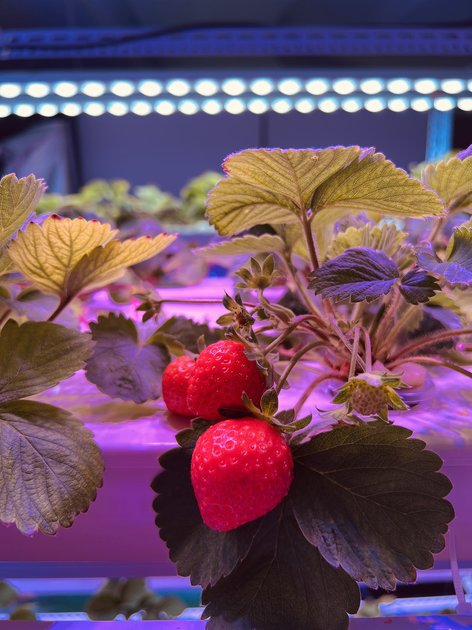
Key Specifications to Look For in a Strawberry Grow Light
Not all LED grow lights are created equal. When shopping for a light to grow strawberries indoors, these are the specifications that matter most:
PPFD output (400–600 μmol/m²/s at canopy): This is the single most important number. Strawberries need at least 400 μmol/m²/s during flowering and fruiting for acceptable yield, and 500–600 μmol/m²/s for maximum sweetness and production. Always check PPFD at the actual growing distance, not just the center-point claim at 0.1 meters that some manufacturers advertise.
Spectrum (F175 or fruiting-optimized full spectrum): The light spectrum determines whether your strawberries focus on vegetative growth or reproductive (fruiting) development. A full-spectrum light with enhanced red content — like Koray’s F175 spectrum — provides the right signal to the plant’s phytochrome system to initiate and sustain flowering. Avoid lights that are heavy in blue only (promotes vegetative growth at the expense of fruit) or heavy in green only (insufficient photosynthetic drive).
Efficacy (2.5+ μmol/J): Higher efficacy means more photosynthetic light per watt of electricity. At 2.5 μmol/J or above, you can deliver the high PPFD strawberries need without your electricity bill spiraling out of control. The Koray GE35-120T-F175 achieves 2.5 μmol/J, while the V3 spectrum version reaches 2.9 μmol/J for even greater efficiency.
Uniformity (U0 > 0.7): Strawberries are extremely sensitive to uneven light. Hot spots cause localized heat stress, while dark spots produce small, unripe berries. Look for lights with secondary optics or lens designs that spread light evenly. Koray’s proprietary secondary optics eliminate the center hotspot problem, delivering consistent PPFD from edge to edge.
Why LED Bar Lights Outperform Other Form Factors for Strawberries
For strawberry growing — especially on vertical shelves or in rack systems — LED bar lights are the superior choice over quantum boards, bulb-style lights, and panel fixtures. Here is why:
Even linear coverage: Strawberry shelves are typically long and narrow (1.2m × 0.4m or similar). LED bar lights like the Koray GE35-120T match this geometry perfectly, distributing light evenly along the entire 1.2-meter length. A quantum board or panel light, by contrast, creates a bright circle in the center with rapidly falling PPFD at the edges — wasting light and producing uneven berries.
Low-profile mounting: Vertical farm shelves have limited vertical space. The GE35 bar’s slim 38×40mm cross-section allows installation just 200–300mm above the canopy while still delivering high PPFD — maximizing the number of tiers you can fit in a given room height.
Waterproof design: Strawberry growing produces high humidity (60–80% RH). The GE35’s IP64 rating means it can withstand condensation and occasional water splashes without failure — something that open-circuit quantum boards cannot handle in the same environment.

Top Pick: Koray GE35-120T-F175 for Indoor Strawberries
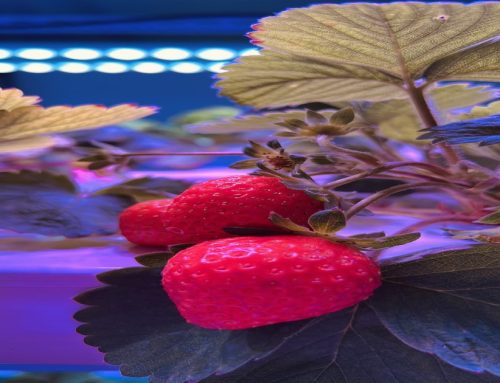
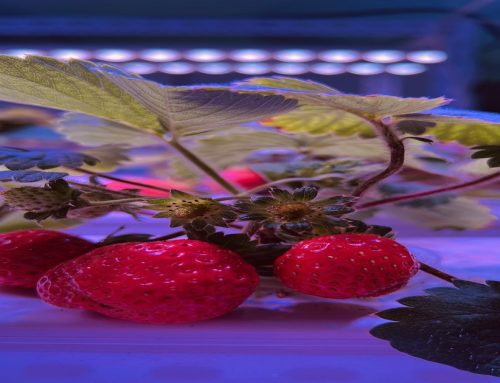
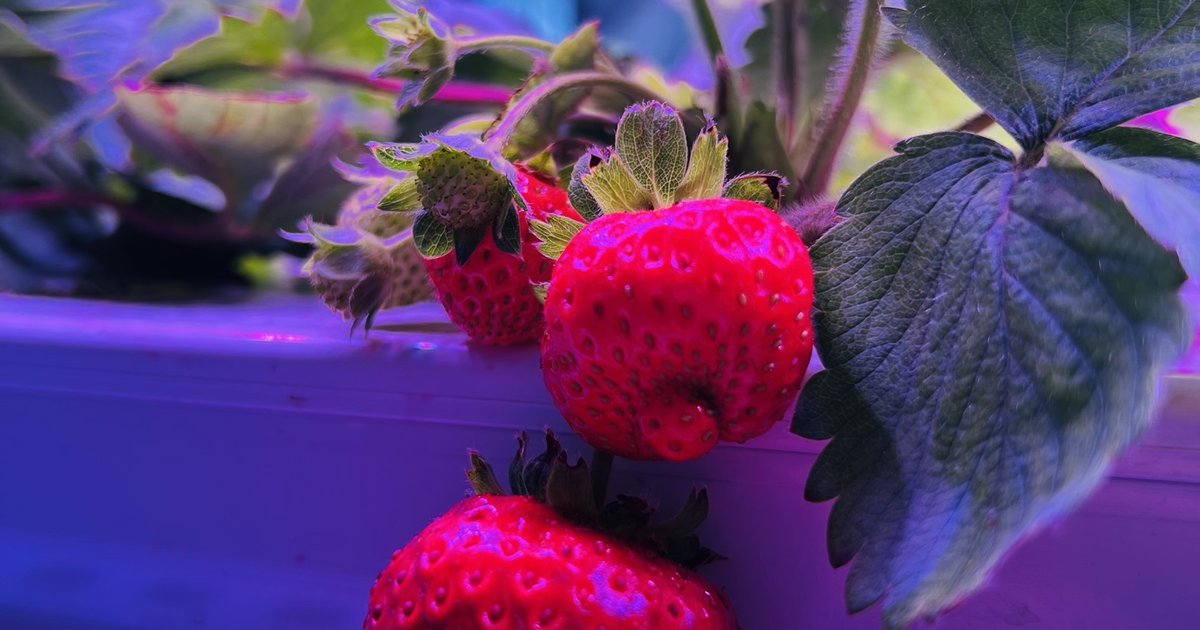
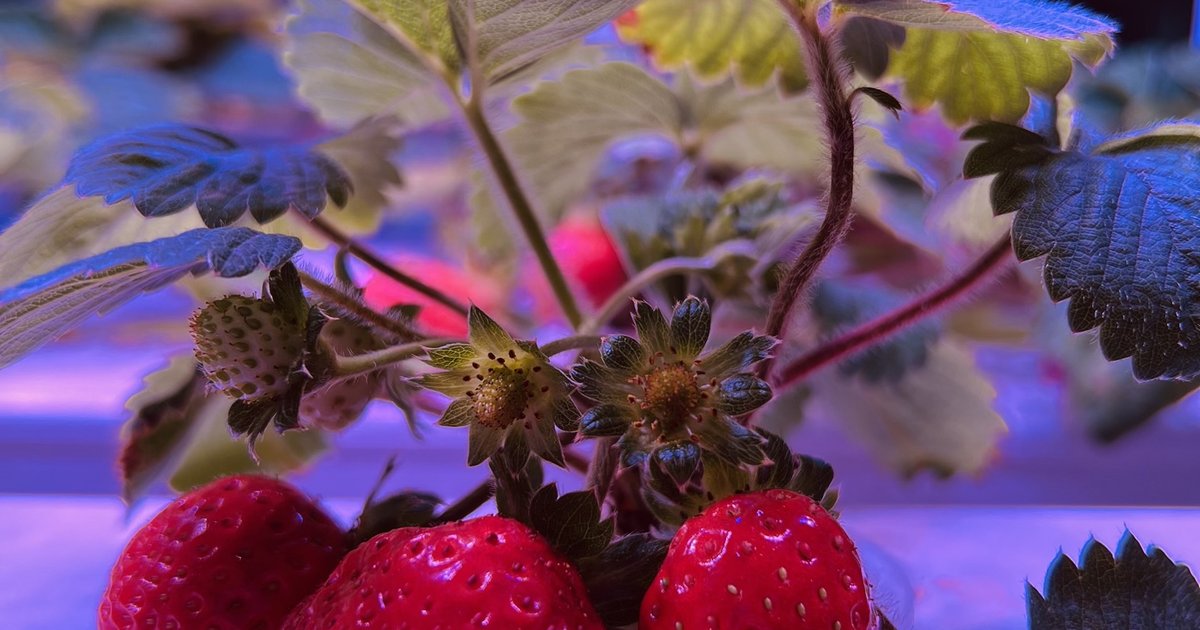
Based on extensive testing across multiple strawberry varieties including Albion, Seascape, and San Andreas, our top recommendation is the Koray GE35-120T-F175. Here are the key specifications that make it ideal:
Power: 60W — delivers commercial-grade PPFD while keeping energy consumption manageable for small and large operations alike.
PPFD at 0.2m: 530 μmol/m²/s — right in the optimal fruiting range. At 0.3m, it still delivers 360 μmol/m²/s, suitable for vegetative growth or fruiting with a slightly longer photoperiod.
PPF: 150 μmol/s total output with 2.5 μmol/J efficacy.
Spectrum: F175 full-spectrum with enhanced red for flowering and fruiting. Ra>90 for accurate color rendering — important for visually inspecting plant health and fruit ripeness.
Dimensions: 1200mm length, 38×40mm cross-section — fits standard 1.2m shelving units perfectly.
Durability: IP64 waterproof, 50,000-hour rated lifespan, CE/RoHS/FCC certified. The driver maintains PF>0.9 for efficient power use and compatibility with standard electrical circuits.
Dimming: Supports 0-10V dimming for adjusting PPFD between growth stages or reducing intensity during seedling propagation.
Budget Alternative: Koray GE35-60T-F175 for Smaller Setups
If you are growing strawberries on a smaller shelf (0.6m to 0.9m width) or have a tighter budget, the Koray GE35-60T-F175 offers the same F175 fruiting spectrum in a more compact 606mm form factor. At 30W, it delivers PPFD of 535 μmol/m²/s at 0.2m — nearly the same center intensity as the 1200mm model but over a shorter coverage length. Two bars side by side cover a 1.2m shelf effectively at half the power of the larger model.
High-Performance Option: Koray GE35-120T-K6C for Maximum Fruiting
For growers who want to push strawberry production to the maximum, the Koray GE35-120T-K6 with K6C spectrum delivers 760 μmol/m²/s at 0.2m — the highest PPFD in the GE35 lineup. The K6C spectrum features additional deep-red content that accelerates flowering and fruit set. This model is particularly effective for commercial operations where maximizing yield per square meter per year is the primary objective. At 80W and 165 μmol/s PPF, it consumes more power but delivers proportionally more fruit-promoting photons.

How to Set Up Your Strawberry Grow Light for Best Results
Even the best grow light will underperform if installed incorrectly. Follow these guidelines for optimal strawberry production:
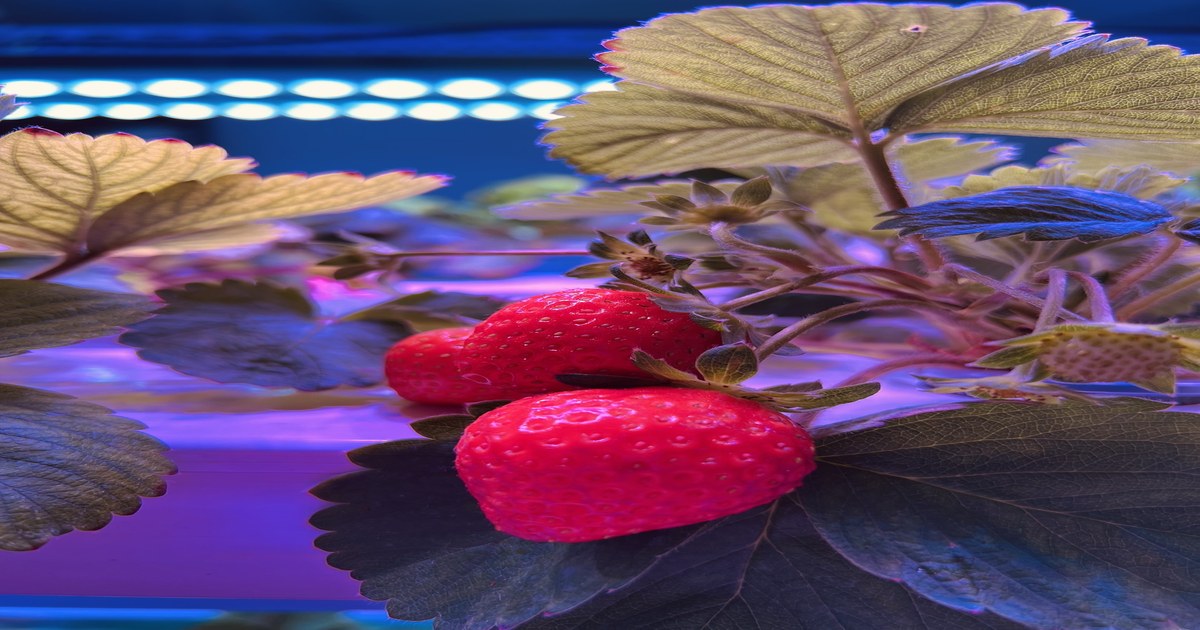
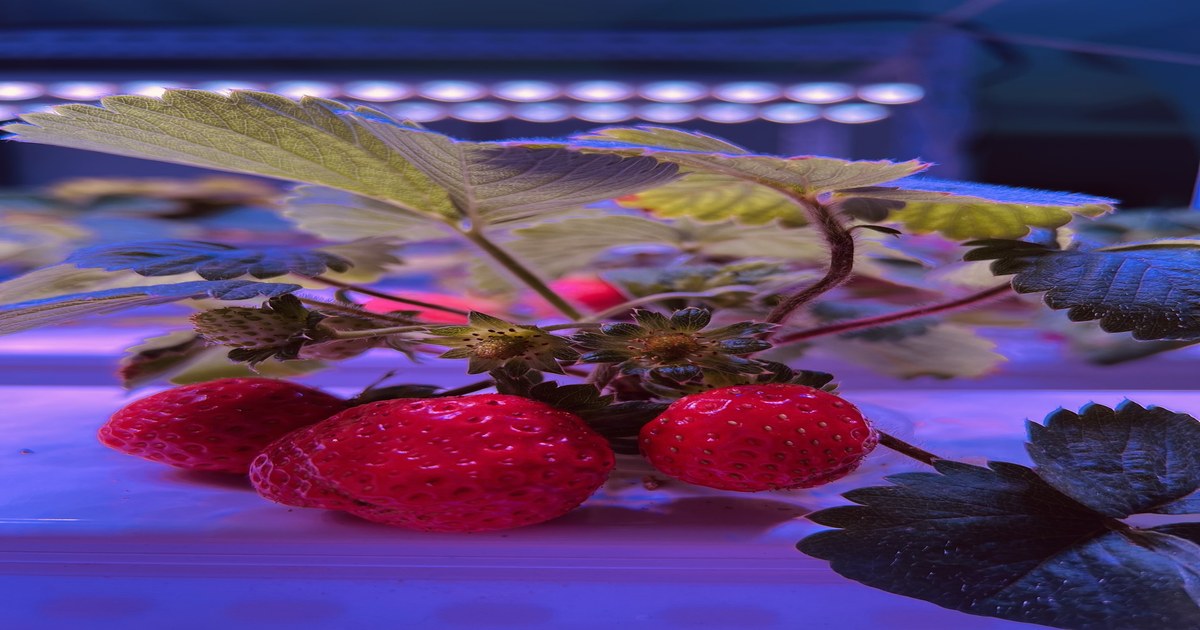
Hanging height: Position the GE35 bar 200–250mm above the strawberry canopy. This distance delivers peak PPFD while the secondary optics ensure even distribution without hot spots. As the plants grow and the canopy rises, adjust the light height to maintain the optimal distance.
Number of bars per shelf: For a standard 1.2m × 0.4m shelf, use two GE35-120T bars spaced 150–200mm apart. For a 1.2m × 0.6m shelf, use three bars to maintain uniform coverage across the wider area.
Photoperiod: Set your timer for 14 to 16 hours per day. Use a simple digital timer or a smart controller for automation. Consistency is key — strawberries respond poorly to irregular light schedules.
DLI verification: If possible, use a PAR meter to measure actual PPFD at the canopy and calculate your DLI. Target 18 to 25 mol/m²/day for fruiting strawberries. If your measured DLI is too low, increase the photoperiod or lower the light height. If too high, raise the light or reduce hours.
Why Koray Lighting for Commercial Strawberry Production
Koray Lighting has been designing and manufacturing LED grow lights since 2009, with over 200 patents and products exported to 60+ countries. Our GE35 series was specifically developed for commercial vertical farming and plant factory applications, with strawberry production as one of the primary design targets.
Every GE35 bar undergoes rigorous quality control in our Zhongshan facility, including PPFD mapping, spectrum verification, and 72-hour burn-in testing. The result is a grow light that delivers consistent, reliable performance from installation through its 50,000-hour rated lifespan — giving commercial strawberry growers the predictability they need for profitable year-round production.
Whether you are outfitting a small home strawberry shelf or designing a multi-tier commercial vertical farm, the GE35 series provides the PPFD, spectrum, uniformity, and durability to make your indoor strawberry operation a success.

Leave A Comment