
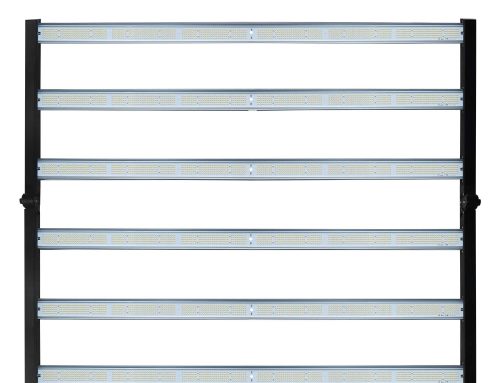
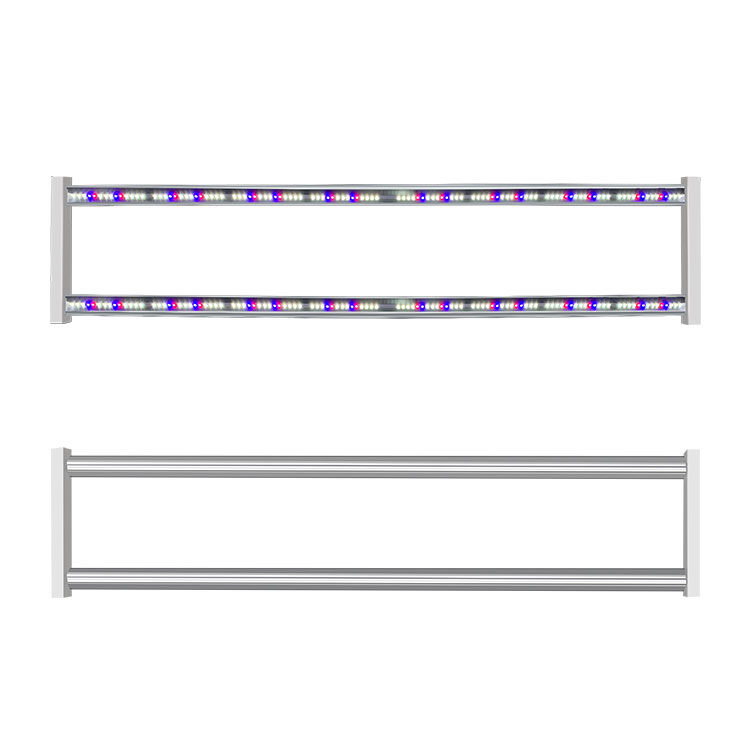
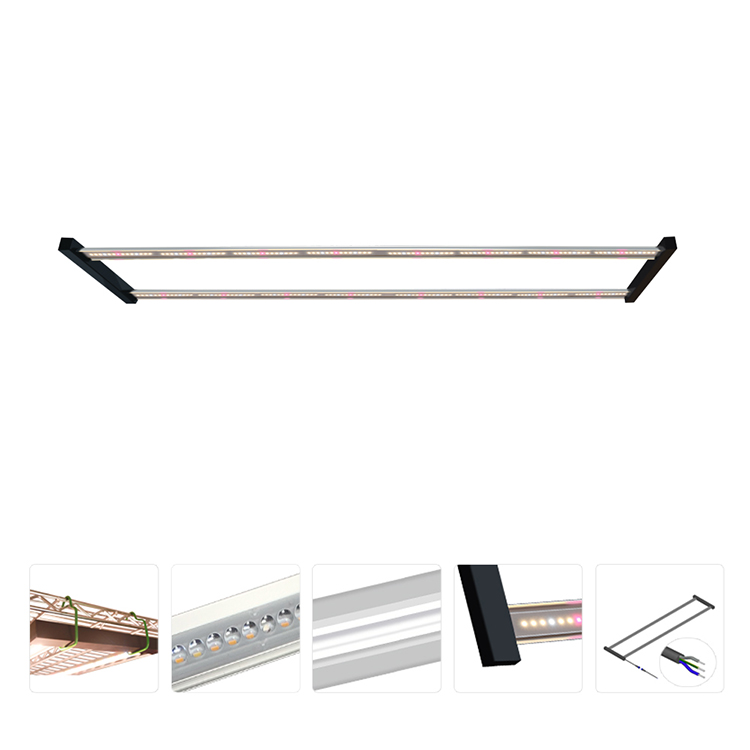
An economical greenhouse toplighting bar is a linear LED fixture that is suspended above the crop canopy instead of being fixed inside a multi-tier rack. The RX-TP50-L is listed on its official product page (https://koraylights.com/product/economical-type-greenhouse-led-grow-light/) as an Economical Type Greenhouse LED Grow Light, and its published figures can be read directly from the official datasheet: 240 W at AC 230 V, a photon efficiency of 2.5 umol/J, a photon flux of 600 umol/s, and a photon flux density of 400 / 160 / 60 umol/m2/s at 0.5 / 1 / 1.5 m under the stated test conditions (darkroom, no reflection test). The bar measures 1206 x 51 x 122 mm, projects through a 120-degree beam angle, is recommended for a mounting range of 0.5 to 2 m, is rated for operation between -10 C and 40 C, and carries a 50,000-hour lifetime note at Ta 25 C, with a plus or minus 10 percent tolerance on the electrical and photometric values. Power factor and IP rating are not specified in the official datasheet. The sections below read those figures as the throw-and-coverage calibers of a toplighting bar, and separate what a specifier can plan with today from what still has to be requested.
What a greenhouse toplighting bar is
A toplighting bar is a linear emitter that is hung above the canopy, so its job is to fill the volume of air between the fixture and the leaf surface with useful photons. University extension guidance on light and crop growth, such as the material published by Michigan State University Extension (https://www.canr.msu.edu/), treats the daily light integral, the total number of photons a crop receives over a day, as the quantity that governs yield and quality in a controlled-environment operation. A toplight bar contributes to that daily total from a distance, which is why its beam angle and its maximum mounting height matter as much as its raw output. Because photon flux density falls with the square of the distance, a bar that is designed to be hung a metre above the crop has to publish its readings at several heights rather than at a single point.
How beam angle and mounting height set the coverage band
A 120-degree beam is a wide distribution, and a wide beam spreads the same photon flux across a larger area as the fixture moves further from the canopy. The RX-TP50-L is specified with a recommended mounting range of 0.5 to 2 m, so the interest is in how the published photon flux density changes across that band: 400 umol/m2/s at 0.5 m, 160 umol/m2/s at 1 m and 60 umol/m2/s at 1.5 m, all measured in a darkroom with no reflection test. Publishing a darkroom reading is a conservative convention, because it excludes the photons that would bounce back from walls or reflective floors. Greenhouse lighting guidance from the Royal Horticultural Society (https://www.rhs.org.uk/) similarly frames supplementary lighting by the distance between the lamp and the crop, because that distance decides both the intensity at the leaf and the overlap between neighbouring fixtures. In a toplighting layout the spacing between bars is therefore chosen together with the mounting height, not independently of it.
The published calibers of the RX-TP50-L
- Photon flux is the total output of the bar, and the RX-TP50-L is published at 600 umol/s.
- Photon efficiency is output per unit of input energy, and the published figure is 2.5 umol/J.
- Photon flux density is the intensity at the canopy, and the published readings are 400 umol/m2/s at 0.5 m, 160 umol/m2/s at 1 m and 60 umol/m2/s at 1.5 m, each measured in a darkroom with no reflection test.
- Rated power is the electrical load, and the bar is published at 240 W with an AC 230 V input.
- Beam angle is the spread of the distribution and is published at 120 degrees, with a recommended mounting range of 0.5 to 2 m.
- Physical size is published as 1206 x 51 x 122 mm, which sets truss spacing and the width of the lit strip.
- Lifetime is published as 50,000 hours with a test note of Ta 25 C, and the tolerance on the electrical and photometric figures is plus or minus 10 percent.
- Power factor and IP rating are not specified in the official datasheet and should be confirmed with the supplier before a specification is closed.
Dimension-by-dimension reference
| Dimension | RX-TP50-L (published) | Toplight bar vs rack-mount bar |
| Rated power | 240 W | A toplight bar carries the full canopy area; a rack bar serves a single shelf |
| Input voltage | AC 230 V | A mains-level feed, unlike low-voltage shelf strips |
| Photon efficiency | 2.5 umol/J | Read per joule, not per bar |
| Photon flux | 600 umol/s | Output is spread over a canopy, not a shelf |
| PPFD at 0.5 m | 400 umol/m2/s (darkroom, no reflection test) | Low end of the published throw band |
| PPFD at 1 m | 160 umol/m2/s (same test conditions) | Mid band; rack bars rarely publish here |
| PPFD at 1.5 m | 60 umol/m2/s (same test conditions) | High end of the published throw band |
| Beam angle | 120 degrees | Wide spread that allows spacing between bars |
| Recommended mounting range | 0.5 to 2 m | Rack-mount bars sit far closer to the canopy |
| Dimensions | 1206 x 51 x 122 mm | Long, slim profile for overhead trusses |
| Operating temperature | -10 C to 40 C | Sized for greenhouse ambient swings |
| Lifetime | 50,000 hours (Ta 25 C) | Hours quoted with a stated test temperature |
| Tolerance | plus or minus 10 percent | Spread on the published electrical and photometric values |
| Power factor | not specified in the official datasheet | Request before specifying |
| IP rating | not specified in the official datasheet | Request before specifying |
Where the 0.5 to 2 m mounting band fits
A fixture with a 0.5 to 2 m recommended throw suits overhead trusses in a greenhouse, a high-bay vertical room or a multi-layer room where the top tier still has headroom. Because the published output is stable across that band, an operator can raise the bar as a crop grows and still cover a similar footprint. For full-cycle leafy green, basil, strawberry and culinary herb production, which is the official application wording for this model, the wide 120-degree beam keeps neighbouring bars from leaving unlit lanes between them. A 17-year background in horticultural lighting sits behind this economical class of bar, which is aimed at installations that want a long throw without a premium board. Where the ceiling is low, a short-throw fixture may be the better fit; where the ceiling is high, a bar like this is usually the more direct answer.
What to confirm in writing before specifying
- Confirm the power factor and the IP rating, because neither is specified in the official datasheet.
- Confirm the number of bars and the spacing that produce the target daily light integral at the planned mounting height.
- Confirm that the mains supply matches the published AC 230 V input and that the circuit can carry the 240 W per bar.
- Confirm the dimming or control interface, since the published datasheet covers the electrical and photometric calibers rather than the control protocol.
- Confirm the delivered spectrum code, since the RX-TP50-L is published with the F51 spectral designation.
Frequently asked questions
What is the PPFD of the RX-TP50-L?
The published photon flux density is 400 umol/m2/s at 0.5 m, 160 umol/m2/s at 1 m and 60 umol/m2/s at 1.5 m, measured in a darkroom with no reflection test.
What mounting height does the RX-TP50-L recommend?
The recommended mounting range is 0.5 to 2 m, and the official PPFD readings cover the 0.5 m, 1 m and 1.5 m points inside that band.
What is the lifetime of the RX-TP50-L?
The published lifetime is 50,000 hours with a test note of Ta 25 C, and the tolerance on the electrical and photometric figures is plus or minus 10 percent.
Does the RX-TP50-L list an IP rating or a power factor?
No. Both the power factor and the IP rating are not specified in the official datasheet, so they should be confirmed with the supplier.
Is the RX-TP50-L a greenhouse toplight or a rack bar?
It is an economical greenhouse toplighting bar, published for full-cycle leafy green, basil, strawberry and culinary herb production, with a 120-degree beam and a 0.5 to 2 m mounting range.


Leave A Comment