
Understanding the Difference Between Grow Lights and General-Purpose Bulbs
When you walk into a hardware store and look at the lighting aisle, you will see plenty of PAR38 bulbs. They look similar in shape and size, they all fit an E27 or E26 socket, and they all claim to be energy-efficient LEDs. But there is a fundamental difference between a regular PAR38 bulb designed for general illumination and a purpose-built grow light like the Koray Lighting RX-PAR38. The difference lies not in the physical form factor, which is indeed the same standardized PAR38 shape, but in the spectral output, the optical design, the driver quality, and the overall engineering philosophy. A regular PAR38 bulb is optimized for human vision, producing light that makes a living room look pleasant. The RX-PAR38 is optimized for photosynthesis, producing light that makes plants grow vigorously. Understanding these differences will help you see why using a dedicated grow light delivers dramatically better results than trying to grow plants under a household bulb.
The Koray Lighting RX-PAR38 is the product of over fifteen years of specialized LED lighting engineering, drawing on the company’s portfolio of more than 200 patents in secondary optics, thermal management, and horticultural spectrum design. In this article, we will compare the RX-PAR38 against regular PAR38 bulbs across every dimension that matters for plant growth, including spectral quality, photosynthetic efficiency, optical design, build quality, and long-term value. By the end, you will have a clear picture of why serious growers choose purpose-built horticultural LEDs and what specific advantages the RX-PAR38 brings to the table.
Spectral Output: The Most Critical Difference
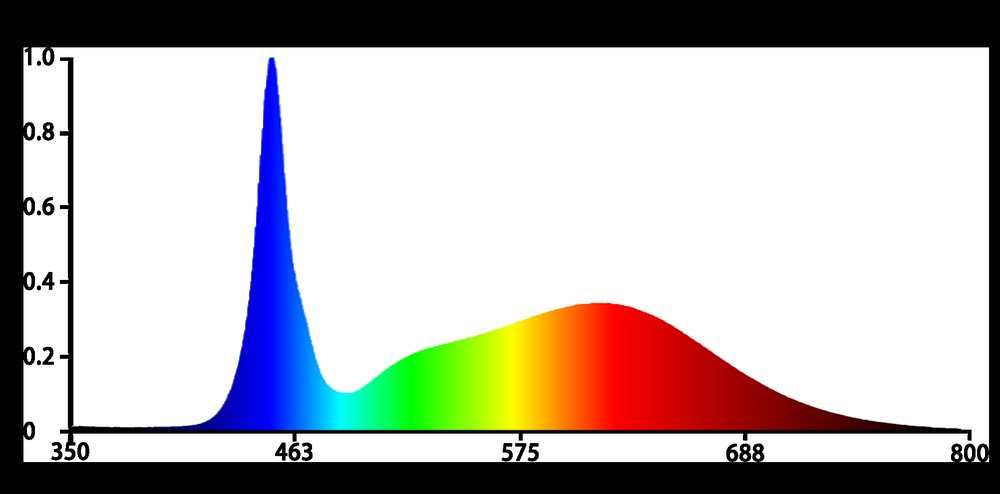
The single most important difference between the RX-PAR38 and a regular PAR38 bulb is the spectral output. Plants do not use light the same way human eyes do. While human vision is most sensitive to green and yellow light in the middle of the visible spectrum, photosynthesis is driven primarily by blue light around 400 to 500 nanometers and red light around 600 to 700 nanometers. A regular PAR38 bulb designed for home lighting typically produces a broad spectrum heavily weighted toward the green-yellow region to achieve a high lumen output and a pleasing color rendering index. This means that a significant portion of the electrical energy consumed by a household PAR38 is converted into photons that plants cannot use efficiently for photosynthesis.
The RX-PAR38, by contrast, is available in multiple purpose-bred spectra designed by Koray Lighting’s optical engineers to maximize photosynthetic photon efficacy. The F175 spectrum provides a balanced full-spectrum output suitable for most vegetables, herbs, and leafy greens, with enhanced blue and red peaks that align with the absorption maxima of chlorophyll a and chlorophyll b. The S85 and S93 spectra are optimized for succulents and ornamental plants, promoting compact growth and vivid coloration. The K6 spectrum features additional deep red wavelengths that are particularly effective for flowering plants and carnivorous species like Venus flytraps. Each of these spectra is the result of extensive research and testing, and none of them would be possible with the generic phosphor blend used in a household PAR38 bulb.
Photosynthetic Efficiency: Micromoles per Joule
The efficiency of a grow light is measured in micromoles of photosynthetically active radiation per joule of electrical energy consumed, abbreviated as micromoles per joule or PPE. A typical household LED PAR38 bulb achieves an efficacy of about 1.0 to 1.5 micromoles per joule, because much of its output is in spectral regions that contribute little to photosynthesis. The RX-PAR38, with its optimized spectra and high-quality LED chips, achieves significantly higher efficacy, delivering more photosynthetically useful photons per watt of electricity. This means that for the same electrical input, the RX-PAR38 provides substantially more usable light for plant growth than a regular PAR38 bulb.
Over time, this efficiency advantage translates directly into lower electricity costs. If you are running a grow light for 16 hours per day, every day of the year, the difference in efficacy between a household bulb and a purpose-built grow light adds up to a significant amount of saved energy. For a commercial operation running dozens or hundreds of fixtures, the savings become substantial enough to justify the higher initial investment in professional-grade lighting within the first year of operation. Koray Lighting has been optimizing this efficiency since 2009, and the RX-PAR38 represents the current state of the art in compact PAR-form-factor grow lighting.
Optical Design: Beam Angle and Light Distribution
Another major difference is the optical design. A regular PAR38 bulb typically has a wide beam angle of 90 to 120 degrees, designed to spread light broadly across a room for general illumination. While this is ideal for lighting a living space, it is suboptimal for growing plants because the light is dispersed over a large area, reducing the intensity at any given point. The RX-PAR38 features a precision-engineered 60-degree beam angle that concentrates the light output into a tighter, more defined coverage area. This focused beam delivers higher PPFD at the canopy level and better penetration into the plant foliage, which is exactly what growing plants need.
Koray Lighting’s proprietary secondary optics system, which is covered by the company’s patent portfolio, shapes the beam profile to minimize hot spots at the center while maintaining uniform intensity across the coverage area. This is a significant achievement because narrow beam angles in poorly designed fixtures tend to create a bright spot in the middle and dim edges, leading to uneven plant growth. The RX-PAR38 avoids this problem through careful optical engineering, delivering a smooth, usable light distribution that supports uniform canopy development. Regular PAR38 bulbs make no such effort because their target application, room lighting, does not require the same precision in beam shaping.
Build Quality and Environmental Protection
Grow lights operate in environments that are far more demanding than typical indoor lighting. The humidity levels in a grow tent or greenhouse can exceed 70 percent, and water splashes from irrigation are common. The RX-PAR38 carries an IP65 waterproof rating, meaning it is protected against low-pressure water jets from any direction and is fully sealed against dust ingress. This level of protection ensures reliable operation in the challenging conditions of a working grow environment. Regular PAR38 bulbs designed for dry indoor use have no such protection and will fail quickly when exposed to sustained high humidity or direct water contact.
The thermal design of the RX-PAR38 is also built for continuous operation. Grow lights typically run for 12 to 18 hours per day, often in enclosed spaces where ambient temperatures are elevated. The RX-PAR38 incorporates an efficient heat sink and thermal management system that keeps the LED junction temperature within safe limits, preserving both the light output and the operational lifespan. With a rated life of over 35,000 hours, the RX-PAR38 will outlast multiple generations of household bulbs that are not designed for the thermal demands of continuous horticultural use.
Long-Term Value and Total Cost of Ownership
At first glance, a regular PAR38 bulb from the hardware store appears cheaper than a professional grow light like the RX-PAR38. However, when you consider the total cost of ownership, the picture changes significantly. A household bulb running 16 hours per day will need replacement every one to two years as its output degrades and it eventually fails. Each replacement costs not only the price of the bulb but also the labor to install it and the lost production time while the plant is without adequate light. The RX-PAR38, with its 35,000-hour rated lifespan, will operate reliably for four to eight years under the same conditions, eliminating the recurring replacement cost and the associated downtime.
Furthermore, the higher photosynthetic efficiency of the RX-PAR38 means lower electricity bills every month. When you add up the savings in energy, the elimination of frequent replacements, and the improved plant growth and yield that result from proper spectral output, the RX-PAR38 delivers a lower total cost of ownership than household PAR38 bulbs over any multi-year time horizon. For commercial growers, this economic advantage is compounded across hundreds of fixtures, making the return on investment even more compelling.
Key Takeaways on RX-PAR38 vs Regular PAR38
The Koray Lighting RX-PAR38 and a regular household PAR38 bulb may share the same physical form factor and socket type, but they are fundamentally different products designed for completely different purposes. The RX-PAR38 delivers purpose-bred spectra optimized for photosynthesis, higher photosynthetic efficacy, a precision 60-degree beam angle for focused canopy coverage, IP65 waterproof protection for humid environments, and a 35,000-hour operational lifespan. Regular PAR38 bulbs, designed for human comfort and general illumination, cannot match any of these attributes. For anyone serious about growing healthy plants indoors, investing in a dedicated grow light like the RX-PAR38 is one of the most impactful decisions you can make, delivering better results, lower operating costs, and greater long-term reliability.
FAQ
Can I use a regular PAR38 household bulb to grow plants?
While plants will grow under any light source that provides sufficient intensity, a regular PAR38 household bulb is far less efficient than a purpose-built grow light like the RX-PAR38. Household bulbs produce spectra optimized for human vision, with much of their output in green and yellow wavelengths that contribute little to photosynthesis. You will get significantly less plant growth per watt of electricity compared to the RX-PAR38.
What spectrum does the RX-PAR38 provide?
The RX-PAR38 is available in multiple spectrum options including F175 for general-purpose growing of vegetables and herbs, S85 and S93 for succulents and ornamentals, and K6 for flowering plants and carnivorous species. Each spectrum is specifically engineered to maximize photosynthetic efficiency for its target application, unlike the generic white phosphor used in household bulbs.
Is the RX-PAR38 waterproof?
Yes, the RX-PAR38 has an IP65 waterproof rating, making it fully protected against dust ingress and low-pressure water jets from any direction. This makes it suitable for use in humid grow tents, greenhouses, and other environments where moisture is present. Regular household PAR38 bulbs have no such protection and will fail in these conditions.
How long does the RX-PAR38 last compared to a regular PAR38?
The RX-PAR38 is rated for over 35,000 hours of operation, which translates to four to eight years of continuous use at 16 hours per day. A regular household PAR38 bulb, not designed for continuous operation, typically lasts one to two years under the same conditions before its output degrades significantly or it fails entirely.
Does the RX-PAR38 fit standard E27 sockets?
Yes, the RX-PAR38 uses a standard E27 screw base that fits the same sockets as regular PAR38 bulbs. This makes it a simple drop-in upgrade for anyone currently using household bulbs for plant lighting. Simply unscrew the old bulb and screw in the RX-PAR38, and you will immediately benefit from the optimized spectrum, focused beam angle, and superior build quality.


Leave A Comment