

Overview
A 24-inch-square grow tent is a tight optical space: a single module has to cover the whole footprint while sitting close enough to the canopy to be productive and far enough away to avoid a hotspot. This guide covers the official datasheet values for the RX-GW45-K330-90D, a 330 x 330 x 60 mm square module offered in two spectrum configurations – F7 and F7 + UVFR – in which the UVA and far-red channels are switched independently of the main spectrum. The three questions a tent grower actually asks are answered in order: how much light the module delivers at each mounting distance, what changes when the UVA and far-red switch is turned on, and which tent size the 330 mm square footprint matches. All own-product figures are quoted from the official RX-GW45-K330 datasheet page 1 specification table. One source note matters up front: the datasheet description section quotes 140 W for the UV and far-red build, while the specification table lists 125 W for F7 and 137 W for F7 + UVFR, and this article uses the specification-table values.
Key Specifications
Own-product values below come from the official RX-GW45-K330 datasheet specification table and are cross-referenced to the official RX-GW45-K330 product page (koraylights.com).
| Shared specification | Official value | Source |
|---|---|---|
| Module footprint | 330 x 330 x 60 mm (13 in x 13 in x 2.4 in) | Official RX-GW45-K330 datasheet, spec table |
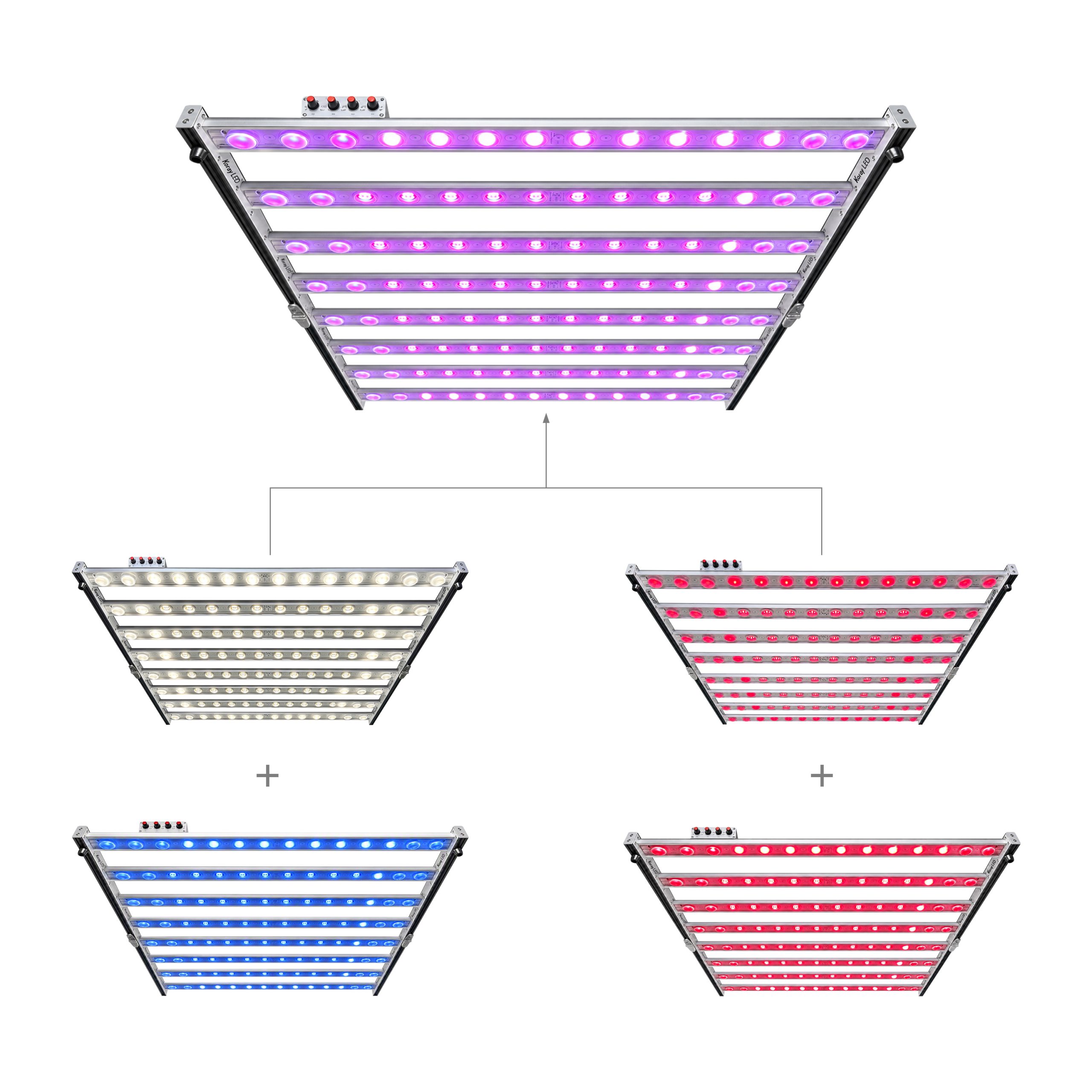
| Spectrum options | F7 / F7 + UVFR (UVA and far-red independently switched) | Official datasheet, spec table |
| Reflector | 90-type reflector protection as standard; 90D lens + reflector cup customizable | Official datasheet |
| Ingress protection | IP65 | Official datasheet |
| Peak PPFD | >1200 µmol/m²/s at 8 in (0.2 m) | Official datasheet |
| Rated lifespan | up to 50,000 hours (Ta ≤ 25 °C) | Official datasheet |
| Surface temperature rise | Tc 33 °K | Official datasheet |
| Operating temperature | -30 °C to 40 °C | Official datasheet |
| Data tolerance | ±10% | Official datasheet |
| Recommended irradiation distance | 0.2-0.5 m | Official datasheet |
| Tent compatibility | 16 in x 16 in, 24 in x 24 in, 32 in x 32 in | Official datasheet |
| Certifications | CE / RoHS / FCC | Official datasheet |
The datasheet pairs each mounting distance with a working footprint: 0.2 m at 0.5 x 0.5 m, 0.3 m at 0.7 x 0.7 m and 0.5 m at a 1 m diameter. The recommended irradiation distance is 0.2-0.5 m, and the module is listed for 16 in x 16 in, 24 in x 24 in and 32 in x 32 in grow tents.
How UVA and Far-Red Act on Plants
The red-to-far-red ratio is one of the signals plants use to read their light environment. Phytochromes are photoreceptor proteins that interconvert between two forms depending on whether they absorb red or far-red light, and the resulting balance controls stem elongation, leaf expansion and shade-avoidance responses; the molecular basis of this switch is reviewed by Legris, Ince and Fankhauser in Nature Communications (2019), open access via PubMed Central PMC6864062.
Separately, plants receive far more UVA radiation than UVB, and UVA acts as an abiotic stress that elicits secondary metabolites. A 2025 study in Plants reports significantly higher phenolic-compound expression under high UVA (Khanal et al., PMC11820885), and a 2022 study in Molecules found that supplemental UVA promoted phytochemical and glucosinolate biosynthesis in a leafy brassica (Hu et al., PMC9695120). The wider orchestration of secondary metabolites by blue and red light, including the photoreceptor classes that respond to each waveband, is summarised by Trivellini et al. in Plants (2023, PMC10223693).
The practical implication is that these responses are dose- and timing-dependent rather than simply beneficial or harmful. The point of an independently switched UVA and far-red channel is that the grower decides when those wavebands are present, instead of having them run with the main spectrum for the entire photoperiod.
PPFD, PAR and Lux: Three Numbers, Three Wavebands
Three different quantities appear side by side on the datasheet, and they do not move together. PPF and PPFD are defined over the photosynthetically active waveband of 400-700 nm, measured in micromoles per second and micromoles per square metre per second respectively (Purdue Extension publication HO-238-W, Purdue University: HO-238-W). Illuminance in lux is a photometric quantity weighted to the response of the human eye; the same published guidance states that foot-candle and lux readings are photometric units focused on people and are not appropriate for indicating plant photosynthesis. PAR expressed in milliwatts is a radiant-power measure and is not restricted to the 400-700 nm photon count in the same way: UVA and far-red energy sit largely outside that band.
This is why the two datasheet rows move in different directions as well as by different amounts. Turning on UVA and far-red raises PAR to 56,031 mW from 48,531 mW, while PPF falls to 269 µmol/s from 282 and PPFD at 0.2 m falls to 1302 µmol/m²/s from 1389. Out-of-band radiant energy rises while the in-band photon count is slightly reduced – the two metrics measure different things, and neither one alone describes the change.
Irradiation Distance: 0.2 m, 0.3 m and 0.5 m
The recommended irradiation distance is 0.2-0.5 m, and the datasheet gives a PPFD reading at each point along that range. For F7 the readings are 1389 µmol/m²/s at 0.2 m, 796 µmol/m²/s at 0.3 m and 345 µmol/m²/s at 0.5 m. Pure inverse-square falloff applies only to a point source: extending the distance from 0.2 m to 0.5 m multiplies it by 2.5, which for a point source would divide intensity by about 6.25 and give roughly 222 µmol/m²/s, well below the 345 µmol/m²/s actually listed. A 330 mm square panel close to the canopy behaves as an extended source, so the measured falloff is gentler than the point-source model.
Distance is therefore a coverage decision as much as an intensity decision: closer means more intensity over a smaller footprint, further means less intensity over a wider one. A planning derivation using the published DLI formula (Purdue Extension HO-238-W) shows how quickly the daily dose accumulates: 796 µmol/m²/s at 0.3 m over a 12-hour photoperiod is about 34.4 mol/m²/day, above the high-light class band of 12-18 mol/m²/day that the same source uses for classification. Where a crop does not need that much daily light, the fixture can be raised toward 0.5 m or the photoperiod shortened rather than run at full output at 0.2 m.
F7 vs F7+UVFR: Per-Dimension Comparison
This table places the two official spectrum rows side by side at every dimension the datasheet reports. All values come from the RX-GW45-K330 datasheet page 1 specification table.

| Parameter | F7 | F7 + UVFR | Difference |
|---|---|---|---|
| Power | 125 W | 137 W | 137 W vs 125 W |
| PPFD @ 0.2 m | 1389 µmol/m²/s | 1302 µmol/m²/s | -87 |
| Illuminance @ 0.2 m | 87,829 lx | 81,581 lx | -6,248 lx |
| PPFD @ 0.3 m | 796 µmol/m²/s | 731 µmol/m²/s | -65 |
| Illuminance @ 0.3 m | 50,477 lx | 45,855 lx | -4,622 lx |
| PPFD @ 0.5 m | 345 µmol/m²/s | 318 µmol/m²/s | -27 |
| Illuminance @ 0.5 m | 21,843 lx | 19,908 lx | -1,935 lx |
| Luminous flux | 17,689 lm | 16,699 lm | -990 lm |
| PPF | 282 µmol/s | 269 µmol/s | -13 |
| PAR | 48,531 mW | 56,031 mW | +7,500 mW |
| Efficacy | 2.3 µmol/J | not listed | – |
| Datasheet crop note | suitable for vegetative growth | turn on the switch UVA and far red | – |
The trade-off is precise: at 0.2 m the UV and far-red build gives up 87 µmol/m²/s of PPFD and 13 µmol/s of PPF in exchange for 7,500 mW more PAR, and it draws more power (137 W against 125 W). The datasheet lists an efficacy of 2.3 µmol/J for the F7 row and does not list a corresponding value for the F7 + UVFR row, so no efficacy comparison is made here. All figures carry the datasheet tolerance of ±10%.
Matching the Module to 16 in, 24 in and 32 in Tents
The datasheet lists the module for 16 in x 16 in, 24 in x 24 in and 32 in x 32 in grow tents, and the coverage diagram explains how one 330 mm square panel serves each size. At 0.3 m the working footprint is 0.7 x 0.7 m, about 27.6 in square, which already exceeds a 24 in tent; a single module mounted at 0.3 m therefore floods a 24 in tent from corner to corner with margin, and the PPFD at that height is 796 µmol/m²/s. A 32 in tent (about 0.81 m) needs either the wider 0.5 m setting, where coverage reaches a 1 m diameter at 345 µmol/m²/s, or the same module run higher than 0.3 m. A 16 in tent is the opposite case: at 0.2-0.3 m the module delivers 1389 or 796 µmol/m²/s into a very small footprint, so photoperiod or mounting height is the control that keeps the daily dose in range for the crop rather than the peak output of the fixture.
For medicinal herbs grown as high-light crops, the 0.2-0.3 m band gives the highest photon flux per fixture, while the 0.3-0.5 m band trades intensity for a wider, more even footprint. Where the same 330 mm panel is used across more than one tent size, setting it at 0.3 m covers the 16 in and 24 in tents generously and provides the PPFD that the 0.5 m setting supplies to a 32 in tent.

The scene above shows the configuration the coverage figures describe: one 330 x 330 x 60 mm square module suspended horizontally at the top of a 24 in x 24 in tent, its regular square array of round reflective-cup emitters facing down, with an independent switch and port visible on the side of the housing. The plants below sit about 0.3 m from the panel, inside the recommended 0.2-0.5 m band, and the square light patch spreads across the full tent floor.
FAQ
What PPFD does the RX-GW45-K330-90D deliver at 0.2 m?
The official datasheet lists 1389 µmol/m²/s for the F7 configuration and 1302 µmol/m²/s for F7 + UVFR at 0.2 m. The family figure quoted on the datasheet is a peak of more than 1200 µmol/m²/s at 8 in (0.2 m), with a tolerance of ±10%.
What changes when the UVA and far-red switch is turned on?
The official table shows PPFD at 0.2 m falling from 1389 to 1302 µmol/m²/s and PPF from 282 to 269 µmol/s, while PAR rises from 48,531 to 56,031 mW and power rises from 125 W to 137 W. The added UVA and far-red energy is largely outside the 400-700 nm band used for PPF and PPFD.
What is the difference between the F7 and F7+UVFR configurations?
F7 is the base full spectrum, listed as suitable for vegetative growth. F7 + UVFR adds UVA and far-red channels on an independent switch, so those wavebands can be turned on when needed rather than run for the whole photoperiod.
How far should the module be from the canopy?
The recommended irradiation distance is 0.2-0.5 m. At 0.2 m the footprint is 0.5 x 0.5 m, at 0.3 m it is 0.7 x 0.7 m, and at 0.5 m it reaches a 1 m diameter.
Which tent sizes does the module suit?
The datasheet lists 16 in x 16 in, 24 in x 24 in and 32 in x 32 in grow tents. One module at 0.3 m covers 0.7 x 0.7 m, which exceeds a 24 in tent, while a 32 in tent is served at the 0.5 m setting where coverage reaches a 1 m diameter.
Why Choose Koray
The RX-GW45-K330-90D is manufactured by Zhongshan Koray Opto-Electronic Co., Ltd., a company with 17 years of experience in LED grow-light manufacturing and 300+ domestic and foreign patents. This guide is built entirely from the official RX-GW45-K330 datasheet page 1 specification table and the official product page at koraylights.com.




Leave A Comment