

Overview: In Greenhouse Toplighting the Mounting Height Decides the Result, Not the Fixture Alone
Two identical lamps hung at two different heights in the same glass greenhouse are not interchangeable. PPF, the total photon output of a fixture expressed in micromoles per second, is a property of the hardware and does not change with the installation. PPFD is different: it counts the photons that arrive on one square metre per second, so it is a property of the installed geometry, and the distance from the fixture to the measurement plane, the emitting angle of the optics and the spacing along a bay all move it.
Guidance from protected-horticulture extension work makes the same point from the measurement side. Purdue University Extension’s publication Measuring Daily Light Integral in a Greenhouse (HO-238-W, Torres and Lopez, Department of Horticulture and Landscape Architecture) notes that photosynthetically active radiation covers the 400–700 nm waveband, that photometric units such as lux or foot-candles describe what the human eye sees rather than how much photosynthesis a crop can drive, that instantaneous light in horticultural research is normally measured in micromoles per square metre per second, and that those instantaneous readings have to be integrated across the day before they become a daily light integral. In the same way, a single PPFD number taken under one set of conditions says very little about a room with a different geometry.
Peer-reviewed work in the same area reaches the same conclusion from the experimental side. A study published in Frontiers in Plant Science and archived by the NIH PubMed Central – Supplemental Light-Emitting Diode Inter-Lighting Increases Tomato Fruit Growth Through Enhanced Photosynthetic Light Use Efficiency and Modulated Root Activity – reports that tomato fruit growth increased when extra photons were delivered by supplemental LEDs, with the effect attributed to improved photosynthetic light use efficiency. The dose actually delivered to the canopy, not the label on the fixture, is what drove the result, and the dose is exactly what a PPFD value with a stated measurement plane describes.
Official RX-G320 Figures and the Test Conditions Behind Them
The official RX-G320 series datasheet describes a 320 W linear fixture in the single-spectrum version of the platform, offered with a customisable light recipe: F75 is the listed spectrum, with F76 as the alternative recipe. The headline photon figure is a PPF of 930 µmol/s, and because that output is paired with 320 W, the datasheet’s comment column gives 2.9 µmol/J, the number to compare against other 320 W-class fixtures. The full specification table, with the condition attached to each value, is published in the official RX-G320 series datasheet PDF.
The PPFD values carry the most important condition of all. The same datasheet lists 645 µmol/m²/s at 0.5 m, 238 µmol/m²/s at 1 m and 117 µmol/m²/s at 1.5 m, all recorded in a darkroom no-reflection test. In other words the figures describe photons delivered directly from the fixture to the plane below, without any contribution from light bouncing back off walls, floor or reflective sheeting, and the datasheet notes that the values are for reference and that optical and electrical data carry a tolerance of ±10 %.
| Parameter | Official value (RX-G320, single-spectrum F75) | Test condition / note |
|---|---|---|
| Model series | RX-G320 | Single-spectrum version with customisable light recipe (F75; F76 is the alternative recipe) |
| Dimensions (L x W x H) | 1218 x 110 x 68 mm | Linear high-bay bar; structure drawing in mm |
| Power | 320 W at AC230 V; 330 W at AC120 V; 320 W at AC277 V | Power factor above 0.9 |
| Photon flux (PPF) | 930 µmol/s | Datasheet specification table |
| PPFD at 0.5 m | 645 µmol/m²/s | Darkroom no-reflection test; reference value, tolerance ±10 % |
| PPFD at 1 m | 238 µmol/m²/s | Same darkroom no-reflection protocol |
| PPFD at 1.5 m | 117 µmol/m²/s | Same darkroom no-reflection protocol |
| Efficacy | 2.9 µmol/J | Datasheet comment column and page bullet; consistent with 930 µmol/s ÷ 320 W |
| Beam angle | 110° | Light emitting angle |
| Recommended irradiation distance | 0.5 – 2 m | Overhead toplighting installation |
| Operating temperature | −10 to 40 °C | Datasheet specification table |
| Rated life | 50,000 h | Rated at ambient temperature Ta 25 °C |
| Data tolerance | ±10 % | Optical and electrical data |
| IP rating | IP65 | Official product page description |
| Dimming | RJ45 dimming socket, 0-10 V or 10 V PWM | Horti Guru smart control compatibility (datasheet) |
| Certification | CE / RoHS / FCC | Official product page |
Beam and service data complete the picture: a 110° emitting angle, a recommended irradiation distance of 0.5 to 2 m for overhead installation, an IP65 enclosure rating, and a rated life of 50,000 hours at an ambient temperature of 25 °C. The official product page adds the enclosure and compliance details used in the tables below.

Mounting-Height Comparison: 0.5 m versus 1 m versus 1.5 m
The three official measurement planes can be read as a comparison of what happens when the same fixture is hung higher, and the answer is that the centre intensity falls quickly while the illuminated footprint grows.
| Mounting height (official test plane) | Official PPFD | Share of the 0.5 m value | Inside the 0.5 – 2 m recommended band |
|---|---|---|---|
| 0.5 m | 645 µmol/m²/s | 100 % | Yes |
| 1 m | 238 µmol/m²/s | about 37 % | Yes |
| 1.5 m | 117 µmol/m²/s | about 18 % | Yes |
For orientation only, an arithmetic inverse-square estimate from the 0.5 m value would predict roughly 161 µmol/m²/s at 1 m, whereas the official darkroom measurement is 238 µmol/m²/s. That gap is a useful reminder that a bar with reflector-cup optics and a 110° emitting angle does not behave like a bare point source, so measured data should be preferred over a calculated guess whenever the number is going to set a hanging height.
In practice the table reads as follows. At 0.5 m the fixture delivers its highest published intensity over the smallest area; at 1 m and 1.5 m the pool widens and the centre value drops to roughly a third and then below a fifth of the 0.5 m value. All three planes still sit inside the official 0.5 to 2 m recommended band, so the decision is not about staying within specification but about how many fixtures a given bay needs to reach the intended intensity at the canopy.
Beam Geometry, Optics and Mechanical Facts
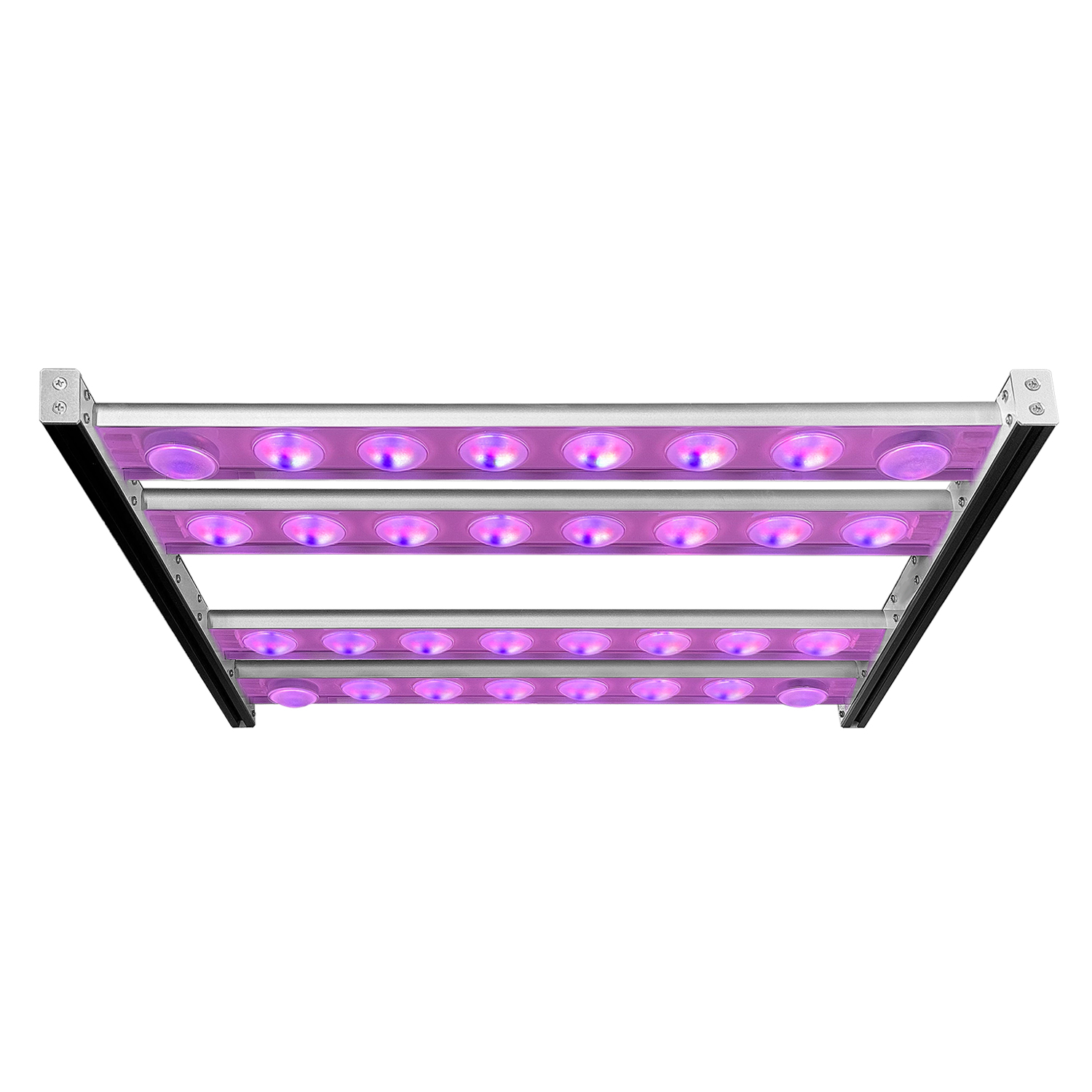
The 110° emitting angle and the reflector-cup optical design are the two elements that shape the light distribution described above. Heat is managed through an MCPCB of 1076 x 102 mm, a large aluminium-backed board that conducts heat away from the emitters, inside a silver-grey aluminium extrusion with heat-dissipating fins and black end caps, with a body length of 1218 mm and an overall size of 1218 x 110 x 68 mm. The fixture hangs from the greenhouse truss with the emitting face downwards.
The enclosure is rated IP65 on the official product page, which in the terms of IEC 60529 (Degrees of protection provided by enclosures) means dust-tight against the first digit and protected against water jets against the second. For a glasshouse where condensation and spray are normal, that rating is the mechanical specification that decides whether the fixture belongs in the growing space at all.
Electrical Interface, Dimming and Compliance
Power input is 320 W at AC230 V, with 330 W at AC120 V and 320 W at AC277 V given on the same datasheet, at a power factor above 0.9. Dimming is handled through an RJ45 dimming socket that accepts 0-10 V or 10 V PWM control, and the fixture is described as compatible with the Horti Guru smart control app, which is what allows a lighting bay to be scheduled and dimmed as a group instead of fixture by fixture. The official product page lists CE, RoHS and FCC, and the datasheet completes the environmental picture with an operating range of −10 to 40 °C and the 50,000-hour life at 25 °C ambient.
Dimension-by-Dimension Comparison Table for Selection
When two linear high-bays are placed side by side, the useful comparison happens one dimension at a time rather than on a single headline figure. The table below sets out the dimensions that carry decision weight for a greenhouse installation and what the official data states for each.
| Comparison dimension | What the official RX-G320 data states | Why it matters when fixtures are compared |
|---|---|---|
| Photon output | 930 µmol/s | Total emitted photons; only comparable against another fixture that also publishes PPF |
| Canopy intensity | 645 / 238 / 117 µmol/m²/s at 0.5 / 1 / 1.5 m | Meaningful only with the measurement plane and the no-reflection protocol attached |
| Efficacy | 2.9 µmol/J | Output per watt; the efficiency dimension of the comparison |
| Beam geometry | 110° emitting angle; 0.5 – 2 m recommended irradiation distance | Sets spacing along the bay and how many units a row needs |
| Enclosure | IP65; aluminium profile 1218 x 110 x 68 mm with heat-dissipating fins | Determines suitability for humid protected-cropping environments |
| Life basis | 50,000 h at Ta 25 °C | A life figure is only comparable when the ambient temperature is stated too |
| Control | RJ45 dimming socket, 0-10 V or 10 V PWM | Bay-level dimming and scheduling |
| Compliance | CE / RoHS / FCC | Documentation for tenders, imports and electrical approval |
Selection Guidance: Where a Single-Spectrum Linear High-Bay Fits
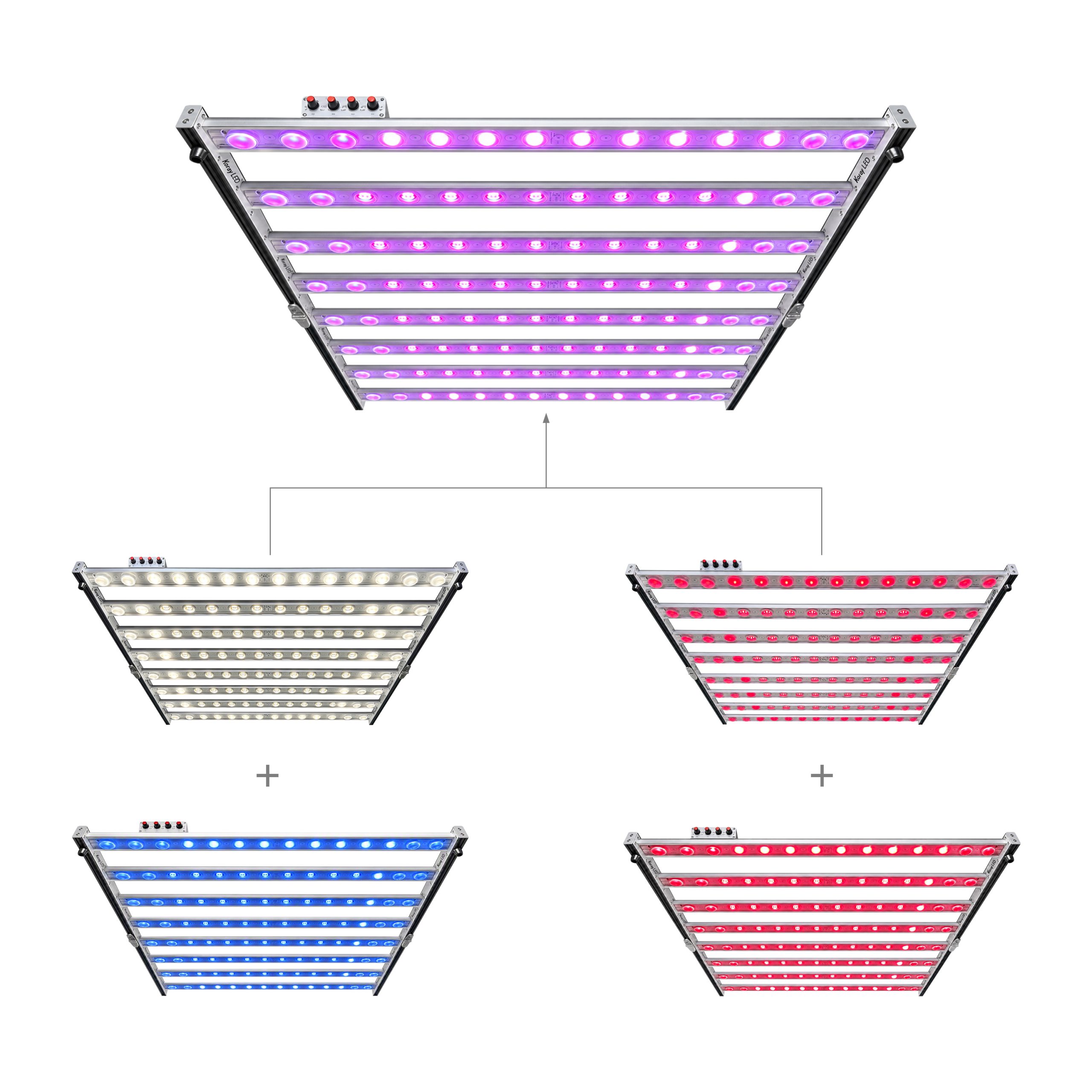
Because the fixture is a linear bar with a 110° beam and a 0.5 to 2 m recommended mounting band, it suits overhead-truss installations where the crop is grown in rows beneath the structure. The plant groups listed officially for the platform are tomato, loofah, vegetables, flowers, ornamentals, succulents and medicinal plants. The F75 recipe is described by the manufacturer as more red for flowering, which makes this version the one to consider in programmes that carry a crop through both the vegetative and the flowering stage under a single lamp type, with F76 as the alternative recipe on the same platform.
Two planning habits keep a decision anchored to evidence. Compare fixtures at the same stated plane, because a 645 µmol/m²/s figure at 0.5 m is not comparable with a figure taken in another room unless both used the same no-reflection protocol; and choose the fixture count from the height that can actually be installed, because on this fixture’s own published numbers doubling the mounting height from 0.5 m to 1 m removes about two thirds of the centre intensity.
For projects that need a documented supplier, the manufacturer’s own pages state 17 years of experience in plant-lighting development and manufacturing together with 300+ domestic and foreign patents, both recorded on the patent and certification page, while the company profile page describes a 2,800 square feet experimental planting area and markets including EU countries, USA, Canada, UK, Israel and Japan. Those two pages are the primary sources for the commercial statements and are worth reading before a specification is frozen.

Conclusion
The RX-G320 single-spectrum linear high-bay is a 320 W, 1218 x 110 x 68 mm fixture with an official PPF of 930 µmol/s, an official efficacy of 2.9 µmol/J, a 110° emitting angle and a 0.5 to 2 m recommended installation distance. Its most decision-relevant data are the three PPFD planes: 645 µmol/m²/s at 0.5 m, 238 at 1 m and 117 at 1.5 m, all measured in a darkroom no-reflection test. Hang height therefore sets the outcome more than any other single choice, and a comparison against another fixture is only meaningful when both numbers were measured at the same plane under the same conditions.
Frequently Asked Questions
What PPFD does the RX-G320 deliver at 0.5 m, 1 m and 1.5 m?
The official RX-G320 single-spectrum datasheet lists 645 µmol/m²/s at 0.5 m, 238 µmol/m²/s at 1 m and 117 µmol/m²/s at 1.5 m, all recorded in a darkroom no-reflection test with a stated tolerance of ±10 %.
Was the 930 µmol/s photon flux measured in a reflective room?
The PPFD values are published as a darkroom no-reflection test, so they exclude photons reflected back from walls, floor or sheeting. The photon flux of the fixture is 930 µmol/s, which pairs with 320 W to give the official 2.9 µmol/J figure.
What does an IP65 rating mean for a greenhouse fixture?
IP65 means the enclosure is dust-tight on the first digit and protected against water jets on the second digit, as defined by IEC 60529. It is the rating the official product page lists for this fixture, which is what supports installation in humid protected-cropping environments.
What are the rated life and operating temperature of the RX-G320?
50,000 hours rated life at an ambient temperature of 25 °C, with an operating temperature range of −10 to 40 °C, both stated on the official datasheet.
How many fixtures does one greenhouse bay need?
It depends on the intensity target at the canopy plane. On the official measurements one fixture reaches 645 µmol/m²/s at 0.5 m, 238 µmol/m²/s at 1 m and 117 µmol/m²/s at 1.5 m, so a bay that must hold intensity at a higher mounting height needs more units per row. The recommended irradiation distance band is 0.5 to 2 m.




Leave A Comment