
Overview
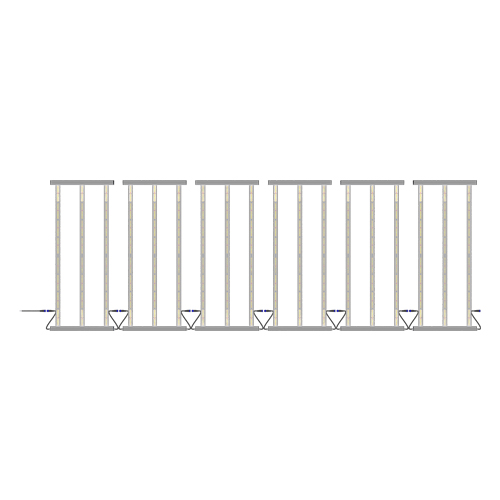
A two-by-four-foot shelf tier is the standard repeating unit in an indoor vertical farm: one 2 x 4 ft tray, one linear fixture above it and a fixed gap between fixture and canopy. Choosing the module for that unit comes down to three questions that exist before any brand is considered – how much photon flux the crop layer needs, how high the fixture must sit to deliver it evenly, and how many units can share a single electrical run. This guide works through those three questions for the RX-ARZ shelf-array family, using the official datasheet values for the RX-ARZ3, RX-ARZ4 and ARZ4-H and their DC counterparts; the smaller RX-ARZ2 appears only as the reference point for propagation tiers. All optical and electrical values below are taken from the official RX-ARZ datasheet specification table and the official DC specification sheet, and carry a factory tolerance of +/-10%.
Key Specifications
Every module in the family is rated to cover a 2 x 4 ft tray, and the following values are quoted family-wide on the official datasheet. Own-product figures are cross-referenced to the official RX-ARZ product page (koraylights.com) and to the datasheet specification table.
| Shared specification | Official value | Source |
|---|---|---|
| Tray coverage | 2 x 4 ft per fixture | Official RX-ARZ datasheet, spec table |
| Peak efficacy | up to 2.6 µmol/J | Official RX-ARZ datasheet, spec table |
| Ingress protection | IP64 | Official RX-ARZ datasheet, spec table |
| Power supply | built-in LED power supply; no external DC connection wires | Official RX-ARZ datasheet |
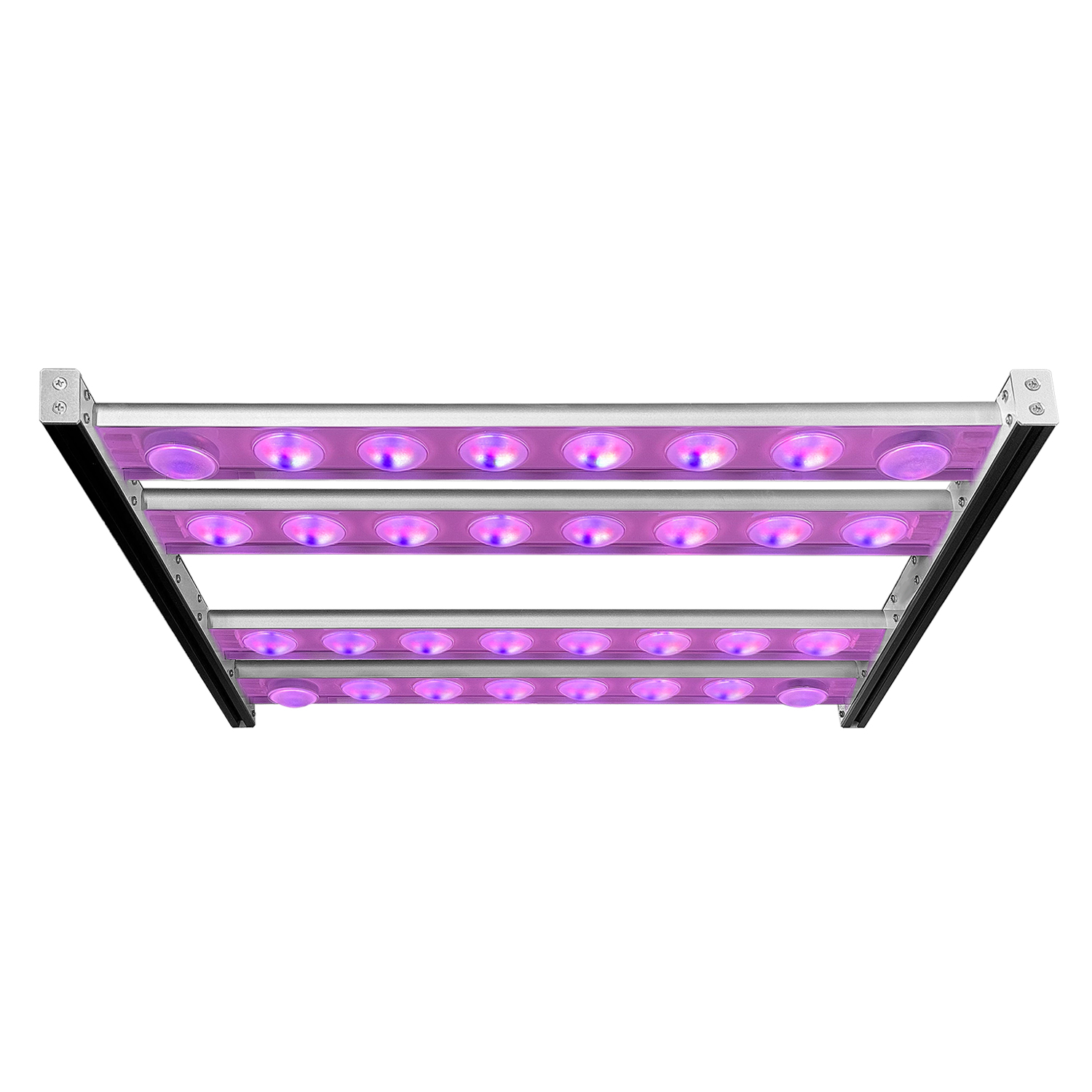
| Optical detail | condensing lenses set at both ends of the array | Official RX-ARZ datasheet |
| Rated lifespan | 50,000 hours (Ta 25 °C) | Official RX-ARZ datasheet |
| Warranty | 3 years | Official RX-ARZ datasheet |
| Certifications | CE / RoHS / ETL | Official RX-ARZ datasheet |
| Max case working temperature | Tc 28 °K | Official RX-ARZ datasheet |
| Operating temperature | -30 °C to 40 °C | Official RX-ARZ datasheet |
| Data tolerance | ±10% | Official RX-ARZ datasheet |
| Recommended mounting height | 6-12 inches above canopy | Official RX-ARZ datasheet |
Two mechanical notes follow from the datasheet. First, all three in-scope models share one enclosure size, 1240 x 520 x 35 mm (48.8 in x 20.5 in x 1.2 in), so a rack designed for one of them accepts the others without re-machining the frame; the reference RX-ARZ2 is narrower at 1240 x 398 x 35 mm (48.8 in x 15.7 in x 1.4 in). Second, the module integrates its LED power supply, so a shelf tier needs no separate driver box and no external DC wiring run.
Uniformity on a Shelf Tier: Why the Ends Are the Hard Part
A shelf tier is an unusual optical problem. The fixture sits only about 150-300 mm above the canopy, close enough to be efficient, yet that same closeness exposes every non-uniformity in the emitter layout. Intensity from a small source falls off with the square of the distance, so a tray at a fixed height below a 1240 mm-long array sees a bright band directly beneath the array and lower values toward the tray ends and outer edges. Canopy uniformity is the ratio between the lowest and the highest PPFD measured across the growing area, and it is this ratio – not the peak value – that decides whether a tray of microgreens grows at one rate or several. The datasheet answers the problem optically: condensing lenses are fitted at both ends of each array so that light which would otherwise spill outward is redirected over the tray ends. The underlying practice of measuring light this way comes from published plant-science guidance, in which PPFD is defined over the photosynthetically active waveband of 400-700 nm and expressed in micromoles per square metre per second (Purdue Extension publication HO-238-W, Purdue University).
Mounting Height: the PPFD Drop Between 6, 8 and 12 Inches
The family's official recommended mounting height is 6 to 12 inches (about 150 to 300 mm) above the canopy, and that band is not arbitrary. For a true point source, doubling the distance to the canopy divides the irradiance by four; the published treatment of inverse-square falloff for plant lighting is given in Purdue Extension HO-238-W. A 2 x 4 ft array, however, is not a point source at these distances. Its emitting area is large relative to the gap, so the measured falloff is gentler than the point-source model predicts. The official datasheet shows this directly: the reference RX-ARZ2 reads 142 µmol/m²/s at 0.2 m and 114 µmol/m²/s at 0.3 m – a drop of roughly 20% when the distance grows by half, where a point-source model would predict a loss of about 56%. The same extended-source behaviour appears higher in the range, where the ARZ4-H measures 482 µmol/m²/s at 0.15 m and 446 µmol/m²/s at 0.3 m, a fall of only about 7.5% as the distance doubles.
Mounting height therefore selects a working point on a trade-off curve rather than being a single correct value. Within the 6-12 in band, moving the fixture down buys photon flux quickly but shrinks the evenly lit area; moving it up flattens the distribution and stretches the useful footprint at the cost of peak intensity.
AC and DC Shelf-Array Modules: One Optical Platform, Two Electrical Runs
Two electrical architectures are published for the same optical platform. The AC modules in the datasheet specification table carry a built-in LED power supply and are rated for a 277 V input, so each fixture connects directly with no separate driver. The datasheet also includes separate 120 V and 277 V PPFD test pages, confirming that both inputs are tested, while the specification table itself lists the 277 V rating. The DC modules are specified for series connection, and their maximum series count falls as per-module power rises. Maximum series connection is the number of fixtures that may be wired in one electrical run from a single supply; it is a wiring limit, not an optical one. The official DC specification sheet gives 10 units for the reference RX-ARZ2 DC, 6 for the RX-ARZ3 DC, 5 for the RX-ARZ4 DC and 3 for the ARZ4-H DC. A rack of N tiers therefore translates directly into a number of electrical runs, and the higher-power modules near the bottom of the range need more runs for the same tier count.
AC vs DC Comparison Table: Power, PPF and Daisy-Chain Limits
The table below places the AC and DC specification rows side by side for each model. All values are official datasheet figures at the stated measurement height; the close-range PPFD column also shows the second official measurement height in brackets.
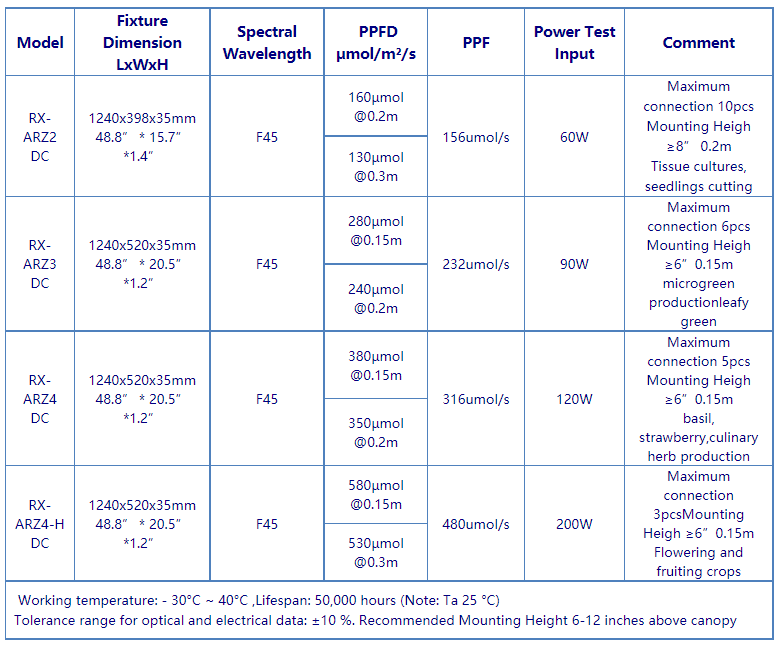
| Model | AC power | AC PPF | AC PPFD (close range / second height) | DC power | DC PPF | DC PPFD (close range / second height) | DC max series |
|---|---|---|---|---|---|---|---|
| RX-ARZ2 (reference) | 50 W / 277 V | 133 µmol/s | 142 @0.2 m / 114 @0.3 m | 60 W | 156 µmol/s | 160 @0.2 m / 130 @0.3 m | 10 pcs |
| RX-ARZ3 | 85 W / 277 V | 232 µmol/s | 274 @0.15 m / 238 @0.2 m | 90 W | 232 µmol/s | 280 @0.15 m / 240 @0.2 m | 6 pcs |
| RX-ARZ4 | 120 W / 277 V | 316 µmol/s | 372 @0.15 m / 344 @0.2 m | 120 W | 316 µmol/s | 380 @0.15 m / 350 @0.2 m | 5 pcs |
| ARZ4-H | 160 W / 277 V | 409 µmol/s | 482 @0.15 m / 446 @0.3 m | 200 W | 480 µmol/s | 580 @0.15 m / 530 @0.3 m | 3 pcs |
Measurement heights differ by row: the RX-ARZ2 is quoted at 0.2 m and 0.3 m; the RX-ARZ3 and RX-ARZ4 at 0.15 m and 0.2 m; the ARZ4-H at 0.15 m and 0.3 m. Values are not interchangeable across rows. All figures carry the datasheet tolerance of ±10%.
Two patterns stand out. PPF is identical between the AC and DC rows for the RX-ARZ3 (232 µmol/s) and the RX-ARZ4 (316 µmol/s), while the DC rows deliver slightly higher PPFD at the same height – 280 against 274 µmol/m²/s at 0.15 m for the ARZ3, and 380 against 372 µmol/m²/s for the ARZ4. The highest-output row, the ARZ4-H DC, steps up to 200 W and 480 µmol/s, and the DC sheet annotates it for flowering and fruiting crops. Because the series limit for that row is 3 units, a fully loaded run of ARZ4-H DC carries 600 W (3 x 200 W), which is the electrical ceiling to design the rack supply around.
Applying This to a Rack Build
Model selection follows the official crop lists rather than peak PPFD alone. For microgreens, leafy greens and ornamental crops the datasheet assigns the RX-ARZ3, whose 238 µmol/m²/s at 0.2 m sits inside the published daily-light-integral range for microgreens of about 9-16 mol/m²/day (Virginia Cooperative Extension, SPES-756, Virginia Tech). A planning derivation using the published DLI formula for indoor lighting – DLI (mol/m²/day) = PPFD (µmol/m²/s) x photoperiod (h) x 0.0036 – gives about 13.7 mol/m²/day for 238 µmol/m²/s over a 16-hour photoperiod, near the middle of that range. For basil, strawberry and culinary herbs the datasheet assigns the RX-ARZ4 (344 µmol/m²/s at 0.2 m) or the ARZ4-H (482 µmol/m²/s at 0.15 m). Propagation tiers – tissue cultures, seedlings, cuttings and starter pots – are the remit of the reference RX-ARZ2 at 142 µmol/m²/s and a minimum 8 in height. Flowering and fruiting crops are annotated on the DC sheet for the ARZ4-H DC at 200 W.
Three build rules follow. Set the mounting height inside the official 6-12 in band and record the chosen gap, because it fixes both peak PPFD and footprint. Choose AC where a rack has one powered feed per tier and DC where a bus-fed run is preferred, sizing the number of runs from the series limits above. Finally, check the delivered DLI against the crop target before finalising photoperiod, since a peak PPFD figure alone does not describe the daily dose.
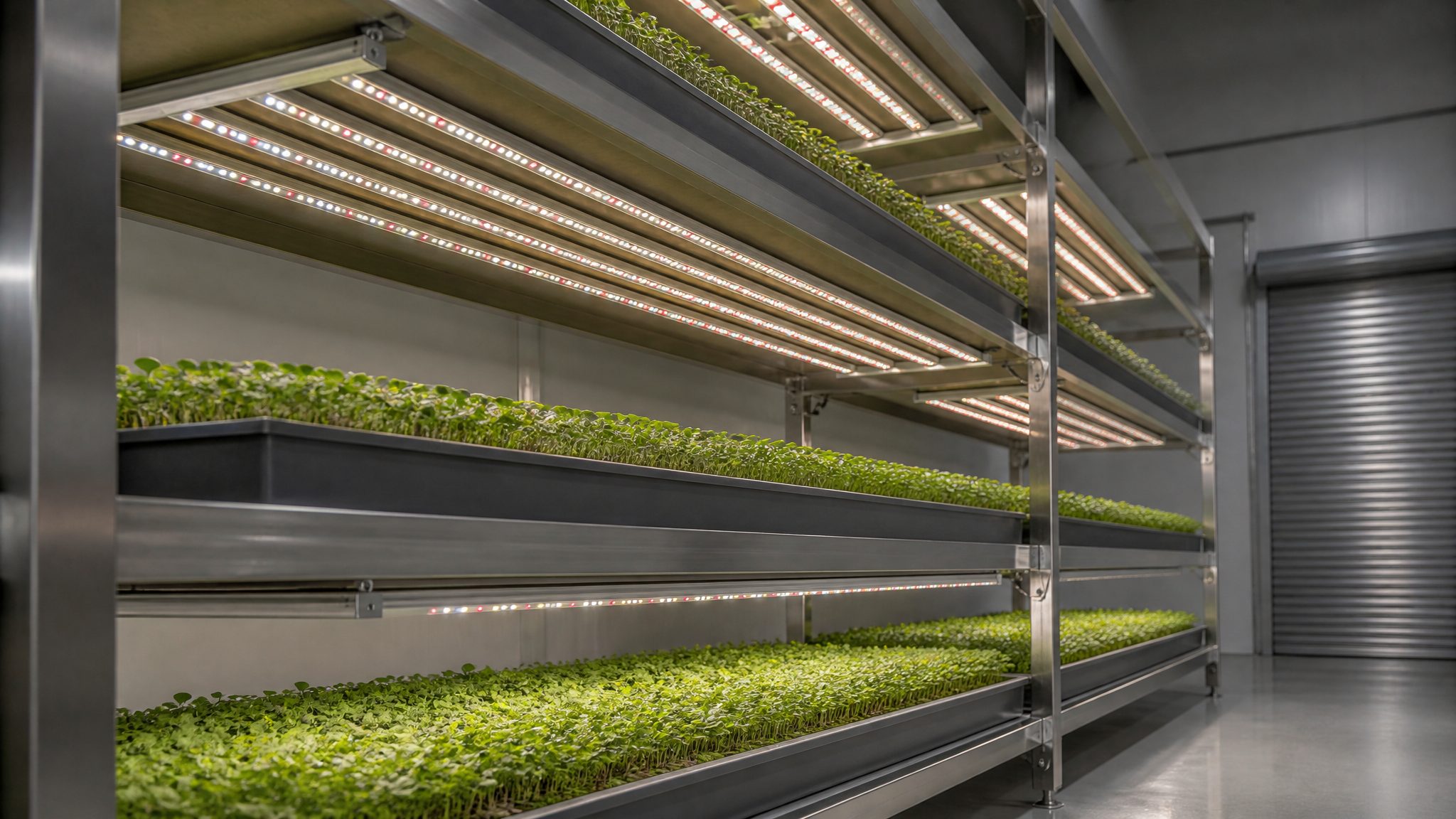
The scene above shows the configuration these figures describe: a four-tier rack in a closed production room, one thin array module mounted horizontally under each shelf and facing down over a 2 x 4 ft tray, with the ends of each module showing the condensing-lens termination and no external driver box anywhere on the frame. The light forms a distinct band between module and tray on every tier, and the trays hold uniformly short microgreens and leafy greens.
FAQ
What PPFD does the RX-ARZ4 deliver at 0.15 m and 0.2 m?
The official AC datasheet lists 372 µmol/m²/s at 0.15 m and 344 µmol/m²/s at 0.2 m for the RX-ARZ4, with a PPF of 316 µmol/s at 120 W / 277 V and a factory tolerance of ±10%.
How do the AC and DC versions of a shelf module differ?
They share the optical platform. The AC rows list a built-in LED power supply and a 277 V input; the DC rows are specified for series connection, with a maximum of 6 units for the RX-ARZ3 DC, 5 for the RX-ARZ4 DC and 3 for the ARZ4-H DC. PPF is identical between the AC and DC rows for the RX-ARZ3 (232 µmol/s) and the RX-ARZ4 (316 µmol/s).
What is the maximum daisy-chain length for each model?
The official DC specification sheet lists 10 units for the reference RX-ARZ2 DC, 6 for the RX-ARZ3 DC, 5 for the RX-ARZ4 DC and 3 for the ARZ4-H DC.
What mounting height should be used?
The datasheet recommends 6-12 inches above the canopy. Within that band a lower setting raises peak PPFD and narrows the evenly lit area, while a higher setting flattens the distribution and widens the footprint.
Which model suits microgreens compared with basil?
The datasheet assigns the RX-ARZ3 (238 µmol/m²/s at 0.2 m) to microgreen production, leafy greens and ornamental crops, and the RX-ARZ4 (344 µmol/m²/s at 0.2 m) or ARZ4-H (482 µmol/m²/s at 0.15 m) to basil, strawberry and culinary herbs.
Why Choose Koray
The RX-ARZ shelf-array family is manufactured by Zhongshan Koray Opto-Electronic Co., Ltd., a company with 17 years of experience in LED grow-light manufacturing and 300+ domestic and foreign patents. This guide is built entirely from the official RX-ARZ datasheet specification table, the official DC specification sheet and the official product page at koraylights.com.




Leave A Comment