

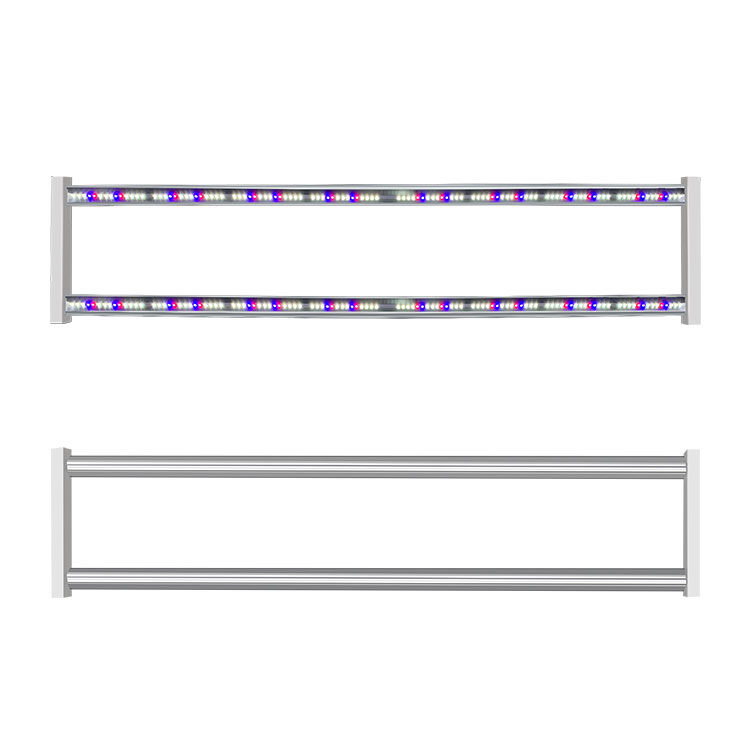
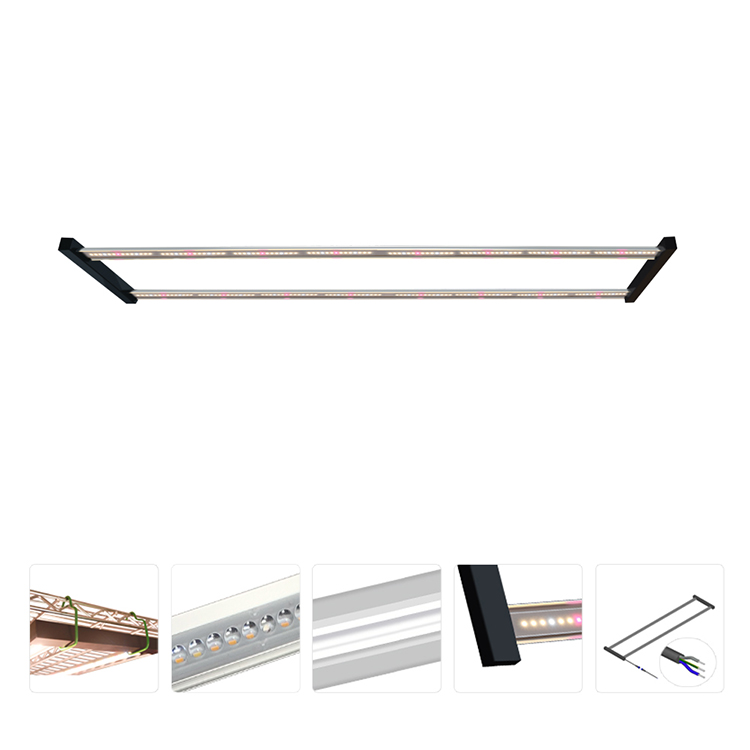
A container hydroponic grow light is a luminaire built to light a rack or shelf inside a repurposed shipping container or a plant factory rather than a wide greenhouse bay. The RX-ARZ2H, listed as model ARZ2H-F22 on its official product page (https://koraylights.com/product/arz2h-f22-container-hydroponic-vegetables-farm-plant-factory-micro-green-plant-grow-lights/), is a double-row LED plant light whose published figures are organized around exactly that setting: a coverage of 1.3 ft × 4 ft (0.4 m × 1.2 m) per fixture, a PPFD of 210–280 µmol/m²/s at a hanging height of 6–12 in, an efficacy of up to 2.4 µmol/J on a Samsung LED emitter, and an input of AC100–240 V at 56 W. This article reads those numbers as coverage and photon-density calibers, explains what the condenser lens is doing in a confined space, and keeps the figures that are published separate from the ones that are not.
What a container hydroponic grow light is
A container hydroponic grow light is a fixture sized to a single rack tier or shelf run inside a controlled, enclosed growing space. Photosynthetically active radiation is the 400–700 nm waveband the photosynthetic apparatus absorbs, and a fixture’s output in that band is counted as photon flux; how much of it lands on the canopy is the photon flux density, PPFD, reported per square metre per second. Cornell University’s Controlled Environment Agriculture program (https://cea.cals.cornell.edu/) works on the indoor and controlled-environment production systems — including container and vertical farms — where light, temperature and humidity are managed together, and in those systems the light’s coverage footprint and its uniformity across that footprint matter as much as its headline output. The University of Florida’s Institute of Food and Agricultural Sciences Extension publishes peer-reviewed soilless-production guidance in EDIS (https://edis.ifas.ufl.edu/publication/SS478), where the same light-and-environment management logic is applied to hydroponic systems.
The container setting imposes two constraints that a greenhouse luminaire does not face. Headroom between tiers is limited, so the gap between the light and the canopy is short and the light distribution has to be usable over that short distance. And the footprint is fixed by the rack, so a fixture’s value is decided largely by whether its published coverage matches the shelf it is meant to light. Both constraints appear directly in this fixture’s published specification.
Coverage per fixture: 1.3 ft × 4 ft
The page publishes a coverage of 1.3 ft × 4 ft, or 0.4 m × 1.2 m, per fixture. Coverage is the horizontal area over which the fixture is intended to deliver its published light, so a 1.3 ft × 4 ft figure describes a strip roughly 0.4 m deep and 1.2 m long — the shape of a narrow rack tier or a shelf run rather than a square room. The rectangle matters: a fixture with a long, narrow coverage matches a long, narrow shelf, and a plan that lays these fixtures end to end can cover a full tier from repeated 1.2 m lengths.
Because coverage and PPFD are two different statements, the coverage figure alone does not say how evenly the light is spread. The page publishes the PPFD range for the fixture and the spacing over which it applies, described below, but it does not publish a uniformity map or a full distribution grid; those are not specified in the official datasheet and should be requested when evenness across the shelf is a design requirement.
PPFD and hanging height: 210–280 µmol/m²/s at 6–12 in
The page publishes a PPFD of 210–280 µmol/m²/s at a hanging height of 6–12 in. PPFD is the photosynthetically active photon flux density reaching a surface, measured in micromoles per square metre per second, and it is an instantaneous rate rather than a daily total. Two things make this figure usable rather than vague: it is given as a range across a stated height band, and the band is short enough to sit inside a container tier.
The height band carries the physics. PPFD falls as the distance from the emitter grows, so a fixture quoted from 210 to 280 µmol/m²/s over 6–12 in is giving the low end of its range at the far edge of that band and the high end closer in. That is why the figure should always travel with its height: the same fixture quoted at 280 µmol/m²/s is a statement about a short spacing, and a plan that mounts it at 12 in should expect the lower end of the published range. The page does not publish a recommended daily light integral, which is not specified in the official datasheet, so the photoperiod has to be planned from the target crop rather than from a stated DLI.
Condenser lens optics and reduced PPFD attenuation
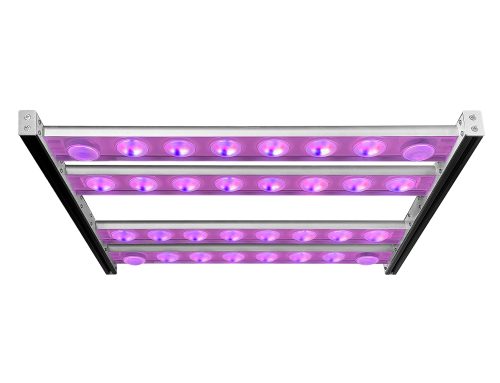
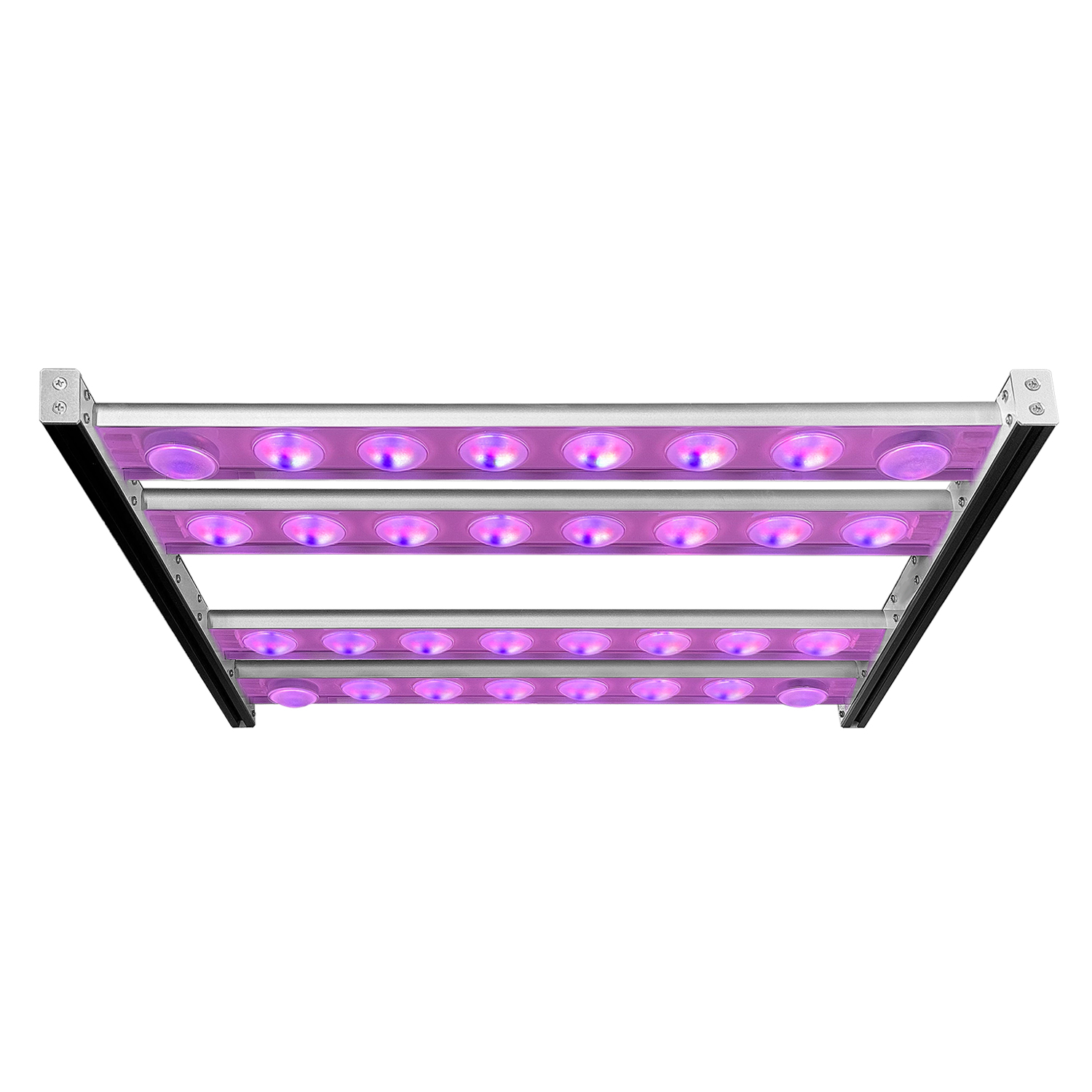
The page describes the fixture’s optics as a condenser lens, credited with better penetration and reduced PPFD attenuation, and it gives an applicable lamp-to-canopy spacing of 0.2–0.5 m. PPFD attenuation is the loss of photon flux density as light travels away from the source and spreads out; a condenser lens narrows the beam so that a larger share of the emitted photons is directed into the canopy zone instead of being spread thinly across the whole space. In a container, where walls are close and wasted light still costs energy, directing the beam this way is what makes a short mounting band workable.
The published spacing of 0.2–0.5 m converts to roughly 7.9–19.7 in, which brackets the 6–12 in mounting band quoted for the PPFD figures. Those two numbers describe the same short working zone from two directions, and the page does not publish a beam angle value for the lens; the beam angle is not specified in the official datasheet and should be requested if the plan depends on a precise beam width.
The 2.4 µmol/J figure behind a 56 W double-row bar
The page publishes an efficacy of up to 2.4 µmol/J for this fixture, whose emitter is described as Samsung LED and whose published input is AC100–240 V at 56 W. Photon efficacy is the ratio of emitted photosynthetically active photon flux to electrical power drawn, in micromoles per joule, so 2.4 µmol/J states how many micromoles of PAR photons the fixture returns for each joule the circuit supplies. The “up to” qualifies it as a best-case value within the rated conditions.
The 56 W figure is the denominator behind that efficacy, which is why the two belong together: at 56 W, an efficacy of up to 2.4 µmol/J corresponds to a photon output in the range implied by that product, and it is the reason a 56 W double-row bar can be repeated across a tier without the electrical draw of a room-scale fixture. The page does not publish the measurement drive current or case temperature behind the 2.4 µmol/J value, and it does not publish a power-factor figure; those are not specified in the official datasheet.
Daisy-chaining: 10 fixtures at 120 VAC, 20 at 230 VAC
The page publishes a maximum daisy-chain of 10 pieces at 120 VAC and 20 pieces at 230 VAC. A daisy-chain is a run in which fixtures are linked from one to the next on a single supply, so the two numbers state how many units can share a circuit before the run must be split. The difference between the two figures follows from the supply: at the higher mains voltage the same power draw corresponds to a lower current per fixture, so roughly twice as many units fit on the chain.
For a container build the practical reading is that the chain length is a function of the site’s voltage, not of the fixture alone. A tier using 120 VAC should plan around runs of ten units, while the same tier on 230 VAC can carry runs of twenty. The page publishes the chain limits and the input range but does not publish a recommended breaker or conductor sizing, which should come from the electrical design for the specific site.
35,000 hours, a 2-year warranty and certifications
Service life is published as 35,000 hours, and the warranty is published as 2 years. A lifespan figure of this kind is a projected operating duration under defined conditions, so it should be read with its test conditions rather than as a calendar promise; the page gives the hours but not the full test conditions, so the reference current and temperature behind the 35,000-hour figure are among the items to confirm. The 2-year warranty is a coverage period, distinct from the lifespan estimate, and both are quoted here exactly as published.
The fixture is listed with CE, RoHS and FCC certification, addressing conformity, hazardous-substance restriction and electromagnetic compatibility respectively. The page does not publish a CRI value or an IP rating; both are not specified in the official datasheet, and a wet or wash-down position in a container should have the ingress protection confirmed before installation.
Container-farm calibers side by side
| Dimension | Official figure | What it sets in a container plan |
|---|---|---|
| Coverage per fixture | 1.3 ft × 4 ft (0.4 m × 1.2 m) | size of the rack strip one fixture is intended to light |
| PPFD | 210–280 µmol/m²/s | instantaneous photon density across the stated height band |
| Hanging height | 6–12 in | the short spacing over which the PPFD figures apply |
| Efficacy | up to 2.4 µmol/J | photons returned per joule of electrical input |
| Emitter | Samsung LED | the emitter family behind the efficacy figure |
| Optics | condenser lens; 0.2–0.5 m spacing | reduced attenuation so a short mounting band works |
| Power | 56 W | electrical input per fixture |
| Input voltage | AC100–240 V | the mains classes the fixture accepts |
| Daisy-chain | 10 pcs at 120 VAC / 20 pcs at 230 VAC | units per supply run before the chain must be split |
| Service life | 35,000 hours | projected operating duration under stated conditions |
| Warranty | 2 years | coverage period, separate from the lifespan estimate |
| Certifications | CE, RoHS, FCC | conformity, substance and EMC marks |
The table keeps each published figure on its own row and states what that figure sets in a container plan, so the specification can be read dimension by dimension rather than as a single headline output.
Fit-for-purpose scenarios
With the calibers above settled, this fixture’s fit is a matter of matching its published coverage to the rack and its published height band to the tier’s headroom. A 1.3 ft × 4 ft coverage suits a narrow shelf run, and the 6–12 in mounting band suits a low tier where a short, directed throw is an advantage rather than a limitation. The daisy-chain limits let a container built on 230 VAC carry longer runs of twenty than an equivalent 120 VAC build planned around ten, and the listed applications — hydroponic vegetables, plant factories, container planting and vertical agriculture — describe where the page intends the fixture to be used. Koray, drawing on a 17-year record in horticultural lighting, publishes these figures for the ARZ2H-F22 as read above; where a plan depends on a value the page does not print, the sensible move is to request it before the layout is fixed rather than to assume it.
What to confirm in writing before specifying
The following items are not specified in the official datasheet and should be requested from the supplier alongside the standard figures: the beam angle value, the IP rating, the CRI, the recommended daily light integral, a PPFD uniformity or distribution map at the intended height, the drive current and case temperature behind the 2.4 µmol/J value, the test conditions behind the 35,000-hour lifespan, and any recommended conductor or breaker sizing for the daisy-chain. Requesting them together keeps the mechanical layout, the photometric plan and the electrical record consistent from the start.
Frequently asked questions
How much area does one fixture cover?
The page publishes a coverage of 1.3 ft × 4 ft, or 0.4 m × 1.2 m, per fixture — a long, narrow strip suited to a rack tier or a shelf run rather than a square bay. Coverage states the intended footprint; evenness across that footprint is not published, so a uniformity map should be requested if it is a design requirement.
At what height, and for how long, do the PPFD figures apply?
The published PPFD is 210–280 µmol/m²/s at a hanging height of 6–12 in, an instantaneous photon flux density rather than a daily total. The page does not publish a recommended daily light integral, which is not specified in the official datasheet, so the photoperiod has to be planned from the target crop.
What is the condenser lens doing?
The page describes the optics as a condenser lens credited with better penetration and reduced PPFD attenuation, with an applicable spacing of 0.2–0.5 m. PPFD attenuation is the loss of light density as the beam spreads; narrowing it directs more photons into the canopy over a short throw, which is what makes the 6–12 in band usable. The beam angle value itself is not specified in the official datasheet.
How many fixtures can be daisy-chained?
The page publishes a maximum of 10 pieces at 120 VAC and 20 pieces at 230 VAC. The difference follows from the supply: at the higher mains voltage the same power draw is a lower current per fixture, so about twice as many fit on a run. The page does not publish recommended conductor or breaker sizing.
What should be confirmed in writing before ordering?
Request the beam angle, the IP rating, the CRI, the recommended daily light integral, a PPFD uniformity map at the intended height, the drive current and case temperature behind the 2.4 µmol/J figure, and the test conditions behind the 35,000-hour lifespan. These are the values the page does not publish, and they should be recorded before the layout is frozen.


Leave A Comment