
Why Hanging Distance Matters for Indoor Grow Lights
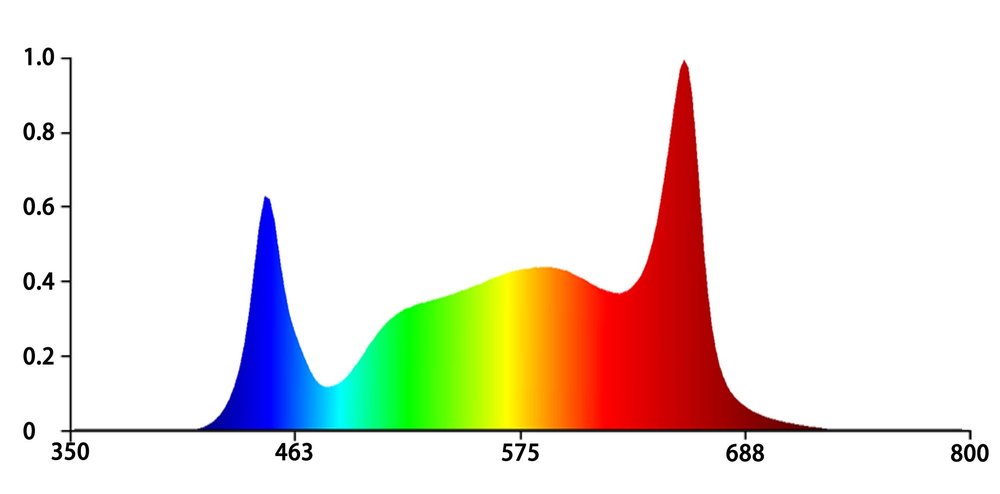
One of the most common questions new indoor growers ask is how far the grow light should be from the plant canopy. This is not a trivial question. The distance between the light source and the plants directly determines the photosynthetic photon flux density (PPFD) that reaches the leaf surface, and PPFD is the primary driver of photosynthetic rate. Too close, and the light intensity may exceed what the plants can use, leading to photoinhibition, leaf bleaching, and heat stress. Too far, and the plants receive insufficient light, resulting in etiolation, leggy growth, reduced flowering, and lower overall yields. Finding the optimal hanging distance is therefore essential for getting the best results from your RX-PAR38 grow light.
The Koray Lighting RX-PAR38 is a 60-watt professional LED grow lamp with a focused 60-degree beam angle and an E27 base, designed for single-point top lighting in grow tents, shelving units, and greenhouse benches. Its compact PAR38 form factor and high-efficiency LED array deliver strong PPFD at close range, but this also means that the distance must be managed carefully to avoid overexposure at the center of the beam. In this guide, we will walk through the science of light falloff, provide specific distance recommendations for different plant types and growth stages, and share practical tips for measuring and adjusting your setup to achieve the best possible results.
Understanding Light Intensity and the Inverse Square Law
The fundamental principle governing how light intensity changes with distance is the inverse square law. This law states that the intensity of light from a point source decreases proportionally to the square of the distance from the source. In practical terms, this means that if you double the distance between the light and the plant canopy, the PPFD drops to approximately one-quarter of its previous value. For example, if the RX-PAR38 delivers 800 micromoles per square meter per second at 0.2 meters, moving it to 0.4 meters would reduce the PPFD to roughly 200 micromoles per square meter per second.
However, the inverse square law applies strictly to point sources in free space. In real-world growing environments, several factors modify this relationship. The 60-degree beam angle of the RX-PAR38 means that the light is not radiating equally in all directions like a bare bulb. Instead, the optics concentrate the photons into a defined cone, which extends the effective range of the light and slows the rate of intensity falloff compared to an unshielded source. Additionally, reflective surfaces in the growing environment, such as mylar-lined tent walls, white painted surfaces, or reflective film, bounce stray photons back toward the canopy, partially compensating for the intensity loss at the edges. Despite these modifying factors, the inverse square law provides a useful baseline for understanding why small changes in distance have large effects on the light received by your plants.
Recommended Distances for Different Growth Stages
The optimal hanging distance for the RX-PAR38 depends primarily on the growth stage of your plants and their inherent light requirements. For seedlings, cuttings, and young clones, the photosynthetic apparatus is still developing, and the plants are highly sensitive to both excessive light intensity and heat. A distance of 0.4 to 0.6 meters is recommended for this stage, providing a gentle PPFD of 150 to 300 micromoles per square meter per second that supports steady growth without causing stress. At this distance, the 60-degree beam of the RX-PAR38 covers a circular area approximately 0.5 to 0.7 meters in diameter, which is ideal for a standard seedling tray or a small propagation bench.
For vegetative growth, when plants are actively producing new leaves and stems, the light requirement increases significantly. Most vegetables, herbs, and ornamental plants perform best at a PPFD of 300 to 600 micromoles per square meter per second during this stage. With the RX-PAR38, this corresponds to a hanging distance of approximately 0.2 to 0.4 meters. At 0.3 meters, the RX-PAR38 delivers a strong, even PPFD across its coverage area, providing ample energy for robust vegetative development. For high-light crops like tomatoes, peppers, and cannabis during the flowering stage, where PPFD targets of 600 to 1000 micromoles per square meter per second are common, the recommended distance narrows to 0.15 to 0.25 meters. At these close distances, the focused 60-degree beam delivers maximum intensity, but care must be taken to monitor canopy temperature and ensure adequate air circulation.
How the 60-Degree Beam Angle Affects Coverage
The 60-degree beam angle of the RX-PAR38 is a deliberate design choice that distinguishes it from grow lights with wider beam angles such as 90 or 120 degrees. A narrower beam concentrates the available photons into a smaller area, increasing the PPFD at the center of the coverage zone but reducing the uniformity at the edges. This makes the RX-PAR38 particularly well-suited for applications where a single fixture is used to light a defined area, such as a shelf, a grow tent section, or a specific plant cluster. The concentrated beam also means that the light penetrates more effectively into the canopy, reaching lower leaves that would otherwise be shaded by the upper foliage.
For growers who need to cover a wider area, the solution is to use multiple RX-PAR38 fixtures spaced appropriately. Because each fixture has a defined coverage footprint at any given distance, you can calculate the number of fixtures needed and their spacing to achieve uniform PPFD across the entire growing area. As a general rule, when using multiple RX-PAR38 lamps at a distance of 0.3 meters, space the fixtures approximately 0.4 to 0.5 meters apart center-to-center to ensure adequate overlap and minimize dark spots between the beams. Koray Lighting also offers the PAR30 variant with a slightly smaller form factor for applications where space is more constrained, and both models share the same high-quality constant-current driver and spectrum options.
Practical Tips for Measuring and Adjusting Distance
The most reliable way to determine the optimal hanging distance for your specific setup is to measure the PPFD at the canopy level using a PAR meter. While dedicated PAR meters can be expensive, there are affordable smartphone-based alternatives that provide reasonable accuracy for hobbyist use. Place the sensor at the center of the coverage area, directly beneath the RX-PAR38, and record the PPFD reading. Then move the sensor to the edge of the coverage area and record that reading as well. The difference between the center and edge readings tells you how uniform the light distribution is at that distance. If the center reading is much higher than the edge, consider raising the light slightly to improve uniformity, even if it means a small reduction in average PPFD.
If you do not have a PAR meter, you can still use observational cues to fine-tune the distance. Signs that the light is too close include upward curling of leaf edges, bleaching or yellowing of the top leaves, and unusually compact internode spacing. Signs that the light is too far include stretching, where the stems become elongated and thin as the plants reach toward the light, pale green or yellowish leaf color indicating insufficient chlorophyll production, and slower-than-expected growth rates. By monitoring these indicators and adjusting the distance incrementally, you can converge on the optimal position for your specific combination of plants, tent geometry, and environmental conditions.
Common Mistakes to Avoid
One of the most common mistakes growers make is setting the light distance once and never adjusting it again. As plants grow taller, the distance between the canopy and the light decreases, which means the PPFD increases over time. A distance that was perfect for short seedlings may deliver excessive intensity to mature plants that have grown 20 centimeters taller. Make it a habit to check and adjust the hanging distance at least once a week, especially during periods of rapid vegetative growth. If your RX-PAR38 is mounted on a fixed bracket, consider using a ratchet hanger or an adjustable pulley system that makes height changes quick and tool-free.
Another frequent error is ignoring the difference between the center and edge of the coverage area. The 60-degree beam of the RX-PAR38 creates a hotspot at the center that can be significantly brighter than the edges, particularly at close distances. If you are growing a mix of light-demanding and shade-tolerant plants under a single fixture, position the high-light plants directly under the center of the beam and the lower-light plants toward the edges where the PPFD is reduced. This simple spatial arrangement allows you to meet the needs of diverse species without requiring separate fixtures or dimming controls.
Key Takeaways on Hanging Distance
The recommended hanging distance for the RX-PAR38 depends on the growth stage and light requirements of your plants, ranging from 0.4 to 0.6 meters for seedlings to 0.15 to 0.25 meters for high-light flowering crops. The 60-degree beam angle provides focused, penetrating light that is ideal for single-point top lighting, and multiple fixtures can be spaced to cover larger areas. Regular monitoring and adjustment of the hanging distance, combined with observational cues and ideally PPFD measurements, will ensure that your plants receive the right amount of light at every stage of development. The Koray Lighting RX-PAR38, with its precision optics and consistent output, gives you the control and reliability needed to dial in your light distance with confidence.
FAQ
What is the ideal hanging distance for the RX-PAR38?
The ideal distance depends on the growth stage: 0.4 to 0.6 meters for seedlings and cuttings, 0.2 to 0.4 meters for vegetative growth, and 0.15 to 0.25 meters for high-light flowering crops. The RX-PAR38 delivers strong PPFD at close range thanks to its 60-degree focused beam angle, so always monitor canopy temperature and adjust as plants grow taller.
How does distance affect PPFD?
Light intensity follows the inverse square law, meaning that doubling the distance reduces PPFD to approximately one-quarter. The 60-degree beam angle of the RX-PAR38 partially mitigates this by concentrating photons into a defined cone, but the principle still applies. Small changes in distance produce large changes in the light received by your plants.
Can I use the RX-PAR38 for tall plants like tomatoes?
Yes, the focused 60-degree beam of the RX-PAR38 provides good canopy penetration, making it suitable for tall plants. For tomatoes and other fruiting crops, position the light at 0.15 to 0.25 meters above the top of the canopy during flowering. As the plants grow taller, raise the light accordingly to maintain the recommended distance.
How do I know if the light is too close?
Signs that the RX-PAR38 is too close include upward curling of leaf edges, bleaching or yellowing of the top leaves, and unusually compact internode spacing. If you observe these symptoms, raise the light by 5 to 10 centimeters and monitor the plants for improvement over the next few days.
How many RX-PAR38 lights do I need for a 1-meter shelf?
For a standard 1-meter shelf, two RX-PAR38 fixtures spaced 0.4 to 0.5 meters apart will provide good coverage with adequate overlap. At a hanging distance of 0.3 meters, each fixture covers a circular area of approximately 0.5 meters diameter, so two fixtures will cover the full length of the shelf with uniform PPFD.

Leave A Comment