
The debate between LED and HPS (High-Pressure Sodium) grow lights has been going on for over a decade. In 2026, the data is clear: LED wins on nearly every metric that matters to commercial growers. But the real question isn’t “which is better?” — it’s “how much can I actually save, and how fast do I recoup the investment?” Let’s run the numbers.
Upfront Cost: The Old Argument Against LED
Ten years ago, LED grow lights cost 3–5x more than equivalent HPS fixtures. That gap has narrowed dramatically. Today, a quality commercial LED fixture like Koray’s GE35 series costs roughly 1.5–2x the price of a comparable HPS setup. But upfront cost is only the beginning of the story.
Energy Consumption: Where LED Dominates
This is where the math gets compelling. A typical 1000W HPS fixture draws about 1100W from the wall (including ballast losses) and delivers roughly 1.7–1.9 μmol/J of photosynthetic efficacy. A modern LED fixture like Koray’s GE35 achieves up to 4.0 μmol/J — more than double the efficiency.
Let’s put this in concrete terms for a 1,000 m² growing area requiring 500 μmol/m²/s average PPFD:
HPS scenario: You’d need approximately 180 fixtures × 1100W = 198 kW of power draw. Running 16 hours/day, that’s 3,168 kWh per day.
LED scenario: With 4.0 μmol/J efficacy, you’d need roughly 85 fixtures × 400W = 34 kW. Running 16 hours/day, that’s 544 kWh per day.
Daily savings: 2,624 kWh. At a commercial electricity rate of $0.10/kWh, that’s $262 per day, or approximately $95,700 per year in electricity savings alone. For growers in regions with higher electricity costs, the savings scale proportionally.
Heat Output: The Hidden Cost of HPS
HPS fixtures convert roughly 60–70% of their energy into heat rather than light. In a sealed growing environment, this means you need significantly more air conditioning to maintain optimal temperatures. LED fixtures run much cooler — Koray’s GE35 uses passive aluminum heat sinks with no fans, reducing both heat output and maintenance points.
For a commercial facility, the HVAC savings from switching to LED can add another 20–30% on top of the direct electricity savings. In our example above, that’s an additional $19,000–$29,000 per year.
Lifespan and Maintenance
HPS bulbs degrade noticeably after 10,000–15,000 hours and need replacement every 1–2 years in commercial use. Each bulb replacement costs $30–$60 plus labor. Multiply that by 180 fixtures over 5 years, and you’re looking at $27,000–$54,000 in bulb replacements alone.
LED fixtures like Koray’s are rated for 50,000+ hours (L90 — meaning they still output 90% of original light after 50,000 hours). At 16 hours/day, that’s over 8.5 years of operation before any significant lumen depreciation. No bulbs to replace, no ballasts to fail.
Crop Quality and Yield
Multiple university studies have shown that full-spectrum LED lighting produces equal or better yields compared to HPS, with improvements in:
• Uniformity: LED fixtures with proper optics (like Koray’s U0 > 0.9 design) deliver even light distribution, reducing the “edge effect” where plants under HPS center-beam grow differently from those at the periphery.
• Spectrum control: Full-spectrum LEDs support the entire photosynthetic range. HPS is heavily weighted toward yellow/orange, requiring supplemental blue light for proper vegetative growth.
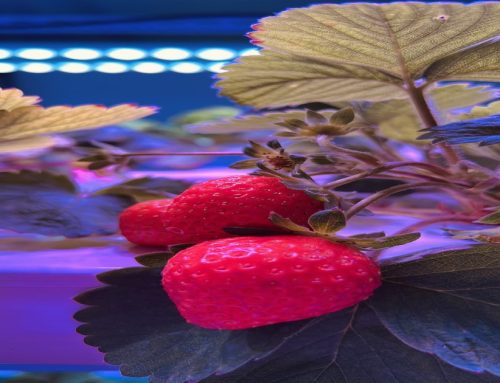
• Multi-tier growing: LED’s low heat output enables vertical stacking — 4–8 tiers in a vertical farm. HPS simply cannot be used in tight multi-tier configurations due to heat buildup.
5-Year Total Cost of Ownership (1,000 m² Example)
| Cost Item | HPS | LED (Koray GE35) |
|---|---|---|
| Fixture purchase | $36,000 | $68,000 |
| Electricity (5 yrs) | $574,200 | $98,700 |
| Bulb/ballast replacement | $40,000 | $0 |
| Additional HVAC | $120,000 | $30,000 |
| Total | $770,200 | $196,700 |
The LED solution saves over $573,000 in 5 years for this 1,000 m² facility. The payback period for the higher upfront cost is typically 8–14 months.
When Does HPS Still Make Sense?
To be fair, HPS still has niche applications: large single-layer greenhouses in cold climates where the waste heat offsets winter heating costs, or operations with very low electricity rates and short growing seasons. But for any controlled-environment agriculture, vertical farm, or year-round production facility, LED is the clear economic winner in 2026.
Make the Switch with Koray
Koray has been manufacturing LED grow lights in Zhongshan, China since 2009, with over 200 patents and a 2,800 m² testing facility. Our GE35 series is purpose-built for commercial vertical farming: 4.0 μmol/J efficacy, U0 > 0.9 uniformity, IP65 rated, and designed for tool-free installation in multi-tier racks.
Ready to calculate your savings? Visit koraylights.com or contact our engineering team for a customized ROI analysis.

Leave A Comment